

 Back
Back










Table of Contents

Financial statements overflow with metrics that claim to measure profitability, but two stand out as particularly important for business owners, investors, and analysts: EBITDA and net income. Both appear prominently in earnings reports and valuation discussions, yet they tell fundamentally different stories about a company's financial performance.
Net income represents the traditional bottom line, what remains after every expense has been accounted for. EBITDA, meanwhile, strips away certain costs to reveal operational profitability before the impact of financing and accounting decisions.
Understanding the distinction between these metrics isn't merely an academic exercise. It shapes how you evaluate investment opportunities, benchmark your business against competitors
Let’s dive deeper into their differences and industry-wide relevance.
What EBITDA Reveals About Your Profitability
EBITDA stands for Earnings Before Interest, Taxes, Depreciation, and Amortization. It provides a focused view of a company’s operational profitability by removing non-operational expenses. EBITDA shows operational profitability by excluding non-operational costs, while net income shows final profit after all expenses.
Unlike EBIT (Earnings Before Interest and Taxes), EBITDA goes a step further by excluding depreciation and amortization. These non-cash expenses, often tied to long-term assets, can obscure the true operational performance of a business.
Recent data from the telecom sector shows real results. In 2024, Ekinops EBITDA margin reached 15.3% after adjusting for non-operational costs and asset depreciation. This demonstrates how EBITDA helps benchmark performance, setting expectations for operational profitability.
Learn the Methods and Formulas to Calculate EBITDA
EBITDA (Earnings Before Interest, Taxes, Depreciation, and Amortization) begins with knowing the two primary methods for its calculation. Each approach provides a clear view of a company’s operational performance by adjusting specific financial metrics.
Practical results highlight these formulas in action. In Q4 2024, Maple Leaf Foods EBITDA rose 29.0% compared to the prior year, after adjustments for interest, taxes, depreciation, and amortization. This underscores the impact of proper EBITDA calculation.
Method 1: Adjusting Net Income
Start with the net income figure from the income statement. Add back non-operational expenses, including interest, taxes, depreciation, and amortization. This formula is expressed as:
EBITDA = Net Income + Interest + Taxes + Depreciation + Amortization
Method 2: Adjusting Operating Income
Alternatively, begin with operating income (also known as EBIT). Add depreciation and amortization to this figure for a streamlined calculation:
EBITDA = Operating Income + Depreciation + Amortization
Understanding Adjusted EBITDA
Building on these calculation methods, adjusted EBITDA offers a way to normalize earnings by excluding one-time or unusual expenses. This approach helps analysts compare performance across periods or companies by removing non-recurring items. Adjusted EBITDA is especially useful when evaluating businesses with irregular events that could distort standard EBITDA figures. Understanding this distinction ensures more accurate financial comparisons and informed decision-making.
Why EBITDA Is Key in Business Valuation
EBITDA, or Earnings Before Interest, Taxes, Depreciation, and Amortization, serves as a cornerstone in business valuation, offering a clear view of a company’s operational efficiency. By focusing solely on earnings generated from core operations, EBITDA eliminates the noise of non-operational expenses, providing a cleaner metric for comparison across industries.
Valuation benchmarks rely on EBITDA's comparability. NowVertical EBITDA growth reached 225% year-over-year in Q4 2024 after operational adjustments. Such figures drive acquisition multiples and investor decision-making.
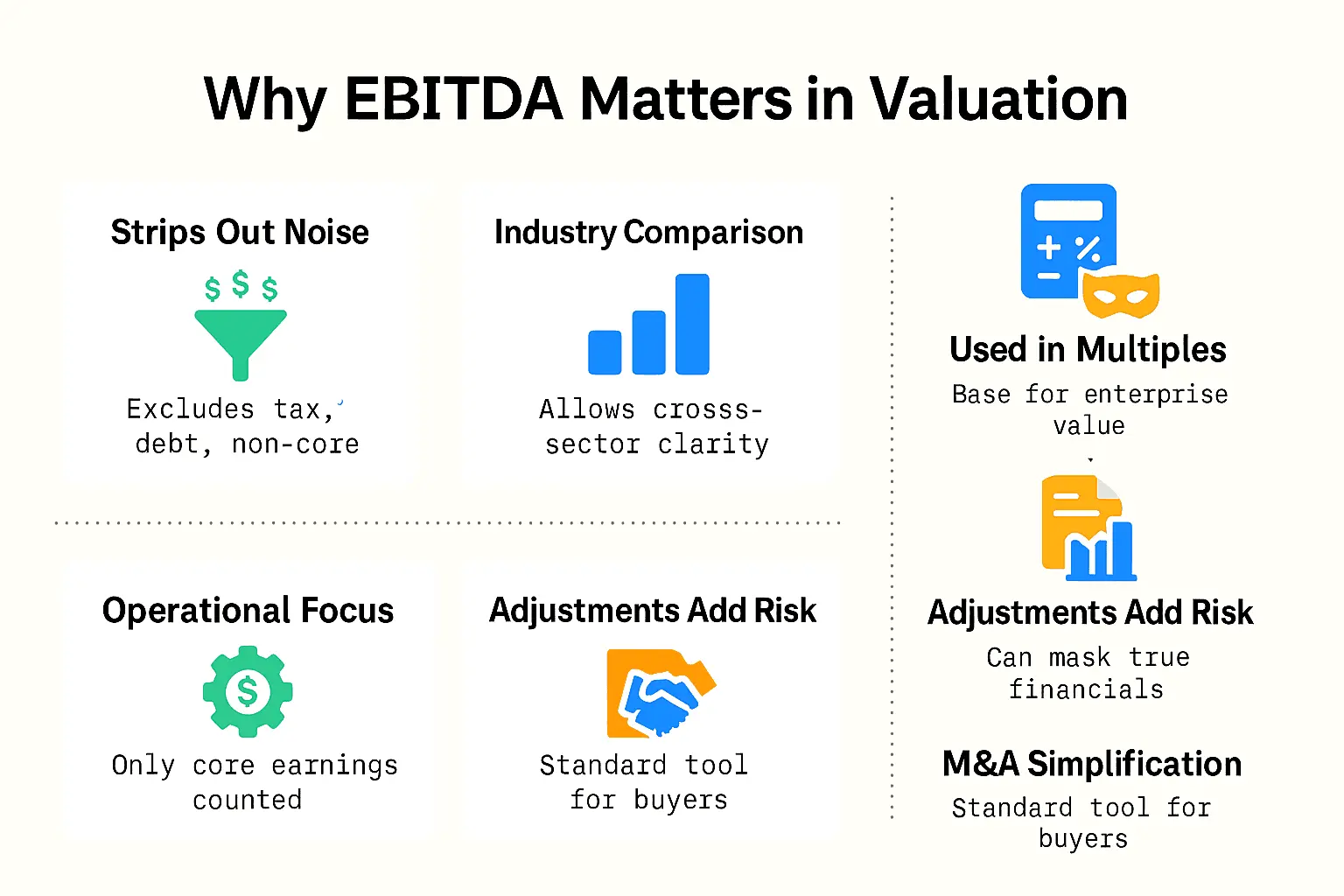
One of its primary uses is in determining valuation multiples, which are essential in mergers and acquisitions. For instance, buyers often use EBITDA to calculate a company’s enterprise value by applying industry-specific multiples. This approach simplifies the valuation process while highlighting profitability margins. However, when you adjust EBITDA (for example, by excluding one-time expenses), you may obscure a business’s true financial health.
Tax considerations also play a role in valuation analysis. Tools like Shopify Tax help businesses understand how tax obligations intersect with metrics like EBITDA, revealing hidden compliance costs that could impact valuation.
For a deeper dive into financial projections that underpin metrics like EBITDA and Net Income, explore how to create a financial model for investors. This resource provides valuable insights into building robust models that attract investors and clarify valuation metrics.
What Your Net Income Really Tells You
Net income, often referred to as the “bottom line,” is a critical indicator of financial performance. It represents the profit remaining after all operating costs, taxes, and other expenses have been deducted from total revenue. This figure provides a comprehensive snapshot of a company’s financial health, offering insights into profitability and operational efficiency.
Beyond its role in profit measurement, net income plays a pivotal part in cash flow statements. It helps businesses understand how much cash is generated or consumed during a specific period, linking profitability to liquidity. For startups and growing businesses, this clarity is essential for making informed decisions about scaling operations or managing expenses.
A real-world example of the importance of net income calculations can be seen in the Veryable Case, where a startup overcame challenges in financial tracking by refining its net income metrics. This adjustment streamlined decision-making and improved operational efficiency.
When to Use EBITDA vs Net Income for Financial Analysis
EBITDA vs Net Income serves distinct purposes, offering unique insights into a company’s performance. Let’s learn when to prioritize what:
- Use EBITDA when: comparing operational efficiency, assessing companies with different capital structures.
- Use Net Income when: needing total profit, evaluating shareholder returns.
EBITDA: A Focus on Operational Efficiency
EBITDA, or Earnings Before Interest, Taxes, Depreciation, and Amortization, isolates a company’s operational performance by excluding non-operational expenses. This makes it particularly useful for comparing businesses across industries or evaluating profitability without the influence of financing decisions or accounting practices. For example, EBITDA is often favored by investors assessing the core profitability of startups or companies undergoing restructuring.
Its simplicity in calculation, adding back interest, taxes, depreciation, and amortization to operating income—makes it a straightforward tool for gauging operational efficiency.
Recent results illustrate the power of EBITDA for operational benchmarking. Consensus Cloud Solutions' Adjusted EBITDA reached $48.1 million in Q2 2025, providing direct comparability for operational efficiency amid fluctuating revenues.
Net Income: A Comprehensive View
Net Income, often referred to as the “bottom line,” provides a holistic snapshot of a company’s financial health. Unlike EBITDA, Net Income accounts for all expenses, including interest, taxes, and non-cash items like depreciation. This makes it invaluable for understanding the overall profitability of a business.
While Net Income is less effective for cross-industry comparisons due to varying tax structures and financing methods, it is essential for evaluating shareholder returns and long-term sustainability. For businesses seeking to attract investors, combining Net Income insights with financial models to attract investors can create compelling narratives in pitch decks.
Evaluating all costs highlights net income’s value. For example, AMD's net income of $771 million in Q3 2024 reflected total profitability after accounting for interest and tax, guiding capital allocation.
Key Differences and Use Cases
The choice between EBITDA and Net Income depends on the context of the analysis:
– EBITDA is ideal for operational comparisons and short-term performance evaluations.
– Net Income is better suited for assessing overall profitability and shareholder value.
Both metrics are indispensable, but understanding their strengths ensures they are applied effectively in financial decision-making.
| Metric | Main Focus | Calculation Basis | Primary Use |
|---|---|---|---|
| EBITDA | Operational profitability | Excludes interest, taxes, depreciation, amortization | Valuation and peer comparison |
| Net Income | Total profitability | All revenues minus all expenses | Regulatory reporting and investor analysis |
| Free Cash Flow | Actual cash generation | Operating cash flow minus capital expenditures | Assessing liquidity and reinvestment capacity |
Why EBITDA Is Great for Measuring Cash Flow
EBITDA, or Earnings Before Interest, Taxes, Depreciation, and Amortization, simplifies the process of evaluating a company’s cash flow. By removing non-operational expenses, such as interest payments and depreciation costs, it provides a clearer picture of a business’s operational performance.
This metric is particularly valuable because it excludes volatile factors that can distort financial comparisons. For example, interest rates and tax policies vary widely across industries and regions, making direct comparisons between companies challenging. EBITDA eliminates these variables, enabling a more straightforward evaluation of core business operations.
Additionally, depreciation and amortization are accounting entries that don’t directly impact cash flow. By excluding them, EBITDA focuses solely on the cash generated by day-to-day operations, offering a more accurate measure of liquidity.
Cash flow evaluation gains clarity with rising operational earnings. In Q4 2024, Dexcom revenue growth was 8% year-over-year, mapping directionally to EBITDA-driven cash flow improvement. Such links inform investors’ assessments of business stability.
How to Turn EBITDA Into Net Income
Understanding EBITDA vs Net Income is crucial when converting between these metrics. EBITDA provides a snapshot of operational profitability, but converting it into net income requires a deeper dive into financial adjustments.
EBITDA (Earnings Before Interest, Taxes, Depreciation, and Amortization) provides a snapshot of a company’s operational profitability, but converting it into net income requires a deeper dive into financial adjustments. To calculate net income, systematically subtract interest expenses, taxes, depreciation, and amortization from EBITDA. This process reveals the company’s true profit after accounting for all costs, including financing and tax obligations.
Making Sense of Net Income and EBITDA
The EBITDA vs Net Income debate is crucial for businesses aiming to make informed financial decisions. Net income provides a comprehensive picture of profitability by accounting for all expenses, including taxes and interest. While net income is indispensable for assessing long-term financial health, EBITDA offers a clearer view of cash flow potential and operational efficiency.
Mastering how to develop a financial roadmap for a startup equips founders to set clear financial goals, allocate resources wisely, and anticipate funding needs at each stage of growth. Balancing these metrics allows businesses to evaluate both immediate operational success and overall profitability.
Why Use Multiple Metrics Together
Combining EBITDA, net income, and free cash flow gives a more complete picture of a company’s financial health. This multi-metric approach helps mitigate the limitations of any single measure and reduces the risk of drawing misleading conclusions. By using these metrics together, you can make more informed decisions and develop stronger financial strategies.
Conclusion
The EBITDA vs Net Income comparison highlights how each metric serves a unique purpose. EBITDA provides a clear view of operational performance by excluding non-cash expenses and financing costs, whereas net income offers a comprehensive snapshot of profitability after all expenses.
By mastering these metrics, you can refine your financial strategies and create more impactful investor presentations. Whether you're preparing a pitch deck or evaluating business opportunities, applying these insights ensures your financial narrative is both accurate and compelling.
If you're aiming to refine your pitch deck with clear, data-driven financial insights, our Pitch Deck Creation service is designed to help you build a compelling investor presentation.
Key Takeaways
- EBITDA highlights operational performance by excluding non-operational costs
- Net income shows total profit after all expenses and deductions
- Both metrics play distinct roles in valuation, investor relations, and analysis
- Using startup examples makes these financial metrics clearer
- Grasping the differences helps build strong strategies and compelling pitch decks
Frequently asked Questions
What is the difference between EBITDA and Net Income?
EBITDA excludes interest, taxes, depreciation, and amortization, showing only operational profitability. Net Income accounts for all expenses, providing a complete view of a company’s profitability.