

 Back
Back










Table of Contents

A solid financial model is the backbone of any startup’s funding journey. With over 1.1 million new businesses founded in the U.S. in 2022, according to Business Founding data, the entrepreneurial landscape continues to expand. However, recent reports from VC Funding reveal a significant drop in startup investments during Q2 2023 across North America, emphasizing the need for meticulous financial planning.
Recent investment activity reveals the scale at stake. In 2024, $31.8 billion in US and Canadian startup investments underscored the demand for robust financial modeling. Investors scrutinize projections more closely, making credible models essential for securing capital.
This article provides a comprehensive blueprint for crafting a financial model that not only attracts investors but also optimizes forecasting for long-term success.
Why Your Startup Needs a Financial Model Blueprint for Growth
A startup financial model blueprint acts as a strategic guide, helping startups forecast growth, allocate capital wisely, and build investor confidence. Startup financial modeling transforms financial data into actionable insight for long-term planning.
For startups in high-growth industries, potential expansion is extraordinary. The global fintech market is set to reach $492.81 billion by 2028, with a projected CAGR of 16.8%. Strategic modeling allows founders to capture more of this opportunity and plan for sustainable growth.
- Stay aligned with business goals: Case studies such as O0 Design show the value of updating your model regularly to reflect evolving strategies.
- Enable informed decision-making: Forecast expenses, track KPIs, and visualize your financial trajectory to guide operational and strategic choices.
- Use validated assumptions: Ground your model in realistic scenarios using a blend of top-down and bottom-up forecasting for improved accuracy.
- Plan for market fluctuations: Anticipate cash flow changes and adapt to uncertainty by building flexible, scenario-based projections.
- Integrate sector-specific tools: Platforms like Precoro optimize cost tracking, while insights like SaaS VC share help tailor models to your industry.
- Support fundraising efforts: Clear, data-driven financial projections increase investor trust and demonstrate your growth potential.
When a board asks “are we on plan?” they mean forecast; when they ask “what are we aiming for?” they mean projection, projection vs forecast for startups lays out cadence, inputs, and owners for each. It keeps reforecasts from looking like moving goalposts.
How to Build a Strong Financial Model for Your Startup
This section explores the step-by-step process of building a comprehensive financial model, incorporating forecasting methods, software tools, and dynamic updates to ensure accuracy and adaptability.
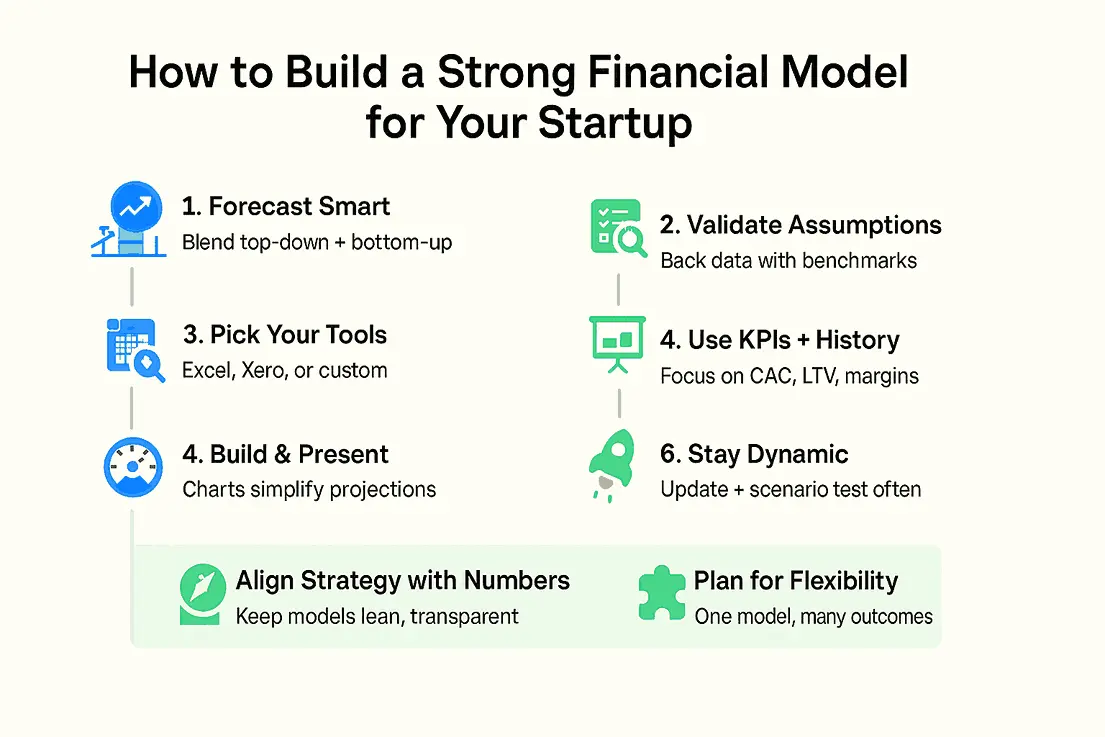
1. Choose the Right Forecasting Approach
Selecting the appropriate forecasting method is the foundation of a strong financial model. Combining top-down and bottom-up approaches offers a balanced perspective.
- Top-down forecasting starts with market size and trends, estimating potential revenue based on industry benchmarks.
- Bottom-up forecasting, on the other hand, builds projections from operational details like pricing, sales volume, and resource allocation.
Using blended forecasting, which integrates both methods, enhances accuracy by aligning short-term operational goals with long-term market share predictions. For example, applying blended forecasting can refine your annual operating plan with balanced indicators, ensuring realistic yet ambitious targets.
Startup fundraising landscapes demand focused expectation setting. In Q3 2024, 42% of pre-seed rounds were below $250,000, according to Carta data. Startups should calibrate their models to reflect what’s typical in today’s climate.
Top-Down vs. Bottom-Up Forecasting
| Characteristic | Top-Down Forecasting | Bottom-Up Forecasting |
|---|---|---|
| Revenue estimation basis | Market size and share assumptions | Operational capacity and sales targets |
| Data sources | Industry reports and market research | Internal metrics and resource plans |
| Projection realism | Ambitious, broad perspective | Grounded, practical perspective |
| Investor appeal | Shows growth potential | Demonstrates execution feasibility |
2. Validate Key Assumptions
Every financial model relies on assumptions, but these must be grounded in reality. Validate assumptions by analyzing historical data, industry benchmarks, and market trends. For startups, this often involves researching competitors, customer behavior, and pricing strategies.
For instance, if your model assumes a 20% monthly growth rate, ensure this aligns with historical performance or comparable industry standards. Stress-testing assumptions under various scenarios can further strengthen your model’s reliability.
3. Select the Right Software Tools
The choice of software can significantly impact the efficiency and accuracy of your financial model. Tools like Excel, Google Sheets, or specialized platforms such as QuickBooks and Xero offer varying levels of functionality.
Opt for software that supports dynamic modeling, allowing real-time updates and scenario planning. This flexibility is crucial for startups operating in unpredictable markets. Additionally, ensure the tool integrates seamlessly with your accounting system to streamline data input and analysis.
4. Analyze Historical Data and Identify KPIs
Historical data serves as a valuable reference point for projections. If your startup lacks extensive data, focus on industry averages or early-stage metrics.
Key Performance Indicators (KPIs) such as customer acquisition cost (CAC), lifetime value (LTV), and gross margin should be identified and tracked. These metrics provide insights into operational efficiency and profitability, guiding strategic decisions.
For a deeper understanding of essential accounting documents that inform reliable model inputs, explore financial statements for startup founders. This resource connects fundamental accounting concepts with strategic financial planning.
5. Create Projections and Communicate with Stakeholders
Developing projections involves estimating revenue, expenses, cash flow, and profitability over a defined period. Use realistic growth rates and account for seasonal fluctuations or market uncertainties.
Once the model is complete, present it to stakeholders in a clear and concise manner. Visual aids like charts and graphs can simplify complex data, ensuring alignment and transparency. Regular updates and open communication build trust and confidence in your financial strategy. If your spreadsheet has 20 tabs and zero alignment, pro forma financial model offers a lean layout: inputs → operating plan → P&L, cash, and balance sheet.
The impact of strategic financial modeling is clear in real outcomes. Abridge doubled its valuation from $2.75 billion to $5.3 billion in just 4 months after a $300 million Series E. The company’s financial rigor was further evidenced by reaching $117 million in contracted annual recurring revenue. This growth illustrates how disciplined modeling and transparent projections unlock investor confidence and fuel exceptional scaling.
6. Regular Updates and Scenario Planning
A financial model is not static; it requires regular updates to reflect changing market conditions and business performance. Dynamic, real-time models enable startups to adapt quickly, ensuring decisions are based on the latest data.
Scenario planning is equally important. By preparing for best-case, worst-case, and most-likely scenarios, startups can mitigate risks and seize opportunities. This proactive approach ensures resilience in the face of uncertainty. Plans should fit on one page before they sprawl into twenty. Startup financial projections template walks through revenue drivers, hiring impact, and unit economics so your top-line story matches burn and runway.
Why Iterative Model Updates Drive Better Outcomes
Building on regular updates, founders should integrate actual operating data to refine their financial models. This practice enhances projection accuracy and ensures assumptions reflect current business realities. Iterative updates support agile decision-making and help startups adapt quickly to changing conditions. By prioritizing real-time data integration, founders maintain credibility with investors and stakeholders.
Startups like yours already closed their rounds with us.
Founders across every stage and industry. Here's what it took.
- Raised $7.6M for Swiipr Technologies
- Raised $0.5M for Ap Tack
- Raised €0.5M for Ivent Pro

What Financial Results Can Startups Expect?
A well-constructed financial model serves as the backbone of a startup’s operational and strategic planning. Startups can anticipate a range of outputs that provide clarity and actionable insights into their financial health.
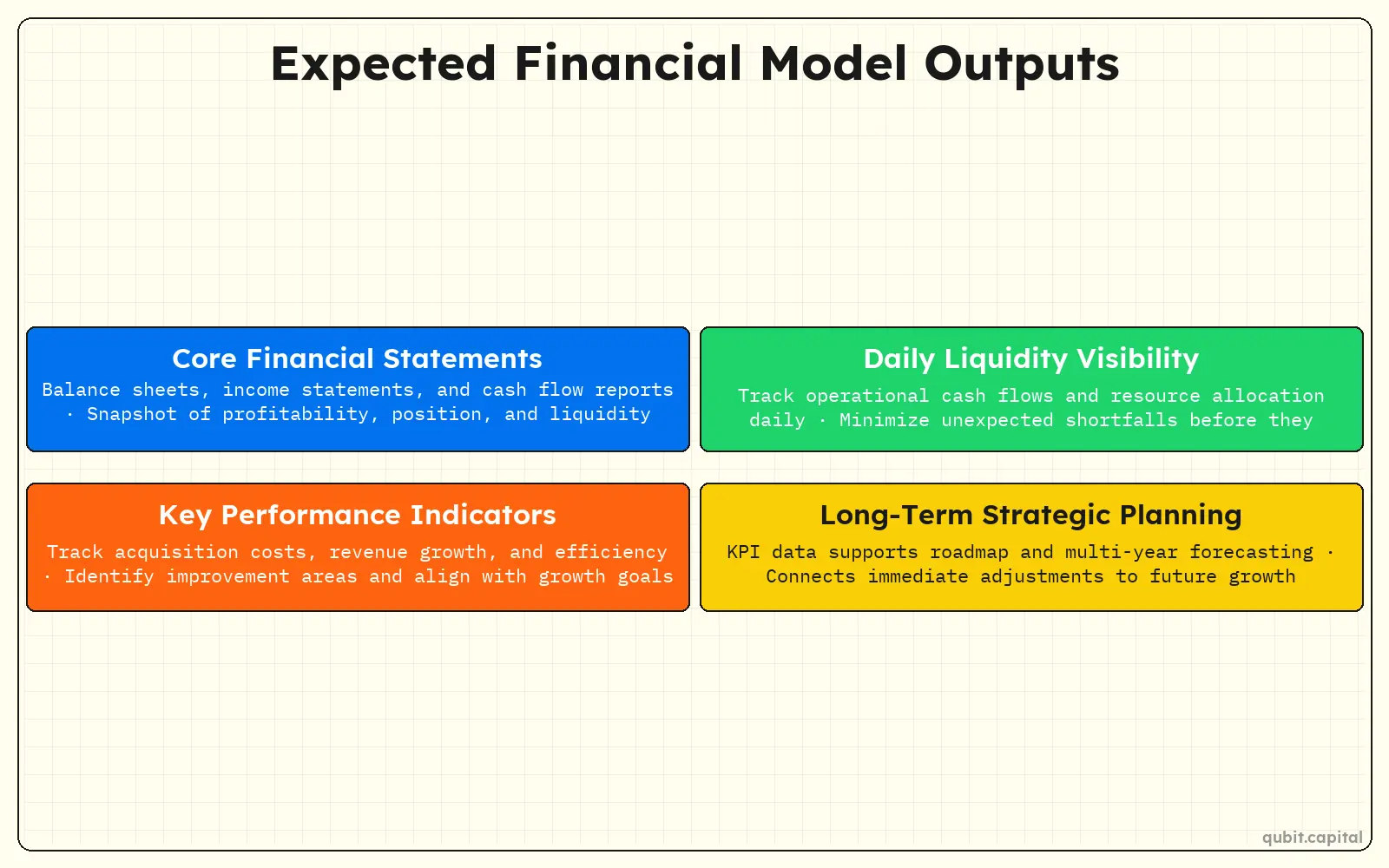
For example, a financial model example in Excel might include balance sheets, income statements, and cash flow statements.
First, robust financial models generate essential financial statements, including balance sheets, income statements, and cash flow statements. These documents offer a snapshot of the company’s financial position, profitability, and liquidity, enabling founders to make informed decisions. Additionally, startups gain visibility into daily liquidity and resource allocation, ensuring that operational cash flows are optimized and unexpected shortfalls are minimized.
Another critical feature of these models is the inclusion of key performance indicators (KPIs). By tracking metrics such as customer acquisition costs, revenue growth rates, and operational efficiency, startups can identify areas for improvement and align their strategies with growth objectives. This data-driven approach not only informs immediate operational adjustments but also supports long-term planning, such as how to develop a financial roadmap for a startup.
Key Inputs for Accurate Financial Forecasting
When creating a startup financial model blueprint, begin by identifying the essential components that drive accuracy. These inputs not only shape projections for your startup financial model but also align financial strategies with broader business goals.
1. Revenue Streams: The Foundation of Forecasting
Market opportunity size should guide revenue modeling. The global electronic health record (EHR) market is forecast to reach $41 billion by 2025. Understanding sector growth helps ensure projections reflect realistic demand.
Revenue streams form the backbone of any financial model. Startups must detail their sources of income, whether through product sales, subscription services, or licensing agreements. Accurate forecasting requires a clear understanding of pricing strategies, customer acquisition rates, and market demand.
2. SaaS Metrics for Subscription-Based Forecasting
Beyond general revenue streams, subscription-based startups must track SaaS-specific metrics to ensure accurate forecasting. Metrics such as Monthly Recurring Revenue, churn rate, Customer Acquisition Cost, and Lifetime Value provide insight into growth, retention, and profitability. These indicators help founders understand recurring revenue stability and identify areas for improvement. Incorporating these metrics strengthens the financial model’s relevance for investors and supports strategic planning.
3. Cost Structures: COGS and OPEX
Cost structures are equally critical. The Cost of Goods Sold (COGS) reflects direct expenses tied to production, while Operating Expenses (OPEX) encompass broader costs such as marketing, utilities, and administrative overhead. Precise estimations in these areas ensure that financial projections remain grounded in reality.
4. Personnel Costs: Balancing Growth and Budget
Employee salaries, benefits, and recruitment expenses often constitute a significant portion of startup costs. Factoring in personnel costs allows businesses to plan for scalable growth while maintaining operational efficiency.
5. Capital Expenditures: Long-Term Investments
Capital expenditures (CapEx) represent investments in physical assets like equipment or technology. These inputs are vital for startups aiming to expand their infrastructure or enhance productivity.
6. Financing Structures: Diversifying Resources
Diverse financing structures, such as equity funding, loans, or grants—helps startups anticipate cash flow fluctuations and manage financial risks. This insight is crucial for planning sustainable growth strategies.
Detailed input sheets that incorporate these components ensure that financial projections align seamlessly with business objectives. Considerations of effective oversight often align with discussions regarding finance management best practices for startups, demonstrating how operational strategies support financial models.
How to Use Supporting Data to Strengthen Your Financial Model
Strengthening your financial projections requires more than just numbers. Supplementary tools, such as a startup financial forecast template, pitch decks, and cost-control workflows, play a vital role in enhancing credibility.
For instance, a well-crafted pitch deck can highlight key financial metrics while aligning them with your business strategy. Similarly, cost-control workflows demonstrate your ability to manage expenses effectively, adding another layer of credibility to your projections. Documenting assumptions and including supporting references further reinforce the validity of your financial model, making it more compelling to stakeholders.
A broader examination of investor-focused strategies highlights financial models to attract investors, connecting meticulous projections with market-oriented approaches. By integrating these supplementary tools, you create a comprehensive narrative that builds trust and confidence in your financial outlook.
You can also use a financial model template to standardize your projections and improve accuracy.
Test Your Financial Model with Scenarios and Sanity Checks
Stress testing your startup financial model blueprint is essential to ensure its resilience and accuracy. By exploring both optimistic and pessimistic scenarios in startup financial modeling, you can uncover potential risks and opportunities.
Regular sanity checks are equally important. These checks validate the logical consistency of your model, ensuring that forecasts align with real-world expectations and data remains consistent throughout. For example, if revenue projections grow exponentially while expenses remain flat, a sanity check would flag this as unrealistic.
Scenario planning and sanity checks together create a robust framework for financial modeling. They help businesses identify vulnerabilities, refine assumptions, and build confidence in their forecasts. Customer acquisition model template links retention, expansion, and churn back to top-of-funnel assumptions. It adds a simple sensitivity table so small changes in win rate or discounting don’t wreck cash. Drop it before your hiring plan to keep pipeline and capacity in sync.
Find the Best Funding Channels for Your Startup
Securing the right funding is a critical step for any startup aiming to scale. Entrepreneurs have access to a variety of financing options tailored to different growth stages. Venture capital offers substantial investment for high-growth potential businesses, while angel investors provide early-stage funding along with mentorship.
Debt financing, such as loans, can be a viable choice for startups seeking to retain equity. Additionally, grants can be a valuable resource for businesses in specific industries or those addressing social challenges.
Simplify Financial Management with Qubit
Efficient financial management is critical for startups aiming to scale effectively. Qubit offers innovative tools designed to streamline operations, providing real-time analytics and reporting that empower businesses to make informed decisions.
Beyond technology, Fuelfinance pairs these tools with dedicated consulting support, ensuring startups can optimize their financial processes and improve overall efficiency. By combining actionable insights with expert guidance, Fuelfinance helps businesses stay ahead in a competitive landscape. Once your scenarios are validated, exploring advanced financial modeling techniques can help you refine your assumptions and improve forecast precision even further.
Conclusion
A startup financial model blueprint, with dynamic modeling and comprehensive forecasting, builds a strong foundation in startup financial planning. By prioritizing financial modeling strategies, businesses can build a resilient financial foundation.
Equally important is the practice of regular updates and iterative model refinement. This ongoing process helps startups stay aligned with their goals and respond effectively to new opportunities or challenges.
If you’re looking to secure seed capital or Series A funding, our Fundraising Assistance service is here to help. Let us guide you through the complexities of fundraising and connect you with the resources you need to thrive.
Key Takeaways
- Comprehensive financial modeling serves as a strategic roadmap for startups
- Using multiple forecasting methods and updating regularly improves projection accuracy
- In-depth analysis of financial inputs boosts forecasting reliability
- Supporting documents and scenario planning increase model credibility
- Specialized tools and expert services like those from Qubit Capital can elevate financial operations
Need numbers investors trust?
Clean assumptions, realistic projections, and a structure that holds up in diligence.
- Forecasts, unit economics, and scenario planning
- Valuation-ready outputs investors can review fast
- Clear structure so you can update it easily
Frequently asked Questions
How does a financial planning blueprint help startups secure funding?
A financial planning blueprint shows investors that you understand your revenue drivers, cost structure, and cash runway. It builds credibility by presenting clear assumptions, realistic projections, and scenario analysis that accounts for both upside and downside cases. Investors are far more likely to fund startups that can demonstrate how capital will be deployed and when profitability is expected.