

 Back
Back









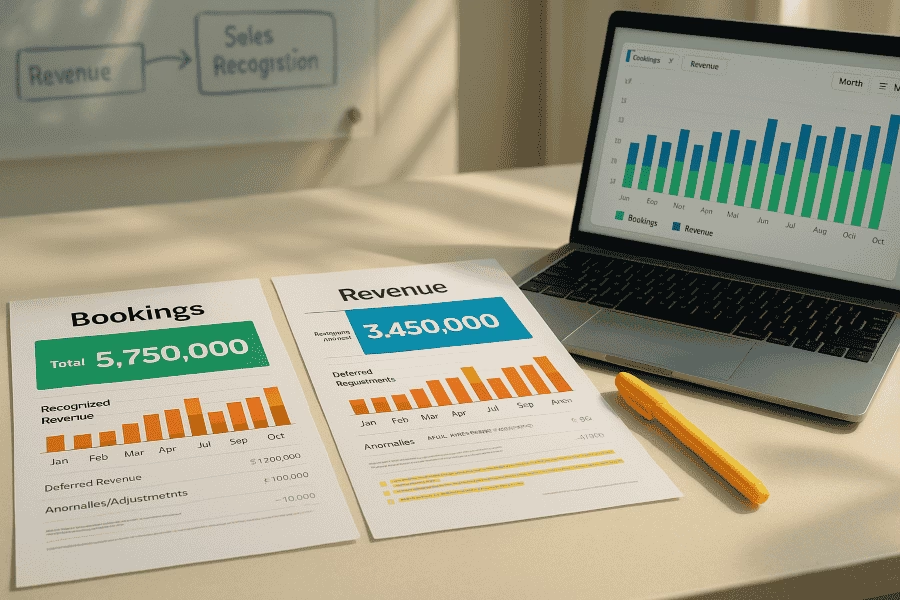
Table of Contents

Financial metrics can often feel overwhelming, especially when terms like “bookings” and “revenue” are used interchangeably. However, these two concepts are distinct and play unique roles in evaluating a company's financial health. Understanding the difference between bookings and revenue is essential for businesses, particularly in the SaaS industry, where subscription models dominate.
The SaaS landscape is rapidly evolving. In 2024, public SaaS companies saw median year-on-year growth rates decline to 15%, a sharp drop from the 30–40% rates seen in 2021–2022. This shift illustrates heightened scrutiny on financial reporting and forecasting. Mastering these metrics is now essential for strategic planning.
Learning how to create a financial model for investors enables startups to present a compelling vision backed by data, demonstrating scalability, profitability, and strategic planning. This article aims to clarify these metrics, exploring their definitions, applications, and implications for financial planning.
Let’s dive into the details and uncover how these metrics shape financial strategies.
Key Financial Metrics Explained: Bookings vs Revenue
Understanding the nuances of key financial metrics is essential for businesses aiming to forecast accurately and maintain compliance. Metrics such as bookings, billings, recognized revenue, and deferred revenue each serve distinct purposes, offering insights into customer commitments, invoicing, and revenue recognition.
Forecasting reliability differentiates high performers. Top quartile SaaS companies consistently maintain a Quick Ratio above 3x even after reaching $100 million ARR. This strength reflects discipline in tracking bookings, billings, and cash.
Bookings are contractual commitments; revenue is recognized income. Understanding this difference is vital for SaaS companies for planning, forecasting, and compliance.
Bookings: A Forward-Looking Commitment
Bookings represent the total contractual value agreed upon when a customer commits to a service. This forward-looking metric provides a snapshot of potential revenue, helping businesses plan for future growth. For example, use bookings to clarify the total contractual commitment and forecast potential revenue.
Example: Signed a $24K subscription (booking); only $2K recognized as revenue this month.
- Record bookings on contract close.
- Track billings in invoices.
- Recognize revenue per delivery.
- Monitor with ASC 606.
Billings: The Invoiced Amount
Billings reflect the amounts invoiced to customers, showcasing the cash flow generated from sales. While bookings indicate commitments, billings are tied directly to invoicing and payment schedules.
Recognized Revenue: Earned Income
Recognized revenue adheres to ASC 606 guidelines, ensuring that income is recorded only when services are delivered or obligations are fulfilled. This metric is crucial for compliance and accurate financial reporting.
Deferred Revenue: Payments Received in Advance
Deferred revenue highlights payments received before services are delivered. This unearned income sits on the balance sheet until the service is provided. Highlight the concept of deferred revenue to emphasize how unrecognized revenue sits on the balance sheet before it’s earned.
Startups like yours already closed their rounds with us.
Founders across every stage and industry. Here's what it took.
- Raised $7.6M for Swiipr Technologies
- Raised $0.5M for Ap Tack
- Raised €0.5M for Ivent Pro

How to Calculate Bookings and Understand Their Types
Accurate bookings calculation is essential for SaaS companies aiming to forecast revenue effectively. Bookings represent customer commitments, and understanding their types, such as new, renewal, upgrade, ACV, TCV, and non-recurring bookings, can reveal growth opportunities and areas for improvement. If you’re planning cuts, the breakdown of sga expenses helps spot line items that affect growth versus those that don’t.
Comparing bookings vs ARR helps SaaS companies distinguish short-term commitments from annual recurring revenue.
Types of Bookings
- New Bookings: These are commitments from newly signed customers, often derived from the sales pipeline. SaaS companies can use tools like CRM systems to track these effectively, with adoption rates reaching 75% in 2024, according to Kruze Consulting.
- Renewal Bookings: These represent existing customers renewing their contracts, ensuring consistent revenue streams.
- Upgrade Bookings: When customers expand their usage or upgrade to higher-tier plans, these bookings reflect increased revenue potential.
- ACV (Annual Contract Value): This metric calculates the annualized value of bookings, helping businesses project recurring revenue.
- TCV (Total Contract Value): TCV accounts for the entire value of a contract, including multi-year agreements.
- Non-Recurring Bookings: These include one-time fees or services, which are not part of the recurring revenue model.
Recent quarterly results show the practical impact of bookings management. In Q4 2025, Sidetrade reported a new Annual Contract Value of €3.25 million. Despite a 14% decline year-over-year, their subscription growth still reached 20%. This highlights how nuanced bookings types inform true performance.
Calculating Bookings
The formula for bookings calculation is straightforward: sum up the total value of customer commitments within a specific period. For example, new contracts signed through the sales pipeline can be a reliable indicator of future revenue.
Understanding the importance of financial forecasting for startups is crucial, as accurate bookings calculations directly impact revenue projections. By differentiating bookings by type, SaaS companies can create precise revenue projections, identify trends, and refine processes to drive growth.
Why Bookings Matter: Key Metrics for SaaS Success
Bookings drive measurable revenue gains. One SaaS company generated $600,000 MRR from new customers, plus $100,000 expansion revenue from its base in a recent period. This split reveals how effective bookings management powers sustained revenue increases.
Accurate SaaS booking measurement serves as the foundation for financial planning, sales performance evaluation, and revenue forecasting.
One critical metric to monitor is the prospect-to-bookings ratio, which reveals how effectively leads are converted into signed contracts. This insight helps identify bottlenecks in the sales process, enabling teams to refine their strategies and improve conversion rates.
Additionally, pricing models play a pivotal role in bookings, as they directly impact customer acquisition and retention. SaaS businesses often face challenges with contract structures, such as varying subscription terms or multi-year agreements, which can complicate forecasting efforts.
Common SaaS Booking Pitfalls
Tracking bookings also supports better cash flow planning. Cash Flow as a key metric, businesses can connect bookings to actual liquidity planning, ensuring they have the resources to meet operational demands. For example, indicators derived from bookings provide clarity on expected income based on billings, allowing for more strategic allocation of funds.
The Role of Cross-Functional Collaboration in Bookings Success
Building on these metrics, effective cross-functional collaboration between sales, finance, and operations strengthens bookings management. Each team brings unique insights, ensuring commitments are realistic, compliant, and aligned with delivery capabilities. This approach reduces errors, enhances forecasting accuracy, and supports strategic decision-making. Consistent communication across functions helps SaaS companies maximize the value of their bookings data.
With the global SaaS market projected to reach $317.55B by 2025 with 18% CAGR, the importance of precise bookings measurement cannot be overstated. As the industry grows, businesses that prioritize tracking and optimizing bookings will be better positioned to thrive in this competitive landscape.
Turn Bookings Into Recognized Revenue with These Strategies
Booking revenue accurately requires converting contractual commitments into recognized income using best practices.
Transforming bookings into recognized revenue is a pivotal process for businesses aiming to maintain financial accuracy and compliance. This section explores actionable strategies to convert contractual commitments into revenue while adhering to ASC 606 standards. By integrating automated tools, managing subscriptions effectively, and optimizing contract handling, businesses can minimize revenue leakage and streamline operations.
1. Automate Quoting with CPQ Integration
Automating the quote-to-cash workflow is essential for reducing manual errors and ensuring seamless revenue recognition. Tools like CPQ Software simplify complex quoting processes, enabling accurate contract creation and efficient revenue conversion. Highlighting CPQ as a vital tool, businesses can align their revenue recognition with deliverables, ensuring compliance with accounting standards. Learn more about how CPQ can streamline quoting processes and improve operational efficiency.
2. Align Revenue Recognition with ASC 606
Adhering to ASC 606 is crucial for determining the precise timing to shift bookings into recognized revenue. This accounting standard ensures that revenue is only recognized after meeting contract obligations, providing clarity and consistency in financial reporting. Businesses should refer to ASC 606 when addressing revenue recognition to avoid discrepancies and maintain compliance.
3. Optimize Subscription Management
Robust subscription management systems are key to handling recurring revenue streams effectively. By automating renewals, tracking contract timelines, and ensuring accurate billing, businesses can prevent revenue leakage and improve customer retention. Subscription management tools not only enhance operational efficiency but also provide visibility into future revenue opportunities.
4. Strategic Contract Handling
Strategic contract handling plays a significant role in aligning bookings with revenue recognition. For example, Sidetrade’s 2023 performance analysis demonstrated how implementing a 45.5-month contract average improved visibility and contributed to €21.1M TCV with 20% revenue growth despite economic uncertainty. This case study underscores the importance of aligning contract timelines with revenue goals to achieve sustainable growth.
A financial roadmap serves as an internal compass, helping teams stay strategically aligned across planning cycles. Knowing how to develop a financial roadmap for a startup is essential for aligning spending with milestones, projecting future capital needs, and navigating growth with clarity and confidence.
Benefits of Cross-Functional Dashboards for Revenue Teams
- Enable real-time visibility into sales pipeline, billing status, and revenue recognition for all relevant teams.
- Reduce manual data reconciliation by centralizing updates and automating metric tracking across departments.
- Support faster, more informed decision-making by surfacing trends and risks as they emerge.
- Increase accountability by making progress and bottlenecks transparent to sales, finance, and operations leaders.
Financial Reporting: Bookings vs Billings Analysis
Financial transparency is increasingly scrutinized. In April 2025, Nate, Inc. faced SEC and DOJ action after its CEO allegedly raised $42 million on false AI claims. This case underscores why robust financial reporting and verification are vital in today's tech landscape.
Understanding bookings vs billings is crucial for accurate financial reporting in SaaS businesses. To illustrate, Sidetrade achieved an impressive 108% year-over-year growth in new SaaS bookings during Q1 2024. While bookings highlight market opportunities, they must transition into billings and recognized revenue to impact financial statements effectively. This dynamic reporting approach can uncover valuable insights into business performance.
Integrating operational and accounting systems is vital for seamless reporting. AI-powered revenue recognition automation, for instance, reduces manual reconciliation errors and improves forecasting accuracy. By predicting bookings-to-revenue conversion patterns, businesses can align their operational data with accounting practices more effectively.
Accurate financial reporting not only ensures compliance but also provides actionable insights for strategic decision-making. By understanding the interplay of these metrics, businesses can optimize cash flow and maintain transparency in their financial statements.
Implementing finance management best practices helps founders maintain control over spending, plan for growth, and build investor trust from day one. Bookings serve as early indicators of future revenue, but only billings and recognized revenue are fully reflected in financial statements. This distinction is crucial for analyzing cash flow and ensuring the financial health of a business.
Key Financial Metrics
The difference between bookings and revenue is a foundational concept in SaaS financial modeling.
Difference between bookings and revenue
Bookings represent the total value of contracts signed within a specific period, while revenue reflects the portion of those bookings that have been earned or delivered. For example:
– Bookings: A customer signs a $12,000 annual contract in January.
– Revenue: If the service is delivered monthly, $1,000 is recognized as revenue each month.
Billings vs revenue is another important distinction for SaaS companies managing cash flow.
Bookings scale can vary widely by business model. For example, Booking Holdings reported annual revenue of $23.74 billion in 2024, with room nights growing 8% and gross bookings up 14% over the previous quarter. Scale illustrates bookings’ potential magnitude in global companies versus niche SaaS providers.
Importance of revenue recognition for SaaS businesses
Revenue recognition ensures compliance with accounting standards and provides an accurate picture of financial health. It helps businesses avoid overstating earnings and aligns with subscription-based models.
Churn Rate
Churn rate measures the percentage of customers lost over a period. High churn impacts recurring revenue and signals potential issues with customer satisfaction or product fit. If valuation multiples don’t agree, revisit ebitda vs net income to match EV/EBITDA and P/E with the right denominator.
Affect of Deferred Revenue on Cash Flow
Deferred revenue, often seen in SaaS, represents payments received for future services. While it boosts cash flow upfront, it’s recorded as a liability until the service is delivered.
Conclusion
Understanding the nuances of bookings, billings, and revenue recognition is essential for effective financial planning. These metrics not only provide clarity on your company’s financial health but also help in aligning your strategies with long-term goals. Throughout this blog, we’ve explored key strategies to optimize these metrics, ensuring they serve as reliable indicators for decision-making and investor confidence.
A clear grasp of these financial concepts empowers businesses to forecast accurately, manage cash flow efficiently, and build trust with stakeholders. If you're aiming to align your financial metrics with investor interest, we at Qubit Capital offer Investor Outreach services to connect you with the right investors. Let’s get started today!
Key Takeaways
- Distinguishing bookings, billings, and recognized revenue is key to SaaS financial success
- Accurate tracking of bookings supports better forecasting and cash flow planning
- Tools like CPQ and compliance with ASC 606 enhance revenue conversion
- Linking operational data with financial reports helps prevent revenue leakage
- Strategic decisions rely on data-driven insights and proven best practices
Need numbers investors trust?
Clean assumptions, realistic projections, and a structure that holds up in diligence.
- Forecasts, unit economics, and scenario planning
- Valuation-ready outputs investors can review fast
- Clear structure so you can update it easily
Frequently asked Questions
What does bookings mean in SaaS financial management?
Bookings in SaaS refer to the total contract value agreed upon when customers commit to services. This metric helps forecast future revenue and guides strategic planning.