

 Back
Back












Table of Contents

Investors rely on financial models to evaluate the viability and profitability of a startup. For founders, a good financial model showcases a deep understanding of their business. It has the power to convince investors of its potential.
Investor priorities have shifted with changing funding landscapes. In 2024, startups on Carta combined to raise $89 billion, marking an 18.4% increase from 2023. This surge underscores heightened scrutiny on financial modeling accuracy. Founders should now position their projections for increased realism and resilience.
Crafting such a model demands a nuanced grasp of what investors are truly seeking. The challenge intensifies when incorporating techniques like scenario analysis, stress testing, and integrating Key Performance Indicators (KPIs).
In this comprehensive guide, we'll delve deep into advanced financial modeling strategies and provide examples relevant to startup founders. We'll explore investor psychology, advanced modeling techniques, and offer step-by-step guidance.
Let's dive in!
Why Create a Financial Model for Investors
Financial modeling definition: It is the process of creating a structured representation of a company's financial situation.
- Assess Viability: Determine if your business can generate sustainable returns.
- Evaluate Risk: Understand potential challenges and your strategies to mitigate them.
- Gauge Growth Potential: See how your business can scale over time.
- Verify Assumptions: Ensure your projections are based on realistic and well-founded assumptions.
Recent capital flows reveal strategic investor focus. In 2024, Series C startups raised 41.8% more capital, while Series D saw a 78.8% spike from the prior year. This shift demonstrates how growth-stage potential drives funding decisions.
Investment modeling helps investors assess viability and potential returns. When you position your financial model with these priorities, you effectively address investor concerns and build confidence.
Curating Financial Model For Different Investor Types
Different investors focus on varying aspects:
- Venture Capitalists (VCs): Look for rapid growth potential and a clear path to significant returns.
- Angel Investors: Seek innovative ideas with early traction and unique value propositions.
- Banks and Traditional Lenders: Prioritize cash flow stability and the ability to meet debt obligations.
Understand their perspectives to highlight relevant aspects of your financial model. Make it more compelling to each investor type.
Cultural Considerations in Investor Expectations
When engaging with international investors, cultural nuances can impact perceptions. Consider:
- Communication Styles: Adapt your presentation to align with cultural preferences.
- Regulatory Environments: Reflect different market conditions and compliance requirements.
- Business Etiquette: Show respect and understanding of local practices.
Startups like yours already closed their rounds with us.
Founders across every stage and industry. Here's what it took.
- Raised $7.6M for Swiipr Technologies
- Raised $0.5M for Ap Tack
- Raised €0.5M for Ivent Pro

Advanced Techniques to Create a Financial Model for Investors
Startup financial modeling benefits from advanced techniques that help founders stand out. These methods enhance the robustness of your financial model. They also provide deeper insights that can influence investor decisions.
Scenario Analysis and Stress Testing
Scenario analysis involves creating multiple financial projections based on varying assumptions to understand how different situations impact your business.
Project financial modeling often relies on scenario analysis to assess outcomes under different conditions. This technique demonstrates the resilience and adaptability of your startup under various conditions.
Steps to Perform Scenario Analysis
- Identify Key Variables: Determine factors that significantly influence financial outcomes, such as sales volume, pricing strategies, or market growth rates.
- Develop Different Scenarios:
- Base Case: Your expected outcome based on current assumptions.
- Best Case: An optimistic scenario with favorable conditions.
- Worst Case: A pessimistic scenario accounting for potential setbacks.
- Model Each Scenario: Adjust your financial model for each scenario, changing only the relevant variables.
- Analyze and Compare Outcomes: Evaluate the financial statements and KPIs across scenarios to understand potential impacts.
Implementing Stress Testing
Stress testing examines the impact of extreme or unlikely events on your financial health, showcasing your preparedness for unexpected challenges.
Tools for Stress Testing
- Sensitivity Analysis: Change one variable at a time to assess its impact.
- Monte Carlo Simulations: Use statistical methods to model the probability of different outcomes.
- Financial Modeling Software: Utilize tools that handle complex simulations efficiently.
Before tweaking pricing again, stress-test assumptions using advance financial modeling methods so CAC, churn, and runway don’t surprise you.
Examples
Example 1 Demand Shock & Pivot (Travel marketplace)
Airbnb, 2020 pandemic
- In spring 2020 revenue fell ~67%; they cut ~25% headcount and raised emergency financing, a live “worst-case” in action.
- Management said 2020 revenue might be <50% of 2019 in downside scenarios; full-year ended down ~30% ($3.4B vs $4.8B), Q4 down 22% YoY, recovery beat the base case. Use this as a template for your base/bear/bull demand lines.
How to copy this: build “Travel Shock” scenarios (−70%, −40%, −20% bookings for two quarters), then show cash runway and the exact levers you’d pull (marketing pause, team resize, product mix shift to longer stays).
Example 2 Surge Capacity (B2B/B2C SaaS)
Zoom, 2020 hypergrowth
Daily meeting participants jumped from 10M (Dec 2019) to 300M (Apr 2020) , a true “best-case” surge scenario.
How to copy this: model a “viral lift” case (e.g., +10× concurrent users for 90 days). Tie it to COGS (compute/egress), support staffing, and SLOs. Show that gross margin stays ≥ your target after extra infra spend.
Investment modeling helps investors assess viability and potential returns.
Example 3 - Supply-Chain Breakdown (Hardware / deep ops)
Tesla, 2021 chip shortage
- Rewrote vehicle software to support alternative chips and kept production moving despite industry-wide stoppages that’s a stress response, not luck.
How to copy this: create a “single-source component fails” case: lead times +12 weeks, unit output −30%. Show dual-sourcing, spec flexibility, and cash conversion cycle impacts.
Using AI-Powered Financial Modeling Tools
Integrating Artificial Intelligence (AI) into financial modeling transforms how startups forecast and analyze data. AI enhances accuracy and efficiency, providing predictive insights beyond traditional methods.
Utilizing AI and Automation
- AI Forecasting Platforms: Predict future trends using historical data and market indicators.
- Data Cleansing Tools: Automate data validation to ensure accuracy.
- Machine Learning Models: Improve predictions by learning from data inputs over time.
Enhancing Accuracy and Efficiency with AI
- Integrate with Existing Models: Use AI plugins with Excel or Google Sheets.
- Automate Routine Tasks: Reduce manual errors and focus on strategic analysis.
- Gain Predictive Insights: Uncover patterns not immediately apparent.
AI-powered modeling has proven transformational. In 2024, Databricks, OpenAI, and xAI secured $10B, $6.6B, and $6B respectively in record-setting funding rounds. Their use of advanced computational models and forecasting positioned each to attract outsized investment.
Integrating Key Performance Indicators (KPIs)
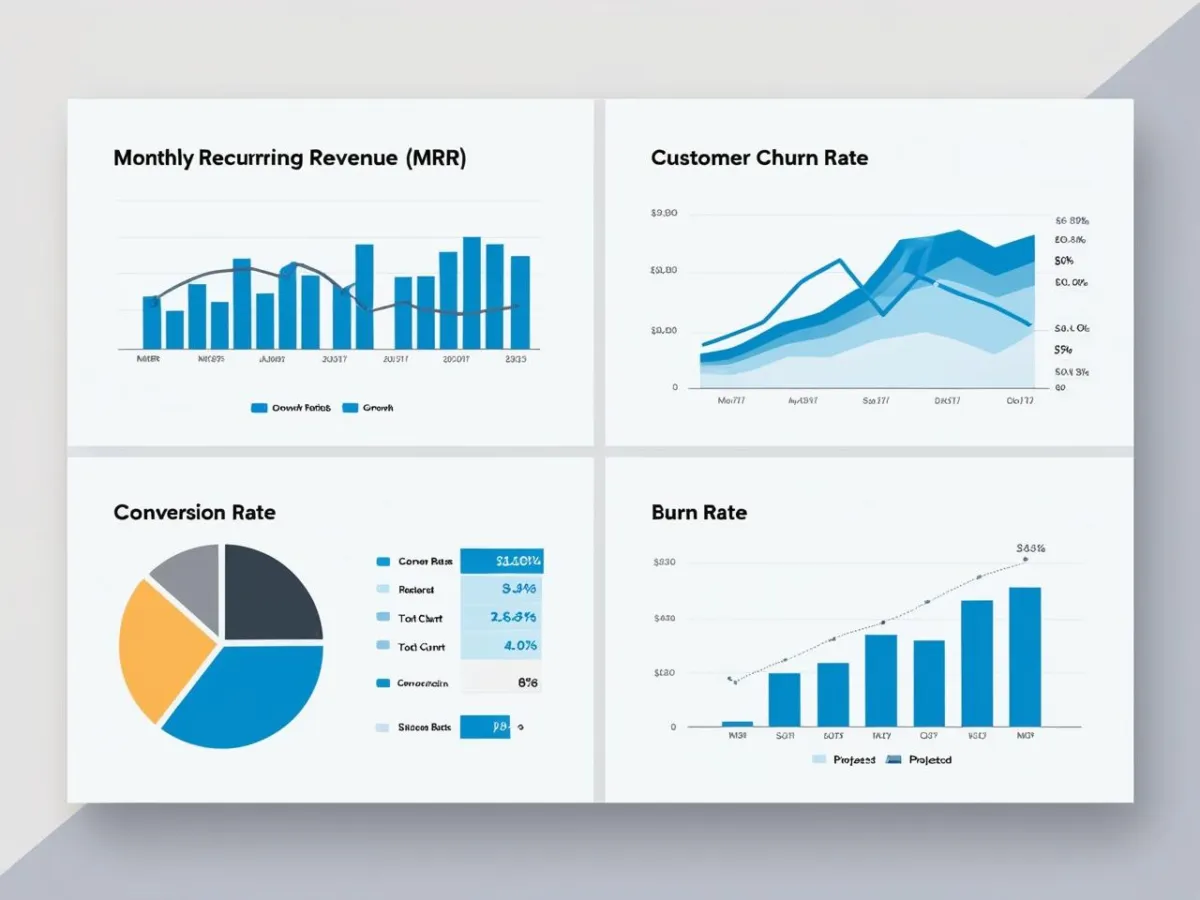
KPIs offer measurable evidence of your startup's performance and potential. Include them in your financial model to provide clear indicators of business health to the investors.
Choosing Relevant KPIs
Select KPIs that align with your industry:
- SaaS Companies:
- Monthly Recurring Revenue (MRR)
- Customer Churn Rate
- E-commerce Businesses:
- Conversion Rate
- Average Order Value (AOV)
- Manufacturing Firms:
- Production Efficiency
- Inventory Turnover Ratio
Integrating KPIs into Your Model
- Create Dashboards: Visualize KPIs with charts for quick interpretation.
- Benchmark Against Industry Standards: Provide context for your performance.
- Ensure Dynamic Updates: Link KPIs to real-time data sources.
Illustrative Examples of KPI Dashboards
- Sales Funnel Visualization: Shows conversion rates at each sales stage.
- Burn Rate Chart: Illustrates cash outflows over time, critical for understanding runway.
- Customer Lifetime Value (CLV): Calculates the total revenue expected from a customer over their engagement period.
Effectively integrating KPIs communicates your startup's performance and strategic focus to investors.
Step-by-Step Guide: How to Create a Financial Model for Investors
You can build a financial model by breaking it down into structured steps. This makes the whole process manageable. These steps are also applicable to project financial modeling, ensuring a structured approach.
Consider starting with a financial model template to save time and ensure best practices.
1. Define Your Objective
Clarify whether the model is for fundraising, internal planning, or both. A clear objective guides the focus and complexity of your model.
2. Gather Historical Data
Collect accurate financial statements and ensure data integrity. Include past income statements, balance sheets, and cash flow statements.
Financial modeling and forecasting financial statements are essential for accurate projections.
3. Make Assumptions
Determine key assumptions like market growth rates, sales conversion rates, and cost drivers based on historical data, benchmarks, or industry reports.
Ownership assumptions matter. Data from 2020–2024 shows founders retain 56.2% after Seed, dropping to just 11.4% post-Series D. Modeling equity dilution remains essential for realistic planning.
4. Choose the Right Tools
Select software that suits your needs, such as Excel for flexibility or specialized financial modeling software for advanced features.
5. Build the Income Statement
Project revenues and expenses, considering all revenue streams, cost of goods sold, operating expenses, and taxes.
6. Create the Balance Sheet
Project assets, liabilities, and equity. Include accounts receivable, inventory, fixed assets, debt, and equity financing.
7. Develop the Cash Flow Statement
Forecast cash inflows and outflows to assess liquidity and your ability to meet financial obligations.
8. Integrate KPIs
Include relevant KPIs to track performance over time. Use visual dashboards for easy interpretation.
9. Perform Scenario and Sensitivity Analysis
Test how changes in assumptions affect outcomes. This highlights potential risks and prepares you for investor inquiries. Before sharing your deck, tighten the narrative with financials for investors so your revenue, margins, and runway line up without surprises.
10. Review and Update Regularly
Ensure accuracy by regularly reviewing and updating the model. Adjust assumptions as necessary to reflect current conditions. Utilize these Financial Model Templates to streamline this process, offering structured formats and built-in formulas.
Balancing Top Down and Bottom Up Forecasting
Building on these steps, founders should combine top down market sizing with bottom up operational data. Top down forecasting sets realistic sales targets based on market share and industry trends. Bottom up forecasting uses internal metrics like sales capacity and resource constraints for detailed short-term projections. Integrating both approaches produces forecasts that are credible and actionable.
Case Study 1: Airbnb modeling a demand crash (and the rebound)
This case study is a prime example of startup financial modeling during a demand shock.
When borders slammed shut in early 2020, Airbnb lived through the kind of “worst-case” you only think you’ll ever model. Bookings evaporated, executives warned that 2020 revenue could fall to “less than half” of 2019, and the company cut ~25% of staff to stabilize cash burn. This is the gold-standard example of a real demand-shock scenario with explicit management actions.
What happened (hard numbers):
- Full-year revenue fell ~30% to $3.4B in 2020 (vs $4.8B in 2019). That’s ugly, but not the −50% cliff they had guided as a downside. Q4 2020 revenue was down 22% YoY as the business pivoted faster than expected toward longer stays and non-urban travel.
- To extend runway, Airbnb restructured and downsized by ~1,900 roles (~25%) while refocusing on its core product, exactly what you’d list in your “if-this-then-that” playbook under a severe revenue shock.
Why founders should care:
- Your model shouldn’t just say “revenue −70%.” It should tie each shock to levers: hiring freeze, marketing pause, vendor renegotiations, and product mix shifts. Airbnb’s path shows how downside assumptions + actions translate into runway saved and faster recovery once demand rebounds.
- KPI lens: Track cash runway (months), variable vs fixed cost split, booking mix (urban vs non-urban), and refund/resolution reserves. Those are the dials that mattered in their recovery narrative. (Their results update makes those pivots obvious.)
Case Study 2: Zoom modeling a demand spike you’re barely ready for
The flip side of stress testing is… success can punch you in the face. Zoom’s usage exploded from ~10 million daily meeting participants (Dec 2019) to ~300 million (April 2020)—a 30× surge in ~3 months. Revenue followed: FY2021 hit $2.65B (+326% YoY), with Q4 at $882.5M (+369% YoY). That’s the canonical “best-case / surge-capacity” scenario.
What happened (hard numbers):
- Verified by Zoom’s own communications and SEC filings: usage went 10M → 200M → 300M daily participants in March–April 2020; fiscal results stepped up accordingly. These are the numbers to anchor your COGS (Cost of Goods Sold), infra, and support load assumptions when modeling a viral lift.
Why founders should care:
- A surge test isn’t “more revenue, yay.” It’s egress and compute costs, SLA/SLO compliance, trust & safety, and support tickets per active account, all of which can crush gross margin if you don’t scale smartly. Zoom’s filings quantify the step-function in revenue; your model should show whether margins hold or collapse during the spike.
Choosing the Right Financial Modeling Tools
When you build a financial model, choosing the right software can impact your workflow and results.
1. Comparing Software Options
Many financial modeling tools offer a financial model template to help you get started quickly.
Microsoft Excel
- Pros:
- Highly flexible with extensive functionalities.
- Widely accepted in the finance industry.
- Supports advanced features like VBA scripting.
- Cons:
- Steeper learning curve for advanced features.
- Collaboration can be challenging without cloud integration.
Google Sheets
- Pros:
- Real-time collaboration capabilities.
- Cloud-based, accessible from anywhere.
- Easy sharing with customizable permissions.
- Cons:
- Limited advanced features compared to Excel.
- Performance issues with very large datasets.
Specialized Software
- Pros:
- Built-in financial modeling and forecasting functions.
- Industry-specific templates and reports.
- Advanced analytics and scenario planning features.
- Cons:
- Higher costs, which may not be feasible for early-stage startups.
- Learning curve associated with new software.
Recommendations Based on Startup Needs
- Early-Stage Startups: Google Sheets is suitable for basic modeling and collaboration when resources are limited.
- Growth-Stage Startups: Excel offers advanced features necessary for complex models.
- Complex Financial Needs: Specialized software is ideal when advanced forecasting and reporting are required.
For clearer cash visibility across teams, plug in effective financial tools for startups and move from manual reports to live dashboards.
Industry surveys show clear tool preference. As of 2024, Excel remains the primary modeling tool among startups, while platforms like OneStream and Abacum help scale and enable collaboration. Tool choice signals operational priorities for startups.
2. Advanced Tool Features
Excel Power Query and Power Pivot
- Purpose: Manage large datasets efficiently.
- Benefits: Simplify data preparation and enhance data analysis capabilities.
Macro Programming with VBA
- Purpose: Automate repetitive tasks and complex calculations.
- Benefits: Save time, reduce errors, and improve model consistency.
Google Sheets Add-ons
- Purpose: Extend functionality with third-party tools for analytics and automation.
- Benefits: Enhance collaboration features and streamline workflows.
Including visuals like screenshots and tutorials can greatly enhance understanding and facilitate learning.
Overcoming Common Challenges
Financial modeling comes with challenges, but proactive strategies can strengthen your model. If you are a nonprofit or a pre-revenue hardware startup, focus your model on cost control, grant forecasting, and break-even analysis.
Potential Pitfalls
Overcomplicating the Model
- Issue: Complex models with unnecessary details can confuse investors.
- Solution: Focus on clarity and include only essential information that adds value.
These steps are crucial for creating an investor ready financial model.
Inconsistent Data
- Issue: Using outdated or inconsistent data leads to inaccurate projections.
- Solution: Establish a single source of truth for data inputs and regularly verify data integrity.
Unrealistic Assumptions
- Issue: Overly optimistic or unfounded assumptions undermine credibility.
- Solution: Base assumptions on market research, historical data, and industry benchmarks.
Lack of Flexibility
- Issue: Models that cannot accommodate changes limit analysis.
- Solution: Design models with adjustable parameters and utilize scenario planning tools.
Addressing Errors
- Implement Error Checks: Use validation rules and error alerts within your model.
- Peer Reviews: Have financial experts or team members review the model.
- Test with Extreme Values: Input outlier values to verify model responsiveness.
Maintaining Accuracy
- Document Methodologies: Keep detailed notes on assumptions and data sources.
- Version Control: Use software to track changes and maintain previous versions.
- Regular Updates: Schedule periodic reviews to update data and assumptions.
Investor priorities emphasize more than just accuracy. In 2024, 73% of investors believe startups they back must enhance resilience to future international crises. Building for adaptability and data consistency is now strategic, not optional.
If the team is debating cells instead of strategy, bring in consulting financial modeling experts to settle assumptions and move.
Adapting to Cultural Differences
With international investors, you must be extra conscious of the cultural differences.
Adapting Your Model
- Regulatory Compliance: Incorporate local financial regulations and reporting standards.
- Currency Adjustments: Present financials in both your local currency and that of the investor's country.
- Language and Terminology: Use region-specific financial terminology and translate key parts if necessary.
Understanding Market Differences
- Accounting Standards: Adjust your model for IFRS or GAAP as applicable.
- Market Dynamics: Consider differences in consumer behavior and economic conditions.
- Tax Implications: Factor in varying tax rates and compliance requirements.
Systematic frameworks support cross-border reporting. By 2025, up to 96% of responses from prior years are prefilled for international submissions. Model automation and localization reduce compliance workload significantly.
Strategies for International Operations
- Local Partnerships: Collaborate with local firms to gain insights.
- Cultural Sensitivity: Be aware of norms that may influence investor perceptions.
- Tailored Communication: Adjust your pitch to align with cultural expectations.
For strategies on navigating financial planning across different markets, read our guide on Financial Planning for Global Expansion.
Maintaining and Updating Your Financial Model
A financial model is a living document. Regular updates and maintenance are indispensable to keep it relevant and accurate.
Importance of Regular Updates
- Reflect Business Changes: Ensure your model mirrors operational realities.
- Respond to Market Shifts: Incorporate new market data and economic indicators.
- Build Investor Confidence: Demonstrate diligence and adaptability.
Setting Up Maintenance Processes
- Scheduled Reviews: Establish regular intervals for model updates.
- Designated Ownership: Assign team members responsible for maintenance.
- Change Logs: Document all updates for transparency.
Automating Updates
- Data Integration: Connect your model to accounting software for real-time data.
- Automated Reports: Generate reports automatically at specified intervals.
- Notifications: Set alerts for anomalies or when certain thresholds are met.
Invest time in regular updates. This will make sure your financial model remains a powerful tool for decision-making and investor communications. Fundraising soon? Cut prep time in half by moving to automated investor reporting that keeps metrics clean and always up to date.
Conclusion
A funding-ready financial model blends sharp numbers with a sharp narrative. Keep it lean, defensible, and aligned with what investors actually ask for. Track the right KPIs, update on a cadence (not vibes), and tie every assumption to reality. Use the techniques above to turn your model from “nice spreadsheet” into “credible plan,” then pressure-test it with investor-style questions before you’re in the room.
Need a financial model investors actually trust? Our financial model creation service builds clear, investor-ready forecasts that support your valuation, funding ask, and growth story.
Key Takeaways
- Align with Investor Expectations: Tailor your model to demonstrate viability, risk mitigation, and growth potential.
- Employ Advanced Techniques: Use scenario analysis, stress testing, and AI tools to enhance your model's credibility.
- Integrate Relevant KPIs: Provide measurable evidence of performance and growth potential.
- Follow a Structured Approach: Breaking down the process into steps facilitates efficiency and thoroughness.
- Select Suitable Tools: Choose software that matches your needs and complexity.
- Adapt for Cultural Differences: Tailor your model for international investors by considering regional nuances.
- Maintain Your Model: Regular updates keep your model accurate and build investor confidence.
Need numbers investors trust?
Clean assumptions, realistic projections, and a structure that holds up in diligence.
- Forecasts, unit economics, and scenario planning
- Valuation-ready outputs investors can review fast
- Clear structure so you can update it easily
Frequently asked Questions
How do you make an investor-ready financial model?
To create an investor-ready financial model, focus on clarity, realistic assumptions, and robust scenario analysis. Highlight KPIs and stress testing for credibility.