

 Back
Back








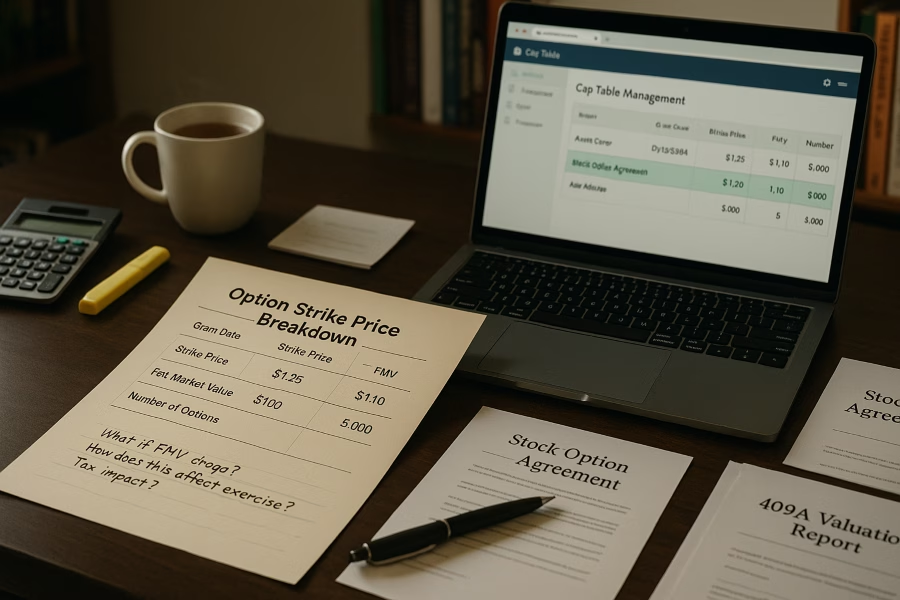
Table of Contents

When startups talk about “equity,” most people hear upside. Future millions. Early believer rewards.
But there is one number that quietly decides how much of that upside you actually keep: the option strike price.
The option strike price is the fixed price you pay to buy your shares later. Get it wrong, and your “generous” stock option grant can turn into a weak deal after taxes and dilution. Get it right, and a normal looking offer can become life changing if the company grows.
For founders and early employees, understanding option strike price is not a nice add on. It affects how attractive your offers are, how fair your equity feels, and how much real value ends up in people’s hands at exit.
This article breaks down what option strike price really is, how it is set, how it impacts startup equity value over time, and what both founders and employees should watch for before signing anything.
Key Principles of Option Strike Price
The strike price determines the cost at which employees and investors purchase equity, affecting potential returns and company valuation. Understanding the concept of an option strike price is essential for anyone exploring options trading.
To demonstrate the magnitude of strike price selection, $1 strike price scenario in a seed-stage startup can result in a $49 profit per share if the company exits at $50. This sharp difference shows how startup employees and investors benefit directly when stock options appreciate, provided the strike price is set judiciously.
Strike prices differ based on the type of option. For call options, the strike price represents the cost at which the holder can purchase the asset, while for put options, it indicates the price at which the asset can be sold. These distinctions are critical for understanding pricing dynamics and evaluating potential gains or losses.
Exchanges set strike prices at standard intervals for consistency. These intervals, called strike widths, depend on the asset price and market conditions.
'Strike widths' are the set increments (such as $1, $2.50, etc.) between available strike prices on exchanges. The application of strike prices also varies between American and European options styles. American options allow holders to exercise their contracts at any point before expiration, offering greater flexibility. In contrast, European options can only be exercised on the expiration date, which impacts how strike prices are utilized in trading strategies.
The relationship between option strike prices and equity valuation is clearly reflected in how to create a financial model for investors, illustrating a shared focus on funding strategies. By grasping the nuances of strike prices, startups can better align their financial goals with long-term growth.
Startups like yours already closed their rounds with us.
Founders across every stage and industry. Here's what it took.
- Raised $7.6M for Swiipr Technologies
- Raised $0.5M for Ap Tack
- Raised €0.5M for Ivent Pro

How Market Dynamics Influence Strike Price
The interplay between the strike price and the market price of an asset is a cornerstone of option trading. The strike price, also known as the exercise price, is the predetermined value at which an option holder can buy or sell the underlying asset. This figure is distinct from the spot price, which reflects the asset's current market value. Understanding this distinction is crucial for assessing the profitability and valuation of options.
When the market price fluctuates, it directly impacts the premium of an option. For call options, if the spot price exceeds the strike price, the option becomes “in the money,” increasing its intrinsic value. Conversely, for put options, profitability arises when the spot price falls below the strike price.
These dynamics underscore the importance of aligning strike prices with market trends. Traders must evaluate how the relationship between the strike price and spot price affects the option's premium and potential returns. This knowledge is essential for making informed decisions in the fast-paced world of option trading.
What Moneyness Means: In, At, and Out of the Money Explained
Moneyness is a fundamental concept in options trading, describing the relationship between an option’s strike price and the underlying asset’s market price. It categorizes options into three distinct states: in-the-money (ITM), at-the-money (ATM), and out-of-the-money (OTM). These classifications help traders assess the potential value and liquidity of an option, though they are not direct indicators of profitability.
An option is considered in-the-money when exercising it would yield a positive payoff. For example, a call option is ITM if the market price of the underlying asset exceeds the strike price. Conversely, a put option is ITM when the market price is below the strike price. At-the-money options occur when the strike price matches the market price, often offering improved liquidity due to their balanced risk-reward profile. Out-of-the-money options, on the other hand, have a strike price that makes them unprofitable to exercise at the current market price.
While moneyness quantifies the difference between the strike price and market price, other factors like volatility and time to expiration also influence an option’s value.
Understanding moneyness is crucial for evaluating options strategies, especially when considering low-risk approaches like selling OTM options.
The Impact of Option Strike Price on Value
The option strike price is a pivotal factor in determining an option’s value, influencing both premiums and profitability. Recent Series A valuation practices illustrate the mechanics behind determining option value. Common stock FMV may fall to $2.80 per share when applying a 30% discount to the $4.00 Series A price per share at a $40M post-money valuation. This underscores how intrinsic value and dilution directly stem from precise strike price calculations in modern startup finance.
Black-Scholes and Binomial Tree models use volatility, time, and interest rates to price options. The strike price is a key part of these models.
How Strike Price Shapes Option Value
The strike price directly affects the premium of an option. For example, an in-the-money December 2024 call option with a $45 strike gains intrinsic value when the underlying stock finishes at $50, resulting in a $5 per contract valuation. Conversely, a December $40 put option becomes more valuable, $7 per contract, if the stock price drops to $33 at expiration. These examples illustrate how even minor shifts in strike price can lead to significant differences in option value.
Accurate option pricing for startups requires formal valuation. 409A valuation services for Series A to C companies range from $12,000–$35,000 and take about 10–14 days. This cost and timeline affect option grant planning and budget forecasts for emerging startups.
Balancing Profitability and Risk
Selecting the right strike price involves balancing the probability of profit with acceptable risk levels. Expert insights suggest that traders should evaluate their risk tolerance alongside market conditions. Additionally, time decay plays a crucial role; as expiration nears, out-of-the-money options lose value rapidly due to diminishing time value. This underscores the importance of choosing strike prices that align with both short-term and long-term trading goals.
Failure to comply with valuation rules can be costly. Penalties for non-compliance can reach as high as 40% of the stock option value, posing severe risks to startups and employees. This underscores the critical nature of accurate strike price setting and legal adherence.
Startup financial assumptions often influence strike price evaluations, as outlined in startup financial assumptions. These projections can guide traders in aligning strike prices with underlying business performance, ensuring a strategic approach to option trading.
The total cost to exercise includes not only the strike price but also potential tax liabilities, which can significantly affect overall profitability. Failing to account for these costs may lead to unexpected financial burdens when options are exercised. Understanding this risk enables more informed decisions and better long-term outcomes for option holders.
How Option Delta Connects to Strike Price
Option delta, a critical measure in options trading, reflects how sensitive an option's price is to changes in the underlying asset's price. This sensitivity is closely tied to the strike price, which determines whether an option is in-the-money, at-the-money, or out-of-the-money.
For at-the-money options, delta typically hovers around 0.5, indicating a balanced sensitivity to price movements. As options move deeper in-the-money, their delta approaches 1, signifying that their price changes almost in tandem with the underlying asset. Conversely, out-of-the-money options exhibit a lower delta, often close to 0, meaning their price reacts minimally to shifts in the asset's value.
These variations in delta highlight distinct risk profiles. Deep in-the-money options, with their high delta, are more responsive to price changes, making them suitable for traders seeking greater exposure. On the other hand, out-of-the-money options, with low delta, are less sensitive and often used for speculative strategies or hedging.
Industry-wide movements confirm the strategic impact of large-scale capital flows on startup equity. IFC’s record $56 billion commitment in 2024 to private companies and financial institutions exemplifies confidence in startup valuation mechanisms and option-driven incentives. Large capital inflows like these reinforce the need for robust strike price strategies at both the company and market level.
How to Assess Which Strike Price Works Best for You
Selecting the right strike price is a critical decision for investors, as it directly impacts potential returns and risk exposure. Many investors gravitate toward strike prices close to the current market value, as these options often provide higher liquidity and lower risk. This preference stems from the fact that near-the-money options are more likely to be exercised, making them a practical choice for those seeking stability.
On the other hand, far out-of-the-money options may appear attractive due to their lower premiums, but they carry significantly higher risk. These options are less likely to reach profitability, which can deter risk-averse investors. Market volatility also plays a pivotal role in determining the ideal strike price. During periods of high volatility, options closer to the market value may offer a better balance between risk and reward.
When considering investor allocations, share percentages for new investors typically remain below 50% to maintain founder control and cap table balance. This guideline informs both the strike price range and equity structuring in early-stage financing.
How to Pinpoint the Best Strike Price Intervals
Determining the optimal intervals between strike prices requires a blend of standardized guidelines and market-specific adjustments. Strike price intervals are primarily influenced by the underlying stock price and its liquidity, ensuring that options remain accessible and practical for traders across varying market conditions.
The widening landscape of high-value startups impacts how strike price intervals are set. 1,308 VC-backed companies had $500 million+ valuations as of December 31, 2024. Such scale demands interval structures that remain fair and liquid for a growing range of startup share prices.
Standardized frameworks, such as those outlined by the OCC Spec, provide consistency in strike price settings. For example, options strike prices typically increase in increments of $2.50 for normal-volume stocks, while high-volume stocks often feature narrower $1 increments. These increments are designed to balance precision with market efficiency, catering to both institutional and retail participants.
Emerging trends are reshaping traditional interval strategies. Micro-strike intervals, such as $1 strike increments for stocks priced under $50, are gaining traction for their ability to support retail trading strategies with improved precision. Additionally, exchanges are adopting volatility-adjusted strike clustering, dynamically calibrating intervals based on prevailing market conditions like VIX levels. This approach enhances liquidity during periods of market turbulence, ensuring traders can execute strategies effectively.
The depiction of equity narratives is enriched by the integration of option strike prices, a detail that resonates with the content covered in financial documents required by investors. Understanding these intervals is crucial for aligning trading strategies with market dynamics.
Using Market Data to Refine Strike Price Choices
- Review option chains to compare available strike prices and identify where trading activity is most concentrated.
- Analyze open interest at different strike prices to gauge market sentiment and ensure sufficient liquidity for your trades.
- Select strike prices with higher open interest to improve execution likelihood and reduce potential slippage in volatile markets.
Conclusion
Equity is not automatically valuable just because the number of options looks big. The strike price is the quiet lever that decides whether your equity becomes meaningful wealth or an expensive souvenir. If you understand how strike price is set, how it changes your real upside, and how taxes and dilution reshape outcomes, you can negotiate and plan with open eyes. Your future self will thank you, and your finance spreadsheet will stop screaming.
If you're ready to elevate your startup's equity strategy, let us help craft a compelling pitch deck. Reach out to learn how our Pitch Deck Creation service can transform your investor presentations.
Key Takeaways
- The strike price is what you will pay later to buy your shares. It decides how much upside you actually keep.
- A lower strike price usually means more potential gain per share, but it still depends on taxes, dilution, and the exit price.
- Strike price is not “picked.” For startup options, it is typically tied to fair market value from a 409A valuation.
- Moneyness is the simple test: if the company value rises above the strike price, your options start having real value.
- Time matters. Options can expire, and waiting too long can turn “future wealth” into “missed deadline.”
- Taxes can change the math. The total cost is strike price plus the tax hit when you exercise or sell.
- For founders, strike price affects hiring. Great equity offers feel bad if the strike is high and the upside feels capped.
- Before signing, always ask for the option details. Strike price, number of options, vesting, expiration, and what happens if you leave.
Need numbers investors trust?
Clean assumptions, realistic projections, and a structure that holds up in diligence.
- Forecasts, unit economics, and scenario planning
- Valuation-ready outputs investors can review fast
- Clear structure so you can update it easily
Frequently asked Questions
What is the relationship between option delta and strike price?
Option delta measures how the price of an option reacts to changes in the underlying asset, and it is closely related to the strike price. At-the-money options have a delta near 0.5, showing balanced sensitivity to price changes.