

 Back
Back








Table of Contents

Investors that consistently win competitive allocations don’t rely on chance, they operate an integrated outreach engine across multiple channels, guided by a clear thesis, strong content, on-platform engagement, and community presence. Done well, this doesn’t just improve deal discovery; it compounds into inbound from founders who are already qualified by stage, sector, and geography.
Recent years have accelerated innovation in outreach approaches. In the period of 2024-2025, hyper-personalized emails using AI delivered six times more transactions and boosted open rates by 29%. This technology-driven approach directly enhances prospect engagement and conversion rates for investors using multi-channel strategies.
This article breaks down the highest-yield startup outreach channels for investors, how to structure campaigns, the role of marketing in investor brand building, and what to measure, without falling into scattershot tactics or vanity metrics.
Let's get started!
Defining Your Thesis Before Selecting Startup Outreach Channels
Outreach efficiency rises dramatically when the thesis is explicit. To source high-quality startups, investors must define their investment thesis and use a mix of outreach channels such as owned content, social media, partnerships, and events.
A clear investment thesis, your unique criteria for target company stage, industry, and size—sharpens channel selection and messaging.
Investors should define stage sweet spot, sector focus, geography, typical check sizes, and post-investment edge. This specificity clarifies outreach.
- Define clear investment thesis (stage, sector, size, value-add)
- Identify top startup outreach channels
- Create thesis-aligned content for each channel
- Personalize outreach with founder context
- Plan follow-up sequences
- Measure channel responses and conversions
Sample LinkedIn outreach: "Hi [Founder], I saw your recent product release and think our thesis aligns. Open to a conversation?"
A clear thesis helps investors focus on their preferred channels, streamlining outreach and improving response rates. A public, concise thesis page also shortens cold-email cycles and gives founders a quick read on fit. If initial outreach is ignored, follow up once with new value. Respect founder do-not-contact requests to avoid reputational damage.
The Role of Sequenced Follow-Ups in Outreach
Building on a clear thesis, investors should implement sequenced follow-ups to maximize response rates. Structured outreach campaigns that space multiple touchpoints over time keep investor value top-of-mind for founders. Each follow-up should add new context or insight, rather than repeating the initial message. This disciplined approach increases the likelihood of meaningful engagement and ensures that targeted outreach efforts translate into real conversations.
Startups like yours already closed their rounds with us.
Founders across every stage and industry. Here's what it took.
- Raised $7.6M for Swiipr Technologies
- Raised $0.5M for Ap Tack
- Raised €0.5M for Ivent Pro

Mapping the Founder Journey for Targeted Outreach
Effective outreach starts with understanding where target founders spend time and what they need at each stage. Technical founders deep in build mode frequent open-source repositories, research communities, and product forums; go-to-market oriented founders engage in niche Slack groups, operator newsletters, and procurement meetups; deep tech and regulated-industry teams orbit university labs, standards bodies, and domain conferences.
By mapping these journeys, discovery, validation, first customers, compliance, and scale, investors choose channels that meet founders where they work rather than broadcasting broadly to other investors.
This is also where channel selection pairs with editorial strategy: content that resolves a friction point at a precise stage will outperform generic “we invest in X” statements across every platform.
Testing and Scoring Outreach Channels
After mapping founder touchpoints, investors should test and score outreach channels before scaling efforts. Using structured frameworks allows for quick experiments across several channels to identify those with the highest engagement. This approach ensures resources are allocated efficiently and outreach strategies remain adaptable. Prioritizing channels based on real founder response data leads to more effective and sustainable deal flow.
Owned Media Foundations for Long-Term Deal Flow
The global impact of owned content is measurable. In 2024, the email marketing market reached USD 6.13 billion and is projected to grow to USD 7.14 billion in 2025. Sustained growth highlights the ongoing strategic significance of investing in assets that investors control and optimize independently.
Owned media is the most durable, compounding asset in an investor’s outreach stack. A focused blog that publishes operator-grade playbooks, teardown analyses, and decision tools becomes the nexus for search discovery, social distribution, and email nurturing.
Editorial discipline matters: solve concrete problems with specificity, share frameworks founders can reuse, and back claims with examples or benchmarks. This approach not only compounds in search but also powers internal linking that guides readers naturally to related resources.
When the topic shifts to persona-led discovery on social platforms, direct them to investors find startups on LinkedIn for a deeper exploration of cadence, formats, and DM etiquette.
Building a High-Value Investor Blog
Start with a hub-and-spoke architecture by publishing a central article explaining 'why now,' buyer economics, and early traction signals. Then, add related pieces on pricing, onboarding, security, and traction.
Each spoke should include a single, clear call-to-action, apply for office hours, submit a founder brief, or access a template library. Over time, this structure establishes topical authority and improves organic discoverability for high-intent queries like “startup outreach channels for investors,” while giving founders a coherent path from reading to engagement.
To reinforce this system with a repeatable framework, pointing to content marketing for investors helps translate editorial strategy into a campaign calendar and repurposing plan.
Newsletters: The Best Marketing Channel for Investor-Focused Content
Newsletters convert anonymous readers into a known audience with ongoing dialogue. The best-performing formats alternate between deep, actionable guides and timely perspectives on market shifts that affect founder decisions. Segmenting subscribers by thesis fit and stage allows for targeted calls-to-action, from thematic office hours to curated founder circles.
A monthly rhythm keeps signal high without overwhelming inboxes, especially if issues follow a consistent template: a core insight, a practical tool or framework, a short case vignette, and a specific ask. When a newsletter references channel orchestration, it can point readers to a deeper post via internal linking, something like
To reinforce their value, 29% of marketing professionals identify their email newsletter programs as best-in-class for achieving key marketing objectives. This result illustrates how focused content and ongoing audience engagement pay dividends in relationship-driven fields.
Using Social Platforms for Startup Discovery
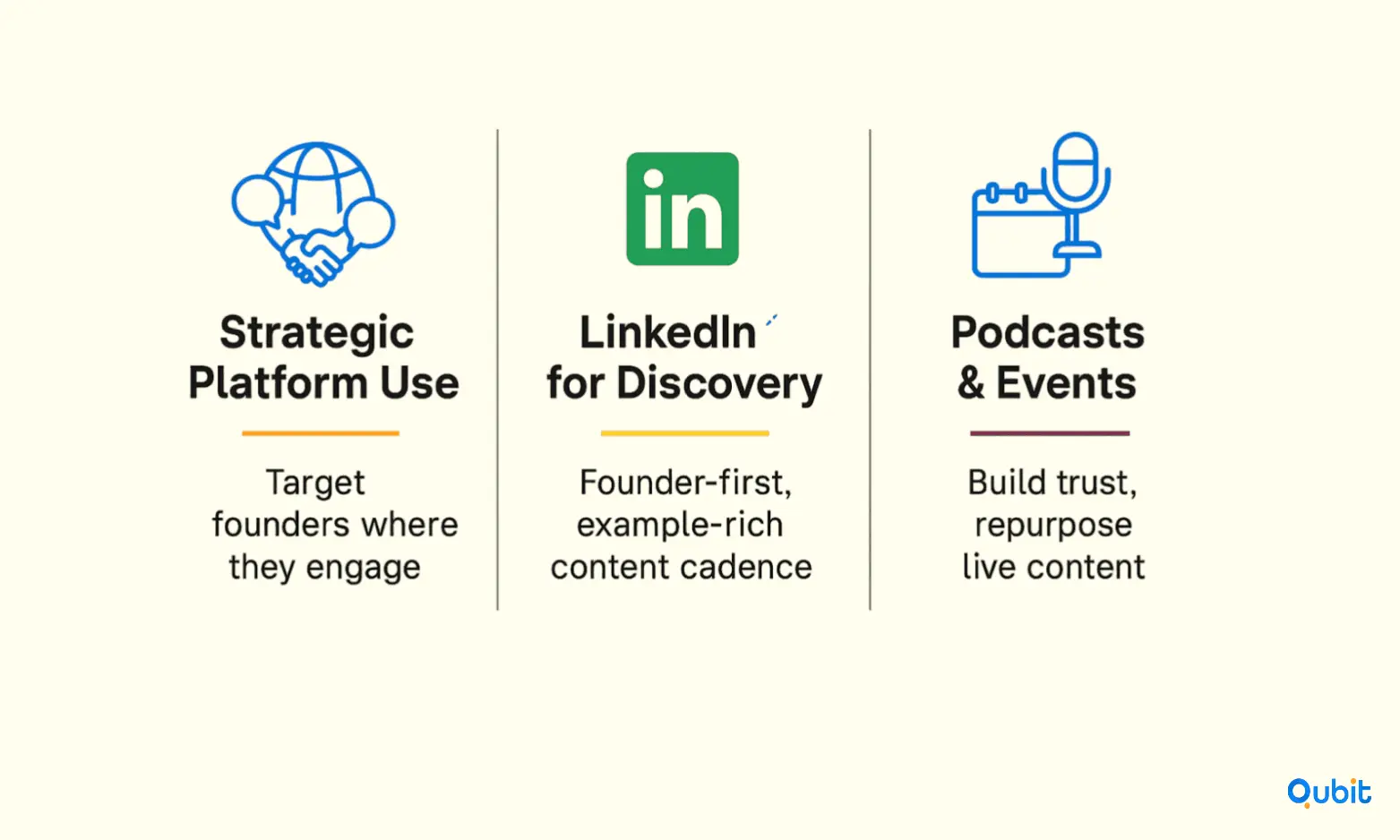
Social channels are essential startup outreach channels that turn owned content into distribution and create context for relationship-building.
Recent outreach trends illustrate increasing effort. In the past year, the number of outbound emails grew by 15% as teams pushed multi-channel engagement. This underscores how scale and frequency are rising across social and email platforms alike.
The goal is to participate where target founders converse and to contribute with unique, operator-grade insight that stands out from generic investor commentary. Short, example-rich posts, teardown threads, and diagrams have outsized impact, especially when followed by prompt, thoughtful engagement in the comments.
Comparing Outreach Channel Strengths
| Channel | Best Use Case | Key Strength |
|---|---|---|
| Direct, personalized founder outreach | High control and customization | |
| B2B discovery and professional branding | Strong network effects and visibility | |
| Phone Calls | Immediate feedback and objection handling | Real-time engagement |
| Events | Relationship building and trust | Deep, in-person connections |
| Podcasts/Webinars | Thought leadership and inbound interest | Scalable audience reach |
Media, PR, and Thought Leadership: Building Pull, Not Just Reach
PR works when it delivers founder utility, not just investor vanity. The most effective media efforts package original insight into decision tools founders can act on immediately: benchmark studies for pricing in a specific vertical, teardown analyses of enterprise procurement cycles, or postmortems that show exactly how a pilot moved to paid. Instead of chasing broad headlines, prioritize trade publications and domain newsletters where thesis-fit founders already spend attention.
For some investors, trade publications and domain newsletters may be the best marketing channel to reach thesis-fit founders. Time PR to coincide with thematic campaigns so each article or interview points to owned assets and a clear next step, like signing up for themed office hours or submitting a one-page founder brief.
Thought leadership is more than opinions, it’s a repeatable practice of publishing frameworks, data, and examples that hold up under scrutiny. One effective cadence is to release a flagship thesis piece, follow with two deep-dive playbooks, and then host a live session to stress-test the ideas with operators and founders. This creates a structured dialogue loop: publish, discuss, refine, and implement. To convert attention into relationships, each media moment should route to a specific destination on owned channels.
Case studies highlight this effect. In early 2024, Anything achieved 3M views on X, converting viral visibility into $2M ARR in just two weeks. This rapid traction underscores how well-timed PR and social amplification can transform founder engagement outcomes.
For example, a sector pricing analysis in a niche outlet can direct readers to a hands-on toolkit hosted on your blog, which then invites founders to a small-group clinic. The PR-to-owned pipeline approach mirrors the system laid out in investor PR strategies.
Each media asset should have one job, awareness, engagement, or conversion—and a single call-to-action to avoid diffusion. Over time, a consistent rhythm establishes a recognizable signal that founders anticipate.
Use selectively for operational clarity:
- Anchor each PR pitch in a founder decision: “Should we price per user or per workflow?” “How do we pass security review in 30 days?” “When does a pilot qualify as product-market fit?”
- Package evidence: anonymized cohort metrics, pipeline conversion snapshots, or case vignettes from portfolio and non-portfolio founders.
- Tie timing to campaigns, not one-off wins; route readers to a clear next step in owned channels.
- Measure not impressions but pipeline effects: office-hour signups, qualified form submissions, and meetings explicitly referencing the media asset.
Measurement That Matters: From Attention to Allocation
Outreach without measurement is theater. The goal is to understand which preferred channels and narratives reliably convert into qualified conversations and competitive allocations. Because fundraising cycles are long and outcomes lag, prioritize leading indicators that correlate with pipeline quality and then validate them against downstream results. A clean measurement stack avoids vanity metrics and focuses on actions founders take that show intent.
Review channel performance weekly to amplify effective outreach.
Start with a minimal analytics core that ties owned channels, social, and events to CRM stages. Track the explicit journey: which post a founder read, what form they completed, which event they attended, what follow-up they received, and where the conversation progressed or stalled. Use UTMs and structured form fields to keep attribution clean, but preserve a free-text field where founders can self-report why they reached out; those qualitative signals frequently reveal unanticipated content-market fit.
Within a 90-day cycle, pay attention to:
- Owned media: qualified form starts, office-hour bookings, and replies to newsletters that ask pointed, context-rich questions. These correlate better with fit than raw pageviews.
- Social: saves/bookmarks, founder DMs that reference a specific framework, and comments that challenge assumptions and invite deeper debate. Impressions and likes are soft signals at best.
- Events: registration-to-attendance rate, attendance-to-meeting conversion, and meeting-to-diligence movement within 30 days. Optimize topics and formats that shorten time-to-substance.
- Partnerships: percentage of curated intros that proceed to a call, and the hit rate of pre–demo day engagements that move into diligence compared with public demo day interactions.
Translate signals into action by reviewing performance weekly and deciding whether to double down, pivot, or sunset a channel or narrative. A weekly 30-minute pipeline review should spotlight top-of-funnel quality, not just volume. If a post drove significant interest but low fit, revise the framing or publish a clarifying note that tightens who should engage. If an event over-indexed in quality leads, repeat the topic with fresh case material and an even clearer application path.
Leveraging advanced measurement platforms can yield significant benefits. For example, integrated outreach solutions have improved sales productivity by 60% and minimized tech complexity. This demonstrates the tangible ROI of connecting analytics and workflow in investor outreach.
Editorial Standards, Governance, and Ethics
1. Clarity and Tone
Great outreach respects founder time, privacy, and attention. Set an editorial bar prioritizing clarity over jargon and examples over abstractions. Hold each asset to three questions: who is this for, what job does it do, and what's the next action? Create a short style guide defining tone, structure, and link discipline ensuring consistency across different authors.
2. Consent and Privacy
When referencing case material from office hours or community events, secure explicit consent and remove identifying details unless founders agree to attribution. Avoid pay-to-play dynamics and make disclosures around portfolio features and conflicts standard practice throughout all communications.
3. Governance Structure
Governance ensures consistency without stifling creativity. Assign clear ownership: a partner for social/editorial, a partner for partnerships/events, and an associate for CRM and analytics. Run weekly standups reviewing channel KPIs, deciding tactical changes, and committing to tight deliverables. Keep a living operating charter covering response SLAs, conflict escalation paths, and decision rights. This clarity prevents internal bottlenecks and keeps promises to founders.
4. Compliance and Data Protection
Compliance is a quiet moat. Ensure GDPR/CCPA compliance across data capture and email marketing with explicit opt-ins, easy opt-outs, and sensible data retention policies. Make it simple for founders to understand what happens with their information, who sees it, and storage duration. Trust built consistently becomes a brand advantage over time.
Conclusion
Building a high-quality, thesis-aligned startup deal flow relies on intentional positioning and leveraging the right startup outreach channels for founder-first value delivery.
Consistency, specificity, and respect for founder time turn outreach from a sporadic activity into a compounding brand moat. When each touchpoint, from a LinkedIn post to a reverse pitch event, is backed by a clear thesis and a tangible next step, investor visibility translates directly into competitive allocations and long-term relationships.
At Qubit Capital, we specialize in aligning startups with the right investors through tailored services like Startup Matchmaking. If you're ready to elevate your portfolio management and connect with optimal investors, we invite you to explore how our expertise can support your goals.
Key Takeaways
- A precise thesis attracts better-fit founders and informs outreach strategy.
- Publish founder-first resources to build long-term inbound deal flow.
- Use platforms like LinkedIn to convert visibility into structured conversations.
- Collaborations with accelerators, universities, and niche communities give earlier access.
- Podcasts, webinars, office hours, and reverse pitches move beyond generic networking.
- Focus on leading indicators tied to qualified, on-thesis meetings.
Find startups worth your time.
Curated startup opportunities matched to your thesis and investment criteria.
- Deal flow filtered by sector, stage, and fit
- Research and context included with every opportunity
- Less noise. More relevant deal flow.

Frequently asked Questions
What are the most effective startup outreach channels for investors?
The best startup outreach channels are LinkedIn, investor blogs, newsletters, partnerships with accelerators, and targeted events. Choose channels that fit your investment thesis.