

 Back
Back








Table of Contents

Finding the right balance between founder-investor alignment and strategic goals can determine the trajectory of a startup’s success. The relationship between investors and startups goes beyond financial backing, it’s about shared vision, complementary strengths, and mutual trust. Without this alignment, even the most promising ventures can falter.
A refined perspective on investor inquiries emerges as you explore questions to ask before investing in a startup, offering nuanced insights into aligning with startup objectives. This connection is vital for fostering growth and ensuring both parties achieve their long-term goals.
In this blog, we’ll explore the dynamics of startup investor fit, uncovering how the right match can unlock growth potential. Let’s dive into the strategies and considerations that make this alignment a cornerstone of success.
Investor Startup Fit: Understanding Profiles and Funding Options
The journey of securing funding for a startup is as diverse as the investors and funding sources available. Investor-startup fit means aligning on goals, expectations, and strategy between founders and investors. Achieving fit increases chances of growth and mutual success. From personal networks to institutional investors, the options are broad. Understanding the spectrum of investor types is crucial for aligning financial needs with strategic goals.
This section explores various funding sources. Each option offers unique benefits, levels of involvement, and financial input. Founders must evaluate which aligns best with their startup’s trajectory.
1. Friends, Family, and Fools (FFF): The Starting Point
For many startups, the initial funding comes from personal networks. Known as Friends, Family, and Fools (FFF), this funding source is often the most accessible. While the financial input may be modest, the emotional investment is significant. However, founders should tread carefully, as mixing personal relationships with business can lead to complications.
2. Business Angels: Strategic Early-Stage Support
Business Angels are individuals who invest their personal funds in startups, often in exchange for equity. They bring not only capital but also industry expertise and mentorship. For startups in their early stages, Business Angels can be invaluable, offering guidance and connections that go beyond financial support.
3. Syndicates: Collaborative Investment
Syndicates are groups of investors pooling their resources to fund startups. A lead investor typically manages the deal, receiving a 15-20% carry (a share of profits from the investment) for their efforts.
4. Venture Capital Funds: Scaling with Institutional Backing
Venture Capital (VC) funds are institutional investors that provide significant funding to startups with high growth potential. In exchange for equity, VCs often take an active role in shaping the company’s strategy. While this can be beneficial, it also means relinquishing some control.
5. Micro VCs: Niche Opportunities
Micro VCs operate similarly to traditional VC funds but focus on smaller capital pools, typically up to $15 million. They target niche markets and early-stage startups, offering a more tailored approach.
6. Corporate Venture Capital (CVC): Strategic Partnerships
CVCs are investment arms of large corporations. Unlike traditional VCs, their primary goal is strategic alignment rather than financial returns. Startups partnering with CVCs gain access to industry expertise, resources, and networks, making this an attractive option for those looking to scale within specific sectors.
7. Accelerators: Structured Growth Programs
Accelerators provide startups with a structured program to expedite growth. These programs typically last three to six months and include mentorship, operational support, and funding in exchange for equity.
8. Bootstrapping: Self-Funded Growth
Bootstrapping involves using personal savings or revenue generated by the business to fund operations. While this approach allows founders to retain full control, it can limit growth potential due to resource constraints.
9. Crowdfunding: Community-Driven Capital
Crowdfunding platforms enable startups to raise funds from a large number of people, often in exchange for early access to products or equity. This method not only provides capital but also validates the market demand for the product or service.
10. Grants: Non-Dilutive Funding
Grants offer non dilutive funding, meaning startups receive capital without giving up equity or taking on traditional debt. They are especially attractive for research heavy, impact focused, or innovative projects that meet specific criteria set by grant makers. However, grant applications can be time consuming, competitive, and restrictive about how and when the money is used.
Choosing the Right Funding Source
Selecting the appropriate funding source depends on various factors, including the startup’s stage, industry, and growth goals. For instance, early-stage startups may benefit from the mentorship of Business Angels or accelerators, while scaling companies might find VC funds or CVCs more suitable.
For example, a health-tech founder found ideal support in a Business Angel with medical industry expertise, speeding up regulatory approvals.
Building an Effective Fundraising Pipeline
- Begin by researching investors using platforms like Pitchbook, CB Insights, and Crunchbase to match your startup’s profile.
- Shortlist investors based on stage, sector focus, and prior investment activity that aligns with your business goals.
- Use CRM tools to organize investor data, track outreach progress, and schedule follow-ups for each prospect.
- Leverage warm introductions from mentors, advisors, or founder networks to build trust and improve engagement rates.
- Regularly update your pipeline, noting investor feedback and adjusting your approach to maximize funding opportunities.
Your understanding of startup matching approaches deepens when you consider startup scouting strategies, which expands the context with overarching early-stage evaluation methods.
Optimizing Founder-Investor Alignment for Startup Success
Achieving investor startup fit is fundamental to driving startup success. This fit, which encompasses shared vision, effective communication, and mutual trust, lays the groundwork for growth.
Shared Vision: The Cornerstone of Alignment
A unified vision is the foundation of any successful founder-investor relationship. Both parties must agree on the startup’s long-term goals, market positioning, and growth trajectory. Misalignment in vision can lead to conflicting priorities, which may hinder progress. Founders should clearly articulate their mission and objectives, while investors must ensure their expectations align with these ambitions.
Effective Communication: Bridging the Gap
Transparent and consistent communication is essential for maintaining alignment. Regular updates on key performance indicators, challenges, and milestones foster trust and ensure both parties remain informed. Open dialogue also allows founders and investors to address concerns proactively, minimizing misunderstandings.
An analytical framework for growth becomes clearer when you examine how to evaluate startup scalability potential, providing a structured view of key performance indicators. This ensures both founders and investors are aligned on achievable growth trajectories.
Mutual Trust: Building a Strong Foundation
Trust is the glue that binds founders and investors together. It is cultivated through honesty, reliability, and shared successes. Founders must demonstrate their commitment to the startup’s vision, while investors should provide unwavering support and guidance.
Balancing risk tolerance is another critical aspect of trust. A balanced approach to risk management is achieved by considering how to assess startup risk profiles, which adds depth to your overall startup matching analysis. This ensures both parties are comfortable with the level of risk involved in pursuing ambitious goals.
Complementary Skill Sets: Enhancing Collaboration
The most effective founder-investor relationships leverage complementary skills to drive innovation and growth. Founders bring creativity and industry expertise, while investors contribute strategic insights and financial acumen. Together, they create a dynamic partnership capable of overcoming challenges and seizing opportunities.
Avoiding 'Dumb Money' Investor Pitfalls
Beyond seeking complementary skills, founders should be cautious of investors who provide only capital without strategic support. These 'dumb money' partners may lack industry expertise, mentorship, or valuable networks, limiting the startup’s growth potential. Accepting such investment can result in missed opportunities for guidance and collaboration, increasing the risk of misalignment and future conflicts. Prioritizing investors who offer both funding and meaningful engagement strengthens the foundation for long-term success.
The Role of Digital Capital and Strategic Investment
Digital capital and early-stage investment vehicles, such as tactical capital (capital used for quick, targeted opportunities) and distribution capital (funding allocated for scaling product distribution), significantly influence founder-investor alignment. These funding mechanisms provide startups with the resources needed to scale operations, enter new markets, and refine their product offerings.
Strategic capital, in particular, goes beyond monetary support by offering mentorship, networking opportunities, and access to industry expertise. This holistic approach strengthens the founder-investor relationship, ensuring both parties are invested in the startup’s success.
Capital efficiency benchmarks play a critical role in investor alignment. For Series A SaaS startups, current burn multiple is 1.6×, spending $1.60 for every new ARR dollar. Meeting such standards helps sustain investor confidence and collaboration.
Maintaining Alignment After Investment
Investor startup fit is not static; effective partnerships require continual nurturing:
- Regular Alignment Check-Ins: Scheduled strategy sessions and review meetings sustain open communication.
- Adaptability: Both founders and investors should be willing to recalibrate goals as markets or companies evolve.
- Shared Problem-Solving: Collaborative responses to challenges strengthen bonds.
- Board Dynamics: Engaged, respectful board interactions foster mutual understanding and accountability.
Focusing on these post-investment practices promotes enduring collaboration and startup success.
Overcoming Common Alignment Challenges
While founder-investor alignment is ideal, it often faces practical hurdles that can undermine the partnership if left unaddressed. Typical challenges include:
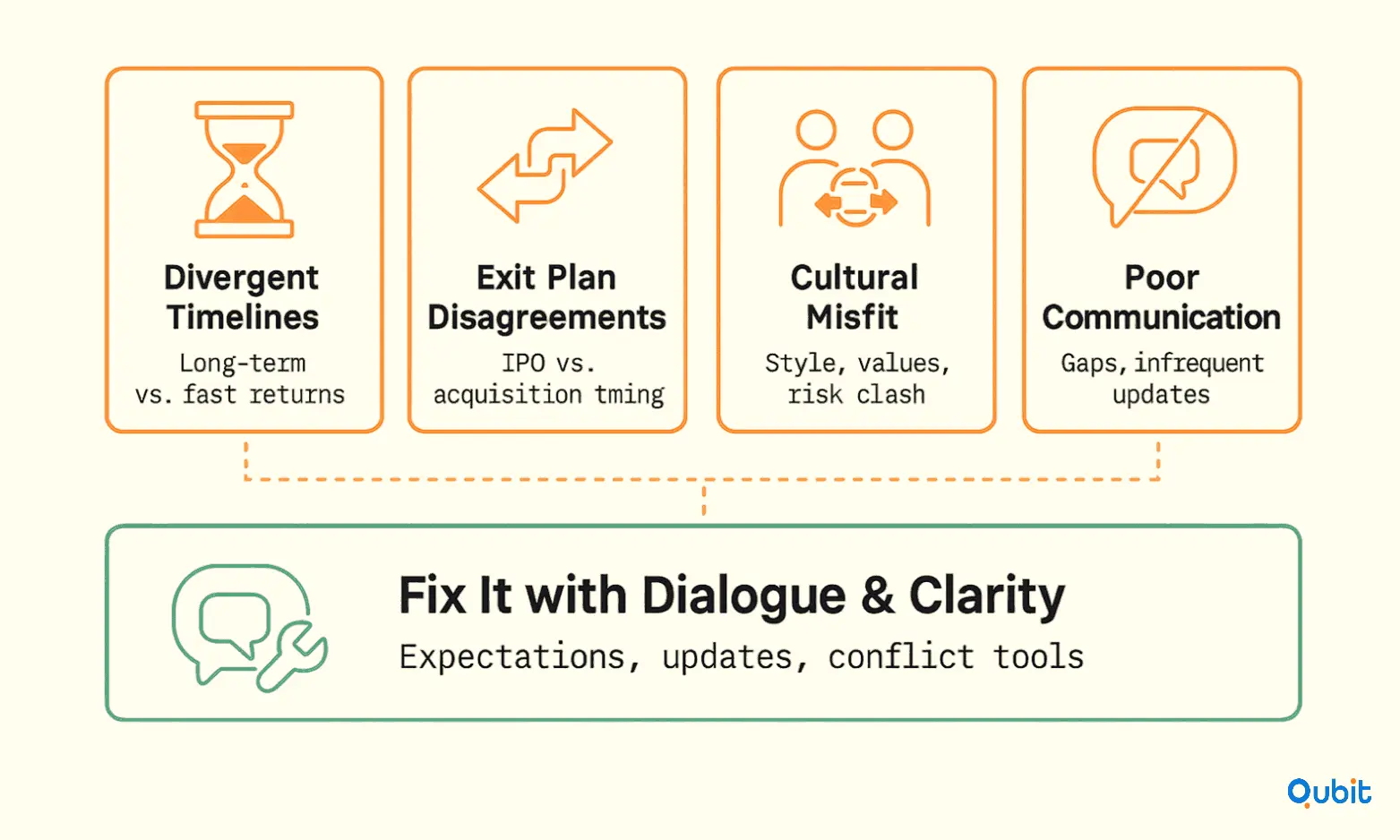
- Divergent Time Horizons: Founders may focus on long-term growth, while investors seek quicker exits, creating tensions around milestones and decision-making.
- Conflicting Exit Strategies: Disagreement on the eventual sale, IPO, or acquisition timing can stall progress or lead to disputes.
- Cultural and Value Misalignment: Differences in work style, risk tolerance, and vision can erode trust and complicate collaboration.
- Communication Gaps: Lack of transparent, frequent updates fosters misunderstandings and reduces responsiveness.
Proactively recognizing these challenges and establishing open channels for dialogue, expectation setting, and conflict resolution helps maintain alignment through changing circumstances.
Aligning Governance and Exit Expectations Early
Addressing governance structures, exit strategies, and board roles early in negotiations helps prevent misunderstandings between founders and investors. Clear agreements on these topics set expectations and reduce the likelihood of future disputes. Proactive alignment fosters trust and ensures both parties remain committed to shared objectives throughout the partnership. This approach is essential for navigating complex decisions and maintaining a healthy working relationship.
Learning from Alignment: Real-World Case Studies
Successful Alignment: Airbnb and Early Investors
Airbnb’s founders and early investors shared a long-term vision despite market skepticism, allowing patient capital to fuel relentless innovation. Frequent communication and mutual respect enabled strategic pivots, helping Airbnb scale globally while preserving founder autonomy.
Misalignment Pitfall: Theranos and Investor Fallout
Theranos’ downfall exemplifies severe misalignment where investors were not adequately informed about operational realities. Lack of transparency and conflicting priorities led to reputational damage, legal battles, and lost capital.
Sector-specific Alignment: Bevel and General Catalyst
Sector focus also influences investor fit. Bevel’s Series A round raised 10 million dollars for its AI health companion product. General Catalyst added both capital and hands-on strategic guidance, allowing Bevel to prioritize deep technical development without constant distraction. This partnership shows how aligned vision and mission-driven goals can create strong momentum in specialized sectors like health technology.
International Alignment: OCELL and Climate Tech Investors
Cross-border deals add another layer to alignment. OCELL’s Series A brought 10 million euros into a Munich-based climate tech startup. Both founders and investors committed to measurable climate impact, clear milestones, and transparent reporting. This shared stance enabled fast scaling with high accountability, showing how values alignment can be even more important in international venture ecosystems.
Alignment in Regulated Sectors: Vermeer and Draper Associates
Regulated industries put alignment under pressure. Vermeer’s Series A in defense technology totaled 10 million dollars and required close coordination with investors. Draper Associates led a strategic extension to support operational resilience over the long term. In high-stakes, regulated fields, the need for the right investor fit becomes sharper, because misalignment can slow growth, limit approvals, and increase risk.
Conclusion
Achieving investor startup fit is a dynamic process that hinges on three essential pillars: shared vision, clear communication, and strategic capital allocation. The actionable strategies and frameworks discussed in this blog provide a roadmap for cultivating these relationships effectively. Whether you're refining your pitch or seeking the right investor fit, these insights are designed to empower your decision-making process.
If you're ready to elevate your startup, our Investor Discovery and Mapping service offers tailored solutions to connect you with the ideal investors. Let us help you take the next step toward achieving your vision.
Key Takeaways
- Strong investor startup fit is essential for startup success.
- Investor types vary from minimal involvement in FFF to strategic support from accelerators and CVCs.
- Digital capital and early-stage funding structures play a pivotal role in shaping investor relationships.
- Clear communication, shared vision, and complementary skills are critical for long-term alignment.
- Utilize structured frameworks and actionable checklists to evaluate and secure the right investor fit.
Frequently asked Questions
Why is investor-startup alignment important for long-term growth?
Investor-startup alignment builds trust, reduces conflicts, and promotes shared vision. This foundation increases the likelihood of sustainable startup growth.