

 Back
Back









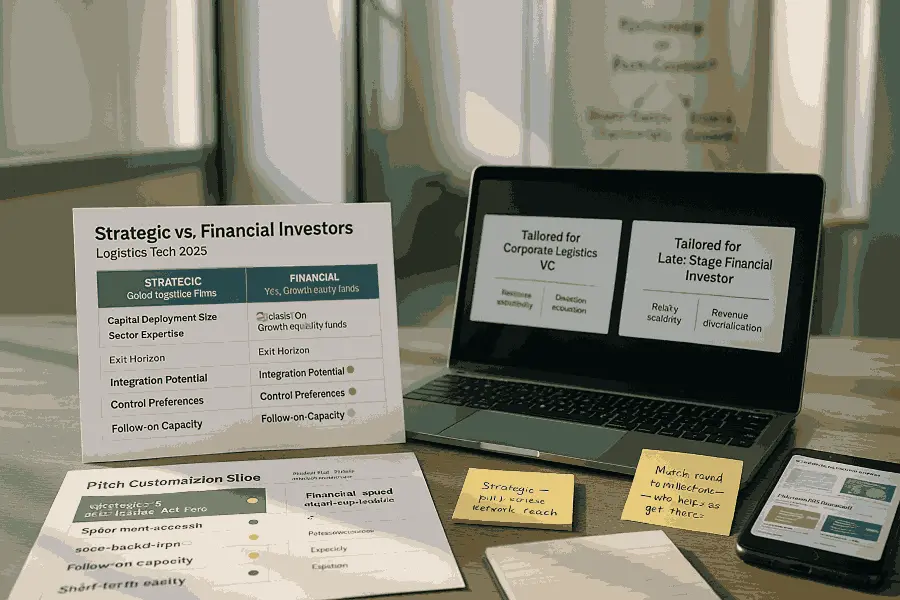
Table of Contents

The logistics technology sector is undergoing a fundamental shift. As supply chains face mounting pressure to deliver resilience and efficiency, digitization and automation have evolved from competitive advantages to operational necessities.
The numbers tell the story. The logistics market surpassed $535 billion in 2024, propelled by widespread adoption of digital and automated solutions. This scale represents both immense opportunity and intensifying competition for founders and investors pursuing operational leverage and sustained efficiency gains.
At the heart of these decisions lies a critical choice: strategic investors offer industry synergy and long-term alignment, while financial investors bring capital efficiency and exit flexibility.
This article is written for logistics tech startup founders, executives, and venture investors navigating funding decisions. Your selection should align with your growth trajectory, exit strategy, and appetite for partnership depth.
Understanding the Investor Dynamics in Logistics Technology
Strategic Investors: More Than Money
Who are they?
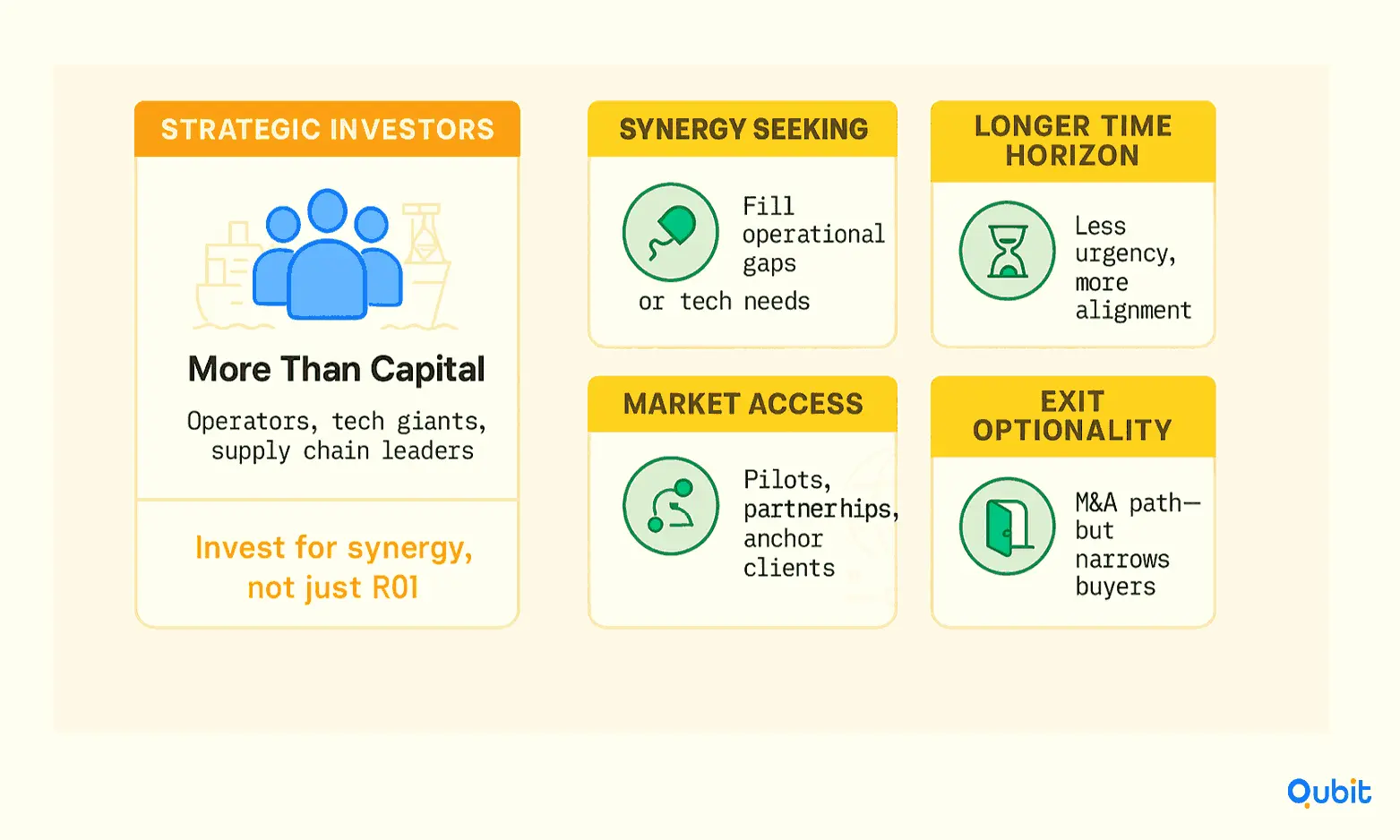
Strategic investors are typically operating companies, often established logistics players, supply chain service providers, tech giants, or infrastructure owners, with a vested interest in the sector. Their investment is about more than potential returns: it’s about synergy, market expansion, technology acquisition, or gaining a competitive edge.
Motivations and Value Add:
- Synergy Seeking: They look for startups that can augment their core business or bridge a gap, such as real-time visibility, automation, or new business models. Supply chain risk drives strategic urgency. In 2024, global supply chain disruptions cost $1.6 trillion, motivating established logisticians to seek integration, visibility, and resilience through technology alliances.
- Longer Time Horizon: Strategic investors may be more patient, valuing influence or eventual acquisition over a rapid financial exit.
- Partnerships and Market Access: They often open doors for commercial pilots, customer introductions, and co-development of products. For instance, a strategic investor might help a logistics SaaS company integrate with global shippers or win anchor clients.
- Higher Valuations Sometimes: They may pay a premium if the technology or team fills a critical gap in their own roadmap.
- Potential for Exit Alignment: Strategic investors may eventually acquire the startup, providing a clear exit but sometimes reducing the universe of future acquirers.
What Strategic Investors Value:
- Alignment with their tech roadmap or service gaps
- Opportunity for joint product development or market expansion
- A chance to pre-empt competition by investing early
Risks to Watch:
- Slower deal cycles due to internal bureaucracy
- Board or observer seat demands and greater influence on company direction
- Exclusivity clauses that can limit your go-to-market agility
What Do Financial Investors Bring?
Financial investors, venture capital firms, growth equity funds, and private equity—operate with a clear mandate: maximize returns within a defined investment horizon, typically 5–7 years. Unlike strategics tied to a single corporate buyer, financial investors preserve broad exit optionality, keeping IPOs, competitive M&A processes, and secondary sales all in play.
Primary Motives: Risk-adjusted financial returns through multiple exit pathways: public offerings, strategic acquisitions by the highest bidder, or secondary transactions to other financial sponsors.
Key Value-Adds
1. Capital efficiency and fundraising momentum
Financial investors bring speed and certainty to fundraising processes. They offer cleaner term sheets with fewer strategic encumbrances and provide access to extensive co-investor networks for syndication—critical when your next round requires $50M+ and multiple lead candidates.
2. Operational architecture for scale
Beyond capital, top-tier financial investors deploy dedicated operating partners and portfolio support teams. They assist with executive recruitment, refine go-to-market strategies, implement financial controls, and build governance frameworks that prepare companies for institutional scrutiny—whether from public market investors or acquirers running deep diligence.
3. Board expertise and pattern recognition
Financial investors typically sit on dozens of boards across their portfolios. This gives founders access to playbooks refined across multiple scaling journeys: how to navigate margin compression during geographic expansion, when to prioritize profitability over growth, and how to position for strategic exit conversations without appearing desperate.
4. Flexibility to pivot
Without allegiance to a specific corporate parent, financial investors support strategic pivots when market conditions shift. If your original thesis targets last-mile delivery but opportunities emerge in warehouse automation, a financial backer won't block the pivot to protect an adjacent business line.
5. Network effects beyond capital
Leading financial investors connect portfolio companies with enterprise customers, technical talent, and other founders solving adjacent problems. These networks often prove more valuable than the capital itself, particularly for logistics startups navigating complex enterprise sales cycles or technical integrations.
What Investors Actually Do Post-Investment
Strategic Investors
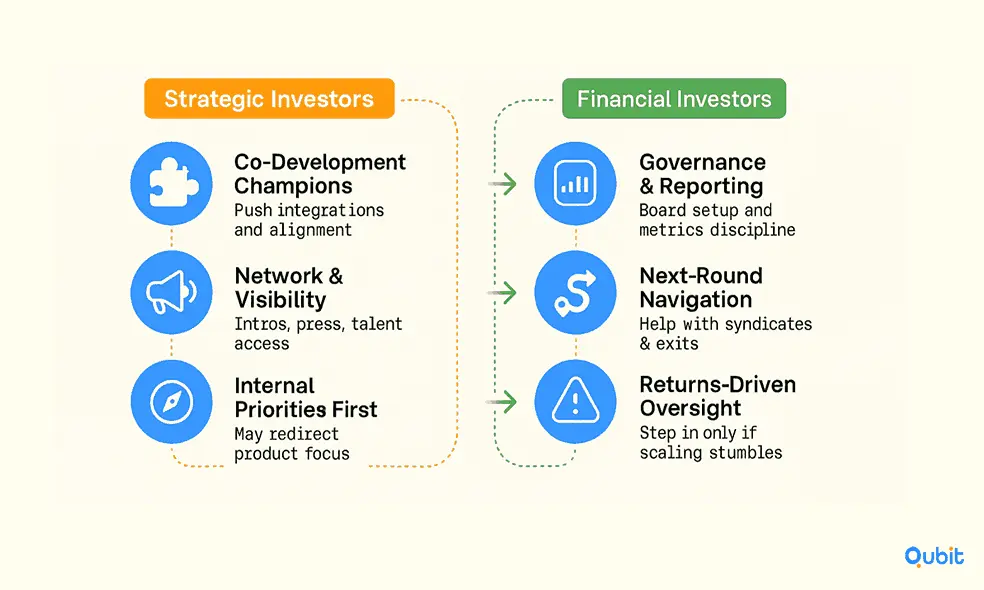
- Champion integration and co-development projects.
- Offer introductions, PR muscle, and talent referrals—but may slow decision cycles.
- Sometimes push for product changes to support internal priorities.
Assessing Cultural Fit and Integration Readiness
This hands-on involvement from strategic investors requires founders to carefully assess cultural compatibility and integration readiness before closing a deal. Misalignment in values, decision-making pace, or operational expectations can lead to friction and undermine the intended synergies. Founders should evaluate whether their team can adapt to the strategic’s processes and whether both sides share a vision for collaboration. Addressing these factors early helps ensure smoother integration and maximizes the value of the partnership.
Financial Investors
- Bring professional boards, discipline in reporting, and assist in future fundraises.
- Connect you to experienced operators, new syndicate partners, and exit pathways.
- Usually less hands-on about product, unless scaling issues threaten returns.
Case Examples: How the Choice Plays Out
Scenario 1:
A mid-stage fleet analytics startup with growing contracts from smaller regional shippers gets both a term sheet from a sector-focused VC and an offer from a global 3PL with interests across multiple continents. The strategic can guarantee recurring pilots and immediate access to a wider customer set, but also asks for a right of first refusal if the company gets an acquisition offer.
The VC, on the other hand, moves fast and proposes a slightly lower valuation but leaves strategic doors open for follow-on investment in logistics and fleet tech startups.
Scenario 2:
A late-series logistics SaaS player, targeting global expansion, closes a mixed round: a top-tier VC leads (ensuring fundraising strength and future capital for global sales ops), while a strategic (major Asian freight leader) joins for regional partnership and data integration.
The result is access to faster product-market fit in new markets, but with term sheet language preventing exclusivity that could block wider partnerships in mobility funding.
Strategic vs Financial: Side-by-Side Decision Table
Here’s a detailed look at how strategic and financial investors line up across the factors that most impact founders:
Choosing the Right Path: Factors to Consider
1. What is your growth bottleneck?
If commercial adoption via big channel partners is essential, a strategic may accelerate your timetable. If global expansion, network effects, or blitzscaling are top of mind, consider financial investors. Their experience and syndicate potential may serve you better when choosing mobility-focused investors.
2. What is your likely exit?
Are you building toward acquisition by an industry incumbent within 3–5 years? Or do you want to preserve optionality for an IPO or broader M&A process? This decision matters early, exclusivity provisions or strategic board composition can narrow your buyer pool or complicate future funding rounds.
3. Who can help you cross regulatory or technical hurdles?
In logistics, market entry often hinges on integration complexity, security certifications, and regulatory approvals. A strategic partner with established compliance frameworks and trusted relationships can accelerate pilot programs and regulatory clearances that might otherwise stall your go-to-market.
4. How much independence are you willing to trade off?
Be realistic about what you're willing to negotiate: board composition, product roadmap autonomy, and freedom to partner with competitors. With strategic investors, ambiguous terms early on can create fundraising blockers later, especially critical for capital-intensive logistics and fleet operations requiring multiple financing rounds. These trade-offs often surface when structuring rounds for high-capex logistics and fleet companies raising capital-heavy rounds.
Tailoring Your Pitch for Investor Priorities
Building on these decision factors, founders should tailor their presentations and key metrics to align with the priorities of their target investors. For strategic investors, emphasize potential synergies, integration opportunities, and long-term market impact. For financial investors, focus on scalable growth, operational efficiency, and clear exit pathways. This targeted approach increases credibility and helps secure more favorable investment terms.
When to Mix: Hybrid Rounds and Best Practices
Leading logistics tech startups now often manage hybrid rounds: letting a VC lead and negotiate board/terms while inviting strategic corporates in for minority stakes, commercial pilots, or “observer” roles. This maximizes capital, learning, and business development, while hedging against dependence on any one partner
Hybrid rounds thrive as corporate VC participation surges. In 2024, global CVC-backed funding increased 20%, reaching $65.9 billion. This influx denotes growing strategic and financial collaboration in tech and logistics investments.
Best Practices for Mixed Syndicates:
- Avoid exclusivity or lock-ins except for explicit, well-compensated partnerships.
- Set clear veto and governance rights.
- Make sure strategic investors can’t block follow-on rounds, new partners, or changes in exit horizon without consensus.
Red Flags (and How to Avoid Them)
- Exclusivity or Right of First Refusal: Only worthwhile if properly compensated and fits your exit goals, avoid unless the commercial upside is clear.
- Over-promises from Strategic Investors: Ensure pilots, integrations, or anchor contracts are linked to investment milestones in writing.
- Financial Investor Churn: Keep a close eye on syndicate alignment as you set up later rounds, fast money can also be fast to push for a sale if sector conditions shift.
- Governance Confusion: Clarify board roles and rights at each funding event to prevent later disputes about scope, strategy, and control.
Conclusion
The choice between strategic and financial investors is a crossroad, one that shapes not just your valuation, but your freedom to operate, access to markets, and eventual exit landscape. For most logistics tech startups, the decision is less about either-or, and more about smart sequencing and a nuanced understanding of each investor’s value-add and risk.
As logistics becomes more digitized, integrated, and regulated, expect the smartest founders to run hybrid fundraising strategies, dialing up strategic partnerships and customer-centricity as proof points, while keeping enough capital flexibility to scale beyond any single corporate’s horizon.
Leverage the detailed frameworks, case histories, and investor mapping linked above to build your most fundable, resilient capital stack, one ready for today’s competition and tomorrow’s industry consolidation. Explore our Investor Outreach service today
Key Takeaways
- Strategic investors care about synergy and may offer faster commercial scale, but often move slower and may request exclusivity or board rights
- Financial investors optimize for scale and exit potential, move faster, and generally enable more independence
- Founders should consider growth bottlenecks, likely exit paths, and their appetite for independence vs. alignment before deciding.
- Hybrid rounds, in which financials lead and strategics follow-on, may provide balanced value if structured carefully
- Being proactive about deal structure, clarity of roles, and governance rights is key to avoiding pitfalls in later stages
Frequently asked Questions
What are the main differences between strategic and financial investors in logistics tech?
Strategic investors focus on synergy, partnerships, and tech access, while financial investors prioritize scalable returns and exit potential in logistics technology.