

 Back
Back









Table of Contents

D2C commerce is experiencing historic expansion. By 2025, global D2C eCommerce revenue was projected to reach $226.93 billion, up from $169.39 billion in 2023. This rapid trajectory highlights sector-wide disruption. Founders must pursue capital strategies that scale with consumer demand and competitive intensity.
As traditional retail channels face disruption and consumer preferences shift toward authentic, personalized brand experiences, D2C companies are positioned to capture unprecedented market share. However, this growth trajectory demands strategic capital deployment that goes beyond traditional startup funding approaches.
This comprehensive guide examines the full spectrum of growth equity options available to D2C brands, providing founders with the strategic framework needed to select optimal financing approaches for their expansion goals.
Understanding D2C Growth Equity
Growth equity represents a distinct financing category positioned between venture capital and traditional private equity, specifically designed for companies that have moved beyond startup validation but haven't yet achieved full market maturity. For D2C brands, this translates to businesses with established customer bases, proven product-market fit, and clear expansion opportunities requiring significant capital deployment.
For most D2C brands, revenue-based financing fits early scaling while growth equity is suited for mature expansion.
Key Characteristics:
- Revenue Requirements: Typically $5-50 million annual revenue
- Investment Size: $2-50 million funding rounds
- Equity Stakes: 10-40% ownership, often minority positions
- Growth Focus: Scaling existing successful operations rather than proving concepts
- Timeline: 3-7 year investment horizons with clear exit strategies
Why D2C Brands Choose Growth Equity
- Operational Control: Growth equity investors typically take minority stakes (owning less than half the company), unlike traditional private equity. Founders maintain control while accessing capital and expertise.
Brand Equity as a Growth Equity Magnet
In addition to operational control, building strong brand equity is vital for D2C success. Consistent brand identity, compelling storytelling campaigns, and personalized customer experiences foster loyalty and increase company valuation. Growth equity investors prioritize brands with high engagement and advocacy, as these attributes signal long-term sustainability. Investing in brand equity enhances both consumer trust and strategic appeal to potential partners.
- Scaling Expertise: Growth equity firms bring specialized knowledge in areas critical to D2C success: supply chain optimization, digital marketing scaling, international expansion, and operational efficiency.
Supply Chain Agility for D2C Expansion
Beyond scaling expertise, supply chain agility is essential for D2C brands seeking sustainable growth. Diversifying sourcing and optimizing freight operations help mitigate risks from tariffs and disruptions. These strategies enable brands to maintain inventory flow and adapt quickly to changing market conditions. Growth equity investors value operational resilience, making supply chain agility a key factor in investment decisions.
- Network Effects: Established growth equity firms provide access to retail partners, distribution channels, and strategic relationships that accelerate expansion beyond what organic growth could achieve.
Omni-Channel Strategy for D2C Growth
Building on network effects, an omni-channel sales strategy enables D2C brands to reach consumers across multiple touchpoints. This approach combines owned ecommerce sites, marketplaces, and select retail partnerships to maximize brand exposure and conversion opportunities. Investors favor brands with diversified channel presence, as it reduces risk and supports scalable growth. Adopting omni-channel strategies strengthens market positioning and increases the likelihood of attracting growth equity capital.
The growth math for D2C and marketplace startups shifts quickly once operational complexity kicks in, something this take on scaling capital for marketplaces & d2c brands spells out with clarity.
The impact of growth equity becomes clear with leading D2C performers. Feastables generated approximately $250 million in sales in its most recently reported year. Their success underscores how strategic capital and scalable operations drive market leadership for emerging consumer brands.
Startups like yours already closed their rounds with us.
Founders across every stage and industry. Here's what it took.
- Raised $7.6M for Swiipr Technologies
- Raised $0.5M for Ap Tack
- Raised €0.5M for Ivent Pro

Types of Growth Equity Options for D2C Expansion
Regional growth is driving new capital innovation. In Southeast Asia, D2C funding reached US$32.5 million in 2024, marking a 208% jump from US$10.6 million in 2023. This surge illustrates the need for flexible growth equity options. D2C growth equity options vary based on financing type, investment size, and equity impact.
| Financing Type | Investment Size | Equity Impact | Best Suited For | Key Benefits | Primary Drawbacks |
|---|---|---|---|---|---|
| Revenue-Based Financing | $500K – $5M | No dilution | Predictable revenue streams | Fast approval, founder control | Higher cost of capital |
| Growth VC | $5M – $50M | 15–30% dilution | Rapid scaling needs | Large capital access, expertise | Board control, pressure |
| Private Credit | $1M – $20M | No dilution | Asset-heavy businesses | Lower cost than equity | Collateral requirements |
| Strategic Corporate Investment | $2M – $100M | 10–25% dilution | Complementary partnerships | Market access, synergies | Strategic limitations |
| Hybrid Structures | $1M – $25M | Variable | Complex expansion plans | Flexibility, staged approach | Structural complexity |
- Revenue-Based Financing: Fast, no dilution, high costs.
- Growth VC: Large capital, some dilution, expertise.
- Private Credit: Low cost, collateral needed.
- Strategic Investment: Partnerships, some dilution.
Revenue-Based Financing: The D2C Growth Catalyst
Revenue-Based Financing (RBF) has revolutionized D2C funding by aligning investor returns directly with business performance while preserving founder equity and control. This model has become particularly attractive as traditional VC funding has become more selective, with D2C brands raising $757 million through alternative financing in 2024.
Core Advantages for D2C Brands:
- Equity Preservation: No dilution of ownership stakes, allowing founders to maintain full control over strategic decisions and company direction
- Speed of Access: Approval processes typically take 2-7 days compared to 3-6 months for traditional equity financing, enabling rapid response to market opportunities
- Flexible Repayment: Payments fluctuate with revenue performance, providing natural cash flow protection during seasonal variations or market downturns
- No Collateral Requirements: Unlike traditional debt, RBF is secured by revenue streams rather than physical assets, making it accessible to asset-light D2C models
- Growth Alignment: Investors succeed only when businesses grow, creating natural alignment between capital providers and brand founders
Optimal Use Cases:
- Inventory Financing: Scaling product lines or seasonal inventory buildups without equity dilution
- Marketing Acceleration: Funding customer acquisition campaigns with predictable return profiles
- Geographic Expansion: Entering new markets with capital that scales based on regional performance
- Technology Infrastructure: Building e-commerce capabilities and operational systems that support growth
Financial Structure:
- Cost Range: 6-20% of monthly revenue for 12-36 months
- Total Payback: Typically 1.2-1.8x of principal amount
- Qualification: $100K+ monthly revenue with 6+ months operating history
- Approval Speed: 48-72 hours with minimal documentation requirements
Strategic capital planning looks very different ...when Customer Acquisition Cost (CAC), retention, and liquidity are pulling in opposite directions..., something the funding guide for consumer & marketplace startups breaks down with clear benchmarks.
Traditional Growth Venture Capital Strategy
- Market Validation and Traction DemonstrationD2C growth equity investors require substantial evidence of market success before investment consideration. D2C brands must demonstrate consistent monthly growth rates of 15-25%, strong customer retention metrics above 60%, and clear evidence of sustainable competitive advantages in their target markets.
- Funding conditions for D2C startups have dramatically shifted. Globally in 2024, seed-stage rounds surged 300% to $3 million, while late-stage rounds averaged $19.5 million. Such shifts require startups to showcase strong monthly growth and retention.
- Strategic Partnership and Expertise AccessBeyond capital, growth VCs provide access to specialized D2C expertise including supply chain optimization, international expansion strategies, and advanced marketing analytics. Portfolio companies benefit from shared learnings across multiple consumer brands and direct connections to retail partners and distribution channels.
Consumer product venture capital firms often support D2C brands with specialized expertise and growth capital.
- Scaling Infrastructure and OperationsGrowth capital enables significant investments in operational infrastructure including warehouse automation, customer service systems, and technology platforms that support multi-channel expansion. These investments typically require $5-15 million commitments that exceed most bootstrapped capabilities.
- Exit Strategy PreparationGrowth VC involvement signals market readiness for eventual exit opportunities through strategic acquisitions or public offerings. This positioning provides credibility with potential acquirers and creates structured pathways for founder liquidity and investor return.
- Board Governance and Professional ManagementGrowth investors typically require board representation and professional management practices including quarterly reporting, strategic planning processes, and operational metrics tracking. While this reduces founder autonomy, it provides valuable discipline and external perspective on strategic decisions.
From acquisition cost thresholds to retention curves, the investor’s guide to consumer & d2c startups breaks down what experienced investors actually look for.
Leading Consumer Growth Equity Firms for D2C Brands
Leading D2C-focused firms operate in a market with major economic impact. In 2025, established brands in the United States will generate about $187 billion in D2C e-commerce sales, while digitally native brands will reach $40 billion. This distinction shapes investment focus and scaling strategies.
Several leading consumer growth equity firms specialize in supporting D2C brands through various growth stages.
1. Forerunner Ventures
Specialized Early-to-Growth Stage D2C Investor
Investment Focus: Modern consumer brands and e-commerce platforms
Check Size: $500K – $15M across multiple rounds
Portfolio Highlights: These consumer growth equity firms have invested in brands like Warby Parker, Glossier, and Oura, providing deep expertise and strategic support.
Value Addition: Consumer behavior insights and brand building expertise
Geographic Focus: North America with selective international opportunities
CPG private equity investors like Felix Capital focus on disruptive consumer brands with high growth potential.
2. Felix Capital
European Growth Equity Specialist
Consumer retail private equity firms often target D2C brands expanding into new markets.
Investment Philosophy: Backing disruptive consumer brands with strong innovation focus
Investment Range: €1M – €20M for scaling European D2C companies
Expertise Areas: Brand positioning, international expansion, operational scaling
Portfolio Strength: Deep network of European retail and distribution partners
Differentiation: Combines growth capital with strategic advisory services
3. L Catterton
Consumer-Focused Growth Equity Leader
Market Position: World's largest consumer-dedicated private equity firm
Investment Size: $10M – $500M for established D2C brands
Strategic Value: Direct retail relationships and global expansion capabilities
Portfolio Companies: Multiple unicorn consumer brands across categories
Unique Advantage: LVMH backing provides luxury and premium brand expertise
4. Summit Partners
Growth Equity Pioneer
Investment Approach: Minority and majority growth investments in scalable D2C models
Funding Range: $10M – $500M with flexible structure options
Sector Expertise: E-commerce, healthcare, and technology-enabled consumer services
Geographic Reach: Global investment capabilities with local market expertise
Track Record: 25+ year history of successful consumer brand exits
Consumer private equity firms play a crucial role in supporting D2C brand expansion through capital and expertise.
For capital-efficient startups with real revenue, the appeal of venture debt solutions for consumer tech startups often lies in keeping control without slowing down.
Implementation Timeline for Growth Equity Preparation
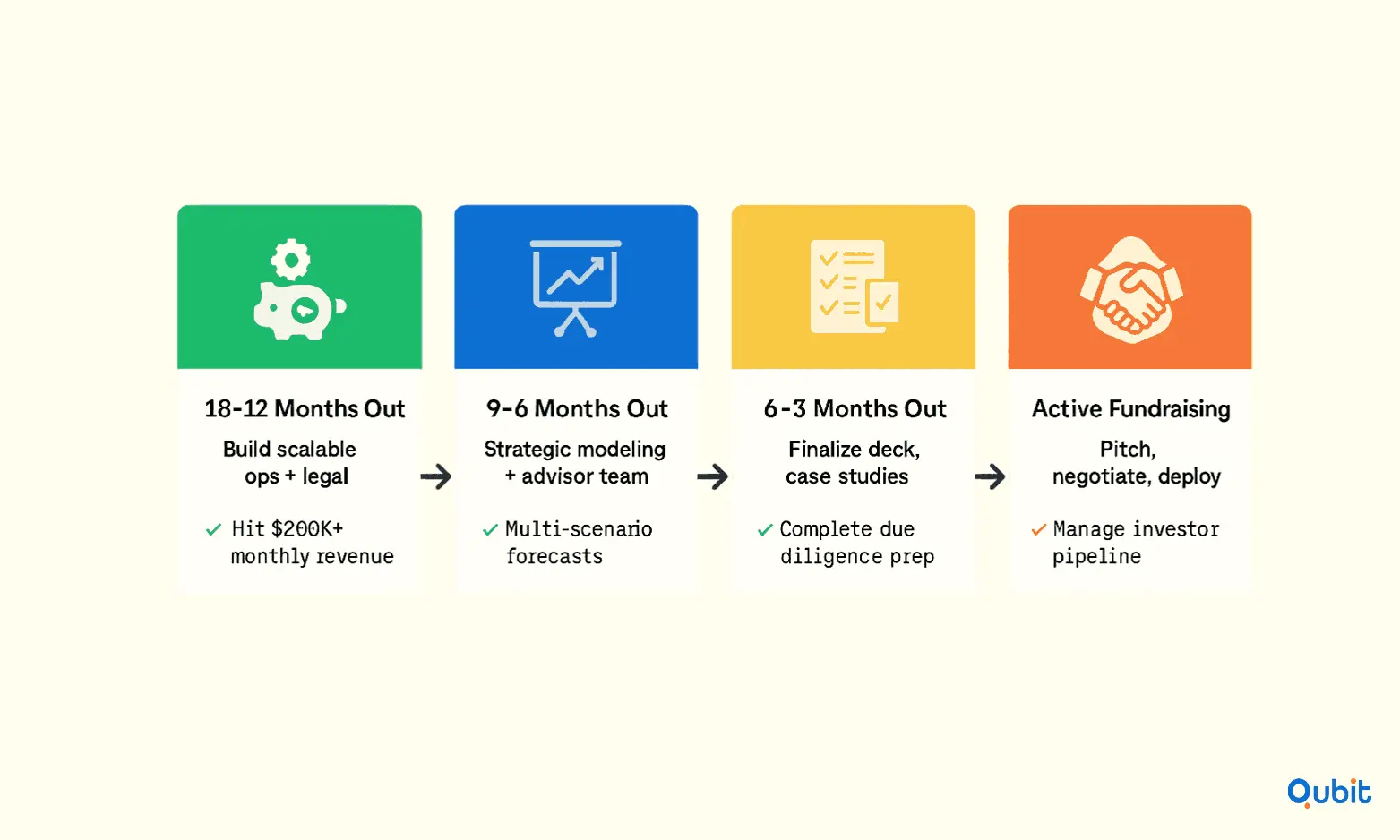
12-18 Months Before Fundraising
Foundation Building Phase:
- Achieve $200K+ monthly revenue consistency with predictable growth patterns
- Implement professional financial reporting and forecasting systems
- Build scalable operational infrastructure including inventory management and customer service
- Establish legal and compliance frameworks for institutional investor requirements
- Develop comprehensive competitive analysis and market positioning strategy
6-9 Months Before Fundraising
Strategic Preparation Phase:
- Complete detailed financial projections with multiple scenario planning
- Engage experienced CFO or financial advisor with growth equity experience
- Build comprehensive data room with operational metrics and growth analytics
- Develop strategic expansion plan with clear capital deployment roadmap
- Begin relationship building with target investor firms through warm introductions
3-6 Months Before Fundraising
Active Preparation Phase:
- Finalize pitch materials including detailed growth strategy presentation
- Complete legal and financial due diligence preparation with professional advisors
- Secure customer references and case studies demonstrating scale potential
- Negotiate term sheet templates with legal counsel guidance
- Establish fundraising timeline with clear milestone targets and decision points
Liquidity, supply-side lock-in, and scalable ops: preparing for series a funding in marketplace startups isn’t just pitch polish, it’s proof of repeatability.
Active Fundraising Period
Execution Phase:
- Manage multiple investor relationships while maintaining operational performance
- Provide regular business updates demonstrating continued growth momentum
- Complete due diligence processes efficiently while protecting confidential information
- Negotiate optimal terms balancing capital needs with strategic flexibility
- Plan post-closing integration and capital deployment for immediate scaling initiatives
Common Challenges and Strategic Solutions
D2C sector complexity is reflected in deal activity. Over 1,700 transactions have closed, cumulatively valued at more than $3.5 trillion. This high volume underlines the operational and financial hurdles described below, demanding expert strategic solutions.
Challenge: Revenue Seasonality Impact on Financing Options
Many D2C brands experience significant seasonal revenue fluctuations that complicate growth equity evaluation and repayment structures. Toy companies see 60-70% of annual sales during Q4, while outdoor gear brands peak during spring and summer months.
Strategic Solution: Develop normalized revenue projections that account for seasonal patterns and build cash management systems that smooth operational cash flows. Structure financing arrangements with seasonal adjustment mechanisms that align payment schedules with cash generation cycles. Consider inventory financing specifically designed for seasonal businesses that provide capital during low seasons and collect during peak performance periods.
Challenge: Balancing Growth Investment with Profitability Requirements
Growth equity investors expect sustainable unit economics alongside rapid expansion, creating tension between short-term profitability and long-term market capture. Customer acquisition costs often increase during scaling phases while operational leverage may not yet offset higher marketing expenses.
Strategic Solution: Implement cohort-based financial analysis that demonstrates long-term customer value creation even during periods of increased acquisition spending. Build scenario models showing profitability timelines under different growth investment levels. Structure investor agreements with milestone-based capital deployment that ties additional funding to achievement of specific efficiency metrics rather than pure growth targets.
Challenge: Maintaining Brand Authenticity During Rapid Scaling
D2C brands often differentiate through authentic customer relationships and personalized experiences that become difficult to maintain during rapid expansion. Growth capital can enable scaling that dilutes brand values if not carefully managed.
Strategic Solution: Invest early in brand guidelines and customer experience standards that can scale across geographies and channels. Build technology systems that maintain personalization at scale through data analytics and automation. Structure expansion timelines that prioritize brand consistency over rapid market capture, ensuring adequate time for team training and system implementation in new markets.
Your Strategic Growth Equity Roadmap
D2C growth equity options provide the financial flexibility and strategic expertise needed for successful brand expansion. A robust D2C expansion strategy combines multiple financing approaches across different scaling phases.
Key strategic principles for D2C growth equity success include:
- Timing Precision: Enter growth equity markets when unit economics (profitability per customer or unit sold) are proven. Ensure operational systems can support 3-5x scaling without restructuring.
- Investor Alignment: Select growth partners who understand D2C business models and consumer brand dynamics rather than generalist investors applying traditional SaaS or technology metrics to consumer businesses.
- Operational Readiness: Build professional management systems, financial reporting capabilities, and scalable technology infrastructure before seeking institutional capital rather than using growth equity to fund basic operational development.
- Strategic Focus: Maintain clear expansion priorities and avoid the temptation to pursue multiple growth opportunities simultaneously just because capital is available. Successful D2C scaling requires focused execution over diversified experimentation.
Conclusion
D2C commerce is entering a decisive growth phase, driven by shifting consumer expectations, digital-first behavior, and scalable brand-led models. As the market expands rapidly, the real differentiator for founders will not be access to capital, but choosing the right type of capital at the right stage.
Growth equity offers a powerful middle ground, enabling D2C brands to scale operations, strengthen supply chains, and expand channels without sacrificing long-term control or brand integrity. However, success depends on preparation: proven unit economics, operational readiness, and clear expansion priorities.
For founders preparing to scale their D2C brands and select partners who share their vision for building enduring consumer brands, explore our Fundraising assistance service. Your shortcut to the right rooms!
Key Takeaways
- RBF provides $500K-$5M with no equity dilution and revenue-based repayment, ideal for D2C inventory and marketing scaling.
- Growth equity requires $5-50M revenue with proven unit economics and $100M+ market opportunities for institutional investment.
- Leading firms like Forerunner Ventures and L Catterton provide consumer expertise and retail partnerships beyond capital.
- Growth equity preparation requires 12-18 months building professional systems and operational infrastructure.
- Combining RBF for immediate needs with growth equity for major expansion maximizes flexibility and control.
Get your round closed. Not just pitched.
A structured fundraising process matched to your stage and investor fit.
- Fundraising narrative and structure that holds up
- Support from strategy through investor conversations
- Built around your stage, model, and timeline
Frequently asked Questions
What are the benefits of consumer growth equity for D2C startups?
Consumer growth equity funding provides D2C startups with expert support, strategic networks, and flexible capital to accelerate scaling without losing control.