

 Back
Back









Table of Contents

Government grants for health tech startups have become a cornerstone for innovation in healthcare, enabling entrepreneurs to transform ideas into impactful solutions. With consumer interest in mobile health solutions surging, evidenced by $401 million invested across 45 deals, these funding opportunities are more critical than ever. Startups can access capital without sacrificing equity, ensuring sustainable growth while addressing pressing healthcare challenges.
Recent years have seen landmark initiatives across North America. Digital Health Innovation Fund offers up to $25-million for Canadian startups through March 2027. This sustained commitment signals a strong international trend toward scalable government-backed support for digital health innovators.
This article will guide HealthTech startups through eligibility criteria, application processes, and comparisons with alternative funding sources. Let’s dive into the details!
HealthTech Government Grants: Top Opportunities
Securing funding is often a critical hurdle for HealthTech startups. HealthTech government grants provide a vital lifeline, bridging early-stage funding gaps and accelerating development.
U.S. federal agencies refresh funding priorities each year. The latest NIH funding opportunity aligns with new innovation areas, open until March 31, 2025. This cycle ensures focused support for startups advancing current health priorities.
HealthTech startups can apply for government grants like NIH SBIR/STTR, NSF SBIR, and EHR-related programs. These are open to early-stage companies addressing health innovation and offer up to $1M in funding.
This section explores specific government grants tailored to HealthTech entrepreneurs, detailing eligibility criteria, grant sizes, and actionable insights to maximize your chances of success. These healthtech government grants cover a wide spectrum, from early-stage innovation to advanced clinical solutions.
1. National Institutes of Health (NIH) SBIR & STTR Programs:
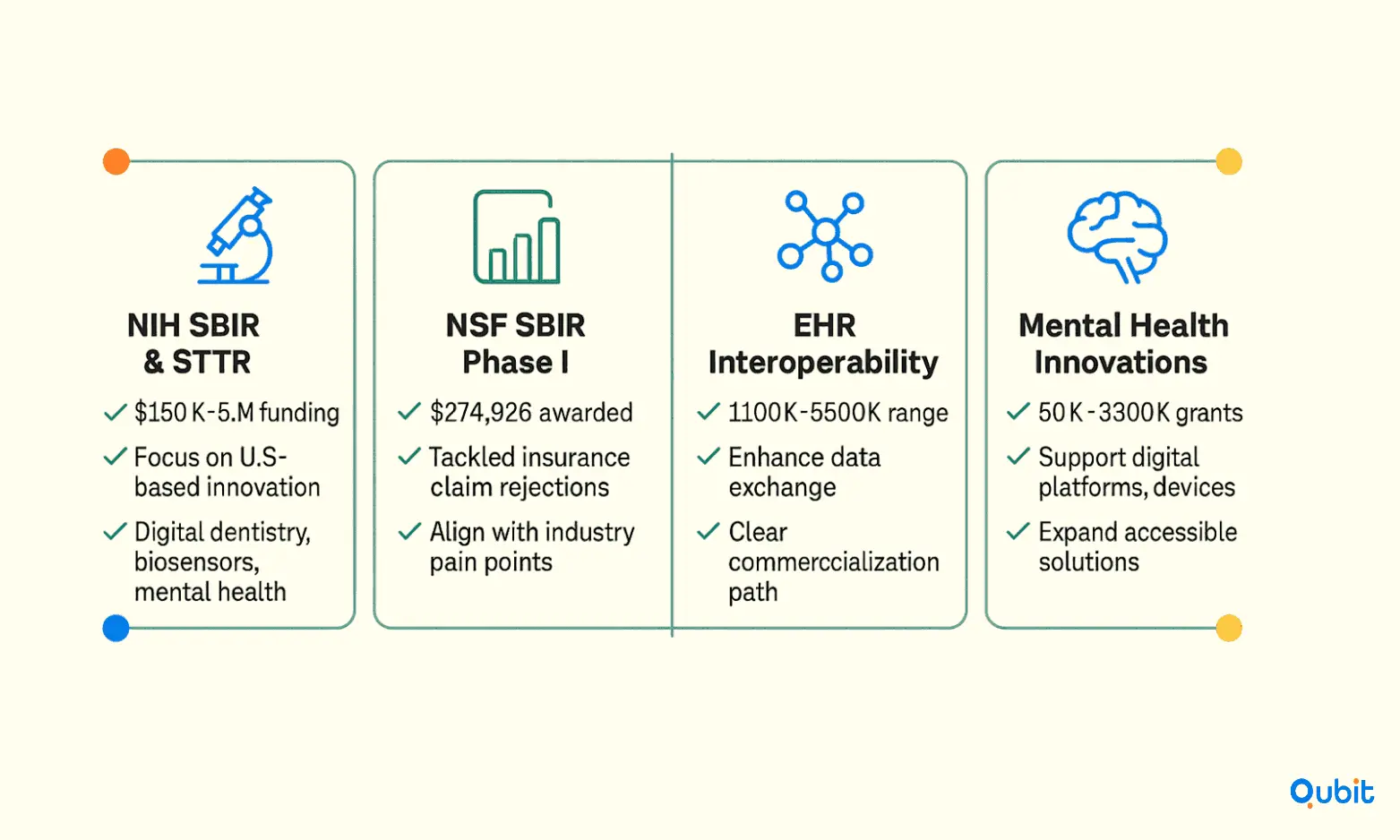
The NIH Small Business Innovation Research (SBIR) and Small Business Technology Transfer (STTR) programs are among the most prominent funding opportunities for HealthTech startups. These grants focus on fostering innovation in areas like digital dentistry, biosensors, and mental health technologies. Eligibility typically requires startups to be U.S.-based and majority-owned by individuals or small entities. Grant sizes range from $150,000 for Phase I to over $1 million for Phase II.
Some medical technology grants specifically support electronic health record grants for interoperability and data security.
For a deeper dive into NIH-specific grants, explore nih sbir sttr grants health startups, which provides clarity on criteria and processes that complement your application strategies.
2. NSF SBIR Phase I Grant: A Case Study
One standout example of how government grants can transform HealthTech startups is the Tampa-based company that secured a $274,926 NSF SBIR Phase I grant. This funding was used to address high insurance claim rejection rates through code-augmented policy implementation. Their success highlights the importance of aligning your innovation with pressing industry challenges.
3. Grants for EHR Interoperability
Electronic Health Record (EHR) interoperability remains a priority for healthcare innovation. Grants in this category often focus on improving data exchange between systems, enhancing patient care, and reducing administrative burdens. Startups working on solutions in this space can access funding ranging from $100,000 to $500,000, depending on the scope and impact of their projects.
One notable government-led example is Canada’s Digital Health Innovation Fund. This initiative commits up to $25-million through March 2027 to help digital health startups drive EHR interoperability and modernize healthcare delivery models. Its eligibility mirrors grant priorities in both scale and impact.
4. Funding for Wearable Biosensors
Wearable biosensors are revolutionizing patient monitoring and preventive care. Government grants targeting this niche often prioritize startups developing devices that integrate seamlessly with healthcare systems. Eligibility typically requires proof of concept and a clear commercialization pathway.
5. Mental Health Device Innovations
Mental health technologies, including wearable devices and digital platforms, are receiving increased attention from grant programs. These grants aim to address the growing demand for accessible mental health solutions, with funding amounts ranging from $50,000 to $300,000.
Staying Updated on New Opportunities
Keeping track of emerging funding opportunities is essential for pitch readiness. In 2024, digital health revenue reached US$13.49 billion. With projections suggesting US$53.92 billion by 2030, the opportunities for grant-funded innovation are larger than ever.
Actionable Insights for Success
- Tailor Your Application: Align your proposal with the grant’s objectives and demonstrate how your innovation addresses critical healthcare challenges.
- Leverage Case Studies: Use examples like the Tampa-based startup to showcase your potential impact and scalability.
- Stay Informed: Regularly monitor funding opportunities through platforms like Fundraise Insider to ensure you don’t miss out on relevant grants.
For a comprehensive framework that ties together various funding stages and strategies, check out how to secure funding for healthcare startups. This guide offers actionable steps to complement your grant-seeking strategy.
Startups like yours already closed their rounds with us.
Founders across every stage and industry. Here's what it took.
- Raised $7.6M for Swiipr Technologies
- Raised $0.5M for Ap Tack
- Raised €0.5M for Ivent Pro
Government Grants and Other Funding Sources for Healthcare Startups
Healthcare startups often require diverse funding streams, including government grants, to scale their operations and bring innovative solutions to market. Accelerators and incubators are important sources of health tech funding, complementing government grants.
These programs are designed to nurture early-stage companies by offering structured guidance, financial backing, and connections to potential investors. Unlike government grants, which often come with rigid application processes and specific eligibility criteria, private accelerators and incubators provide a more dynamic and tailored approach to startup development.
Key Players in the Space
Several prominent programs have established themselves as leaders in supporting healthcare startups:
- Rock Health: Known for its focus on digital health, Rock Health provides seed funding, mentorship, and access to a vast network of healthcare professionals and investors. Startups in this program benefit from a strong emphasis on innovation and scalability.
- Healthbox: This program combines funding with a robust mentorship framework, helping startups refine their business models and navigate the complexities of the healthcare industry. Healthbox also facilitates pilot opportunities with healthcare providers, enabling startups to test their solutions in real-world settings.
- Other Notable Programs: Programs such as Y Combinator and Plug and Play Tech Center also extend their resources to healthcare startups, offering a mix of funding, mentorship, and exposure to global markets.
Other Notable Support Mechanisms
- State-Level Grants and Subsidies:
- Many state governments are rolling out their own HealthTech grants, subsidies for diagnostics, and incentives for rural healthcare technology deployment.
- International Collaborations:
- Cross-border grants and partnerships with global agencies (e.g., WHO, Gates Foundation) are supplementing domestic funding for digital health, AI, and pandemic response.
For founders in Ontario, local programs also play a key role. The starter company grant offers up to $5,000 plus business training for health-tech entrepreneurs seeking first-stage funding and mentorship. Regional access ensures startups can scale from pilot to growth.
As of startups seeking structured mentorship and additional capital opportunities, a review of healthtech accelerator seed funding uncovers early-stage investment programs and mentorship opportunities, which enhances your understanding of innovative funding channels.
Comparing Private and Public Funding
Private funding sources like accelerators and incubators complement government grants by addressing gaps that public funding often cannot fill. While government grants for health tech startups typically focus on research and development, private programs emphasize commercialization and market readiness. This dual approach enables startups to progress from concept to execution more effectively.
Moreover, private programs often operate on shorter timelines, allowing startups to access resources and funding more quickly. This agility is particularly valuable in the fast-paced healthcare sector, where timely innovation can significantly impact patient outcomes.
Beyond Funding: The Value of Networks
One of the most significant advantages of private accelerators and incubators is the access they provide to extensive professional networks. These connections can lead to partnerships, pilot programs, and even additional funding opportunities. For instance, many accelerators host demo days where startups pitch their ideas to a room full of investors, healthcare executives, and industry leaders.
Additionally, exploring impact investing healthcare startups expands your perspective by exploring models where financial returns and social outcomes coalesce, enriching your funding review.
How Startups Can Access These Opportunities
To access healthtech government grants, monitor central and state government portals for calls for proposals, grant applications, and scheme updates.
Leveraging Official Portals for Secure Grant Applications
Building on the importance of monitoring government portals, startups should prioritize using official websites like Grants.gov for all grant applications. These platforms centralize opportunities, provide secure submission processes, and offer detailed eligibility criteria. Relying on recognized portals helps applicants avoid fraudulent schemes and ensures compliance with federal requirements. This approach streamlines grant discovery and enhances the security of sensitive business information.
- Monitor central and state government portals for calls for proposals, grant applications, and scheme updates.
- Partner with leading research institutions (IITs, AIIMS, ICMR) to leverage infrastructure and collaborative grant opportunities.
- Engage with industry associations to advocate for policy changes and stay informed about new incentives.
- Focus on priority areas like AI in healthcare, rural health access, mental health, and indigenous medical device manufacturing to align with government funding priorities.
- Prepare strong proposals that demonstrate innovation, scalability, and alignment with national health goals.
Steps for Submitting Successful Grant Applications
- Register your startup and create an account on official portals such as Grants.gov before beginning any application process.
- Review eligibility criteria and application instructions carefully to ensure your project aligns with specific grant requirements.
- Prepare all required documentation, including technical proposals, budgets, and compliance certifications, in advance of submission deadlines.
- Use portal tracking features to monitor application status and respond promptly to any requests for clarification or additional information.
- Participate in agency webinars or information sessions to clarify requirements and strengthen your application strategy.
If grants are not available for your specific project, consider alternative funding streams or seek feedback for reapplication.
Prepare strong proposals that demonstrate innovation, scalability, and a clear path to market. These steps can improve your chances of securing grants for healthcare startups.
Conclusion
Securing funding for HealthTech innovation, especially through healthtech government grants, is about strategically aligning with opportunities that drive growth. The insights shared here emphasize the importance of crafting a clear funding roadmap.
A clear healthcare startup funding roadmap is essential for long-term success. Whether you’re targeting public grants or private investments, taking actionable steps now can position your HealthTech venture for long-term success.
If you’re looking to de-risk your raise while protecting ownership, at Qubit we understand non-dilutive stacks, investor signals, and diligence readiness. Strengthen your round through our assistance for healthcare startups and connect with our team today.
Key Takeaways
- Government grants offer essential non-dilutive funding for HealthTech startups.
- Detailed eligibility criteria and real-world case studies provide actionable insights.
- The guide covers a broad spectrum of grant options, from EHR projects to wearable biosensors.
- Alternative funding sources such as accelerators can complement public grants.
Get your round closed. Not just pitched.
A structured fundraising process matched to your stage and investor fit.
- Fundraising narrative and structure that holds up
- Support from strategy through investor conversations
- Built around your stage, model, and timeline
Frequently asked Questions
How do health tech startups qualify for government grants?
Health tech startups qualify for government grants by meeting specific eligibility criteria and aligning projects with public health goals. Thorough proposals and innovation are key factors.