

 Back
Back









Table of Contents

Biotech companies are no longer treating the public markets as a distant milestone. They are planning for it early, deliberately, and with multiple paths in mind.
As of July 22, 82 biotech firms went public through IPOs, while 47 chose the SPAC route, according to Endpoints. Together, these listings raised $25.86 billion, underscoring how central public market strategies have become for life sciences companies.
IPOs and SPACs each offer distinct advantages, timelines, and risks. Choosing the right path requires more than market timing. It demands operational readiness, regulatory discipline, and a clear long-term narrative that resonates with public investors.
This guide breaks down what biotech companies need to prepare for IPOs and SPACs, with practical insights to help founders and executives enter the public markets with confidence and control.
Strategic Biotech IPO Preparation and Transformation
Preparing for an IPO or SPAC is not just a financing event. It is a full organizational transformation. Biotech firms must strengthen financial reporting, governance frameworks, and digital infrastructure well before entering the public markets. The right path, IPO or SPAC, depends on operational maturity, clinical progress, and how well the company’s story aligns with current market demand.
This stage is especially critical for biotech executives, finance leaders, and legal teams responsible for navigating regulatory scrutiny and long-term accountability.
An IPO in a healthcare organization marks the shift from a private, innovation-driven company to a publicly traded entity operating under constant market evaluation. That transition brings access to capital, but also sustained pressure around transparency, execution, and performance.
Recent data shows why preparation matters. Biotech companies that went public in 2024 are down roughly 50% from their deal price on average. The takeaway is blunt. Public markets reward readiness, not ambition alone.
Strong strategic planning, operational discipline, and realistic market positioning are what separate successful biotech listings from costly missteps.
The Value of Multidisciplinary Deal Teams
This transformation requires biotech firms to assemble multidisciplinary deal teams early in the IPO process. Involving legal counsel, investment bankers, auditors, and investor relations specialists ensures comprehensive oversight and expertise. Such collaboration helps manage regulatory demands, market positioning, and investor communications. Coordinated teams streamline the IPO journey and reduce risks associated with public market entry.
Biotech firms may pursue several IPO transformation paths. Each should be tailored to unique operational and market needs.
Choosing the Right Public Market
Selecting the appropriate public market significantly influences a biotech company’s IPO success. Markets like Nasdaq may offer higher valuation potential and greater liquidity, while Euronext or dual listings can provide broader investor access and cost efficiencies. Careful market selection aligns company goals with investor expectations and long-term growth opportunities.
IPO Strategy Steps
- Financial assessment
- Governance planning
- Digital upgrades
Some may opt for a traditional IPO route, focusing on building investor confidence through robust financial disclosures and a compelling growth narrative.
Recent biotech IPOs demonstrate the importance of investor confidence and robust financial disclosures. Others might explore reverse mergers, where a private company merges with an existing public company to access public markets, or SPACs as alternative strategies.
Evaluating operational readiness is critical before selecting a transformation strategy. Companies must assess their financial systems, compliance frameworks, and scalability to meet the demands of public markets. This includes ensuring transparent reporting mechanisms, robust governance structures, and the ability to sustain growth post-IPO.
Choosing the right strategy hinges on aligning the company’s strengths with market opportunities. A biotech firm with groundbreaking research may prioritize showcasing its innovation pipeline, while one with established revenue streams might focus on financial stability.
Startups like yours already closed their rounds with us.
Founders across every stage and industry. Here's what it took.
- Raised $7.6M for Swiipr Technologies
- Raised $0.5M for Ap Tack
- Raised €0.5M for Ivent Pro

What Should a Biotech IPO Checklist Cover?
A comprehensive IPO preparation checklist is essential for biotech companies to meet stringent financial reporting standards.
Preparing for an IPO demands a meticulous approach to financial reporting, especially for biotech companies aiming to meet stringent compliance standards. Robust systems are essential to ensure accuracy, transparency, and alignment with regulations such as ASC 606 (Revenue Recognition) and ASC 842 (Lease Accounting).
Market trends reinforce the essential role of clinical development in IPO readiness. In 2023, all biotech IPOs featured clinical-stage assets, with nearly a third of these already in Phase III. This underscores investor focus on late-stage validation and robust data.
Conducting an Internal Assessment
- Conduct thorough financial audits to validate historical data and ensure compliance with public company standards.
- Clarify the capitalization table by resolving outstanding equity issues and documenting all share classes accurately.
- Refine investor messaging to communicate the company’s value proposition clearly and address potential investor questions.
A thorough internal assessment is the cornerstone of IPO readiness. This process identifies gaps in current reporting practices and simulates the operational demands of a public entity. Key areas to evaluate include:
- Revenue Recognition Compliance: Ensure adherence to ASC 606 by reviewing contracts, revenue streams, and performance obligations.
- Lease Accounting Standards: Validate compliance with ASC 842 by assessing lease agreements and their financial impact.
- Data Integrity: Confirm the accuracy and completeness of financial data across all systems.
- Audit Preparedness: Evaluate the readiness of financial statements for external audits, ensuring they meet public company standards.
- System Scalability: Assess whether existing systems can handle the increased complexity and volume of reporting required for a public entity.
How Do You Align Talent for IPO Success?
Successful biotech IPO preparation demands more than financial readiness; it requires aligning talent and governance structures for public company operations.
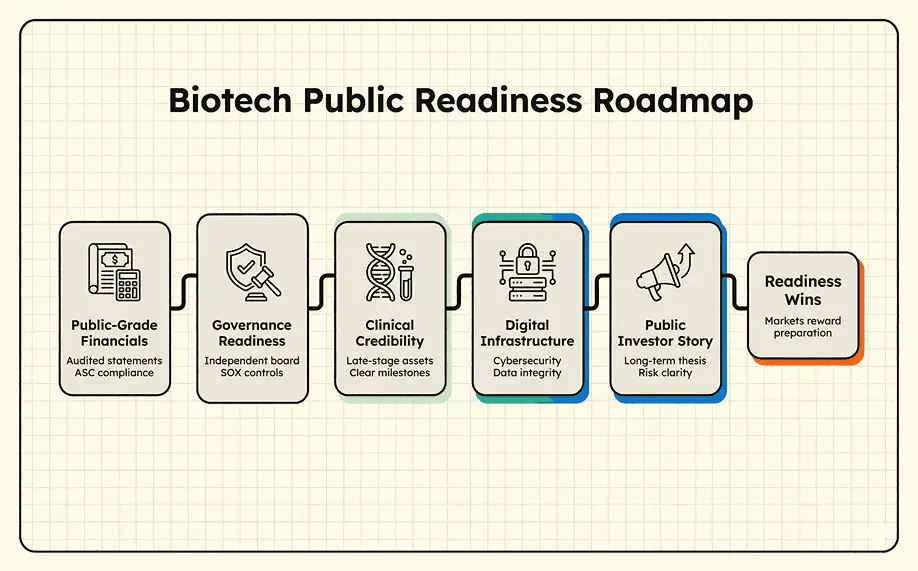
Building Leadership for IPO Readiness
Experienced leadership is the cornerstone of a successful IPO. Evaluating your executive team’s ability to navigate the complexities of public markets is essential. This includes assessing their track record in strategic decision-making, financial management, and stakeholder communication. Companies should prioritize leaders who can adapt to the demands of increased transparency and accountability.
Recent trends show a market openness to emerging management teams. Between 2018 and 2023, about 40 percent of new assets were launched by companies with little commercialization experience, nearly doubling their contribution over the previous five years. This positions innovative leadership as increasingly viable in the sector.
Strengthening Governance Structures
Robust governance frameworks are non-negotiable for public companies. Implementing systems that adhere to Sarbanes-Oxley (SOX) compliance is critical for maintaining investor confidence. SOX compliance ensures accurate financial reporting and mitigates risks associated with corporate misconduct. Establishing an independent board with diverse expertise further enhances governance, providing oversight and strategic guidance during the IPO process.
Actionable Steps for IPO Success
- Conduct Leadership Evaluations: Regularly assess the capabilities of your executive team to ensure alignment with public company expectations.
- Implement SOX Compliance: Develop internal controls and audit processes to meet SOX requirements.
- Form an Independent Board: Assemble a board with varied expertise to strengthen governance and decision-making.
For companies exploring alternative financing strategies during their IPO journey, a focused discussion on biotech venture debt royalty financing reveals complementary options to traditional capital approaches.
How to Plan for Growth After a Biotech IPO?
Post-IPO sustainability depends on the broader investment climate. Globally, biotech investments are projected to reach $546 billion, fueling unprecedented opportunities for emerging firms. This environment supports ambitious scaling and innovation strategies.
Long-term success after biotech IPO preparation requires scaling operations, safeguarding intellectual property, and navigating complex tax landscapes.
Companies must prioritize operational scaling. Assess infrastructure, workforce capabilities, and funding channels to meet market demands.
Protecting intellectual property (IP) is equally critical. As public companies attract heightened scrutiny, securing patents, trademarks, and proprietary technologies becomes a cornerstone of maintaining competitive advantage. Comprehensive assessments of IP security should be conducted regularly to mitigate risks and ensure compliance with evolving regulations.
Tax strategies also play a pivotal role in post-IPO growth. Understanding domestic and international tax implications in biotech IPOs is essential for optimizing financial outcomes. Companies expanding globally must account for varying tax codes, transfer pricing regulations, and potential tax treaties to avoid costly penalties.
Before pursuing a public listing, companies should ensure their earlier-stage capital strategy is sound. Understanding how to secure funding for biotech startups can strengthen the financial foundation needed for post-IPO growth.
Digital Transformation Readiness for Biotech Firms
Preparing for an IPO demands more than financial readiness, it requires a robust digital foundation. For biotech firms, integrating modern digital tools and cybersecurity systems is essential to meet the expectations of both investors and regulators. Upgrading IT infrastructure ensures seamless operations, while compliance with frameworks like GDPR and HIPAA safeguards sensitive data and builds trust.
Digital transformation commands major investment in therapeutics platforms. In Q4 2024, $26.0 billion was invested in therapeutics and discovery platforms across 416 funding rounds. This scale demonstrates how essential technology adoption is for competitive presence in public markets.
Digital transformation in biotech is not just about adopting new technologies; it’s about creating a secure and scalable environment that supports innovation. For example, implementing advanced cybersecurity measures can protect proprietary research and intellectual property from cyber threats.
Moreover, aligning IT systems with regulatory requirements ensures that firms can handle audits and maintain transparency, which are critical for IPO readiness. Investors are increasingly scrutinizing the technological capabilities of biotech companies, making digital transformation a key factor in securing funding and achieving operational excellence.
What Is SPACs in the Biotech Sector?
Biotech SPACs and biotech SPAC deals have emerged as transformative tools for firms seeking rapid entry into public markets. SPACs have also influenced IPOs healthcare and medical sectors, offering distinct advantages over traditional IPOs.
SPACs vs Reverse Mergers vs IPOs: Which Fits?
Both biotech and pharma companies must carefully choose the right pathway to go public. Comparing biotech and pharma IPOs helps companies understand which pathway best fits their needs.
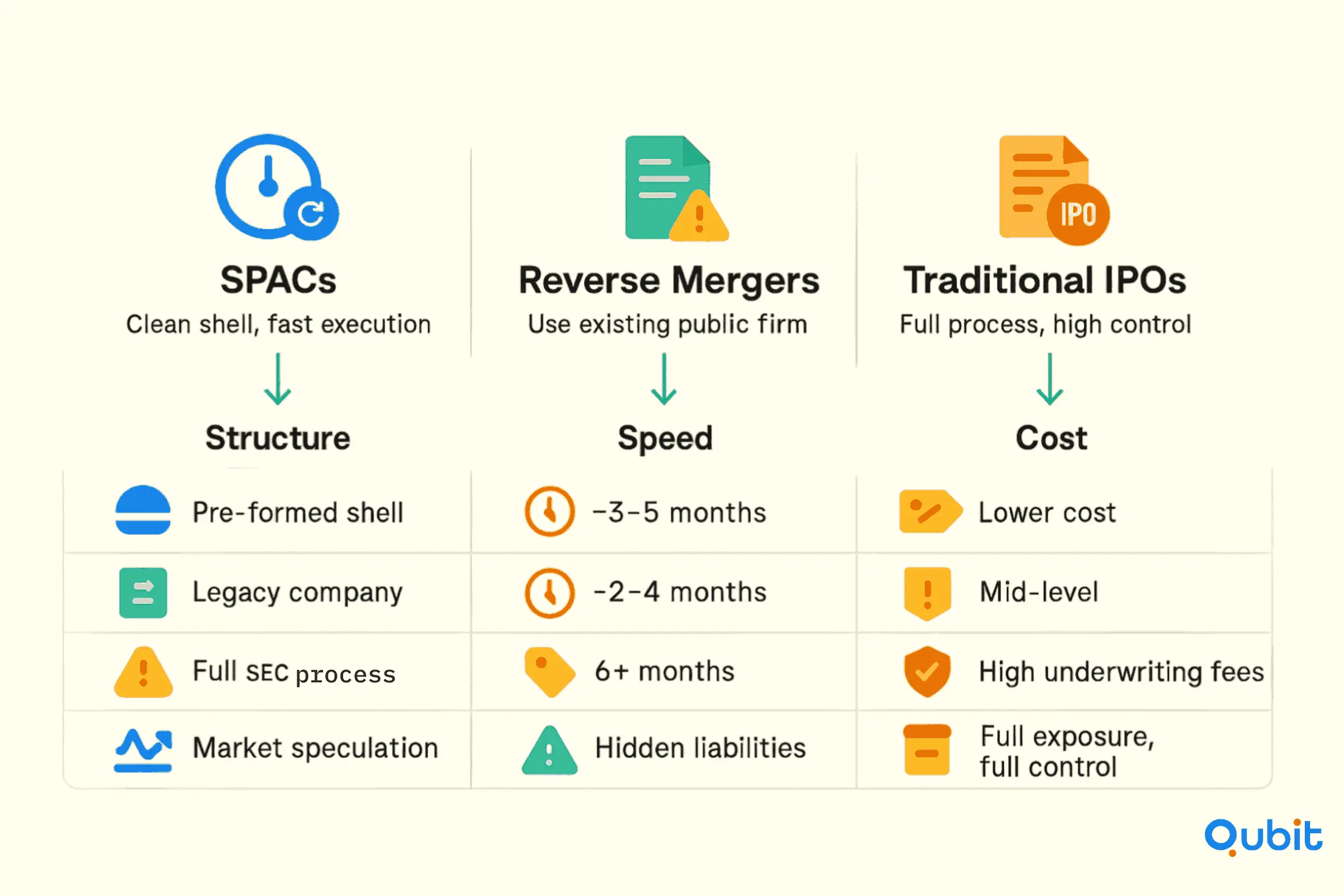
Structural Differences
SPACs (Special Purpose Acquisition Companies) are pre-existing entities created solely to merge with a target company, offering a clean shell with minimal legacy liabilities. In contrast, reverse mergers involve merging with an existing public company, which may carry historical liabilities or operational baggage. Traditional IPOs, on the other hand, require a company to go public independently, often involving extensive regulatory filings and underwriting processes.
Timelines and Costs
SPAC transactions typically outpace traditional IPOs in terms of speed, often completing within a few months. This expedited timeline appeals to biotech firms aiming for rapid market entry. Reverse mergers also offer a faster route but may involve additional due diligence to address legacy issues. Traditional IPOs, while offering greater control over valuation, demand a longer timeline, often exceeding six months, and higher costs due to underwriting fees and compliance requirements.
Current public market momentum is striking. In 2024, IPO activity saw $3.8 billion raised by 19 companies, compared to $2.7 billion from 13 IPOs in 2023. This volume strengthens SPAC and IPO pathways as prominent funding options.
Key Considerations
For biotech firms assessing IPO readiness, SPACs provide a cost-effective and efficient alternative with fewer encumbrances. Reverse mergers may suit companies willing to navigate legacy challenges for quicker access to public markets. Traditional IPOs remain the gold standard for firms seeking maximum transparency and valuation control, albeit at a higher expense.
Regardless of the path chosen, pre-IPO valuation history plays a key role in investor confidence. Reviewing Series A and B valuation benchmarks helps companies gauge where they stand before entering public markets.
What Is the Advantages of SPACs for Biotech Companies?
Special Purpose Acquisition Companies (SPACs) have emerged as a transformative option for biotech firms seeking to go public. Unlike traditional IPOs, SPAC deals for biotech companies offer unique benefits that align with the fast-paced nature of the industry.
Accelerated Time-to-Market
Biotech companies often face time-sensitive challenges, especially when advancing groundbreaking therapies or technologies. SPAC transactions enable firms to go public within months, significantly reducing the time-to-market compared to traditional IPO processes. This expedited timeline allows biotech innovators to focus on their core mission, developing life-saving solutions, without prolonged delays.
Many recent biotech IPOs have benefited from SPAC transactions, reducing time-to-market compared to traditional processes.
Pharma IPOs also benefit from expedited timelines, enabling innovators to access capital and accelerate growth. SPACs also create new opportunities to invest pharmaceutical companies, accelerating growth and capital access.
Efficient Upfront Capital
SPAC deals provide finite, upfront capital, eliminating the need for multiple funding rounds. This streamlined approach ensures companies have the resources they need to scale operations, conduct clinical trials, and accelerate product development, all without the uncertainty of piecemeal financing.
Market Stability Through Price-Lock Mechanisms
Volatility in public markets can be particularly challenging for biotech firms, whose valuations often hinge on clinical milestones. SPAC transactions incorporate price-lock mechanisms, offering market stability and reducing exposure to unpredictable fluctuations. This stability fosters investor confidence and creates a more predictable environment for growth.
SPACs are reshaping how biotech companies approach public offerings, offering speed, financial efficiency, and stability. For firms aiming to capitalize on these advantages, understanding the nuances of SPAC transactions is essential.
Strategies to Attract a SPAC Partner
Securing a SPAC partner for biotech SPAC deals demands a strategic approach that combines operational excellence and a compelling market narrative.
1. Strengthen Internal Controls and Compliance
A biotech company’s ability to meet stringent SEC requirements is a critical factor in attracting SPAC sponsors. This includes maintaining accurate financial reporting, implementing cybersecurity measures, and ensuring compliance with accounting standards. For example, Semnur Pharmaceuticals successfully prepared for a $2.5 billion SPAC merger by emphasizing regulatory readiness and securing $40 million in capital for its non-opioid pain therapy development.
2. Highlight Public Market Potential
SPAC sponsors prioritize companies with scalable growth opportunities and a clear value proposition for public investors. Medera Gene Therapy, for instance, secured a $623 million SPAC merger to fund its cardiovascular gene therapy programs, enabling critical phase 2b trials and a Nasdaq listing. This example underscores the importance of presenting a strong case for immediate capital infusion and long-term market viability.
3. Communicate Effectively with Investors
Transparent communication about market potential and operational readiness builds sponsor confidence. Biotech firms can benefit from foundational insights in biotech startup fundraising strategies, which provide a comprehensive overview of early-stage capital acquisition and public market preparation.
Conclusion
Biotech IPO preparation and SPAC readiness require strategic alignment of financial, governance, and digital transformation efforts
By implementing actionable checklists and tailoring strategies to the unique needs of biotech ventures, businesses can position themselves for success in public markets. For those exploring funding rounds prior to a public offering, a nuanced explanation in biotech follow-on round dilution management provides approaches to maintain equity balance during successive funding rounds while you explore public offering options.
At Qubit we understand audit & governance, and follow-on dilution math. Make the public-markets leap with our biotech startup fundraising assistance and book a readiness review.
Key Takeaways
- Different IPO transformation paths exist, each necessitating tailored operational strategies.
- Evaluate financial, governance, digital systems for IPO readiness.
- SPACs provide a faster, cost-effective route to public markets, influencing IPOs healthcare and medical sectors.
- Long-term planning must address tax implications and sustainable growth post-IPO.
- Integrating digital transformation and modern governance is critical for success.
Get your round closed. Not just pitched.
A structured fundraising process matched to your stage and investor fit.
- Fundraising narrative and structure that holds up
- Support from strategy through investor conversations
- Built around your stage, model, and timeline
Frequently asked Questions
What should be included in a biotech IPO preparation checklist?
A biotech IPO preparation checklist should cover SEC-compliant financial reporting, audited financial statements, governance framework upgrades, cybersecurity systems, and internal controls. It must also address talent alignment, board composition with independent directors, and operational scaling plans to meet public company requirements.