

 Back
Back










Table of Contents

Effective investor outreach begins with a clear investment priority plan. Without a structured approach, startups risk wasting valuable time and resources chasing leads that may not align with their goals. The process of identifying and prioritizing investors ensures that your efforts are directed toward those most likely to support your vision.
Understanding how to find investors for startups lays the foundation for prioritizing outreach efforts effectively. By mapping out potential investors and categorizing them based on their interests, funding history, and alignment with your business model, you can create a targeted strategy that maximizes results.
This blog will guide you through actionable steps to build an investment priority plan, explore key strategies for investor engagement, and highlight the importance of scalable models and compelling value propositions.
What Investors Expect and How to Prioritize Investors Outreach
To prioritize investors, startups should rank potential backers by alignment of goals, industry experience, and deal terms. Early focus accelerates outreach and increases funding odds.
Investors allocate capital expecting future returns, but their timelines differ sharply. Some want long-term growth; others want short-term gains. Read which one you are pitching, because it changes the story you should lead with.
Startups like yours already closed their rounds with us.
Founders across every stage and industry. Here's what it took.
- Raised $7.6M for Swiipr Technologies
- Raised $0.5M for Ap Tack
- Raised €0.5M for Ivent Pro

What Investors Expect from You
Investors allocate capital expecting future returns, and their goals range from long-term growth to short-term gains. Build a raise plan that maps those goals before you reach out. Knowing whose money wants what keeps your pitch aligned with the right investors.
When venture capitalists invest, they typically acquire 20% to 40% equity in a Series A round, and a Crunchbase analysis of 105 public tech companies found the median VC ownership at exit was 53%, according to Crunchbase, 2024. Lead investors also receive a board seat 61.5% of the time, compared with 35% for non-lead investors, giving them direct decision-making influence beyond their capital contribution. That 53% median ownership shapes how you sequence your raise. Every round you delay dilutes you less if revenue carries the story. Treat the board seat as a negotiation, not a default. A lead investor with control will shape your next raise, so vet them early.
Some investors build wealth over decades; others chase immediate returns through high-risk bets. Read that split before you pitch: a long-horizon fund wants durability, a quick-return investor wants an exit. Match your raise narrative to the money's clock, not the other way around.
Align investor goals with your raise sequence before outreach begins. That alignment sets clear terms and keeps both sides committed through the round.
How to Find and Prioritize Investors Outreach
Aligning capital with your strategy starts by targeting the right investors. Recent market data shows global venture funding reached $94.6B in Q2 2025 despite deal volume dropping to its lowest since 2016. Strong capital with heightened competition means your outreach must be selective, not broad:
Warm introductions remain the most effective path to an investor meeting. According to DocSend’s fundraising research, a warm intro guarantees at least five minutes of focused attention from an investor, while a cold email typically receives just two seconds of consideration before being dismissed. Founders who personalize their cold outreach can still improve reply rates from an average of 8.5% to over 17%, but building referral networks through industry events and mutual connections consistently yields stronger results. Read those numbers as investor psychology, not logistics. A warm intro borrows the referrer's credibility before you say a word. Cold outreach forces the investor to price your risk from zero. Sequence your raise so your strongest intros open the round, not close it.
- Engage at Industry Events: Attend relevant events to build long-term relationships with investors, gaining insights into their preferences and priorities through face-to-face conversations that foster trust and alignment with your goals.
- Target Industry Experts: Focus on investors with a proven track record in your industry, as their experience with similar companies means they understand your business model and growth potential, making them more likely to offer valuable insights alongside funding.
- Expand Your Network: Use professional networking platforms like LinkedIn to connect with individuals who share your sector interests, helping you identify potential investors who align with your investment priority plan.
Tracking Outreach Metrics to Optimize Investor Engagement
Treat outreach like the funnel it is: track open rates and reply rates per investor segment. Those numbers tell you which part of your story investors actually respond to. Refine messaging and timing the same way you would refine a pitch between meetings.
Regularly updating investor strategy based on feedback ensures adaptability and long-term success in outreach efforts. This iterative approach allows you to refine your investment priority plan and focus on investors who truly match your objectives.
Multi-Channel Outreach for Investor Engagement
Recent data shows 60% of investors prioritize long-term growth over short-term outcomes when selecting opportunities. That shift toward sustainability and strategic alignment changes what investors screen for first. Position your outreach to answer that screen before they raise it.
Diversify outreach across email, LinkedIn, industry events, and social media. Each channel reaches a different investor in a different mindset, so match the channel to where trust forms fastest. A multi-channel approach lets your raise sequence adapt to how each investor prefers to be approached.
Evaluate Funding Options
Selecting the right funding source is essential for shaping your startup’s trajectory. Here’s a revised bullet list with a consistent structure:
- Key Considerations:
Evaluate control versus capital needs, assess equity dilution, and ensure the chosen funding source aligns with your startup’s current growth stage and long-term goals. - Friends and Family:
Preserves control and is relatively accessible, but can strain personal relationships if expectations aren’t met. - Angel Investors:
Typically invest between $5,000 and $100,000. They are ideal for early-stage ventures needing moderate capital and personalized guidance. - Venture Capitalists:
Provide substantial funding but usually require significant equity and decision-making influence. - Incubators and Accelerator Programs:
Offer seed funding along with valuable mentorship. Accelerator programs typically take 5-10% equity in exchange for support. - Equity Financing:
Involves selling shares in your company, which can attract strategic partners but results in dilution of ownership. - Traditional Loans:
Offer non-dilutive funding options; however, repayment obligations may burden cash flow. - Crowdfunding:
Provides access to a large number of investors and broad reach, but demands significant effort in campaign creation and promotion.
Effective Follow-Up Practices in Investor Outreach
- Schedule your first follow-up three to five days after the initial outreach to maintain momentum and demonstrate commitment.
- Send subsequent follow-ups at seven to ten day intervals, ensuring you remain persistent without overwhelming the investor.
- Limit the total number of follow-ups to three or four, balancing persistence with respect for the investor’s time and attention.
Get Ready to Welcome Investors
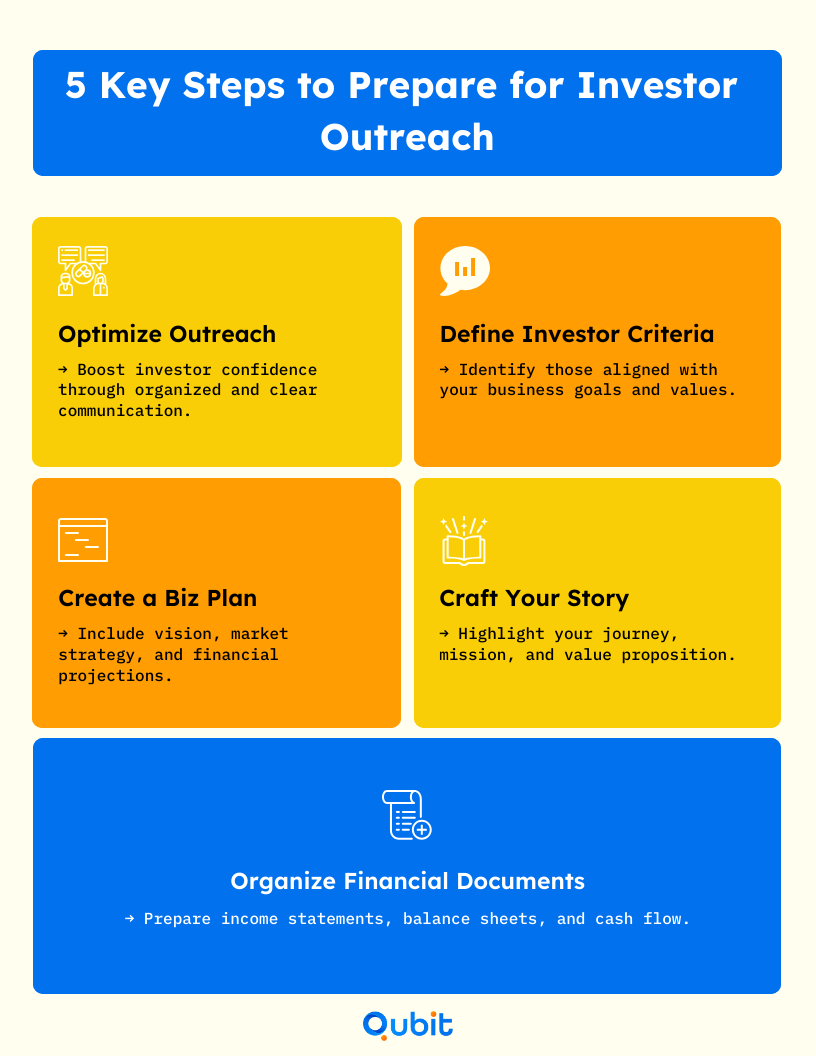
Securing investor interest requires meticulous preparation. Here are the key steps:
- Streamline Your Outreach:
Clear and thorough preparation not only boosts investor confidence but also facilitates meaningful discussions about your business’s future. - Define Investor Criteria:
Identify investors who align with your business goals and values to ensure you approach the right individuals or firms. - Develop a Comprehensive Business Plan:
Outline your vision, market strategy, and financial projections to provide a clear roadmap that showcases your company’s potential and long-term sustainability. - Craft and Rehearse Your Story:
Deliver a compelling narrative that highlights your journey, mission, and competitive edge, leaving a lasting impression on potential investors. - Organize Essential Financial Documents:
Prepare income statements, balance sheets, and cash flow projections to demonstrate professionalism and build trust.
Select Your Ideal Investor
Choosing the right investor shapes your startup's trajectory more than the check size. Score potential investors on fit with your stage and strategic goals before you reach out. Stage-fit alignment is what makes a partnership last past the first board meeting.
Clear communication and firm negotiation are equally essential. Defining terms early prevents misunderstandings and ensures both parties are committed to shared objectives. Ask critical questions, such as the investor’s expectations for involvement and their track record with similar ventures. These insights will help you assess their ability to support your business beyond funding.
A simple framework cuts the selection process down to what matters. Prioritize investors who align with your investment priorities and show genuine interest in your mission. Investors who buy the mission early argue for you in the room when you are not there.
Structured outreach produces more focused investor engagement. Y Combinator’s investment approach shows the pattern: $125K for 7% equity, then up to $375K in later rounds. Staged checks let you prove milestones cheaply, so each later round is negotiated from strength. As you identify and rank potential backers, managing your investor pipeline effectively ensures no high-value relationship falls through the cracks.
What Are the Latest Investor Outreach Trends?
Strategic investor mapping keeps shifting, so your outreach approach should shift with it. A major change: 57.1% of investors now favor meetings organized by the company versus only 7.1% preferring sell-side arrangements. Own the outreach logistics yourself, and align your pitch with what investors actually want to buy.
The clearest shift is toward a structured raise sequence that ranks opportunities before effort is spent. Founders now pair that with personalized communication and data-driven pitches. Both moves cut wasted cycles and signal seriousness to investors.
By staying attuned to these developments, founders can refine their outreach approaches and position themselves for success in a competitive funding environment. The strategic investor mapping technique is evolving rapidly, driven by emerging trends that are reshaping how startups secure funding.
How Do Community-Driven Investment Strategies Work?
The startup ecosystem thrives on shared knowledge, and crafting an effective investment priority plan is no exception. Entrepreneurs are increasingly turning to peer experiences to shape their strategies, ensuring that every decision aligns with a well-defined investment hierarchy. For instance, founders often prioritize securing early-stage funding by focusing on scalable growth metrics, as highlighted in community discussions.
Experts emphasize the importance of identifying and ranking funding needs, from operational essentials to long-term innovation.
Reflecting community-driven change, pre-seed funding now exceeds 20% of all venture rounds globally. That adoption of early-stage prioritization shows founders are sequencing raises earlier than before. Learn from peers' wins and misses, then build a funding hierarchy that makes your next investor conversation sharper.
What Supplementary Resources Help with Investors?
Sharpening your outreach approach is part of building a real raise plan. This section collects articles and authoritative resources to help you refine that plan. Use them to pressure-test your investor priorities before you start the round.
Working through these materials gives you concrete moves on the raise sequence. Whether you are tightening outreach or building the plan, they add clarity and direction.
How Should You Prioritize Different Investors?
Investor outreach gets sharper when it connects to sales, marketing, and IT decisions. Those links give you a structured way to align investor goals with how the business runs. Sorting priorities this way is what a real investment priority plan looks like in practice.
Some founders also pool resources through investor syndicates for early-stage startups, combining capital from multiple backers to reach funding targets faster.
How Can You Excel in Pitching to Investors?
Learning how to prioritize investors outreach will help you tailor your pitch and maximize engagement.
The competition for investor attention is intensifying. In 2025, venture and growth investors deployed $425 billion across more than 24,000 deals globally, a 30% increase year over year, with AI-focused startups capturing nearly half of all funding. For founders outside AI, this concentration means pitches must work harder to demonstrate clear unit economics and a defensible growth path.
1. Craft a Clear Value Proposition
Your value proposition is the first risk test an investor runs on you. In seconds, it tells them whether your market is real and whether you understand it. Get it tight and the rest of the pitch gets an easier hearing.
Take Airbnb’s early pitch as an example. Their one-sentence value proposition, ”Book rooms with locals, rather than hotels”, helped them secure $600k in seed funding. This clarity and focus demonstrated their market understanding and potential, which resonated with investors.
To refine your pitch, actionable resources like the Fundraising checklist can be invaluable. This tool ensures your value proposition addresses key investor concerns, from market opportunity to traction metrics. Integrating the checklist into your pitch deck planning can help you present a polished and persuasive case.
Additionally, aligning your pitch with investor profiles is crucial. Mastering investor mapping fundamentals ensures your outreach efforts are targeted and effective. This step allows you to tailor your value proposition to resonate with specific investor priorities.
Remember, short and impactful pitches can open doors to significant funding opportunities. A clear value proposition isn’t just a statement, it’s a strategic asset that can transform investor interest into tangible results.
2. Develop a Scalable Business Model
Building a scalable business model is essential for demonstrating growth potential and attracting investor interest. Here are the key points to consider:
- Scalability as a Cornerstone:
A scalable model not only showcases your ability to expand but also ensures sustainable operations with low marginal costs, which is increasingly prioritized by investors. - Data-Driven Case Building:
Integrate financial projections and market size data into your strategy to provide tangible evidence of your startup’s growth potential within a competitive landscape. - Investor Pitch Enhancement:
Highlight scalability data in your pitches to align with current investor trends and demonstrate the strength of your business model. - Growth Strategies from Paul Graham:
Leverage insights from Paul Graham’s “Growth Model” to refine your approach and emphasize scalability as a critical driver of success. - Investor Geography Consideration:
Evaluate the pros and cons of local versus global investors to refine your outreach strategies, tailoring your approach to meet specific investor preferences. - Operational Efficiency in Diverse Markets:
Prove your startup’s ability to thrive in various markets while maintaining operational efficiency, positioning your business as a high-potential investment opportunity.
A scalable business model is not just about growth; it’s about proving your startup’s ability to thrive in diverse markets while maintaining operational efficiency. By integrating growth strategies, market insights, and investor expectations, you can position your business as a high-potential investment opportunity.
3. Demonstrate Tangible Traction
Measurable progress is what lowers perceived risk in an investor's head. Growing engagement, rising revenue, or new customers each answer the question they are silently asking: is this working? Lead with the metric that most directly de-risks your story.
Key performance metrics provide undeniable proof of market interest. For instance, showcasing a consistent rise in active users or a notable improvement in customer retention rates can validate your business model. This data-driven evidence, drawn from early successes, not only builds investor confidence but also positions your plan as a sound and scalable opportunity.
When crafting your investment hierarchy, ensure that your progress is quantifiable and aligned with your goals. Investors are far more likely to commit when they see a well-documented track record of growth and potential.
4. Build an Impactful Team
A well-assembled team can often sway investor confidence more effectively than the product itself. Highlighting the expertise and achievements of your team demonstrates credibility and positions your startup as a reliable investment opportunity. Investors are drawn to teams with proven track records, as these accomplishments signal the ability to execute and adapt in dynamic markets.
Strategic hiring plays a pivotal role in shaping your investment priority plan. Implementing proven strategies to attract and retain Top Talent ensures your team impresses prospective investors.
Additionally, using data analytics for investor mapping enables startups to make informed decisions and optimize outreach. This approach ensures measurable hiring strategies that align with your investment order of operations.
5. Ensure Financial Transparency
Clean financials are how investors check whether they can trust everything else you said. Clear, accurate statements signal you can run the company they are about to fund. Messy numbers raise a risk flag before they reach diligence.
Credibility is built through transparency. Providing detailed, error-free documentation reassures investors that your business operates with integrity and accountability. This not only strengthens trust but also positions your organization as a reliable partner for future investments.
An investment priorities plan thrives on clarity. By presenting financial data in a straightforward manner, businesses can highlight their strategic goals and performance metrics, ensuring alignment with investor expectations.
Conclusion
Securing investor interest starts with understanding how to prioritize outreach and standing on solid fundamentals. Lead with a clear value proposition, a scalable model, real traction, a strong team, and clean financials. Together these show investors the business is viable and worth the risk.
Equally important is crafting an actionable investment priority plan. This roadmap not only aligns your goals with investor expectations but also ensures that every step you take is purposeful and impactful.
When you apply these strategies, your startup is poised to enhance investor engagement and achieve success. If you’re ready to find the ideal investors, Qubit Capital is here with our fundraising outreach support. Let’s elevate your approach.
Key Takeaways
- A compelling, concise value proposition is key to engaging investors.
- A scalable business model proves growth potential and attracts investment.
- Demonstrable traction and a strong team significantly enhance investor confidence.
- Thorough preparation and clear investor criteria streamline successful outreach.
- Financial transparency is essential for sustaining lasting investor relationships.
Want a targeted investor list you can actually use?
A curated shortlist based on your stage, sector, geography, and check size.
- Thesis-aligned investors matched to your round
- Decision-maker contacts with relevant context
- Ready for outreach, not just research

Frequently asked Questions
How do I create an effective investment priority plan for my startup?
Start by listing investors whose focus matches your industry, stage, and funding needs. Segment them by past deal history and check size. Rank each group by how closely their goals align with yours. Reach out to the highest-fit investors first. This order saves time and improves your funding odds.