

 Back
Back









Table of Contents

Scenario analysis is a powerful tool for understanding and preparing for uncertainty in financial planning. By exploring different hypothetical situations, businesses can anticipate potential challenges and opportunities, enabling them to make informed decisions. This approach is particularly valuable in financial modeling, where changing assumptions can reflect significant shifts in a company’s operations.
Startup funding trends illustrate scenario analysis’s importance. In 2023, $31.8 billion invested in US and Canadian startups showed rising complexity and risk. These investment volumes make accurate forecasting tools indispensable. This article will show how scenario modeling improves strategic decisions.
Utilizing scenario analysis often complements financial forecasting tools, enabling startups to choose the right software for accurate projections. It provides a structured way to evaluate risks and adapt strategies, ensuring resilience in volatile markets.
Whether you're aiming to refine your financial model or prepare for unexpected changes, scenario analysis equips you with the insights needed to thrive in an unpredictable environment.
What is Scenario Analysis?
Scenario analysis helps startups anticipate challenges and enhance financial planning by evaluating various future conditions. Advanced financial modeling techniques often include scenario analysis to prepare for uncertainty and optimize projections. Scenario analysis offers a powerful method for assessing the impact of various future possibilities on critical financial metrics. By simulating different scenarios, organizations can gain structured insights into potential risks and opportunities, enabling more informed decision-making.
It is a methodical approach to evaluating how potential future events might impact an organization’s financial performance. This technique is particularly valuable in finance, where uncertainties can significantly affect investments and operations. For example, scenario analysis is a key concept in financial modeling. It allows financial models to adjust assumptions dynamically, reflecting significant changes in a company’s operations or external conditions.
Beyond its technical applications, scenario analysis plays a crucial role in building robust financial projections. These projections ensure that investors have a clear understanding of potential risks and opportunities, fostering confidence in the organization’s strategic planning.
By evaluating multiple outcomes, businesses can prepare for uncertainties and capitalize on favorable conditions. Whether assessing market trends, operational shifts, or external economic factors, scenario analysis equips firms with the tools to anticipate challenges and seize opportunities effectively.
Startups like yours already closed their rounds with us.
Founders across every stage and industry. Here's what it took.
- Raised $7.6M for Swiipr Technologies
- Raised $0.5M for Ap Tack
- Raised €0.5M for Ivent Pro

Step-by-Step Process for Scenario Analysis in Finance
Scenario analysis is a powerful tool for strategic planning, allowing businesses to anticipate potential futures and make informed decisions. To maximize its effectiveness, this process should follow a structured approach, ensuring clarity and actionable insights.
This section explains how to perform scenario analysis in financial modeling, guiding you through each step for accurate projections.
These practical steps walk you through setting up and executing financial scenario analysis for startups.
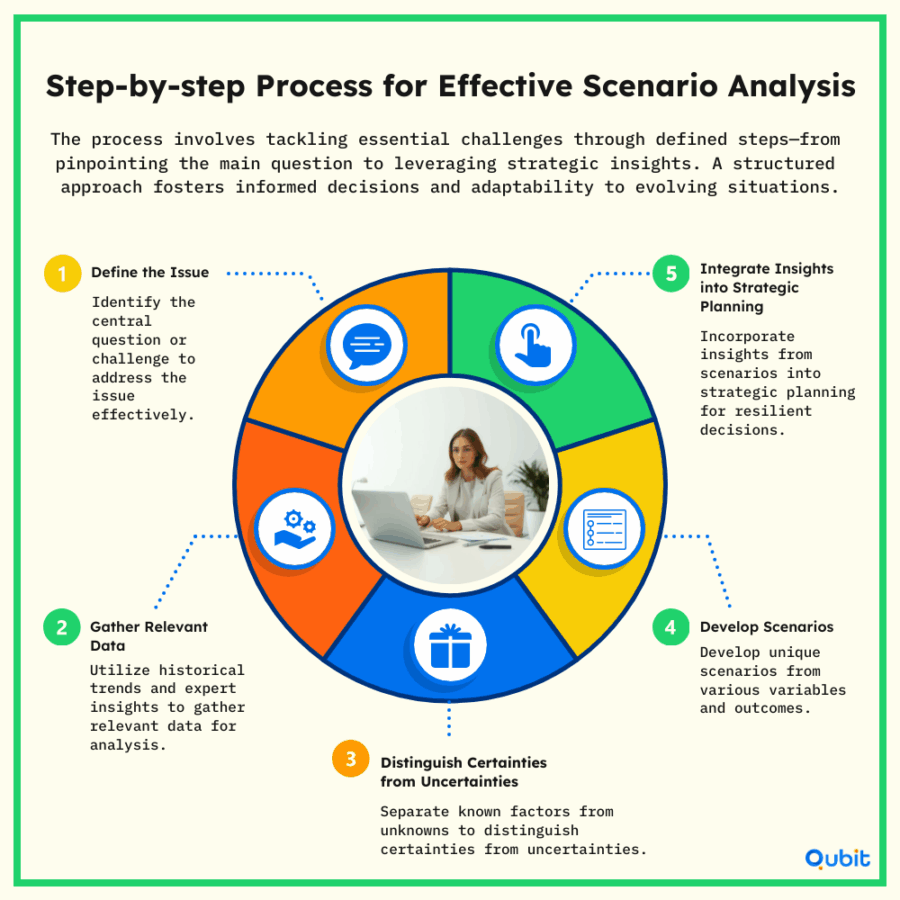
1. Define the Issue
Begin by identifying the core question or challenge that the scenario analysis aims to address. Whether it's assessing market trends, evaluating risks, or exploring growth opportunities, a well-defined issue sets the foundation for the entire process.
2. Gather Relevant Data
Collect data that is both quantitative and qualitative. This includes historical trends, industry reports, competitor analysis, and expert opinions. Comprehensive data ensures that the scenarios developed later are grounded in reality and provide meaningful insights.
Investors now advise startups to ensure extended capital buffers. Runway of 24–36 months is now recommended for stability. This reflects strategic planning trends for resilience.
Ensuring Scenario Realism with Robust Assumptions
Building on the data collection step, scenario realism depends on grounding assumptions in accurate historical data and relevant market benchmarks. Incorporating stakeholder insights ensures that scenarios reflect practical business realities rather than abstract possibilities. This approach increases the credibility and usefulness of scenario analysis outcomes. Reliable assumptions help prevent misleading projections and support more informed strategic decisions.
3. Distinguish Certainties from Uncertainties
Separate elements that are predictable from those that are uncertain. Certainties, such as regulatory requirements or demographic trends, serve as fixed points in your analysis. Uncertainties, like technological advancements or economic shifts, require deeper exploration to understand their potential impact.
4. Develop Scenarios
Create a range of plausible scenarios based on the certainties and uncertainties identified. Each scenario should represent a distinct potential future, highlighting key variables and outcomes. For example, an example of scenario analysis might involve projecting the impact of a new competitor entering the market versus a scenario where the competitor does not materialize.
Structuring Assumptions for Clarity and Comparison
After developing scenarios, use consistent formatting and clearly labeled assumption tables to organize key variables. This structure simplifies scenario comparison and streamlines future updates to your financial models. Well-organized tables also enhance communication with stakeholders by making assumptions and outcomes transparent. Consistency in presentation reduces errors and supports ongoing scenario analysis efforts.
5. Integrate Insights into Strategic Planning
Once scenarios are developed, use them to inform decision-making. Evaluate strategies under each scenario to identify the most resilient and adaptable approaches. This step ensures that your planning is proactive rather than reactive.
Complementary Tools: PEST Analysis
To enhance the scenario planning process, consider integrating PEST Analysis. This methodology examines the political, economic, social-cultural, and technological contexts influencing your scenarios.
Effective scenario planning can clarify operational targets. Green Bud, LLC committed to full operational capacity within 120 days of license award. Their structured timeline reflects direct scenario implementation. This exemplifies how scenario analysis converts planning steps into clear milestones.
By following these steps, businesses can uncover valuable insights and prepare for a range of potential futures. Scenario analysis not only supports strategic planning but also fosters adaptability in an ever-changing environment.
Exploring Various Types of Scenario Analysis
Understanding how to perform scenario analysis in financial modeling helps organizations prepare for uncertainties in various domains. Executive strategies have evolved amid uncertainty. 42% of CFOs now engage in proactive scenario planning. Increasing frequency reflects the demand for robust scenario modeling to address economic volatility.
Best-Case Scenario Analysis
This approach focuses on identifying the most favorable outcomes. Organizations use best-case analysis to project optimistic possibilities, such as higher-than-expected revenue growth or successful product launches. These scenarios help businesses set ambitious goals while ensuring they remain prepared to capitalize on positive developments.
For example, a scenario analysis example might involve projecting revenue growth under optimistic market conditions.
Worst-Case Scenario Analysis
Conversely, worst-case analysis examines the most challenging situations an organization might face. Whether it's a sudden market downturn or regulatory changes, this method enables businesses to anticipate obstacles and develop contingency plans. For example, financial scenario analysis can help organizations assess the impact of reduced cash flow or increased operational costs, ensuring they remain resilient during tough times.
Multiple Scenario Analysis
Rather than focusing solely on extremes, multiple scenario analysis explores a range of possibilities, combining both optimistic and pessimistic projections. This comprehensive approach allows organizations to evaluate diverse outcomes and adjust strategies accordingly. Integrating AI financial modeling tools into scenario analysis can automate projections and optimize decision-making processes, showcasing technological advancements in scenario modeling.
Stress test scenarios are a key part of scenario analysis, helping organizations evaluate resilience under adverse conditions.
As industries face increasing uncertainty, adopting these methodologies ensures businesses remain agile and proactive in their planning efforts. Scenario analysis in finance, for instance, is particularly valuable for project financial planning, helping organizations adapt to evolving conditions effectively.
What if scenario analysis allows businesses to explore a range of possible outcomes by adjusting key assumptions.
Differentiating Scenario Analysis from Sensitivity Analysis
Understanding the distinction between scenario analysis and sensitivity analysis is essential for effective risk assessment. While both methods aim to predict outcomes under varying conditions, they differ significantly in their approach and strategic purpose.
Scenario analysis focuses on outlining specific future scenarios, often incorporating multiple variables to simulate complex situations. For example, a company might evaluate the financial impact of a market downturn combined with regulatory changes. This method provides a holistic view of potential risks and opportunities, enabling businesses to prepare for a range of possibilities.
On the other hand, sensitivity analysis examines the impact of adjusting individual variables, keeping other factors constant. For instance, a business might assess how changes in interest rates alone affect profitability. This technique isolates the influence of specific elements, offering a more granular understanding of their significance.
Both approaches are invaluable for decision-making, yet they serve distinct purposes. Scenario analysis provides a foundation for exploring advanced financial modeling techniques, helping businesses move beyond basic methodologies.
Recent forecasts illustrate scenario diversity. Austria’s economy contracted 0.8% in 2023, but projections span 0.3% to 1.6% growth through 2025. This demonstrates how scenario analysis can inform multi-year planning.
Comparing Scenario, Sensitivity, and Stress Testing
| Method | Purpose | Variable Scope | Typical Application |
|---|---|---|---|
| Scenario Analysis | Assess multiple plausible outcomes | Multiple variables change together | Strategic planning and risk management |
| Sensitivity Analysis | Measure impact of one variable | Single variable changes at a time | Testing model responsiveness |
| Stress Testing | Evaluate resilience under extremes | Extreme changes in key variables | Regulatory compliance and crisis planning |
Scenario Modeling in Excel for Financial Analysis
Scenario modeling is crucial for volatile market deals. Private credit now finances over 70% of mid-market transactions during unstable periods. Excel tools help analyze these complex arrangements.
Businesses can simulate best-case, worst-case, and most likely scenarios in Excel. This allows clear analysis of how changes in revenue or costs impact the bottom line.
Scenario modeling techniques in Excel allow users to create, save, and merge multiple financial scenarios for better forecasting. Excel’s Scenario Manager, found under the Data Tools menu, lets users create and manage multiple scenarios seamlessly.
Additionally, Excel’s integration with tools like the sensitivity analysis template provides users with ready-to-use resources for deeper analysis. These templates are particularly useful for professionals who need to evaluate how small changes in variables can affect overall outcomes.
For organizations focused on resilience, combining Excel’s Scenario Manager with strategies like stress testing financial models ensures preparedness against unexpected market shifts. This dual approach empowers businesses to make informed decisions, reducing risks and optimizing financial performance.
Pitfalls and Limitations of Scenario Analysis
Scenario analysis in finance, while valuable for forecasting, presents several challenges that businesses must consider.
A significant drawback is its inability to account for unforeseen growth drivers, particularly in industries undergoing rapid transformation. Emerging technologies, shifting consumer behaviors, or unexpected market disruptions often fall outside the scope of predefined scenarios. This limitation can leave organizations unprepared for sudden changes that defy traditional projections.
Over-reliance on scenario analysis can also be problematic. Treating these models as definitive forecasts rather than exploratory tools may lead to complacency, where decision-makers fail to consider alternative strategies or adapt to real-time developments.
Finally, scenario analysis may struggle to predict outcomes in highly volatile environments. Industries with unpredictable variables, such as geopolitical shifts or regulatory changes—can render even the most carefully constructed scenarios obsolete.
While scenario analysis offers valuable insights, understanding its limitations is essential for making informed, adaptive decisions in an ever-changing business landscape.
Executing Scenario Analysis in Financial Modeling
Scenario analysis plays a pivotal role in financial modeling, offering a structured approach to assess risks and forecast potential outcomes. By simulating various scenarios, businesses can better understand the impact of uncertainties on their financial performance and make informed decisions.
This section details how to perform scenario analysis in financial modeling for more robust risk assessment and forecasting.
Financial models can be tailored to suit different needs, typically falling into two categories: pre-defined configurations and expert modes. Pre-defined models are ideal for businesses seeking quick insights, as they rely on standardized assumptions and parameters. These models simplify the process, making them accessible to teams without extensive financial expertise. On the other hand, expert modes provide advanced customization, allowing professionals to define intricate variables and assumptions that align with specific business contexts.
The flexibility of these modes ensures that scenario analysis can adapt to diverse industries and challenges. Whether evaluating market volatility, operational risks, or investment opportunities, selecting the right model configuration is crucial for accurate analysis. Bridge the gap with lean finance automation that scales from seed to Series A without drama.
Large organizations see major results from detailed scenario modeling. GE simplified and strengthened its balance sheet by exiting the AerCap stake for $2B proceeds. Their scenario-driven decisions underscore the real business impact financial models deliver.
Conclusion
Mastering how to perform scenario analysis in financial modeling is essential for startups facing uncertainty. Throughout this blog, we’ve explored strategies that emphasize clarity, precision, and adaptability in financial modeling. By implementing these techniques, businesses can build robust models that not only enhance investor trust but also prepare them for a range of possible outcomes.
At Qubit Capital, we understand the challenges of uncertainty and the importance of presenting reliable financial projections.
If you're ready to fortify your financial models and gain investor trust, connect with our team through our Investor Outreach service. We can help you approach the future with confidence and clarity.
Key Takeaways
- Scenario analysis is vital for forecasting diverse future outcomes.
- Distinct from sensitivity analysis, it provides structured risk assessment.
- Types include best-case, worst-case, and multiple scenario approaches.
- Excel and tools like Datarails simplify complex scenario modeling.
- A systematic, step-by-step process supports informed decision-making.
Need numbers investors trust?
Clean assumptions, realistic projections, and a structure that holds up in diligence.
- Forecasts, unit economics, and scenario planning
- Valuation-ready outputs investors can review fast
- Clear structure so you can update it easily
Frequently asked Questions
What is scenario analysis in financial modeling?
Scenario analysis is a structured method of evaluating how different future conditions—such as market downturns, rapid growth, or regulatory changes—would affect a company’s financial outcomes. It allows startups and businesses to stress-test their financial models by simulating best-case, worst-case, and base-case scenarios to inform strategic decisions.