

 Back
Back










Table of Contents

Most investors decide within the first three minutes whether they’re interested in a pitch. This data underscores the critical role of a compelling pitch deck in grabbing investor attention. Over the years, pitch decks have evolved from simple presentation tools to dynamic narratives that combine design finesse, storytelling, and key data points.
Creating a pitch deck that resonates with investors isn’t just about listing facts, it’s about weaving a story that aligns your vision with their goals. From visually appealing slides to concise messaging, every element must work together to convey trust, credibility, and potential. Understanding the essential elements of a pitch deck is the first step in creating one that truly stands out.
What is a Pitch Deck?
It is a concise, visually engaging presentation designed to showcase a startup’s business plan and vision. Pitch deck creation involves designing a concise, visually engaging presentation that showcases your startup’s vision and value proposition.
Foundations of a Winning Pitch Deck Creation
To craft a pitch deck that secures funding, focus on combining concise slides, a clear narrative, visual storytelling, and actionable metrics. Tailor your content to the specific audience, avoid common mistakes like overloaded slides, and use feedback iteratively to refine your deck.
Over the years, pitch decks have evolved from simple slide decks into strategic storytelling tools, blending data with narrative to captivate audiences.
The startup ecosystem is more competitive than ever. In 2025, over 150 million startups actively compete for investor capital, with nearly 137,000 new ventures launching daily. This intense pace demonstrates why a refined pitch deck is necessary to get noticed.
Core Components of a Great Pitch Deck
A winning pitch deck typically follows a tried-and-tested structure, ensuring clarity and focus. Experts recommend limiting the deck to 10–11 slides, each addressing a specific aspect of the business. These slides should be concise, visually appealing, and easy to understand. Additionally, the entire deck should be supported by a tweet-length overview, a single sentence that captures the essence of the business and hooks the investor.
To create impact, the following elements are crucial:
- Vision: Define the overarching goal or mission of the startup. A strong vision slide inspires investors by highlighting the company’s long-term aspirations.
- Problem: Clearly articulate the market gap or pain point the startup seeks to address. Investors want to understand why this problem matters and how solving it adds value.
- Solution: Present the product or service as the answer to the identified problem. This slide should explain the unique approach or innovation behind the solution. Connect the dots from pain to product with pitch deck solution slide
- Market Opportunity: Showcase the size, growth potential, and demand of the target market. Include data-driven insights to validate the opportunity.
- Team: Highlight the expertise and credentials of the founding team. A capable, passionate team is often a decisive factor for investors.
Each slide should focus on one clear message. Avoid cluttering slides with excessive text or visuals, simplicity is key. By incorporating these core components, startups can craft a compelling pitch deck that builds investor confidence and drives engagement.
The Power of a 140-Character Overview
Your deck’s value proposition, often displayed on the opening slide, should be clear enough to fit into a single tweet. This 140-character overview acts as the hook, drawing investors into the narrative. For example, a tech startup might use: “Empowering small businesses with AI-driven tools to triple productivity.”
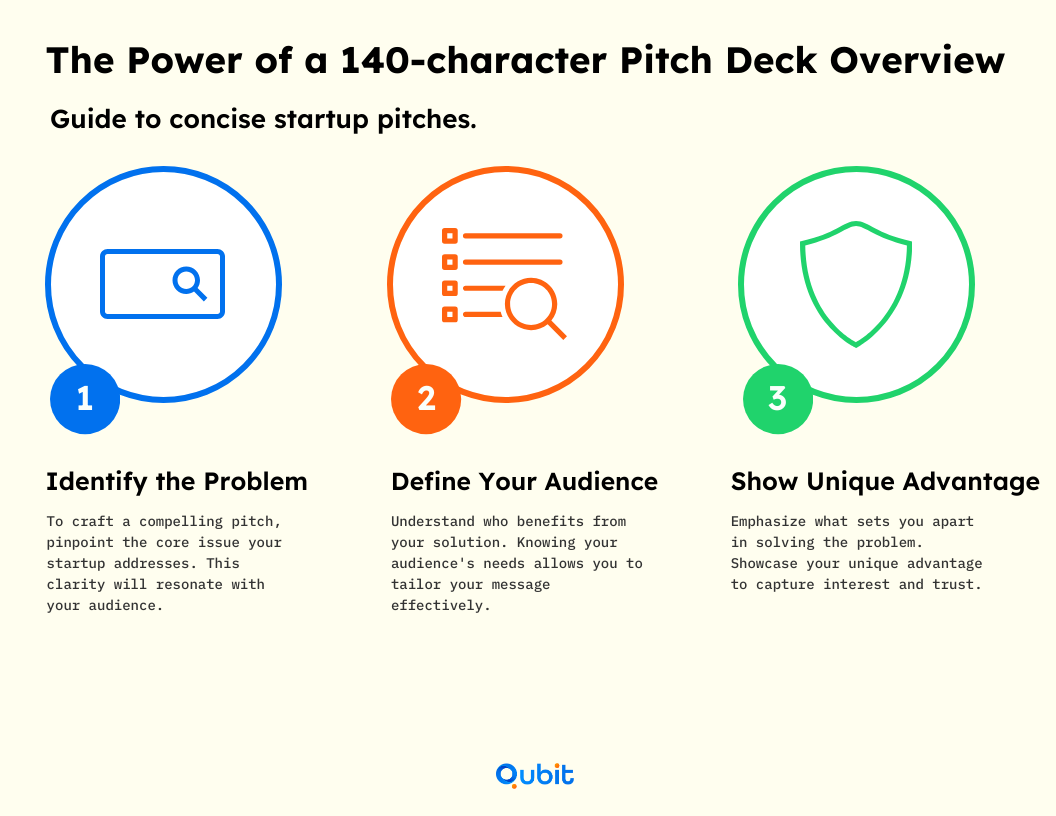
Crafting this concise statement requires answering three questions:
- What problem are you solving?
- Who benefits from your solution?
- What makes your approach unique?
Best Practices for Slide Structuring
To ensure your pitch deck delivers impact, follow these practical tips:
- Limit Text: Use bullet points instead of paragraphs. Keep wording concise and avoid jargon.
- Use Visuals: Incorporate graphs, charts, and images to complement the text. Ensure visuals are high-quality and relevant.
- Maintain Consistency: Stick to uniform fonts, colors, and design elements across all slides.
- Focus on Flow: Arrange slides logically to create a compelling narrative.
- End with Impact: Conclude with a strong call-to-action, whether it’s a funding ask or a partnership proposal.
By adhering to these principles, your pitch deck will be structured to captivate and persuade investors. To get a sanity-check structure against investor-ready pitch deck before you hit send.
Startups like yours already closed their rounds with us.
Founders across every stage and industry. Here's what it took.
- Raised $7.6M for Swiipr Technologies
- Raised $0.5M for Ap Tack
- Raised €0.5M for Ivent Pro

Advanced Strategies and Iterative Feedback
Iterative Feedback Steps
Proper organization of quantitative metrics can significantly affect productivity. 68% of companies report difficulty locating critical documents, costing an average of 21.3% of productivity time. Efficient workflows thus become essential for startups refining their pitch decks under time pressure.
Iterative feedback is a cornerstone for refining your pitch deck and ensuring it resonates with investors. Creating a pitch deck is not just about presenting information; it's about adapting and enhancing your narrative based on constructive input. Here's a step-by-step guide to leveraging iterative feedback effectively:
- Solicit Input from Diverse Stakeholders: Before finalizing your pitch deck, present it to a mix of mentors, peers, and potential investors who can provide varied perspectives. This approach ensures that you address blind spots and align your deck with audience expectations.
- Prioritize Actionable Insights: Focus on feedback that highlights specific areas for improvement, such as clarity in storytelling, visual consistency, or alignment with industry benchmarks.
- Implement and Test Changes: After addressing feedback, test the updated version with a smaller audience to gauge its impact. This step ensures that your revisions have the intended effect and don't introduce new inconsistencies.
By iterating through this process, you cultivate a pitch deck that evolves to meet the demands of your audience, reducing the risk of losing their attention, a challenge faced by as many as 75% of potential investors.
Dual Version Strategy
When it comes to pitch deck presentation, one size rarely fits all. A dual version approach, creating both live and asynchronous presentation formats, helps ensure your pitch resonates in diverse settings.
- Live Presentation Version: Tailor this version for in-person or virtual meetings. Highlight key points with dynamic visuals and concise slides, leaving room for verbal elaboration. This approach engages investors directly and allows for real-time interaction.
- Asynchronous Presentation Version: Design this version for scenarios where investors review the pitch independently. Include detailed notes, clear data visualizations, and a compelling narrative flow that guides them through the deck without requiring your presence.
Creating these two versions enables you to accommodate varying investor preferences and circumstances, maximizing your pitch deck's reach and effectiveness. Match the ask to the audience with choose between pitch deck and business plan.
Integrating Quantitative Metrics
Quantitative metrics are vital in an effective pitch deck. They provide investors with tangible proof of a startup’s potential.
These metrics, such as Monthly Recurring Revenue (MRR) growth or funding achievements, demonstrate a company’s ability to generate consistent income. They also show the potential to scale operations.
- Highlight Key Performance Indicators (KPIs): Showcase metrics like revenue growth, customer acquisition costs, or lifetime value. These figures provide concrete evidence of your startup's progress and scalability.
- Use Data Visualizations: Presenting metrics through charts or infographics enhances comprehension and makes your data more compelling. For example, a bar chart illustrating month-over-month growth can instantly convey your trajectory.
- Tie Metrics to Projections: Demonstrate how past performance informs future goals. For instance, extrapolate customer retention rates to forecast market share expansion over the next five years. If metrics keep raising questions, borrow a few ideas from financial slides tips to make them land faster.
Incorporating Quantitative Metrics and Case Studies
Metrics and KPIs
Quantitative metrics are the backbone of an effective pitch deck, providing investors with tangible proof of a startup’s potential. These metrics, such as Monthly Recurring Revenue (MRR) growth or funding achievements, showcase the company’s ability to generate consistent income and scale operations.
Case Studies
Case studies offer real-world examples that reinforce the importance of integrating metrics into a pitch deck. They provide a relatable context for investors to understand how data translates into actionable insights and success.
Effective decks supported major funding rounds in 2024. Artisan raised $12 million, the largest amount among Y Combinator’s 2024 graduates, demonstrating how transparent presentation of metrics attracts investment. This result highlights the crucial role of real data in pitch deck impact.
Another notable example is Mixpanel, which open-sourced its pitch deck after securing funding and achieving an $865M valuation. The deck emphasized clear, data-backed insights, showcasing Mixpanel’s growth trajectory and market potential. Learn from Mixpanel’s success where a persuasive pitch deck led to remarkable funding outcomes.
You can also get inspired by Pento, which adopted a design-centric approach to its pitch deck. By blending concrete metrics with an aesthetically appealing format, Pento captured investors’ attention while maintaining focus on its market positioning and growth. This combination of design and data ensured that its metrics resonated effectively, contributing to its fundraising success.
Successful startups often use case studies to highlight key achievements, such as customer acquisition rates or product adoption timelines. By analyzing these examples, entrepreneurs can identify patterns that resonate with investors. A well-crafted pitch deck is not just a presentation; it’s a narrative that merges metrics with real-world outcomes, inspiring confidence in the company’s vision and execution.
Storytelling and Visual Engagement
Successful pitch deck creation relies on blending storytelling methods with data-driven designs for memorable presentations.
1. Narrative Frameworks
A pitch deck’s narrative serves as the backbone of its presentation, guiding the audience through your startup’s journey. It’s not just about sharing facts, it’s about using storytelling techniques for pitch decks that resonate emotionally and logically. When asking yourself, “What is a pitch deck’s purpose?”, think of it as your startup’s storybook, designed to captivate investors by demonstrating growth potential and vision.
Here’s how to build an effective narrative framework:
- Develop a Clear Story Arc: Structure your pitch deck like a story with a beginning, middle, and end. Start by identifying the problem or opportunity, introduce your solution, and conclude with why your team is uniquely equipped to succeed. If the story reads well but revenue logic is light, clarify with business model slide.
- Focus on the ‘Hero’s Journey’: In many cases, your startup can be positioned as the hero overcoming obstacles. Highlight challenges you’ve faced and how your solution is actively solving them.
- Integrate Emotional Touchpoints: Investors connect with stories that evoke emotion. Share relatable anecdotes, customer success stories, or impactful statistics that inspire confidence and belief in your product or service.
2. Visual Data Storytelling
Visual storytelling is the art of translating complex information into digestible graphics, charts, and images. By enhancing your pitch deck with minimal text and impactful visuals, you can tell a story that is both easy to follow and visually appealing.
Here’s how to master visual data storytelling:
- Convert Complex Data into Simple Visuals: Use graphs, pie charts, and infographics to simplify intricate statistics. For example, instead of listing percentages in text form, showcase them in a colorful pie chart that grabs attention.
- Design for Clean Minimalism: Avoid cluttered slides. Limit text to essential points and let visuals do the talking. Platforms like Canva make it easy to design sleek, professional slides with minimal effort.
- Emphasize Consistency in Design: Maintain a consistent color palette and typography across all slides. This creates a polished, cohesive look that keeps the audience focused on your message.
Actionable Insights
To enhance storytelling and visual engagement in your pitch deck, consider these tips:
- Develop a clear story arc to give your presentation flow and structure.
- Convert complex data into simple visuals that are easy to understand.
- Keep text to a minimum for maximum visual impact.
By integrating storytelling and visual engagement effectively, your pitch deck can become a powerful tool to captivate investors and convey your startup’s potential.
Tailoring Your Pitch Deck for Investor Engagement
Audience Analysis
The foundation of successful startup pitch decks for investors lies in understanding your audience.
Every investor brings unique interests, expectations, and decision-making criteria to the table. By conducting thorough audience analysis, you can pinpoint what resonates most with specific investor groups. For instance, venture capitalists often prioritize growth potential and scalability, while angel investors may focus on innovative ideas and market entry strategies.
To align your deck with these varied priorities, research investor demographics extensively. Start by reviewing their investment portfolio to identify patterns, what industries they favor, the stage of companies they invest in, and their financial thresholds.
Understanding investor motivations matters even more in active capital markets. In H1 2025, approximately $145 billion was allocated by investors into seed-through-growth rounds in U.S. and Canadian startups. Knowing these funding trends helps founders customize their pitch to investor focus areas.
Social media platforms like LinkedIn can provide additional insights into their professional interests and affiliations. This targeted approach ensures that your pitch is not only relevant but also compelling. Tailoring your presentation to your audience, especially to tailor your pitch deck for investors, ensures that investor interests are directly addressed.
Customizing Content for Investors
Once you’ve completed your audience analysis, customizing your pitch deck becomes the next logical step. Tailor your slides to highlight the data and narratives that matter most to each investor group.
For example, if targeting venture capitalists, emphasize metrics like customer acquisition cost (CAC), lifetime value (LTV), and market scalability. On the other hand, a private equity firm might appreciate a focus on cash flow and ROI projections.
Visuals play a significant role in customization. Use graphs, charts, and infographics to convey complex data in digestible formats. Investors often have limited time to review pitches, so clarity and precision are critical. Make sure your visuals align with the key takeaways you want to deliver.
Feedback loops are another effective customization tactic. Present your deck to a small group of trusted mentors or potential investors and gather constructive criticism. This iterative process helps refine the content, ensuring it addresses investor concerns and strengthens your overall pitch.
Using AI and Modern Design Tools
Pitch deck maker platforms now use AI and design software to transform how decks are conceptualized and refined. One standout example is Peony, which offers modern pitch deck enhancement features for just $40 per month. Affordable pricing ensures even early-stage founders can access advanced design and analytics capabilities.
Pitch deck maker platforms now use AI and design software to transform how decks are conceptualized and refined. Exploring the best pitch deck tools can help teams simplify design decisions and maintain consistency across versions.
Why Brand Consistency Elevates Pitch Deck Impact
Building on advanced design tools, maintaining brand consistency throughout your pitch deck reinforces professionalism and credibility. Consistent use of colors, fonts, and logos helps investors recognize and remember your startup’s identity. This approach fosters trust and signals attention to detail, which can influence investor confidence. By aligning every slide with your brand, you create a cohesive narrative that stands out in competitive funding environments.
Steps to Secure and Track Pitch Deck Sharing
- Set password protection or access controls to restrict pitch deck viewing to authorized investors and stakeholders only.
- Generate unique sharing links for each investor to monitor individual engagement and interest in your pitch deck.
- Track slide views and time spent on each section to identify which content resonates most with potential investors.
- Export your pitch deck in multiple formats, such as PDF or PPT, to accommodate investor preferences and maintain presentation flexibility.
Avoiding Common Pitfalls and Ensuring Clarity
When it comes to crafting an effective pitch deck presentation, clarity is paramount. Unfortunately, many entrepreneurs stumble into common pitfalls, such as overcrowded slides, excessive text, and generic designs. These mistakes not only dilute the impact of the presentation but can also hinder investors' ability to grasp key insights. Let’s explore these pitfalls and actionable strategies to address them.
Common Mistakes in Pitch Decks
- Overloaded Slides
Slides packed with too much information can overwhelm investors. Instead of focusing on your message, they may struggle to digest dense visuals and excessive text. A prime example is the tendency to cram multiple charts or paragraphs into a single slide, leaving no breathing room for the audience to process. - Excessive Text
Pitch decks are not novels, yet some presenters fill slides with endless text. This approach distracts from verbal delivery and creates a tedious viewing experience. Investors expect concise, impactful statements—not walls of text. - Lack of Customization
Using generic templates or failing to tailor your deck to your audience can signal a lack of effort. Investors appreciate a pitch deck that aligns with their focus areas and demonstrates an understanding of their priorities. - Unclear Metrics
Poorly presented metrics, or worse, a lack of metrics, can discourage investors. Data-driven insights are crucial, but cluttered or vague presentations of numbers can diminish their effectiveness.
Best Practices for Clarity and Impact
Neglecting clarity and organization in supporting materials carries real cost. Incomplete or chaotic due diligence data can delay deals by 4–8 weeks and shrink valuations by 10–15%. Precision and structure are therefore non-negotiable for founders.
- Keep Slides Minimal
Aim for simplicity. Use white space strategically to highlight key points and ensure visuals are clean and organized. - Prioritize Data Over Words
Replace long paragraphs with succinct bullet points or visual data representations. A compelling chart or graph often communicates more effectively than text-heavy slides. - Tailor Your Design
Customize your pitch deck to align with your audience's interests and preferences. For instance, if pitching to tech-focused investors, emphasize innovative solutions and industry-specific metrics. - Highlight Key Metrics
Present data in a clear, visually appealing format. Use charts, infographics, or tables to showcase performance indicators and growth potential. The Front App example demonstrates how well-organized metrics can captivate investor attention. - Seek Expert Help
If refining your pitch deck feels overwhelming, consider seeking professional guidance. Sometimes, an expert’s perspective can turn a good presentation into a polished and compelling one.
Step-by-Step Checklist
- Define Your Core Message
Begin by identifying the central theme of your pitch deck. This core message should align with your startup’s mission and clearly articulate the value proposition. Investors want to see the unique solution your business offers and how it addresses a specific market need. - Design a Concise Slide Structure
Keep your pitch deck streamlined. Limit slides to essential topics such as problem identification, solution overview, market opportunity, business model, traction, team credentials, and funding request. Aim for clarity and brevity, investors appreciate succinct presentations. - Integrate Internal Metrics
Incorporate data-driven insights to strengthen your narrative. Highlighting metrics like revenue growth, customer retention rates, or market share demonstrates your startup’s potential for scalability. Leveraging Internal Business Metrics in Pitch Decks emphasizes why accurate metrics are pivotal in making a compelling case to investors. - Refine Through Feedback
Perfect your pitch deck by seeking constructive feedback from experienced professionals, mentors, or colleagues. This iterative process ensures you address potential weaknesses and improve overall presentation quality. - Tailor to Investor Needs
Customize your pitch deck for each investor. Research their investment preferences and focus on areas they value, such as industry trends, financial projections, or unique competitive advantages. Personalization shows respect for their time and increases engagement.
Strategic Tips
- Include Visuals and Infographics
A well-designed pitch deck uses visuals, charts, and infographics to convey complex information quickly. For example, use pie charts to illustrate market segmentation or bar graphs for revenue projections. - Craft an Engaging Opening Slide
Your opening slide should capture attention immediately. Consider using a bold statement, a striking image, or a compelling statistic to hook your audience. - Prioritize Storytelling
Beyond numbers, your pitch deck should tell a story. Create an emotional connection by narrating your startup’s journey, challenges faced, and future aspirations. - Emphasize Scalability
Investors look for startups with growth potential. Use slides to demonstrate how your business model scales, supported by market analysis and strategic plans. - Practice Your Delivery
A well-crafted pitch deck is only effective if presented confidently. Rehearse your pitch multiple times to ensure you deliver it smoothly and address investor questions with ease. Developing strong investor presentation skills can influence how clearly your vision lands in the room.
Conclusion
Pitch deck creation is more than compiling slides; it’s about crafting a compelling story tailored to your audience. Throughout this blog, we've explored the importance of data-backed strategies, visually engaging designs, and personalization in developing a pitch deck that resonates with investors. By leveraging these insights, startups can significantly increase their chances of securing funding while showcasing their vision with clarity and impact.
A well-designed pitch deck not only captures attention but also instills confidence in your ability to deliver results. At Qubit Capital, we understand the intricacies of startup funding and specialize in creating pitch decks that align with your unique business goals.
If you're ready to elevate your fundraising journey, our Pitch Deck Creation service is here to assist. Let us help you turn your ideas into a compelling narrative that drives success.
Key Takeaways
- A clear, concise narrative coupled with a 10–11 slide structure is vital to capture investor attention.
- Integrating quantitative metrics and real-world case studies increases credibility and engagement.
- Iterative feedback and dual version creation (live and asynchronous) significantly refine the pitch deck.
- Visual storytelling enhances emotional engagement while maintaining clarity through minimal text.
- Tailoring content to specific investor audiences is crucial for differentiating your pitch deck.
Need a pitch deck investors actually read?
A deck built to answer real investor questions. Clear story, strong positioning, investment-ready slides.
- Structure your narrative and core messaging
- Fix clarity gaps and investor objections
- Investor-grade design and structure
Frequently asked Questions
What is the meaning of pitch deck in startups?
A pitch deck in startups is a concise, visual presentation that outlines a business plan and value proposition to investors. It helps founders communicate their vision and strategy clearly.