

 Back
Back









Table of Contents

Global VC investment reached $120 billion in Q3, up from $112 billion in Q2. This signals accelerated market confidence and sets new benchmarks for innovation. This momentum is reflected in the volume and size of funding rounds, with both early-stage startups and established players attracting significant capital. As AI capabilities become more sophisticated and industry adoption accelerates, the funding landscape for SaaS platforms is experiencing a notable transformation, setting new benchmarks for growth and innovation
This blog delves into the funding momentum behind AI-driven SaaS platforms, offering data-driven insights and emerging trends.
Let’s jump right in to uncover how AI is shaping the future of SaaS funding.
Funding Trends for AI-Driven SaaS Platforms
Investment in AI-driven SaaS platforms is reaching new heights in 2026. Key trends include:
- Increased deal volume: The number of funding rounds for AI SaaS startups has grown compared to previous years, indicating sustained investor confidence.
- Larger average deal sizes: Investors are writing bigger checks, especially for companies demonstrating strong product-market fit and scalable AI solutions.
- Sector-specific momentum: Industries such as healthcare, finance, and aerospace are attracting targeted investments, with vertical SaaS solutions (software designed for specific industries) seeing a surge in funding.
- Active investors: Leading venture capital firms are focusing on AI SaaS, often participating in multiple rounds across different verticals.
These trends underscore a shift in investor priorities. Scalability, vertical specialization, and ethical AI practices have become key criteria for funding decisions.
AI startups attracted $89.4 billion in VC, making up 34% of all global VC allocations in 2025. This dominance shows a substantial shift in investor priorities. Recent mega deals set a new precedent. OpenAI raised $40 billion in a single round, representing the largest AI funding event of the year. This record-breaking raise illustrates the exceptional investor appetite for transformative AI innovation.
Your exploration of AI-driven SaaS funding is enriched by the comprehensive insights on software startup fundraising strategies, which detail overarching approaches within the software start-up landscape.
Risks of Funding Concentration in Mega-Rounds
This surge in mega-rounds and concentrated funding among mature AI SaaS enterprises introduces potential risks for the broader startup ecosystem. Smaller startups may face increased competition for capital, limiting opportunities for early innovation. Over-concentration can also reduce diversity in funded solutions, potentially slowing sector-wide progress. Awareness of these risks encourages investors to support a wider range of ventures.
Startups like yours already closed their rounds with us.
Founders across every stage and industry. Here's what it took.
- Raised $7.6M for Swiipr Technologies
- Raised $0.5M for Ap Tack
- Raised €0.5M for Ivent Pro

What’s Fueling AI-Driven SaaS Funding Momentum?
Multiple factors are driving the surge in AI SaaS funding in 2026:
- Breakthroughs in generative AI: New capabilities are enabling SaaS platforms to offer unprecedented personalization, automation, and decision support.
- Enterprise adoption: Large organizations are accelerating their integration of AI-powered SaaS, seeking efficiency gains and competitive advantages.
U.S. leadership shapes investor optimism. U.S. private AI investment hit $109.1 billion in 2024, nearly 12× China’s total and 24× the U.K. This dominance ensures North America remains at the heart of global AI funding momentum.
- Regulatory clarity: Evolving standards around AI ethics and data governance are increasing investor confidence by reducing perceived risks.
- Market demand: Businesses across sectors are prioritizing digital transformation, fueling demand for AI-driven solutions that can scale and adapt to changing needs.
Vertical Specialization in AI
Major vertical AI players are raising unprecedented capital. Databricks completed a $10 billion deal, while xAI secured $6 billion. Their sector-specific platforms attract outsized investment, driving innovation in targeted markets.
Artificial intelligence is reshaping industries by diving deep into sector-specific challenges, a trend known as vertical specialization. This approach is driving significant investment, particularly in industries like healthcare, finance, and aerospace, where tailored AI solutions are proving transformative.
The Rise of Industry-Specific AI Solutions
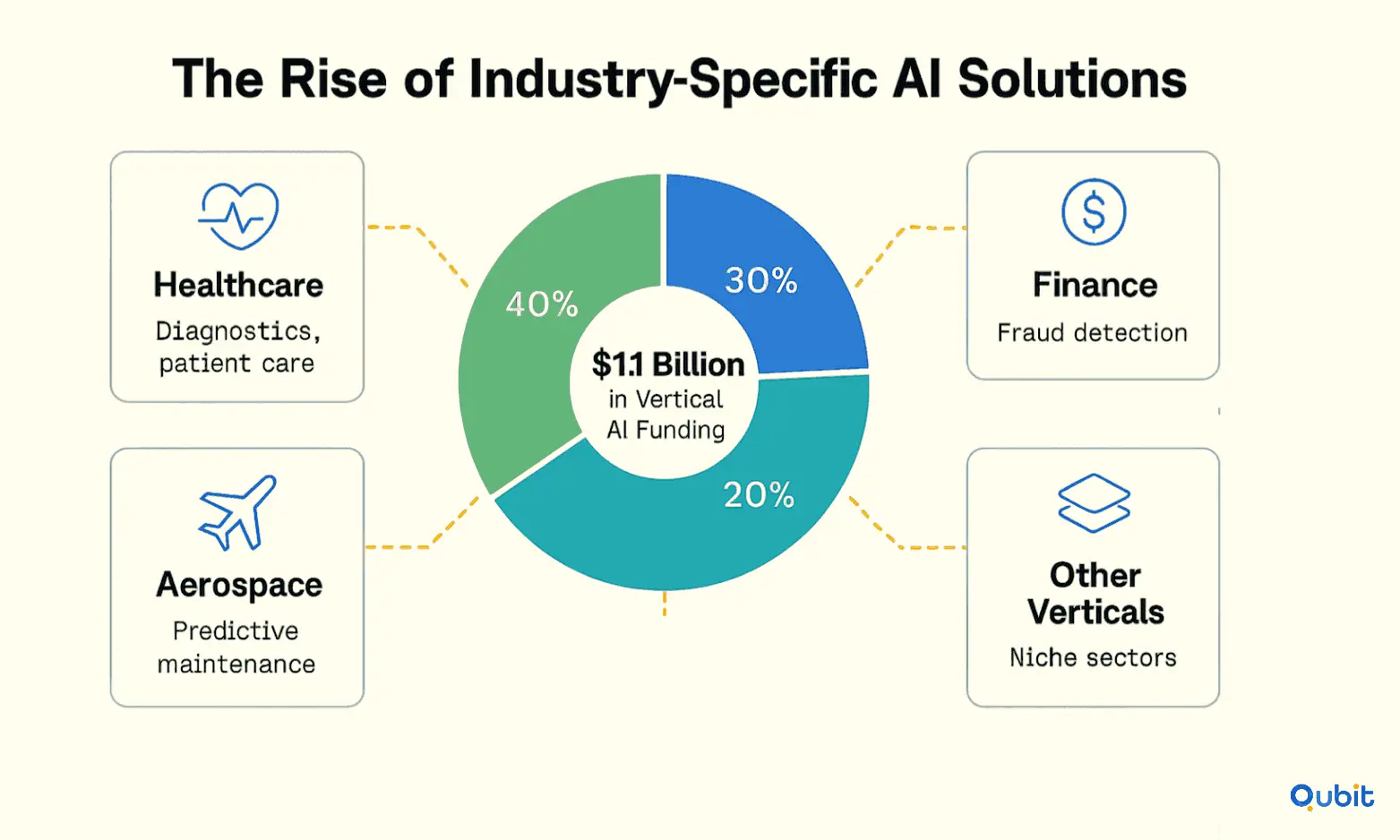
Vertical specialization in AI focuses on creating solutions that address the unique needs of specific sectors. For example, healthcare AI applications are revolutionizing diagnostics and patient care, while financial AI tools are enhancing fraud detection and risk management. Aerospace, too, is leveraging AI for predictive maintenance and optimizing flight operations.
Investor interest in these niche markets is surging. A recent statistic highlights that $1.1 billion has been funneled into vertical AI funding, underscoring the growing demand for industry-specific innovations.
Sector-specific nuances are illuminated through vertical SaaS funding trends, offering a detailed view of how AI is shaping investment opportunities in targeted industries.
Identifying Problems and Potential Risks in AI Deployment
The rapid adoption of artificial intelligence (AI) has brought transformative opportunities, but it also introduces a range of challenges. From escalating privacy concerns to the unintended consequences of biased algorithms, organizations must address these risks to ensure responsible AI deployment. Below, we outline the key challenges associated with AI implementation:
- Privacy and Security Issues: The increased reliance on vast datasets has heightened the risk of data breaches and unauthorized access. Sensitive information, if mishandled, can lead to significant reputational and financial damage.
- Shortage of Skilled AI Professionals: The demand for AI expertise far exceeds the current supply, creating a talent gap that slows innovation and complicates implementation.
- Unintended Biases in AI Models: AI systems often reflect the biases present in their training data, leading to unfair or discriminatory outcomes. These biases can undermine trust and result in regulatory scrutiny.
- Regulatory Hurdles: As governments and organizations work to establish ethical AI standards, navigating complex and evolving regulations becomes a critical challenge for businesses.
Addressing these risks requires a proactive approach, combining robust data governance, investment in talent development, and a commitment to ethical AI practices.
- Invest in robust data governance.
- Prioritize talent development.
- Adopt ethical AI principles companywide.
Evaluating Investment Opportunities in AI-Driven SaaS
AI-driven SaaS platforms present unique investment opportunities in 2026. Investors and founders should evaluate scalability, market potential, and ethical AI practices for sustainable growth.
1. Scalability: The Foundation of Growth
Scalability is a non-negotiable criterion when evaluating AI SaaS startups. A scalable business model ensures that the company can handle increased demand without a proportional rise in costs. Key indicators of scalability include:
- Cloud Infrastructure: Startups leveraging cloud-based platforms can easily scale their operations to accommodate growth.
- Automation: AI SaaS solutions that automate repetitive tasks reduce operational bottlenecks, enabling seamless expansion.
- Subscription Models: Recurring revenue models, such as SaaS subscriptions, provide predictable cash flow, supporting scalability.
2. Market Potential: Assessing Demand and Competition
Rapid market growth enhances opportunity. Global VC investment climbed from $118 billion in Q4’24 to $126 billion in Q1’25. This rising capital pool highlights why timing and scalability are vital considerations.
Understanding the market potential of an AI SaaS startup involves analyzing its target audience, industry trends, and competitive landscape. Investors should consider:
- Total Addressable Market (TAM): A large TAM indicates significant growth opportunities.
- Customer Retention Rates: High retention rates signal product-market fit and customer satisfaction.
- Emerging Trends: Aligning with broader software investment trends can provide valuable insights into market readiness and future demand.
3. Ethical AI Practices: Building Trust and Compliance
Ethical considerations are increasingly shaping the AI SaaS landscape. Startups that prioritize transparency, fairness, and compliance with data privacy regulations are better positioned to gain trust and avoid legal pitfalls. Key aspects to evaluate include:
- Bias Mitigation: AI models should be designed to minimize bias and ensure fairness.
- Data Privacy: Adherence to regulations like GDPR and CCPA demonstrates a commitment to protecting user data.
- Explainability: AI systems should provide clear, understandable outputs to foster user confidence.
By focusing on these criteria, investors can identify startups with the potential for sustainable growth, while founders can align their strategies to attract funding and build trust.
Actionable Strategies: How Startups Can Attract Funding in 2026
AI-driven SaaS platforms seeking funding in 2026 should consider these strategies:
Use this checklist when preparing for fundraising: Ensure scalable infrastructure, industry fit, ethical compliance, and strong traction metrics.
Founder Ownership Retention as a Funding Strategy
Building on these strategies, maintaining founder ownership is increasingly valued by investors in AI SaaS startups. Retaining majority control incentivizes founders to pursue long-term innovation and strategic growth. This approach reassures investors that leadership remains committed and aligned with the company’s vision. Founder control can also foster resilience during market fluctuations, strengthening trust and stability.
- Demonstrate scalability: Investors favor platforms that can efficiently scale operations and revenue without proportional cost increases.
- Showcase vertical expertise: Tailoring solutions to specific industries increases perceived value and funding potential.
- Prioritize ethical AI: Transparent, bias-mitigated, and privacy-compliant AI models build trust with both customers and investors.
- Leverage data-driven narratives: Use clear metrics and outcomes to illustrate traction and market fit.
Leveraging Accelerators and Mentorship for Funding Success
- Identify reputable AI accelerator programs offering tailored funding, mentorship, and prototyping support for early-stage SaaS startups.
- Apply to mentorship initiatives that connect founders with industry experts, investors, and commercialization partners for strategic guidance.
- Participate in cohort-based programs to access market exposure, networking opportunities, and hands-on coaching to accelerate growth.
Conclusion
AI-driven SaaS isn’t just riding the current funding wave, it’s shaping where the next waves break. Capital is flowing faster, rounds are bigger, and vertical specialists are pulling ahead, but the bar is higher than ever: real scalability, clear market need, and visibly responsible AI.
For founders, that means you can’t pitch “AI” as the story. It supports the story: defensible data, repeatable outcomes, and a business model that can survive when hype cools. Tight governance, ethical guardrails, and founder alignment are now part of the investment checklist, not nice-to-haves.
The winners will be the startups that pair technical ambition with operational discipline, and turn investor curiosity into long-term conviction.
A well-defined perspective not only strengthens your pitch but also builds trust with potential investors. Convert proof into proceeds, partner with our SaaS fundraising assistance and run a focused, data-forward raise.
Key Takeaways
- AI-driven SaaS platforms are revolutionizing funding and innovation.
- Agentic AI and data-centric strategies are key growth drivers.
- Human-AI collaboration significantly boosts productivity.
- Vertical specialization and ethical standards are critical for investment success.
- Evaluating scalability and market potential is essential when considering investments.
Get your round closed. Not just pitched.
A structured fundraising process matched to your stage and investor fit.
- Fundraising narrative and structure that holds up
- Support from strategy through investor conversations
- Built around your stage, model, and timeline
Frequently asked Questions
What are the top funding trends for AI-driven SaaS startups in 2026?
Key funding trends in 2026 include larger deal sizes, increased investor confidence, and vertical specialization in industries like healthcare and finance.