

 Back
Back









Table of Contents

Traditional venture capital offers funding but often lacks the strategic support necessary for sustained growth. This is where corporate investors come into play. They not only provide capital but also offer strategic partnerships, industry expertise, and access to extensive resources.
Leveraging corporate investors for growth has become a pivotal strategy. Studies show that startups backed by corporate venture capital survive longer and also achieve better financial outcomes.
In fact, according to CB Insights, startups with corporate investors are 3 times more likely to reach an initial public offering (IPO) than those without.
In this guide, you'll learn advanced strategies to attract corporate investors and how to position yourself strategically with their objectives, You’ll also discover ways to overcome potential challenges.
If you're ready to harness the power of corporate partnerships for exponential growth, read on.
Why Corporate Investors Matter for Your Startup's Success
Understanding Corporate Investors
Corporate investors are established companies that invest in startups, typically through their corporate venture capital (CVC) arms.
Unlike traditional venture capitalists who primarily seek financial returns, corporate investors are motivated by strategic objectives. Innovation, access to new technologies, and entry into emerging markets motivate corporate investors.
They provide not just funding but also resources, expertise, and networks that can accelerate a startup's growth.
Defining Corporate Venture Capital and Its Benefits
Corporate venture capital involves corporations making systematic investments into external startups.
These investments aim for financial returns and also strive to achieve strategic goals like technology acquisitions and market intelligence. The underlying theme is to foster innovation within their operations.
Key Insight: Corporate investors often look for startups that complement their existing business, fill gaps in their product lines, or provide innovative solutions that can be integrated into their offerings.
Real-Life Examples of Successful Corporate Investments
Consider Slack, the widely used communication platform.
In its early stages, Slack secured investment from corporate giants. These strategic partnerships provided more than capital—they opened doors to vast networks, integrated technologies, and co-marketing opportunities.
This collaboration led to tighter integrations between Slack and other customer relationship management (CRM) tools, enhancing value for users and propelling Slack to become a leader in its domain.
Another example is Uber's partnership with Toyota.
Toyota invested $500 million in Uber with the strategic objective of collaborating on autonomous vehicle technology. This partnership allowed Uber to utilize Toyota's manufacturing expertise while providing Toyota with insights into ride-sharing technologies.
The Impact of Corporate Investors on Startup Growth
Statistical Advantages of Corporate Partnerships
Startups backed by corporate investors often enjoy significant advantages:
- Higher Survival Rates: Access to resources and mentorship increases resilience. Studies suggest that startups with corporate backing experience higher survival rates, though specific figures vary. Corporate partnerships often provide strategic advantages that enhance long-term success compared to those without such support.
- Better Financial Outcomes: Strategic partnerships often lead to increased revenues and market share. Research indicates that startups with corporate investors tend to achieve higher revenue growth rates compared to those without, though specific growth percentages may vary by industry and context.
Strategic Benefits of Corporate Investment
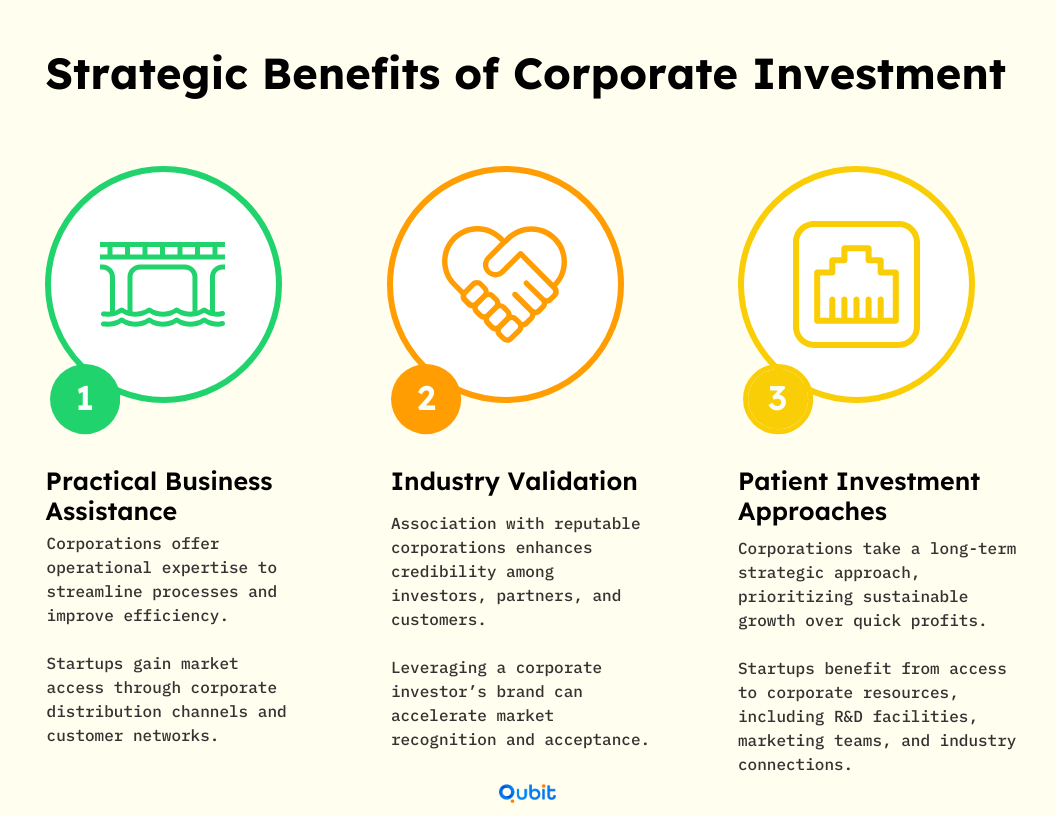
- Practical Business Assistance
- Operational Expertise: Corporations offer guidance in streamlining operations, supply chain management, and process optimization.
- Market Access: Tap into established distribution channels and customer bases.
- Industry Validation
- Credibility Boost: Association with reputable corporations enhances credibility with customers, partners, and other investors.
- Brand Recognition: Leveraging the corporate investor's brand can accelerate market acceptance.
- Patient Investment Approaches
- Long-Term Vision: Corporations may have longer investment horizons, focusing on strategic alignment over quick returns.
- Resource Commitment: Access to research and development facilities, marketing teams, and other resources.
To dive deeper into how these strategic benefits play out, explore our comprehensive guide on advanced corporate investment strategies.
Understanding Different Types of Investors in Startups
While corporate investors offer unique benefits, it's essential to understand how they differ from other investor types. Familiarizing yourself with the different types of investors can help tailor your approach and maximize your chances of success.
Positioning Your Startup with Corporate Investors
Why Strategic Alignment Matters
A successful partnership depends on the alignment of your startup's goals and values with those of a corporate investor.
Strategic misalignment can lead to conflicts, hinder decision-making, and ultimately stunt growth. Conversely, when both parties share a common vision, the partnership can accelerate innovation and market penetration.
The Importance of Shared Goals and Values
- Mutual Growth: Shared objectives ensure both the startup and the corporate investor benefit from the partnership.
- Reduced Conflict: Alignment minimizes the risk of disagreements that can derail progress.
- Enhanced Innovation: Collaborating toward common goals fosters an environment conducive to innovation.
Case Example: When Dropbox partnered with a major technology company, both entities shared an interest in enhancing productivity solutions. This strategic alignment led to seamless integrations between Dropbox and Microsoft Office, benefiting users of both platforms and expanding market reach.
Personalization Techniques to Attract Corporate Investors
A clear insight into corporate investor psychology is key to crafting a compelling pitch. Here are techniques to ensure strategic alignment:
- Tailor Your Pitch to Corporate Culture
- Research Corporate Values: Understand the company's mission, values, and strategic objectives.
- Align Messaging: Use language and examples that resonate with their corporate ethos.
- Highlight Mutual Benefits
- Value Proposition: Clearly articulate how the partnership will help achieve shared goals.
- Strategic Synergies: Demonstrate how your startup's technology or service complements the corporate investor's offerings.
- Use Storytelling Techniques
- Emotional Connection: Use narratives that resonate with the corporate's brand and history.
- Success Stories: Share testimonials or case studies that highlight your impact.
For more advanced strategies on aligning with corporate investors, check out our detailed strategies for aligning with corporate investors.
Templates and Checklists for Strategic Alignment
To assess alignment effectively, use the following checklist:
- Mission Alignment: Do your startup's mission and the corporate's mission align?
- Value Proposition: How does your product or service add value to the corporate investor?
- Cultural Fit: Is there compatibility in work culture and ethics?
- Long-Term Goals: Do both parties have similar long-term objectives?
- Risk Tolerance Levels: Are both parties comfortable with the associated risks?
- Investment Criteria Match: Does your startup meet the corporate's investment criteria?
Utilizing these templates can streamline your preparation process and ensure you're targeting the right corporate partners.
Advanced Strategies to Attract Corporate Venture Capital
Step-by-Step Guide to Attracting Corporate Investors
Attracting corporate investors requires a strategic and well-researched approach. Here's a step-by-step guide:
1. Research Potential Corporate Investors
- Identify Corporations with Aligned Interests
- Use industry platforms to find corporations investing in your sector.
- Analyze industry reports to identify active corporate investors.
- Analyze Past Investments
- Review their investment history to gauge their investment patterns and sectors of interest.
- Understand the size and stage of startups they've invested in.
- Understand Their Strategic Objectives
- Read annual reports, press releases, and corporate strategies.
- Look for stated goals such as entering new markets or acquiring new technologies.
2. Tailor Your Pitch to Each Corporate Investor
- Personalize Proposals
- Address specific needs and interests of the corporate investor.
- Avoid generic pitches that don't speak directly to the corporation.
- Showcase Strategic Fit
- Highlight how your startup complements their business.
- Use data and case studies to demonstrate potential synergies.
- Use Data-Driven Insights
- Present market research, customer data, and performance metrics.
- Demonstrate a clear understanding of industry trends.
3. Demonstrate Strategic Fit and Mutual Benefits
- Align with Their Innovation Goals
- Show how your startup adds value to their innovation roadmap.
- Provide examples of how integration could benefit their existing products or services.
- Provide Case Studies
- Offer examples of successful partnerships or pilots.
- Include metrics that showcase your startup's impact.
4. Use Networks and Industry Connections
- Utilize Industry Connections
- Engage with mentors, advisors, and industry leaders who can introduce you to corporate investors.
- Participate in accelerator programs that have corporate partners.
- Attend Industry Events
- Participate in conferences, trade shows, and networking events where corporate investors are present.
- Consider speaking engagements or panel participation to increase visibility.
5. Prepare Thoroughly for Due Diligence
- Organize Documentation
- Keep financial statements, business plans, and legal documents updated and readily available.
- Demonstrate Compliance
- Ensure all regulatory compliances are met.
- Be prepared to discuss intellectual property rights and protections.
- Anticipate Questions
- Prepare answers for potential questions regarding market strategy, competition, and scalability.
Understanding Corporate Investor Psychology
A clear view of what drives corporate investments is essential for building effective strategies and establishing successful partnerships:
- Strategic Interests Over Financial Returns
- Corporations may prioritize market access, technology acquisition, or talent over immediate financial gains.
- Risk Aversion
- Corporations often have lower risk tolerance compared to venture capitalists. They may prefer startups with proven concepts.
- Long-Term Outlook
- They may focus on long-term synergies rather than short-term exits.
Tip: Emphasize stability and scalability in your discussions to align with their risk profiles.
Crafting a Compelling Narrative Through Storytelling
Using storytelling can engage corporate investors effectively:
- Use the Hero's Journey Framework
- Position your startup as the hero addressing a significant market challenge.
- Incorporate Anecdotes
- Share customer success stories that highlight your impact.
- Emphasize Vision and Mission
- Connect emotionally by sharing your passion and commitment.
- Visual Aids
- Utilize compelling visuals, infographics, and prototypes to bring your story to life.
Sample Case Studies of Successful Corporate Partnerships
Case Study: Startup X's Successful Partnership with a Technology Corporation
Background: Startup X, an innovative AI solutions provider for supply chain optimization, sought to expand its market reach.
Strategy: They identified a global logistics company as a strategic partner. Startup X tailored their pitch to highlight how their AI technology could enhance the company's operational efficiency.
Outcome:
- Investment Secured: The corporation invested $10 million in Startup X.
- Strategic Alliance: The partnership included joint development initiatives.
- Growth Achieved: Startup X's revenue grew by 150% within a year, and the corporation reported a 25% increase in supply chain efficiency.
For more insights on overcoming hurdles in this process, explore the challenges and opportunities with corporate investors.
Managing the Challenges and Risks of Corporate Investment
Mitigating Risks of Accepting Corporate Investment
While corporate investments offer numerous benefits, there are potential risks to consider.
Potential Challenges and Risks
- Strategic Misalignment
- Conflicting Objectives: Corporations may have agendas that don't fully align with the startup's vision.
- Priority Shifts: Corporations might pivot their strategies, impacting the partnership.
- Example: A corporate investor may decide to exit a market central to your operations, leaving you without crucial support.
- Loss of Independence
- Influence Over Operations: Corporations may seek control over certain aspects of the startup.
- Decision-Making Constraints: Autonomy might be limited due to corporate policies.
- Example: Restrictions on partnerships with competitors of the corporate investor.
- Changing Corporate Priorities
- Market Shifts: Corporations might deprioritize the startup due to changing market conditions.
- Internal Restructuring: Mergers, acquisitions, or leadership changes can affect the partnership.
- Example: Post-merger integrations may lead to the dissolution of the venture arm supporting your startup.
Additional Risks
- Intellectual Property Concerns: Risk of IP leakage or misappropriation.
- Cultural Clashes: Differences in corporate and startup cultures leading to operational friction.
- Dependence Risk: Over-reliance on one corporate partner can jeopardize stability if the relationship sours.
Strategies to Mitigate Risks and Challenges
- Establish Clear Agreements
- Define Roles and Expectations: Clearly outline the responsibilities of each party in formal agreements.
- Set Mutual Goals: Establish shared objectives to guide the partnership.
- Legal Protections: Work with experienced legal counsel to protect your interests.
- Maintain Open Communication
- Regular Updates: Maintain consistent communication channels with designated liaisons.
- Feedback Mechanisms: Implement systems for constructive feedback and conflict resolution.
- Transparency: Be upfront about challenges and changes within your startup.
- Diversify Partnerships
- Avoid Over-Reliance: Engage with multiple partners or investors to spread risk.
- Maintain Independence: Preserve core decision-making authority within your startup.
- Plan Exit Strategies
- Termination Clauses: Include provisions for a mutual or unilateral exit under specific conditions.
- Contingency Plans: Develop alternative strategies in case the partnership ends abruptly.
Managing Negotiations with Corporate Investors
Awareness of corporate investor psychology matters significantly during negotiations with corporate investors:
- Address Risk Concerns
- Highlight mitigation measures and demonstrate a proactive approach to managing risks.
- Emphasize Value Alignment
- Focus on shared values and mutual benefits to build trust.
- Maintain Professionalism
- Balance assertiveness with flexibility.
- Recognize that corporate decision-making processes can be slower due to internal hierarchies.
For an in-depth exploration of negotiation strategies, refer to our guide on negotiating corporate partnerships.
Sector-Specific Insights on Corporate Investments
How Corporate Investments Impact Different Sectors
Different industries have unique dynamics when it comes to corporate investments. Updating your strategies accordingly enhances your appeal.
Technology Sector
- Rapid Innovation Pace
- Corporations seek startups to stay ahead in innovation.
- Emphasize your agility and cutting-edge solutions.
- Data Security Concerns
- Highlight robust security measures and compliance certifications.
- Integration Potential
- Showcase how your technology can smoothly integrate with existing systems.
Example: Cybersecurity startups partnering with tech giants to enhance protective measures across platforms.
Healthcare Sector
- Regulatory Compliance
Demonstrate adherence to healthcare regulations like HIPAA.
- Patient Outcomes
Focus on how your solution improves patient care and outcomes.
- Ethical Considerations
Address ethical aspects transparently, such as data privacy.
Example: Digital health startups collaborating with pharmaceutical companies to develop patient-centric solutions.
Energy Sector
- Sustainability Focus
Align with environmental, social, and governance (ESG) goals.
- Innovation in Renewables
Provide solutions that enhance efficiency in renewable energy sources.
Example: Clean energy startups attracting investments from traditional oil and gas companies transitioning to sustainable practices.
Staying Ahead with Industry Trends
- Sustainability and ESG
Corporations are investing in eco-friendly solutions to meet sustainability goals.
- Digital Transformation
There's a push toward digitization across sectors like manufacturing and retail.
- Artificial Intelligence and Automation
High interest in technologies that enhance efficiency and reduce costs.
Tip: Stay informed about industry trends and align your offerings to meet emerging demands.
Sector-Specific Sample Case Studies
Case Study: FinTech Startup Z's Alliance with a Financial Corporation
Background: FinTech Startup Z developed an AI-driven fraud detection system for financial transactions.
Strategy: Recognizing the corporation's commitment to enhancing security measures, Startup Z tailored their pitch to highlight how their technology could reduce losses due to fraud.
Outcome:
- Investment Secured: The corporation invested $15 million and entered into a strategic partnership.
- Integration Achieved: The fraud detection system was integrated into the corporation's platforms, reducing fraudulent transactions by 40%.
- Market Expansion: Startup Z gained credibility, leading to contracts with other major financial institutions.
Understanding Cultural Considerations in Different Industries
To succeed, you must grasp the nuances of industry culture:
- Corporate Etiquette
- Adhere to industry-specific professional norms, including communication styles and dress codes.
- Decision-Making Processes
- Recognize hierarchical structures within corporations and adjust your approach accordingly.
- Communication Styles
- Adapt your messaging to resonate with industry professionals, whether it's data-driven, customer-focused, or innovation-centric.
Tip: Engage with industry insiders or consultants to gain insights into the corporate culture of your targeted sector.
Conclusion
Using corporate investors can be transformative for startups aiming for accelerated growth. By understanding their impact, aligning strategically, and employing advanced attraction strategies, you unlock unparalleled opportunities.
Remember, every corporate partnership is unique, and success hinges on mutual value creation and clear communication.
Key Takeaways
- Align with Corporate Investors Strategically
Ensure your startup's goals and values align with potential corporate partners to foster mutually beneficial relationships.
- Understand Corporate Investor Psychology
Recognize that corporate investors prioritize strategic alignment and long-term synergy over immediate financial returns.
- Tailor Your Pitch and Storytelling
Personalize your approach by addressing specific corporate needs and using compelling narratives to engage investors.
- Prepare Thoroughly for Due Diligence
Organize documentation, ensure compliance, and anticipate investor concerns to demonstrate professionalism and readiness.
- Mitigate Risks Proactively
Establish clear agreements, maintain open communication, and plan exit strategies to navigate potential challenges.
- Leverage Networks and Industry Connections
Utilize industry events, mentors, and advisors to connect with corporate investors and expand your reach.
- Stay Informed About Industry Trends
Align your offerings with current trends like sustainability and digital transformation to enhance appeal.
- Customize Strategies for Different Sectors
Tailor your approach based on sector-specific dynamics, regulations, and cultural considerations.
- Diversify Partnerships
Avoid over-reliance on a single investor by engaging with multiple partners to spread risk.
- Seek Professional Support
Consider partnering with firms like Qubit Capital to navigate the complexities of corporate investments effectively.
Final Thoughts
Engaging with corporate investors requires a nuanced approach that combines strategic alignment, advanced pitching techniques, and an understanding of investor psychology.
The insights and strategies outlined in this guide enable startups to position themselves effectively and attract corporate venture capital. Eventually, this will drive sustainable growth.
Preparation and personalization are key. Adjust your approach to each potential corporate partner, and be proactive in addressing risks and matching objectives.
We specialize in connecting innovative startups with the right corporate investors. Our expertise lies in facilitating partnerships that drive growth and foster innovation. Whether you're navigating the complexities of corporate venture capital or seeking strategic advice, we're here to support you.
Contact Qubit Capital today to discover how we can support your journey toward success.
Frequently asked Questions
What Are Corporate Investors?
Corporate investors are established companies that invest in startups to foster innovation and gain competitive advantages. They typically operate through corporate venture capital arms and offer not just funding but also resources, expertise, and strategic partnerships.