

 Back
Back







Table of Contents

Recent years have seen stable capital availability in travel tech. In 2023-2024, startup funding volume held near $5.2 billion globally. This signals investor confidence despite shifts toward B2B ventures and later-stage rounds. For founders, it means the Series B environment remains highly competitive with significant opportunities for scale.
This stage demands a clear understanding of metrics that investors prioritize, such as revenue growth, customer acquisition costs, and scalability potential. By analyzing benchmarks tailored to the travel industry, founders can refine their strategies and position their businesses for sustainable growth.
The overview provided by the travel startup fundraising strategies piece sets a comprehensive groundwork for understanding the evolution of funding approaches in travel start-ups. Building on this foundation, this article delves into actionable insights and benchmarks that define Series B success.
From recent funding trends to real-world examples, we’ll explore how travel start-ups can achieve scalability and attract investor confidence.
Series B Metrics: What Does Series B Mean for Your Travel Startup?
Series B financing typically marks your shift from proving product-market fit (Series A) and building out your commercial engine to scaling efficiently and competing at greater scale. The series B funding stage in travel startups must focus on ARR, CAC, LTV, monthly user growth, and gross margin. These benchmarks attract investor interest and drive scaling.
Investors at this stage want to see evidence of traction, repeatable revenue streams, and clear scalability pathways. Understanding the key metrics relevant to your travel startup—and how investors assess these—is critical to successfully raising Series B funds.
Startups like yours already closed their rounds with us.
Founders across every stage and industry. Here's what it took.
- Raised $7.6M for Swiipr Technologies
- Raised $0.5M for Ap Tack
- Raised €0.5M for Ivent Pro

What Are the Essential Series B Metrics for Travel Startups?
Investors compare CAC against LTV. This helps them assess your startup’s efficiency and profitability. CAC (Customer Acquisition Cost) is how much you spend to acquire a new customer. LTV (Lifetime Value) is the total revenue a customer brings during their relationship with your startup.
Here are the series b metrics travel startup investors scrutinize:
1. Annual Recurring Revenue (ARR)
At Series B, demonstrating consistent and scalable revenue growth is paramount. Travel startups are typically expected to reach an ARR benchmark of at least $5 million to $10 million.
Industry Benchmark: Most Series B travel startups exhibit growth rates between 100% and 200% year-over-year.
2. Customer Acquisition Cost (CAC)
CAC measures how much your startup spends to acquire each new customer. Investors compare CAC against LTV. This helps them assess your startup’s efficiency and profitability.
Industry Benchmark: A healthy CAC for scaling travel startups is typically under 30% of LTV.
3. Customer Lifetime Value (LTV)
LTV indicates the revenue each customer generates throughout their relationship with your startup. High LTV suggests robust customer retention and monetization strategies.
Industry Benchmark: Ideally, your LTV-to-CAC ratio should be at least 3:1 or higher for travel startups at Series B stage.
4. Monthly Active Users (MAU)
MAU shows how many users actively engage with your product each month. For travel startups, this metric proves real demand, not just curiosity-driven signups. Investors read MAU as a signal of product-market fit, retention strength, and whether growth is organic or paid-fuelled.
A rising MAU trend also validates that your product is becoming a habit, which is gold in travel where switching costs are low and loyalty is hard-won.
Industry Benchmark: Investors prefer startups with steady MAU growth rates of around 15%–20% per month.
5. Gross Margin & Profitability Pathway
Investors seek startups that clearly outline paths toward profitability, demonstrated by improving gross margins over time.
Industry Benchmark: Travel startups typically show gross margins of 50% or higher by Series B, with clear improvement trajectories.
Financial Metrics Investors Care About Most
At Series B, financial discipline becomes even more crucial. Investors often closely review these additional financial health indicators:
Revenue Growth Rate
Series B startups should demonstrate consistent revenue acceleration. Investors usually look for year-over-year revenue growth rates surpassing 100%.
Burn Rate & Runway
Burn rate and runway together show your team’s control over operations and planning.
Industry Benchmark: Aim for a runway of at least 18–24 months post-Series B funding.
Burn rate is the amount of money a startup loses each month. Runway is the number of months until you run out of cash at your current burn rate.
Churn Rate
Churn rate is the percentage of customers who discontinue service—significantly impacts LTV and growth.
Industry Benchmark: Keep churn rates ideally under 5% monthly, especially for subscription or recurring revenue travel services.
Startups looking to extend runway without additional dilution may also consider venture debt as a flexible scaling option alongside equity financing.
What Operational Benchmarks Should Travel Startups Hit at Series B?
Operational maturity is a key indicator of readiness for travel investments and Series B investors. Consider the following benchmarks:
1. Operational Scalability
Your business processes should be robust enough to support rapid expansion without compromising service quality or increasing overhead proportionately. Investors typically expect clear automation of operations, standardized processes, and scalable infrastructure.
Watch out for hidden operational costs in rapid expansion. Regulatory changes and seasonal shifts may affect scaling.
2. Team and Talent Growth
Investors closely observe your team composition, emphasizing hiring strategic roles for growth and operational leadership to meet boom standard benchmarks. A typical Series B travel startup expands to 40–100 employees, focusing heavily on leadership hires in operations, sales, marketing, and product management.
3. Market Penetration & Expansion
Demonstrating solid market penetration in existing regions and clear, data-backed expansion plans into new markets is critical. Investors favor travel startups that clearly outline international or multi-regional expansion strategies with realistic timelines.
If your story is strong but meetings stall, use investor-ready fundraising tactics for travel to tighten narrative, metrics, and pipeline.
4. Leveraging Strategic Partnerships for Growth
Strategic partnerships can accelerate market reach and revenue diversification for travel startups at the Series B stage. By collaborating with established industry players, startups gain access to new customer segments and distribution channels that might be difficult to penetrate independently. These alliances can also unlock co-marketing opportunities, technology integrations, and bundled offerings that enhance value for both partners. Investors often view strong partnerships as evidence of operational maturity and a scalable growth model.
When evaluating potential partners, focus on alignment in target markets, complementary capabilities, and shared incentives for success. Effective partnerships should be structured with clear performance metrics, mutual commitments, and mechanisms for ongoing collaboration. This approach helps ensure that both parties remain invested in the partnership’s long-term outcomes and that operational risks are minimized.
- Identify partners with established networks in your target markets to accelerate user acquisition and brand visibility.
- Negotiate terms that enable data sharing, joint marketing, or bundled services to maximize mutual benefit and operational efficiency.
- Establish regular performance reviews and communication channels to address challenges and adapt strategies as the partnership evolves.
5. Integrating AI and Automation for Scale
Integrating AI and automation into core operations enables travel startups to scale efficiently and improve unit economics. Automated systems can streamline customer service, personalize recommendations, and optimize pricing, reducing manual workload and operational costs. These enhancements often result in higher gross margins and improved customer satisfaction, both of which are attractive to Series B investors seeking scalable business models.
AI-driven insights can also support better decision-making in marketing, inventory management, and demand forecasting. By leveraging automation, startups demonstrate operational maturity and readiness for rapid growth without proportional increases in headcount or overhead. Investors may assign valuation premiums to startups that show clear, effective use of automation and AI to drive efficiency.
- Automate repetitive tasks such as booking management, customer inquiries, and payment processing to reduce errors and costs.
- Leverage AI for dynamic pricing, personalized offers, and predictive analytics to enhance user experience and revenue potential.
- Continuously monitor automation performance to ensure systems deliver measurable improvements in efficiency and customer outcomes.
Broader sector trends reinforce the need for scalable operations. The projected annual growth rate for travel and tourism stands at 5.8% over the next decade. This long-term expansion demands travel startups adopt automation and standardized processes to capitalize on sustained opportunity. For Series B readiness, aligning operations with sector momentum is essential.
What Should a Series B Metrics Checklist Include for Travel Startups?
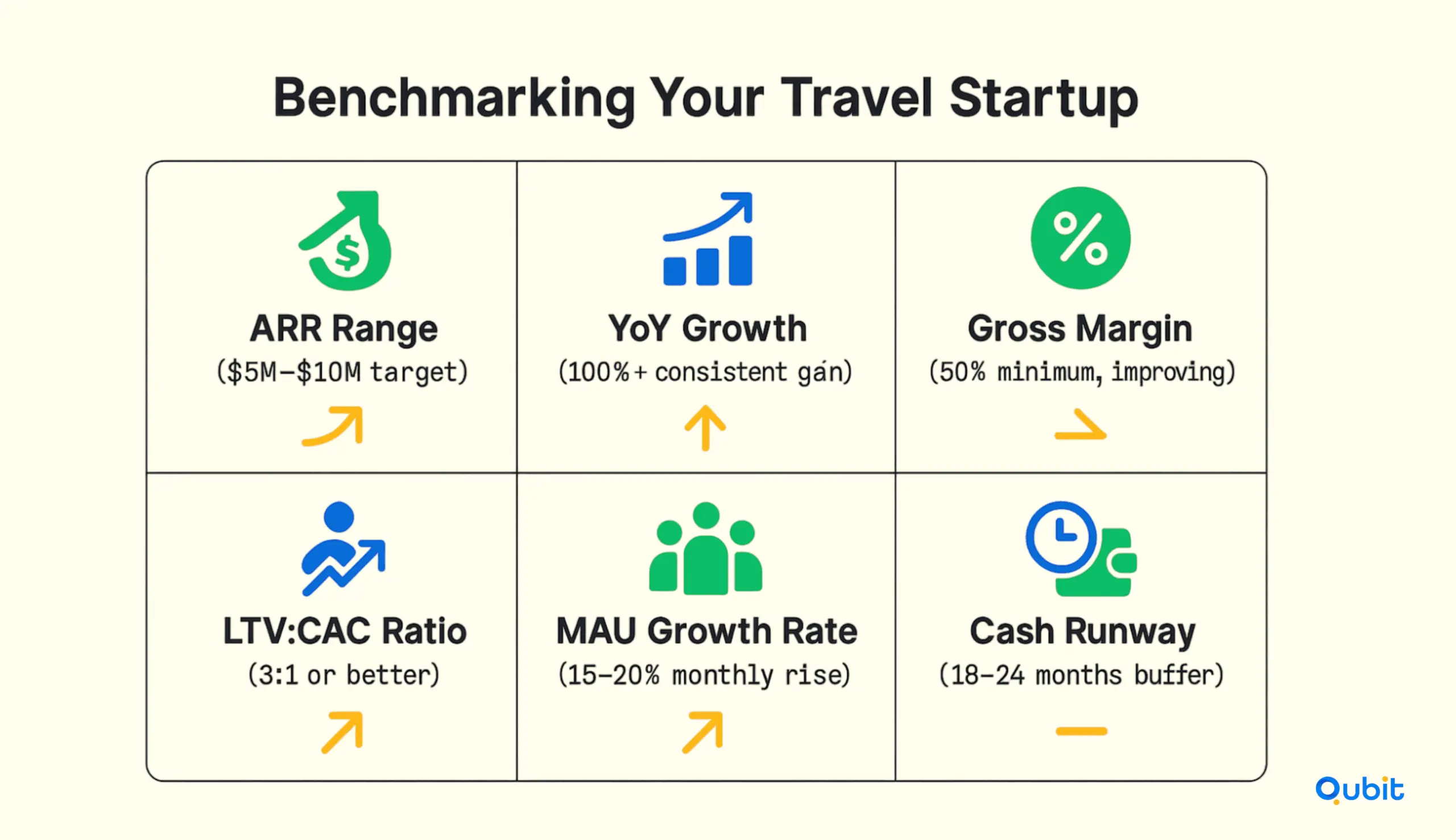
Benchmarking your travel startup for Series B metrics and milestones involves measuring your business against key investor expectations.
- ARR $5–10M
- LTV/CAC ≥3:1
- Gross margin ≥50%
- Churn <5%
- Runway >18 months
- Track MAU growth monthly
Ensure your gross margins are around 50% or higher and improving steadily. Pay close attention to customer economics: your customer lifetime value (LTV) should be at least three times your customer acquisition cost (CAC), signaling efficient growth.
Regularly track monthly active users (MAU), aiming for monthly increases of 15–20%, alongside maintaining a monthly churn rate below 5% to demonstrate strong customer retention.
Financial discipline is equally crucial, maintain a healthy cash runway of 18–24 months post-investment. By carefully aligning your business with these critical metrics, you’ll clearly demonstrate readiness and appeal strongly to Series B investors, positioning your travel startup for successful fundraising and continued growth.
Travel Price Funding Rounds: Benchmarking Success
Funding patterns in the travel sector reveal how startups position themselves for scale. Raising $36.5M across two rounds reflects a structured growth approach that many travel startups aim to replicate. Metrics tied to Series B milestones, including a $16.8M raise, are often used across the industry to assess readiness for expansion and long-term competitiveness.
Series B: A Critical Benchmark for Scaling
A Series B round in the $15M to $20M range typically signals a shift from validation to acceleration. At this stage, investors expect evidence of repeatable revenue, operational efficiency, and a clear expansion strategy. In travel startups, Series B funding functions less as runway and more as proof that the business can scale without breaking its unit economics.
Startups evaluating their own readiness often compare Series B metrics across the market. These comparisons help identify whether growth, traction, and operational maturity align with investor expectations at this stage.
Total Funding and Staged Growth
Raising capital across multiple rounds reflects a staged approach to growth. Total funding of $36.5M across two rounds aligns with a strategy where each raise supports a specific expansion objective, such as market entry, product depth, or team scaling. This phased model reduces risk while reinforcing investor confidence through measurable progress.
Comparative benchmarks highlight the paths ambitious travel startups can pursue. Ramp achieved $300 million in funding, with valuation reaching $32 billion. Their revenue and customer numbers doubled year-over-year, illustrating successful scaling at a much larger magnitude. Ramp’s journey demonstrates what’s possible for Series B and beyond, signaling attainable ambitions for growth-focused teams.
Understanding the benchmarks is only part of the equation, scaling travel startups with the right funding strategy requires aligning capital deployment with each growth stage.
Startup Series B Funding: Recent Cases and What They Signal
Recent early-stage and growth-stage funding rounds offer practical signals for startups navigating Series A and beyond. These cases show how investors are prioritizing scale readiness, regional strength, and defensible technology rather than just momentum.
In travel technology, capital concentration continues to intensify. In 2025, a small number of billion-dollar-plus deals accounted for a disproportionate share of total sector investment, reinforcing a clear pattern. Investors are backing companies with proven operational scale and credible expansion paths. For Series-stage startups, this trend raises the bar on growth ambition and execution discipline.
Atlys – Visa Tech Scaling Globally
Atlys, a travel technology platform that automates and simplifies global visa applications, raised $20 million in a Series B round co-led by Peak XV Partners (formerly Sequoia Capital India) and Elevation Capital, with participation from existing and new investors including DST Global and Headline.
The round follows rapid growth and positions the company to expand its product and engineering capabilities, enter new international markets, and scale operations to meet increasing demand from global travelers. Atlys has also expanded its presence across key regions such as the US, UAE, and UK.
Amenitiz – AI-Powered Hospitality Tech Expansion
Barcelona-based Amenitiz secured $45 million in a Series B funding round to accelerate expansion of its all-in-one hotel management platform for independent hoteliers across Europe. Led by Spanish venture capital firm Kfund through its growth fund Leadwind, with existing investors like Eight Roads and Thayer Ventures joining, the capital will be used to drive AI-driven product innovation, broaden market reach, and deepen adoption of tools that help small hotels compete with larger chains and global OTAs. The platform now supports more than 15,000 independent properties, reflecting strong scale momentum ahead of this growth investment.
Strategic Insights
These case studies emphasize the importance of aligning funding strategies with market needs, technological innovation, and customer acquisition goals. For travel startups, understanding these benchmarks can inform effective Series B scaling strategies.
To explore alternative funding approaches that align with these benchmarks, check out our detailed analysis on revenue based financing travel startup.
Conclusion
Series B is where travel startups stop selling potential and start proving durability. Investors expect predictable growth, disciplined unit economics, and operations that scale without chaos. Hitting the right benchmarks across ARR, CAC, LTV, MAU, and margins signals readiness to compete at a larger, more demanding level. Founders who treat Series B as an execution milestone, not just a funding event, position themselves for sustained growth and stronger investor confidence.
At Qubit, we understand retention cohorts, CAC payback, and scalable GTM (go-to-market strategies). Run a fast readiness audit with our travel fundraising assistance and turn metrics into momentum.
Let’s work together to scale your travel startup successfully, ensuring you’re fully prepared for your next stage of growth.
Key Takeaways
- Series B investors prioritize scalable revenue, efficient customer economics, and operational maturity over early traction narratives.
- ARR of $5–10M, LTV-to-CAC ratios above 3:1, and gross margins near 50% are baseline expectations.
- Consistent MAU growth and low churn validate real demand and long-term retention in a competitive travel market.
- Financial discipline, including burn control and 18–24 months of runway, directly impacts Series B success.
- Clear expansion strategies, automation, and strong partnerships signal readiness to scale without breaking unit economics.
Get your round closed. Not just pitched.
A structured fundraising process matched to your stage and investor fit.
- Fundraising narrative and structure that holds up
- Support from strategy through investor conversations
- Built around your stage, model, and timeline
Frequently asked Questions
What series b metrics do travel startups need to attract investors?
Travel startups raising Series B should target ARR of $5–10M, an LTV-to-CAC ratio of at least 3:1, gross margins above 50%, and monthly churn below 5%. Investors also look for strong MAU growth, predictable revenue, and at least 12 months of runway to confirm the business can scale without running out of cash.