

 Back
Back








Table of Contents

Investor interest in travel innovation is still alive and kicking, but competition has sharpened. In 2024, travel startups raised around $5.8 billion, meaning investors are choosier, not gone.
To win attention, a travel pitch deck must do more than list numbers. Investors expect emotional storytelling that clearly explains the problem, backs it with credible market data, and proves traction through unit economics and TAM. Design, clarity, and smart tech integration are no longer optional.
This guide is built for startup founders and early-stage investors who want to understand what actually makes a travel pitch deck work. It takes about seven minutes to read and walks through the key elements that help your story land and your metrics convince.
Let’s get into what separates forgettable decks from fundable ones.
How to Make a Travel Startup Pitch Deck
Your travel startup pitch deck should be designed to identify investment opportunities and present them clearly to potential investors. A travel startup pitch deck should highlight narrative, layout, and design to meet investor expectations and showcase your business potential.
1. Build a Captivating Narrative
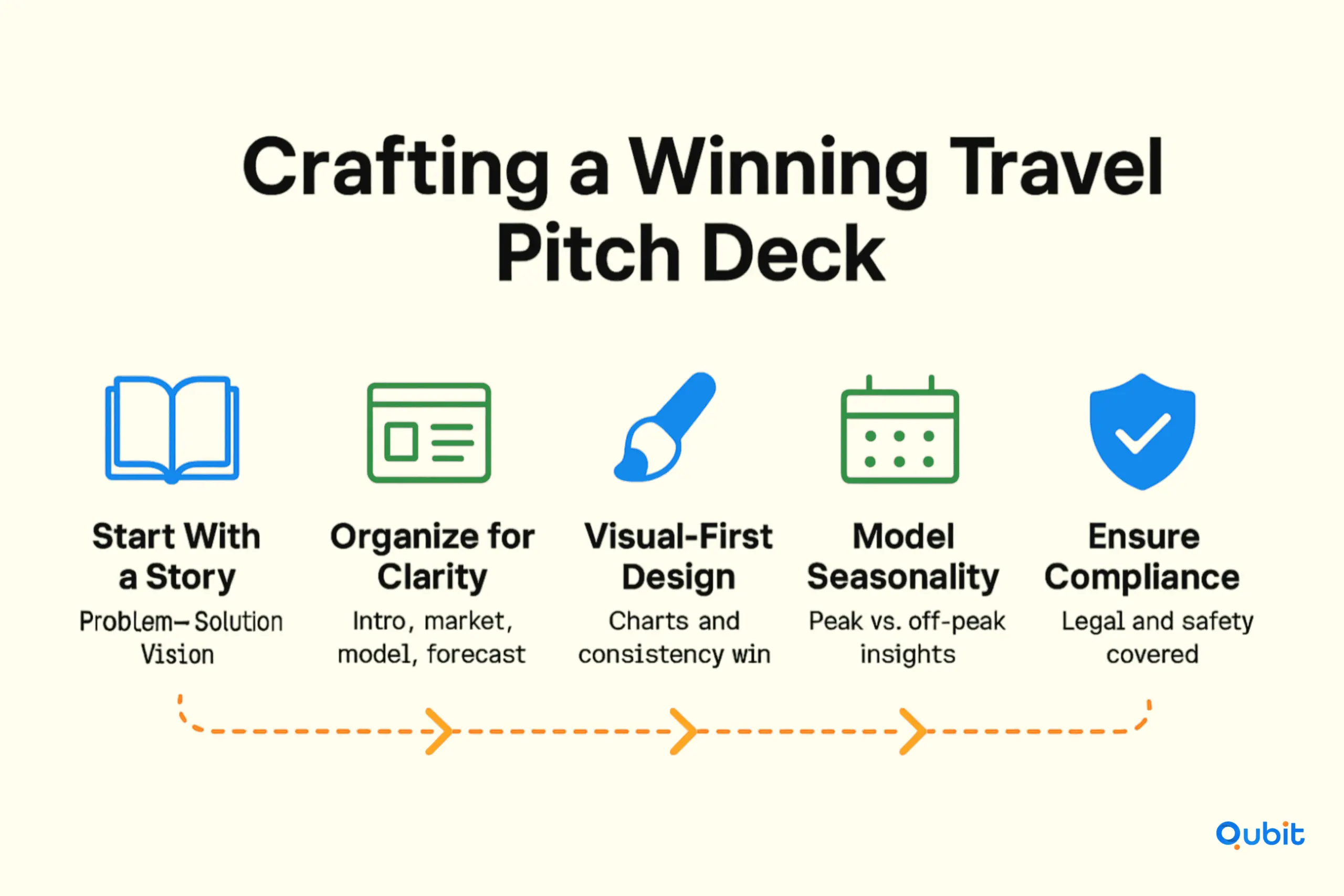
A strong narrative is the backbone of any successful pitch deck. Investors are drawn to stories that highlight the problem your travel startup solves, the unique solution you offer, and the potential impact on the market. Begin with a clear problem statement, followed by your vision and mission. Use real-world examples or customer testimonials to make your story relatable and memorable.
Early-stage pitch deck execution can attract essential capital. Uber's 2008 pitch deck secured $200K in pre-seed funding by clearly presenting its problem, unique solution, and market potential. This approach demonstrates how a sharp narrative coupled with clear business logic can drive investor commitment, making it vital for new travel ventures.
2. Structure Your Pitch Deck for Clarity
A well-organized layout ensures your message is easy to follow. Divide your pitch deck into sections such as:
- Introduction: Briefly introduce your startup and its core mission.
- Market Opportunity: Highlight the size and growth potential of the travel industry.
- Solution: Explain how your product or service addresses a specific gap.
- Business Model: Showcase how your startup generates revenue.
- Financial Projections: Provide realistic forecasts, incorporating seasonality modeling to address revenue fluctuations.
3. Use Design to Enhance Storytelling
Design elements should complement your narrative, not overshadow it. Use visuals like charts, graphs, and infographics to simplify complex data. Choose a clean, professional design with consistent fonts and colors.
4. Address Seasonality with Financial Modeling
Seasonality is a critical factor in the travel industry. Demonstrating awareness of revenue fluctuations and strategies to mitigate them will reassure investors of your preparedness. Incorporate seasonality modeling into your financial projections to show how your startup plans to maintain stability during off-peak periods.
Consider how unexpected events, like a pandemic, could affect travel demand and investor confidence.
5. Highlight Regulatory Readiness
Regulatory compliance is essential for building investor confidence. An exploration of compliance considerations shows that the travel startup regulatory checklist outlines how systematic regulatory measures contribute to a credible investment narrative. Include this in your pitch deck to emphasize your startup’s readiness for industry challenges.
6. Tailor Your Pitch for Funding Stage and Investor Type
Adapting your pitch deck for the specific funding stage and investor type can significantly improve your chances of success. Early-stage investors often seek clear problem statements, compelling vision, and evidence of initial traction, while later-stage investors prioritize financial projections, scalability, and defensible differentiation. Understanding these differences allows you to emphasize the most relevant aspects of your business at each stage.
For angel investors or seed funds, focus on the founding team’s expertise, the uniqueness of your solution, and early customer validation. For venture capitalists or institutional investors, highlight robust market analysis, growth metrics, and a clear path to profitability. Each investor type brings different expectations and risk tolerance, so customizing your narrative and data detail is crucial.
- Research the background and investment focus of each target investor to align your pitch with their interests and portfolio themes.
- Adjust the depth of financial modeling and market data based on whether you are raising seed, Series A, or later-stage capital.
- Prepare multiple versions of your deck, each emphasizing the elements most valued by the intended audience for maximum impact.
Startups like yours already closed their rounds with us.
Founders across every stage and industry. Here's what it took.
- Raised $7.6M for Swiipr Technologies
- Raised $0.5M for Ap Tack
- Raised €0.5M for Ivent Pro

Showcase Unit Economics and TAM Validation
Investors need proof that your business model works at the individual transaction level before they believe in scale. Unit economics, showing customer acquisition cost (CAC), lifetime value (LTV), and contribution margin per customer, demonstrates whether each sale generates sustainable profit. Pair this with Total Addressable Market (TAM) analysis to show the revenue ceiling your startup can reach.
For travel startups, this means breaking down costs per booking, average transaction value, and repeat purchase rates. If your LTV-to-CAC ratio is 3:1 or higher, highlight it prominently. Then layer in TAM data: quantify your target market size, serviceable addressable market, and realistic penetration rates over three to five years.
Strong unit economics prove your model works today. TAM validation proves it can scale tomorrow. Together, they form the quantitative backbone that supports your emotional narrative and separates serious ventures from speculative ideas.
The competitive edge lies in proven design. Travel pitch deck templates adapted from real ventures have collectively raised over €300 million. This underscores how adopting robust structure and tested storytelling directly positions new startups for stronger fundraising outcomes.
Create Presentation Slides with AI in Seconds
AI-powered tools now enable users to generate presentation slides in mere seconds, transforming the way professionals prepare for impactful pitches. These tools combine speed with precision, ensuring visually stunning slides that maintain consistent branding throughout your deck.
The integration of AI into slide creation not only accelerates the process but also guarantees high-quality visuals tailored to your needs. Whether you're showcasing travel destinations or presenting business strategies, these tools simplify the design process while delivering professional results.
The Most Critical Slides for Travel Startups
Not all slides carry equal weight in travel startup pitches. The problem slide is your most important opportunity—investors must viscerally understand the friction, pain, or gap your startup eliminates. For travel ventures, this means illustrating booking complexity, hidden fees, fragmented planning, or unmet traveler needs that existing solutions ignore.
Your market opportunity slide ranks second in importance. Travel is vast, so investors need proof you're targeting a specific, addressable segment with quantifiable demand. Show TAM with credible sources, then narrow to your serviceable market and realistic penetration over three years.
The business model slide separates viable ventures from concepts. Clearly demonstrate your revenue streams, transaction fees, subscriptions, commissions, or hybrid models, and show margin structure. Travel investors have seen countless ideas fail on unit economics, so prove yours work.
Finally, the traction slide validates everything else. Real bookings, partnerships with hotels or airlines, user retention data, or revenue growth prove market acceptance beyond your pitch narrative.
Common Pitch Deck Mistakes to Avoid
Even strong travel startups sabotage their fundraising with preventable errors. Overloading slides with text is the most frequent mistake, investors lose interest when forced to read paragraphs instead of absorbing key points visually. Keep slides to one core idea each, using bullet points sparingly and visuals generously.
Another critical error is presenting unrealistic financial projections without supporting logic. Claims of 10x growth with no explanation of customer acquisition strategy or market penetration rates signal inexperience. Ground your forecasts in defensible assumptions tied to unit economics and addressable market data.
Neglecting the competition is equally damaging. Stating "we have no competitors" suggests poor market research. Instead, acknowledge competitors honestly and articulate your differentiation clearly—whether through technology, customer experience, pricing model, or market positioning.
Finally, failing to clarify your funding ask and use of proceeds leaves investors uncertain about next steps. Specify exactly how much you're raising, what milestones the capital will achieve, and your expected runway. Clarity builds confidence and accelerates decision-making.
Conclusion
Throughout this blog, we’ve explored strategies to structure your pitch deck effectively, emphasizing the importance of emotional engagement and clarity. From showcasing your vision to highlighting market opportunities, every element plays a role in capturing attention and driving interest.
A well-structured travel startup pitch deck communicates your business potential and builds trust with investors. If you’re looking to make investors lean in by slide three, at Qubit we understand seasonality curves, route/unit economics, and distribution through Online Travel Agencies (OTA) and Global Distribution Systems (GDS).
Upgrade your deck with our travel fundraising assistance and book a quick pitch audit.
Key Takeaways
- Investor interest in travel startups is still strong, but competition means only clear, well-designed decks get attention.
- A compelling narrative that blends emotional storytelling with credible data is essential to stand out.
- Clear structure and logical flow help investors quickly understand the problem, solution, and business model.
- Strong design enhances storytelling by making complex data easy to absorb, not by adding visual noise.
- Seasonality modeling is critical in travel and signals that founders understand revenue volatility and risk.
- Unit economics and TAM validation are non-negotiable, proving both near-term viability and long-term scale.
- Pitch decks must be tailored by funding stage and investor type to meet different risk and information expectations.
- Regulatory readiness and compliance strengthen credibility and reduce perceived execution risk.
Get your round closed. Not just pitched.
A structured fundraising process matched to your stage and investor fit.
- Fundraising narrative and structure that holds up
- Support from strategy through investor conversations
- Built around your stage, model, and timeline
Frequently asked Questions
What are common mistakes in a travel startup pitch deck?
Common mistakes in a travel startup pitch deck include too much text, unclear market analysis, and missing a compelling story. Focus on clarity, data, and emotional impact.