

 Back
Back










Table of Contents

Crafting a financial model that genuinely inspires investor confidence is a core advantage in fintech, not a nice-to-have. With market revenues projected to reach $1.5 trillion by the end of the decade, investors have plenty of options, so they back the founders who can clearly show how strategy, product, and go-to-market translate into believable numbers.
A strong model does more than forecast revenue. It tells a clear story, uses simple visuals to make complex data easy to grasp, and stays tightly aligned with your broader business objectives.
This guide will walk you through how to build that kind of investor-ready financial model, one that signals discipline, clarity, and real upside.
Building Reliable Financial Models for FinTech Startup Success
A financial model for fintech startup success acts as the backbone of strategic planning. It offers clarity and direction for growth. Investors rely heavily on financial projections to assess scalability, profitability, and risk, making the accuracy and reliability of these models paramount. Let's see how:
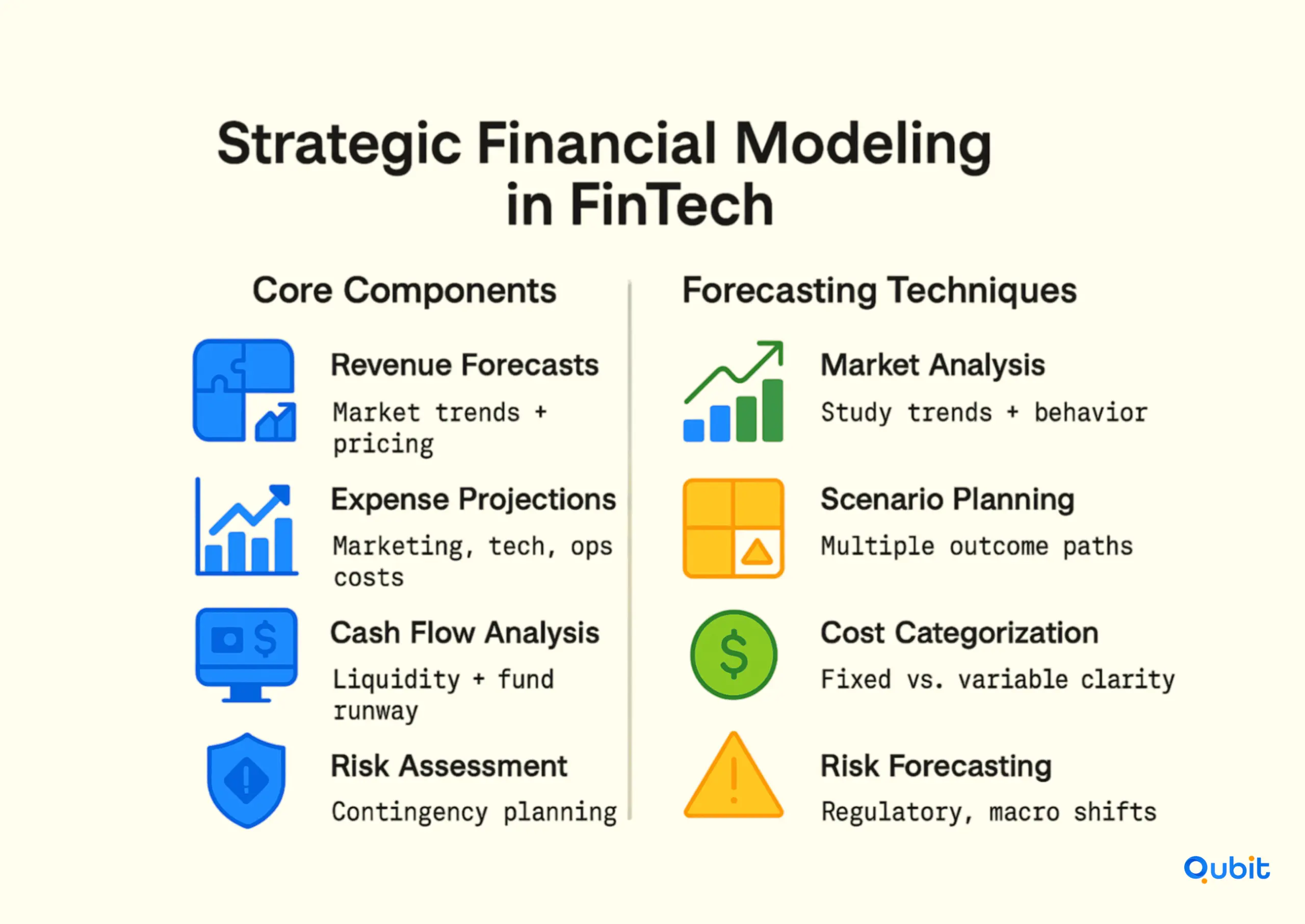
The Strategic Role of Financial Models
Financial projections are often described as a roadmap for business planning. This analogy highlights their importance in helping fintech startups align their operational goals with long-term financial objectives. Robust financial models serve as a strategic roadmap for early-stage fintechs, ensuring they can adapt to market dynamics while maintaining focus on growth.
On the investor side, expectations are high. Many of the people you’re pitching are accredited investors, typically defined as having $1 million in net worth (excluding a primary residence) or $200,000 in annual income. When you’re in front of that crowd, your financial model has to match the level of sophistication in the room, clear assumptions, consistent logic, and numbers that stand up to serious scrutiny. That’s how you earn real confidence, not just polite nods.
Key Components of Reliable Financial Models
A well-constructed financial model includes several critical elements:
- Revenue Forecasts: Predicting income streams based on market trends, customer acquisition rates, and pricing strategies.
- Expense Projections: Accounting for operational costs, marketing budgets, and technology investments.
- Cash Flow Analysis: Ensuring liquidity to sustain operations and fund growth initiatives.
- Risk Assessment: Identifying potential challenges and preparing contingency plans.
- Data Validation: Using accurate, up-to-date data to ensure projections are realistic and actionable.
Integrating Top-Down and Bottom-Up Forecasting
Building on established forecasting techniques, founders should combine top-down market sizing with bottom-up internal data for balanced projections. Top-down analysis estimates market opportunity using TAM, SAM, and SOM, while bottom-up forecasting relies on actual sales and cost data. Integrating both methods produces financial models that are credible, data-driven, and persuasive to investors. This approach supports strategic planning and strengthens fundraising narratives.
Insights into FinTech Business Models
Fintech companies operate differently from traditional financial institutions. Their reliance on technology, scalability, and innovative revenue streams sets them apart. For instance, fintech revenues are projected to grow at 15% annually compared to just 6% for traditional banks between 2023 and 2028. This growth edge underscores the importance of tailoring financial models to reflect the unique dynamics of fintech operations.
Techniques for Forecasting Revenue and Expenses
- Market Analysis: Study industry trends and customer behavior to predict revenue growth.
- Scenario Planning: Develop multiple projections based on varying market conditions.
- Cost Categorization: Break down expenses into fixed and variable costs for better tracking.
Validating MVPs for Compliance and Safety
Beyond standard risk analysis, fintech founders should validate MVPs early for regulatory compliance, operational safety, and AI readiness. This process includes testing against legal requirements, security protocols, and technical standards. Early validation reduces development risk and builds investor confidence in the startup’s scalability. It also ensures smoother integration with future financial modeling efforts.
Risk Analysis and Data Validation
Risk analysis is a cornerstone of reliable financial modeling. By identifying vulnerabilities, such as regulatory changes or market volatility, fintech companies can prepare mitigation strategies. Equally important is data validation, which ensures that all inputs are accurate and reflect current market realities.
Revenue Models and Crafting Income Statements for FinTech Startup
Digital payments are fueling modern fintech revenue strategies. In July 2025, UPI processed 19.47 billion transactions in India alone, illustrating how transaction-fee-based models can scale. For fintech startups, this kind of volume isn’t just a growth story, it directly shapes how revenue lines, assumptions, and sensitivity analyses show up in the income statement.
FinTech startups thrive on diverse revenue streams, each tailored to their unique business models. Transaction fees, subscription services, and freemium offerings are among the most popular strategies, enabling companies to monetize user engagement effectively. For example, subscription models provide predictable income, while freemium services attract a broad user base with the potential for upselling premium features.
Crafting accurate income statements and cash flow projections is equally critical. These financial tools offer a clear snapshot of a startup’s fiscal health, helping founders identify trends, allocate resources, and plan for sustainable growth.
Tracking Key Performance Metrics for FinTech Startup Success
Key performance indicators (KPIs) such as Customer Acquisition Cost (CAC: cost to acquire a customer), Customer Lifetime Value (CLV: total revenue from a single customer), and churn rate provide actionable insights into operational efficiency and growth potential.
CAC highlights the cost-effectiveness of marketing strategies, while CLV measures the long-term profitability of acquired customers. Monitoring churn rate ensures customer retention strategies remain robust. These metrics not only guide strategic decisions but also serve as benchmarks that maintain investor confidence.
Recent sector analysis reveals changing growth dynamics: average customer growth dropped to 37% from 55% between 2020 and 2023. For fintech startups, understanding this shift is key for setting realistic KPI targets and explaining performance trends to investors during due diligence. A fintech due diligence checklist will often compare your KPIs against these sector-level benchmarks.
A close look at the fintech due diligence checklist outlines the review criteria that may arise during investor assessments of your financial model.
Modern Tools and Techniques for FinTech Startup Financial Modeling
Streamlining financial modeling in FinTech requires the right mix of tools and techniques. Advanced Excel templates, such as the Fintech Financial Model by Rafael Navarro-Rubio, CFA, offer comprehensive modules covering customer acquisition, revenue forecasting, expenses, and integrated cap tables. These templates act as blueprints for creating consistent, investor-ready projections.
API-based systems, like those provided by Currencycloud and Mambu, further enhance model accuracy by refining inputs and enabling better forecasting. Implementing API-based solutions can also unlock new revenue streams for FinTech companies, making them a practical choice for modern financial modeling.
Examining the insights presented in fintech fundraising strategies and opportunities offers you a comprehensive framework that contextualizes the financial modeling approaches discussed here.
Real-World Case Studies in FinTech Financial Modeling
1.Stripe
Stripe’s financial model exemplifies how high-volume transaction fees can fuel scalable revenue growth. As a payment processing platform, Stripe has mastered the transaction fee revenue model, enabling consistent profitability even with fluctuating user activity. This approach highlights the importance of aligning financial models with operational scalability.
2. Pangeo.io
Pangea.io, a startup focused on business foreign exchange management, showcases an exemplary fintech financial model built from the ground up. The financial model includes transaction volume forecasting for different client tiers, pricing structures, client acquisition costs, and system development expenses.
The model strategically aligns with Pangea's client acquisition processes, marketing strategies, and variable/fixed costs, enabling dynamic scenario adjustments for future growth forecasting. This approach helped Pangea secure venture capital interest by clearly communicating its revenue drivers, cost structure, and funding needs through detailed income statements and cash flow projections.
The model also supports strategic planning and investor discussions by providing key performance indicators (KPIs) tailored for fintech businesses
Conclusion
A financial model for fintech startup is more than numbers; it builds investor confidence and drives decisions.
Throughout this blog, we’ve explored essential strategies like accurate forecasting, operational planning, revenue modeling, and risk analysis. Each of these components plays a critical role in crafting a financial narrative that resonates with investors.
By implementing these actionable steps, startups can refine their financial models to not only showcase their growth potential but also address uncertainties with clarity.
If you’re looking to turn spreadsheets into investor conviction, at Qubit we understand bottom-up forecasts, unit economics, and scenario stress tests. Review your financial model using our services and be sure of what you present.
Key Takeaways
- Robust financial models are essential for building investor trust in fintech ventures.
- Accurate forecasting and effective risk analysis provide a strategic roadmap for growth.
- Diverse revenue models enhance financial transparency and operational success.
- Specialized tools and consulting services help optimize model structures.
- Emerging trends like AI integration and embedded finance are reshaping fintech financial modeling.
Frequently asked Questions
How do reliable forecasts benefit fintech startups?
Reliable forecasts in fintech financial models guide strategic planning, help secure investor trust, and support sustainable growth by mitigating key risks.