

 Back
Back










Table of Contents

Securing funding is a critical milestone for startups, often achieved through initial capital-raising efforts. However, unforeseen challenges or strategic opportunities can demand additional financing before the next major funding round. This is where bridge rounds come into play. Acting as a short-term solution, bridge rounds provide startups with the financial runway needed to sustain operations, seize opportunities, or prepare for larger funding rounds.
Your exploration of bridge rounds connects with the broader overview presented in types of startup funding, offering you a contextual backdrop that frames the variety of financing options available.
This blog dives into how bridge rounds can extend a startup’s runway, offering actionable insights, real-world examples, and data-driven strategies to help founders make informed decisions.
What Is a Bridge Round of Funding and Why Does It Matter?
A bridge round of funding is a vital financing tool for startups seeking additional capital between major funding milestones. Recent market data highlights tangible impact on startup finances. In Q3 2024, Series A pre-money valuations reached a median of $45M for primary rounds and $43.6M for bridge rounds. This difference underscores the nuanced negotiation dynamics and investor perceptions shaping bridge round outcomes.
These interim rounds provide the necessary runway to sustain operations, refine products, or achieve key growth metrics before pursuing larger priced rounds. Often executed through convertible notes or direct equity investments, bridge rounds offer flexibility in structuring deals while addressing immediate financial needs.
Bridge financing meaning in venture capital refers to short-term funding that provides startups with flexibility before larger rounds.
As Venture Cap explains, venture capital firms are often the first equity source before a bridge round, setting the stage for subsequent funding opportunities. Startups typically turn to bridge rounds when seed capital begins to run low, as highlighted by Seed Funding. This strategy ensures businesses can maintain momentum without prematurely entering a Series A round or diluting equity at unfavorable terms.
The prevalence of bridge rounds is growing, with 42% of all seed-stage investments in Q1 2024 falling into this category, the highest rate in the past decade. This trend underscores their importance in the current funding landscape, particularly for early-stage companies navigating uncertain economic conditions.
For founders, understanding the nuances of bridge rounds is essential to making informed decisions about equity versus debt financing. The discussion around bridge rounds benefits from contrasting insights offered in equity vs debt financing, which presents a comparative view to help you evaluate financing trade-offs.
Startups like yours already closed their rounds with us.
Founders across every stage and industry. Here's what it took.
- Raised $7.6M for Swiipr Technologies
- Raised $0.5M for Ap Tack
- Raised €0.5M for Ivent Pro

How to Make Bridge Rounds Work for Your Strategy
A bridge round of funding can be a lifeline for startups facing transitional periods or market uncertainties. These short-term financing solutions provide essential cash infusions, enabling businesses to extend their runway, invest in growth, and prepare for larger funding rounds. By strategically using a bridge round can help startups avoid layoffs and position themselves for sustainable growth.
1. Extending Runway During Market Slowdowns
Economic downturns or unexpected delays in product development can strain a startup’s finances. Bridge rounds offer a temporary solution, ensuring operations continue uninterrupted. For example, Airbnb’s $7.2M bridge round in 2010 allowed the company to scale rapidly, leading to a $112M Series B within a year. This demonstrates how interim funding can stabilize operations and set the stage for explosive growth.
2. Supporting Strategic Hiring and Product Development
Securing bridge financing can also enable startups to invest in critical areas like hiring top talent or accelerating product development. A SaaS startup, for instance, utilized a €500K bridge round via SAFE notes to maintain momentum while preparing for its Series A. Within six months, the company raised its Series A at a 40% higher valuation, proving how short-term financing can directly impact long-term success.
3. Facilitating Market Expansion
Bridge rounds are not just about survival—they can also fuel growth initiatives like entering new markets. By allocating funds strategically, startups can achieve key milestones that attract larger investors. This trend is becoming increasingly common, with 60-70% of funding rounds in 2023-2024 classified as bridge rounds. This normalization reflects shifting investor expectations and the growing reliance on interim financing to meet ambitious goals.
4. Preventing Layoffs and Bankruptcy
When cash flow becomes tight, bridge rounds can prevent drastic measures like workforce reductions or shutting down operations. By securing temporary funding, startups can focus on improving growth metrics and preparing for future funding rounds. This approach not only stabilizes the business but also enhances its valuation potential, as evidenced by real-world examples like Airbnb and the SaaS startup mentioned earlier.
For founders exploring alternative financing options, insights on startup loans and debt options provide valuable context on how bridge rounds compare to traditional loan-based approaches.
5. Engage Lead Investors Early for Syndicate Support
Securing a successful bridge round often depends on the support of lead investors. Lead investors play a pivotal role in rallying other participants and setting terms that attract additional capital. By engaging these investors early, founders can build momentum, clarify expectations, and address concerns before they become obstacles.
Early conversations with lead investors also help align interests and establish credibility with the broader investor base. This proactive approach signals transparency and preparedness, which can increase confidence among potential syndicate members. Lead investors often assist in structuring the bridge round, negotiating terms, and facilitating due diligence, streamlining the closing process.
Founders should prioritize clear communication about funding needs, planned milestones, and intended use of proceeds when approaching lead investors. This clarity not only accelerates decision-making but also strengthens relationships for future fundraising. Ultimately, early lead investor engagement can mean the difference between a stalled bridge round and a successful capital infusion.
How to Determine the Size of Your Bridge Round of Funding
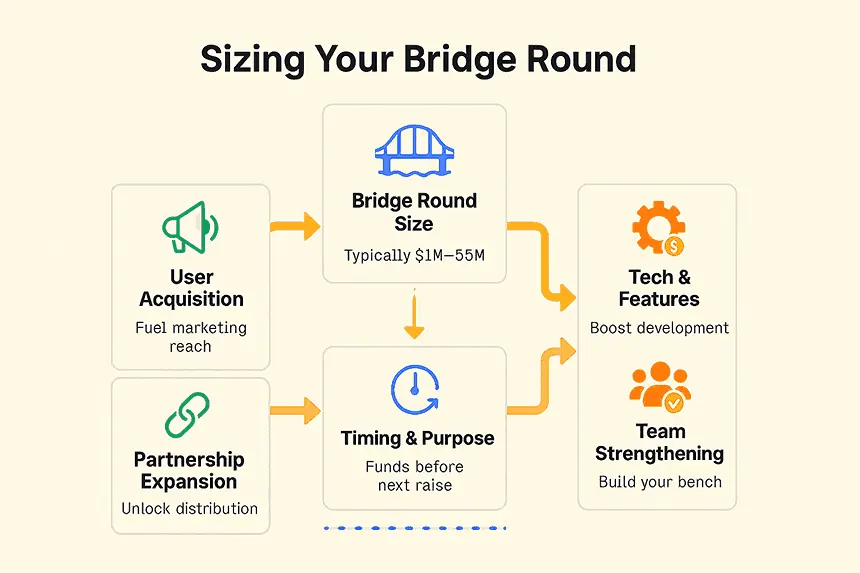
Determining the size of your bridge round is a critical step for startups aiming to secure short-term funding.
Understanding current market benchmarks sharpens negotiation. In the first half of 2025, $7.1B in venture capital was deployed, signaling increased liquidity for bridge rounds. Founders should calibrate ask sizes based on active market appetite and sector-specific norms.
These rounds are designed to address immediate financial needs while driving essential growth metrics. For instance, funds raised during a bridge round are often allocated toward user acquisition, enabling startups to expand their customer base and demonstrate market traction. Additionally, a significant portion of the capital may be directed toward product development, ensuring the business can refine its offerings and meet the demands of scaling.
Understanding how much to raise depends on your startup’s specific goals. If your primary focus is accelerating growth, you might prioritize funding for marketing campaigns or partnerships. Alternatively, if product innovation is key, investing in development teams and technology upgrades could take precedence.
By carefully assessing your startup’s immediate needs and long-term objectives, you can determine the optimal size of your bridge round and set the stage for sustainable growth. To explore alternative financing solutions beyond bridge rounds, check out our comprehensive guide on types of debt financing for startups. This resource offers a deeper understanding of short-term funding options that can complement or replace bridge financing.
Do You Really Need a Bridge Round?
Determining whether a bridge round of funding is essential requires a clear understanding of your startup’s financial health and growth trajectory. Bridge rounds often play a pivotal role during transitional phases, such as scaling operations or expanding product offerings, but they aren’t always the right solution for every funding gap. Start by assessing your cash runway, the amount of time your startup can sustain operations before running out of funds.
Why Investor Base Cohesion Matters
Funding urgency has increased as global liquidity expands. In Q2 2025, global venture funding reached $91 billion. Founders should act swiftly to secure bridge capital while conditions remain favorable. A fragmented group of investors can complicate negotiations, slow decision-making, and reduce the likelihood of securing bridge funding. Ensuring alignment among investors streamlines the process and increases the chances of a successful round. Addressing potential divisions early can help avoid delays and strengthen your funding position.
Tools like the Burn Rate Calculator provide an objective way to calculate your burn rate and forecast when your cash reserves will be depleted. This insight can help you identify whether a funding gap exists and how urgent it might be.
Bridge financing private equity solutions can also help forecast funding needs and manage cash reserves effectively. Timing is another critical factor. If your startup is facing delays in securing its next round of funding or encountering scaling challenges, a bridge round could offer the breathing room needed to maintain momentum. However, extended runway planning has become increasingly important, with many startups now budgeting for 24+ months of operations to mitigate risks tied to market fluctuations.
Ultimately, the decision to pursue a bridge round should be based on a combination of financial forecasting, operational needs, and strategic timing. If you’re unsure, consulting with experts can provide clarity and ensure your funding strategy supports sustainable growth.
Is a Bridge Round Right for Your Startup?
Bridge financing startup solutions are common in venture capital, helping companies overcome short-term hurdles. However, bridge rounds come with risks that demand careful evaluation.
Equity dilution is a significant concern, as raising funds quickly often means offering more shares to investors. According to Carta data, bridge rounds median dilution was 10.4% at Seed and 3.3% at Series D—substantially lower than the 20% typically seen in priced Seed or Series A rounds. Understanding these tradeoffs helps founders align deal terms with growth goals.
Additionally, the financial landscape for startups remains challenging, 70% of VC-backed exits in 2023 were below the total capital invested. This underscores the importance of assessing whether the potential return on investment justifies the equity trade-off.
Ultimately, the decision to pursue a bridge round should align with your startup’s immediate needs and long-term strategy. Balancing the benefits of short-term growth with the risks of dilution is key to making an informed choice.
Best Practices for Transparent Bridge Round Communication
- Provide regular updates on cash runway, burn rate, and milestones to keep investors informed and engaged throughout the process.
- Clearly communicate the purpose of the bridge round, targeted outcomes, and how new funds will be allocated to build investor confidence.
- Address investor questions promptly and share both challenges and progress to foster trust and align expectations for future funding events.
Conclusion
A bridge round of funding plays a pivotal role in extending a startup’s runway and preparing for larger funding opportunities.
By strategically utilizing these rounds, startups can secure the resources needed to fuel growth and innovation during critical phases.
Integrating data-driven funding strategies ensures that decisions are not only well-informed but also aligned with long-term goals. This approach minimizes risks and maximizes the potential for sustainable success. For startups, evaluating funding needs carefully and seeking expert guidance can make all the difference in achieving milestones effectively.
If you're ready to connect with the right investors, we invite you to explore our Investor Outreach service at Qubit Capital. Let us help you build meaningful relationships that drive your startup forward.
Key Takeaways
- Bridge rounds offer essential interim funding to extend a startup’s runway.
- They can be structured as equity or convertible notes to address immediate capital needs.
- Typical bridge rounds of funding range from $1M to $5M, aligned with key growth metrics.
- Real-world examples, such as Airbnb’s success, highlight strategic benefits.
- Utilizing tools like Burn Rate Calculators helps ensure data-driven funding decisions.
Get your round closed. Not just pitched.
A structured fundraising process matched to your stage and investor fit.
- Fundraising narrative and structure that holds up
- Support from strategy through investor conversations
- Built around your stage, model, and timeline
Frequently asked Questions
What is the difference between a bridge round and other rounds of funding?
A bridge round of funding is a short-term solution used between larger rounds of funding. Its purpose is to cover immediate expenses and buy time until a startup secures more significant investment.