

 Back
Back








Table of Contents

Securing funding is often a pivotal challenge for startups, and SAFE convertible securities have emerged as a popular solution. Recent shifts in early-stage fundraising reveal sweeping adoption rates. In Q1 2025, SAFEs comprised 90% of all pre-seed deals tracked on Carta. This signals startups are overwhelmingly favoring SAFEs for their simplicity and speed. Investors and founders should view this as validation of market-wide trust in the SAFE structure.
Your examination of SAFE convertible securities is enriched when seen as part of the broader framework outlined in types of startup funding, which interconnects various methods of raising capital. This article will demystify SAFEs, explore their advantages, and provide actionable insights for startups and investors alike. Let’s jump right in!
What You Need to Know About SAFE Convertible Securities
SAFE convertible securities simplify startup fundraising by allowing investors to convert their investment into equity at a future event. Unlike traditional convertible notes, SAFEs eliminate the complexities of debt repayment and interest accrual. This simplicity makes them particularly attractive to early-stage companies aiming to minimize overhead while securing funding quickly.
The industry-standard SAFE form, updated in 2018 to a post-money basis, further enhances transparency by clearly defining ownership percentages post-investment.
According to Carta Data, 61% of U.S. startup SAFEs in 2024 used only valuation caps, reflecting a shift toward simplified terms that reduce negotiation friction. This approach allows startups and investors to align expectations without the need for complex clauses or additional provisions.
For startups, SAFEs offer a practical solution to raise funds without the uncertainty of immediate valuations. Their flexibility and ease of use continue to make them a cornerstone of early-stage financing strategies.
How SAFE Convertible Securities Compare to Priced Equity Rounds
SAFE convertible securities offer startups a flexible way to secure funding without the immediate pressure of determining their valuation. Unlike priced rounds, which require a direct equity exchange based on the company's current market valuation, SAFE agreements delay this process.
Instead, they allow investors to convert their investment into equity at a future date, typically during a subsequent funding round. This approach is particularly advantageous for early-stage startups that may struggle to establish a fair valuation due to limited financial history or market traction.
Recent global data shows pre-seed is the fastest growing round type, now making up over 20% of all venture rounds. Founders benefit from this trend, as SAFEs enable easier pre-seed participation. This upward trajectory highlights increased demand for flexible instruments over rigid priced equity rounds.
Priced rounds, while more traditional, can complicate fundraising efforts for startups in their infancy. These rounds demand a precise valuation, which often involves extensive negotiations and legal documentation. For startups still refining their business model or scaling operations, this process can be both time-consuming and resource-intensive. SAFE agreements, by contrast, streamline the fundraising process, enabling startups to focus on growth while deferring valuation discussions to a later stage.
Insights from equity vs debt financing can further clarify the distinctions between different capital structures, offering you a comparative perspective alongside the mechanics of SAFE convertible securities.
SAFE Convertible Securities vs. Convertible Notes: Debt or Equity?
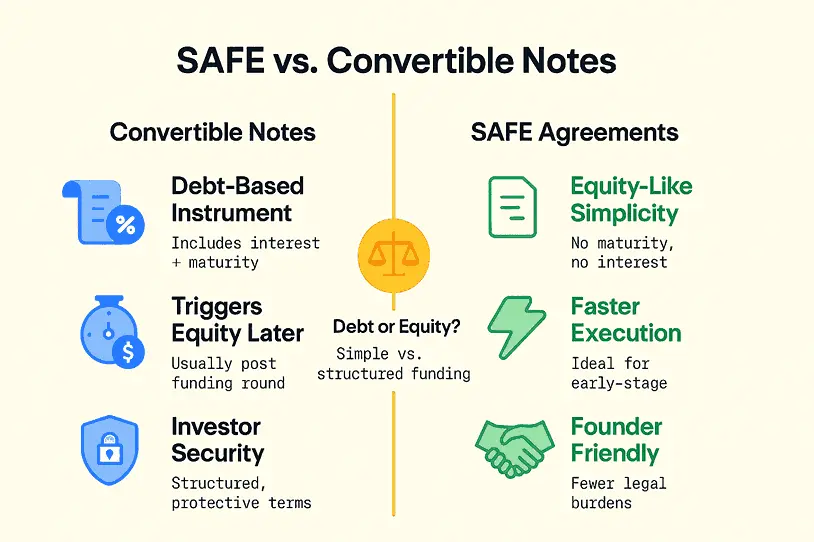
When comparing SAFE agreements and convertible notes, the distinction lies in their fundamental structure. Convertible notes are debt instruments that accrue interest and come with a maturity date, requiring repayment if they don’t convert to equity. In contrast, SAFE convertible securities eliminate these debt characteristics, offering a streamlined funding solution without repayment or interest obligations.
According to CB Insights, convertible notes accounted for over 70% of pre-Series A U.S. deals by March 2025, up from 60% in 2023. This reflects heightened demand amid startup growth and economic uncertainty. Understanding these trends can help you select the optimal instrument for your situation.
Convertible notes operate as loans that eventually convert into equity. This conversion is typically triggered by a future funding round or specific valuation.
Timing also plays a crucial role in differentiating these instruments. Convertible notes often convert at a later stage, aligning with the startup’s growth trajectory. SAFEs, however, are designed for faster execution, making them ideal for early-stage startups seeking immediate capital.
Ultimately, SAFEs prioritize simplicity and speed, while convertible notes offer structured terms that may appeal to investors seeking more security. Understanding these differences helps startups choose the right tool for their funding needs.
A comparison with debt financing for startups provides context on how alternative funding approaches differ, reflecting nuances that can emerge when evaluating SAFE agreements against borrowing strategies.
Pre-Money vs Post-Money SAFEs: Dilution and Ownership Impact
When Should You Choose SAFE Convertible Securities?
SAFE convertible securities are often the preferred choice for startups when valuation uncertainty looms large. These agreements allow founders to secure funding without the immediate need to determine a precise company valuation, making them ideal during early-stage fundraising or volatile market conditions.
Startups benefit from SAFE convertible securities when market conditions make valuation difficult or when quick fundraising is essential. However, not every business structure can issue SAFEs efficiently. C-corporations are uniquely positioned to utilize SAFE agreements due to their legal framework, which supports equity-based fundraising.
Other entities, such as LLCs, may encounter complications because their structure lacks the mechanisms to issue securities in the same way. This distinction underscores the importance of aligning your corporate structure with your fundraising strategy.
By choosing SAFE convertible securities, startups gain a streamlined path to funding while postponing complex valuation negotiations. However, ensuring your business is structured as a C-corporation is crucial to fully capitalize on this fundraising tool.
For founders exploring alternative financing options, an analysis of startup loans and debt options contributes an additional viewpoint, broadening your understanding of financing choices available alongside SAFE agreements.
Find Ready-to-Use SAFE Agreement Templates
Accessing standardized SAFE convertible securities templates has never been easier. Ready-made SAFE templates are widely available, providing startups with a streamlined way to manage fundraising paperwork. These templates are designed to simplify the complexities of SAFE agreements, ensuring compliance and reducing the risk of errors.
Platforms like Carta offer tools that take this efficiency a step further. By automating the documentation process, Carta helps founders implement SAFE templates seamlessly, saving time and effort. With features tailored to SAFE fundraising, such platforms eliminate the need for manual adjustments, making the process faster and more reliable.
Whether you're new to SAFE agreements or looking to optimize your fundraising workflow, these resources provide a practical solution. Standardized templates combined with intuitive tools empower startups to focus on growth rather than administrative tasks.
Your Checklist: 4 Key Steps Before Starting a SAFE Fundraise
Preparing for a SAFE (Simple Agreement for Future Equity) round requires a thoughtful approach to ensure your startup is positioned for success. This checklist highlights four critical steps to assess your readiness for SAFE convertible securities.
Before launching a SAFE convertible securities round, review these essential steps to ensure your fundraising process is efficient.
1. Evaluate Potential Equity Dilution
Understanding how SAFE convertible securities impact equity dilution is essential. Analyze scenarios where SAFEs convert into equity during a priced round, and assess how this affects founder ownership.
Among top-performing founders in 2025, median seed dilution dropped to 19%, with many structuring SAFEs to remain below the 18% threshold. This approach demonstrates that strategic conversion terms can effectively protect founder equity. You're encouraged to model dilution scenarios, aiming to stay at or under prevailing thresholds.
2. Establish Clear Fundraising Targets
Define the exact amount you aim to raise and align it with your startup’s financial needs. Clear targets help avoid overfunding or underfunding, ensuring you maintain control over your equity distribution.
3. Plan Critical Milestones Before Conversion
Set measurable milestones that demonstrate growth and value creation before SAFEs convert into equity. These milestones can include revenue benchmarks, product launches, or customer acquisition goals, which strengthen your position during future priced rounds.
4. Implement Effective Tracking of Conversion Terms
Use robust tracking mechanisms to monitor SAFE terms, including valuation caps, discount rates, and conversion triggers. This ensures transparency and simplifies the process when SAFEs convert into equity.
By following this checklist, startups can confidently approach SAFE fundraising while safeguarding their equity and long-term growth potential. Before you set terms, search advantages and disadvantages of equity capital to weigh runway, governance, and exit flexibility..
5. Seek Professional Legal and Tax Guidance
Engaging with experienced legal and tax professionals is essential before finalizing any SAFE or convertible note fundraising. These experts help founders navigate complex regulatory requirements, ensuring that all agreements comply with relevant laws and minimize future disputes.
Professional guidance also clarifies the tax consequences for both the company and investors, which can vary depending on the structure and jurisdiction. By consulting advisors early, startups can avoid costly mistakes, structure terms to align with their growth goals, and build investor confidence. This step strengthens the foundation for a successful fundraising process and long-term business stability.
Weighing the Pros and Cons of SAFEs for Fundraising
SAFE convertible securities have gained traction as a popular fundraising tool for startups, offering both advantages and challenges. On the positive side, SAFEs simplify negotiations and reduce administrative complexity, making them faster and more affordable compared to traditional equity agreements. This streamlined approach allows founders to focus on scaling their business rather than getting bogged down in lengthy legal processes.
However, SAFEs are not without their drawbacks. One major concern is dilution risk, as the conversion terms can lead to unexpected equity dilution for founders once the SAFE converts into shares. Additionally, the lack of standardized conversion terms can create uncertainties, leaving both investors and founders unsure of the final ownership structure.
While SAFEs offer undeniable fundraising advantages, founders must weigh these benefits against potential risks to ensure they align with their long-term goals.
How to Kickstart Your SAFE Fundraising Journey
Starting a SAFE fundraising round requires a clear roadmap and the right tools. Begin by defining your fundraising goals, such as the amount you aim to raise and the timeline for securing investments. This clarity helps align your strategy with investor expectations and ensures you stay focused on achieving milestones.
Understanding conversion dynamics is equally critical. SAFE convertible securities allow investors to convert their funding into equity during a future priced round. To model potential outcomes, use tools like the SAFE calc, which lets you simulate conversions based on valuation caps and discount rates. This tool provides valuable insights into how your SAFE agreements might impact future equity distribution.
Finally, plan for transparency. Share projections and conversion scenarios with potential investors to build trust and confidence in your approach. With clear goals, a solid understanding of SAFE mechanics, and the right investment tools, your fundraising journey can start on the right foot.
Convertible Notes: Features and Metrics You Should Know
Convertible notes are a unique type of debt instrument designed to convert into equity under specific conditions. These instruments are structured as loans, meaning they come with repayment obligations and interest accrual, which distinguishes them from alternatives like SAFEs.
In 2024, convertible note issuance reached $48 billion across major markets. Investors typically receive a 15–25% discount on the next funding round, ensuring value for early commitment. These market metrics highlight why convertible notes have increased in popularity among both founders and backers.
Key features of convertible notes include interest rates that accumulate over time and maturity dates that define when repayment or conversion must occur. Conversion mechanisms are particularly significant, as they determine how the debt transitions into equity. Common triggers include discount rates, which offer early investors a reduced price on shares, and valuation caps, which set a maximum company valuation for conversion purposes.
Conclusion
SAFE convertible securities are a fast, founder-friendly way to raise early capital without locking in a valuation too soon. They keep fundraising lean, but they are not “free money.” If you do not model dilution and track terms across multiple SAFEs, you can lose more ownership than you expect when conversion hits. Use clean, standard terms, prefer post-money clarity, and treat every SAFE like future equity you are already planning around.
If you're ready to take the next step in securing capital for your startup, we’re here to help. Explore our Fundraising Assistance service to simplify your funding journey and access expert resources tailored to your needs. Let us guide you toward achieving your goals with confidence.
Key Takeaways
- SAFEs are a speed-first early-stage funding tool that converts to equity later, without interest or a maturity date.
- In Q1 2025, SAFEs made up 90% of pre-seed deals tracked on Carta, showing broad adoption.
- Valuation-cap-only SAFEs are common, with 61% of U.S. startup SAFEs in 2024 using only a cap.
- Post-money SAFEs give clearer ownership and dilution visibility than pre-money SAFEs.
- Convertible notes act like debt, with interest and maturity, while SAFEs remove repayment pressure.
- Always model dilution across all SAFEs and set milestones the round is meant to unlock before the next priced round.
- Get legal and tax review early so your terms, entity structure, and conversion tracking stay clean.
Frequently asked Questions
When should a startup choose SAFE over convertible notes?
Startups often choose SAFE convertible securities when they want to avoid debt and complex terms. SAFEs are ideal for early-stage fundraising and uncertain valuations.