

 Back
Back












Table of Contents

Grabbing an investor’s attention is more challenging than ever. With investors review a pitch deck for less than 3 minutes before deciding to pass or proceed. This rapid evaluation underscores the need for a concise, compelling narrative that immediately captures and retains interest.
By weaving a compelling narrative, you can transform your presentation from a collection of data and statistics into a memorable experience that captivates investors.
But how do you go beyond basic storytelling to truly engage your audience? This guide dives into advanced storytelling techniques for presentations along with practical strategies to craft a storytelling pitch deck
Let’s embark on this journey to discover how making your pitch deck memorable through storytelling can unlock investor interest and set you apart from the competition.
What Is the Power of Storytelling and Startup Traction in Pitch Decks?
To make your pitch deck unforgettable, use advanced storytelling techniques such as emotional connection, frameworks, and tailoring your narrative to your audience.
Stories are a fundamental part of human communication. They have the power to engage, inspire, and persuade. When used effectively in your pitch deck, storytelling creates a memorable experience. It resonates with investors on emotional and intellectual levels.
The Psychological Impact of Storytelling on Investors
Our brains are wired to respond to stories. Neuroscientists have found that narratives can activate multiple areas of the brain, including regions responsible for emotions, sensory experiences, and memory. A study from Stanford University revealed that stories are up to 22 times more memorable than facts alone.
When you tell a story, you’re not just sharing information; you’re creating an experience. This experience can lead to neural coupling, where the listener’s brain activity mirrors that of the storyteller. This phenomenon fosters empathy and understanding, making your pitch more relatable and impactful.
For example, starting your pitch by sharing a personal anecdote about the problem you’re solving can establish an emotional connection with investors. It provides context and makes your mission tangible.
Startups like yours already closed their rounds with us.
Founders across every stage and industry. Here's what it took.
- Raised $7.6M for Swiipr Technologies
- Raised $0.5M for Ap Tack
- Raised €0.5M for Ivent Pro

Delving into Investor Psychology
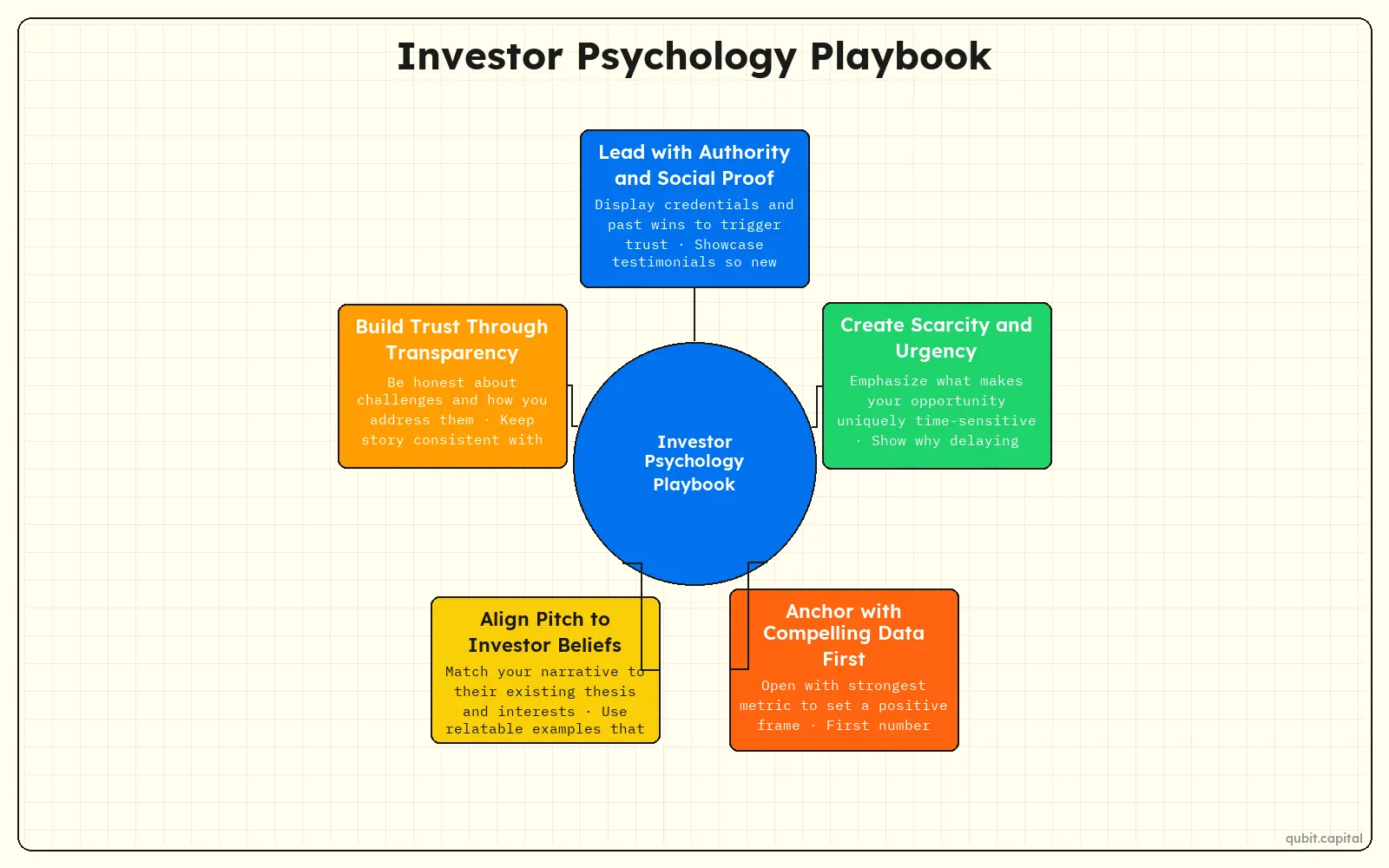
Several psychological triggers can shape how investors perceive your pitch, especially when evaluating traction startups.
Understanding these triggers matters because investor attention is scarce. A DocSend study of over 200 funded startups found that VCs spend an average of 3 minutes and 44 seconds reviewing a pitch deck, meaning every psychological signal in your deck must land quickly.
1. Psychological Triggers That Influence Investor Behavior
Several psychological triggers can shape how investors perceive your pitch:
- Authority Bias: Displaying expertise and confidence can make investors more likely to trust and invest in you. Highlight your experience and credentials to leverage this bias.
- Social Proof: Showcasing testimonials, endorsements, or existing clients can reassure investors of your credibility. When others have confidence in your venture, new investors may follow suit.
- Scarcity and Urgency: Emphasizing the uniqueness or time-sensitive nature of your opportunity can motivate investors to act quickly. Highlight what sets your startup apart and why now is the ideal time to invest.
By incorporating these triggers into your narrative, you subtly influence investor perceptions.
2. Cognitive Biases and Their Impact on Investment Decisions
Investors are subject to cognitive biases that can affect their choices:
- Confirmation Bias: The tendency to favor information that confirms existing beliefs. Aligning your pitch with an investor’s interests or experiences can make them more receptive.
- Anchoring Bias: Relying heavily on the first piece of information presented. Starting your pitch with compelling data or a strong value proposition sets a positive tone.
- Availability Heuristic: Overestimating the importance of information that comes to mind easily. Using memorable stories or relatable examples increases your influence.
Understanding these biases allows you to structure your narrative in a way that resonates.
3. Building Trust and Credibility Through Narrative Techniques
Trust is vital in securing investment. Effective storytelling can build this trust:
- Consistency: Ensure your story aligns with your data and actions. Inconsistencies can undermine credibility.
- Transparency: Be open about challenges and how you’re addressing them. Honesty fosters confidence.
- Authenticity: Share genuine motivations and passions driving your venture. Authentic stories are more relatable.
Integrating data into your story enhances credibility. For insights on balancing narrative with analytics, read using data-driven storytelling to persuade investors.
Despite crowded competition, only 1% of pitch decks actually secure funding, highlighting the intense scrutiny investors apply and the need for strategic storytelling to build credibility.
How Do Storytelling Frameworks Strengthen Pitch Deck Traction Slides?
Enhance your storytelling techniques by utilizing frameworks that help showcase startup traction in pitch deck strategies.
The Business Hero’s Journey
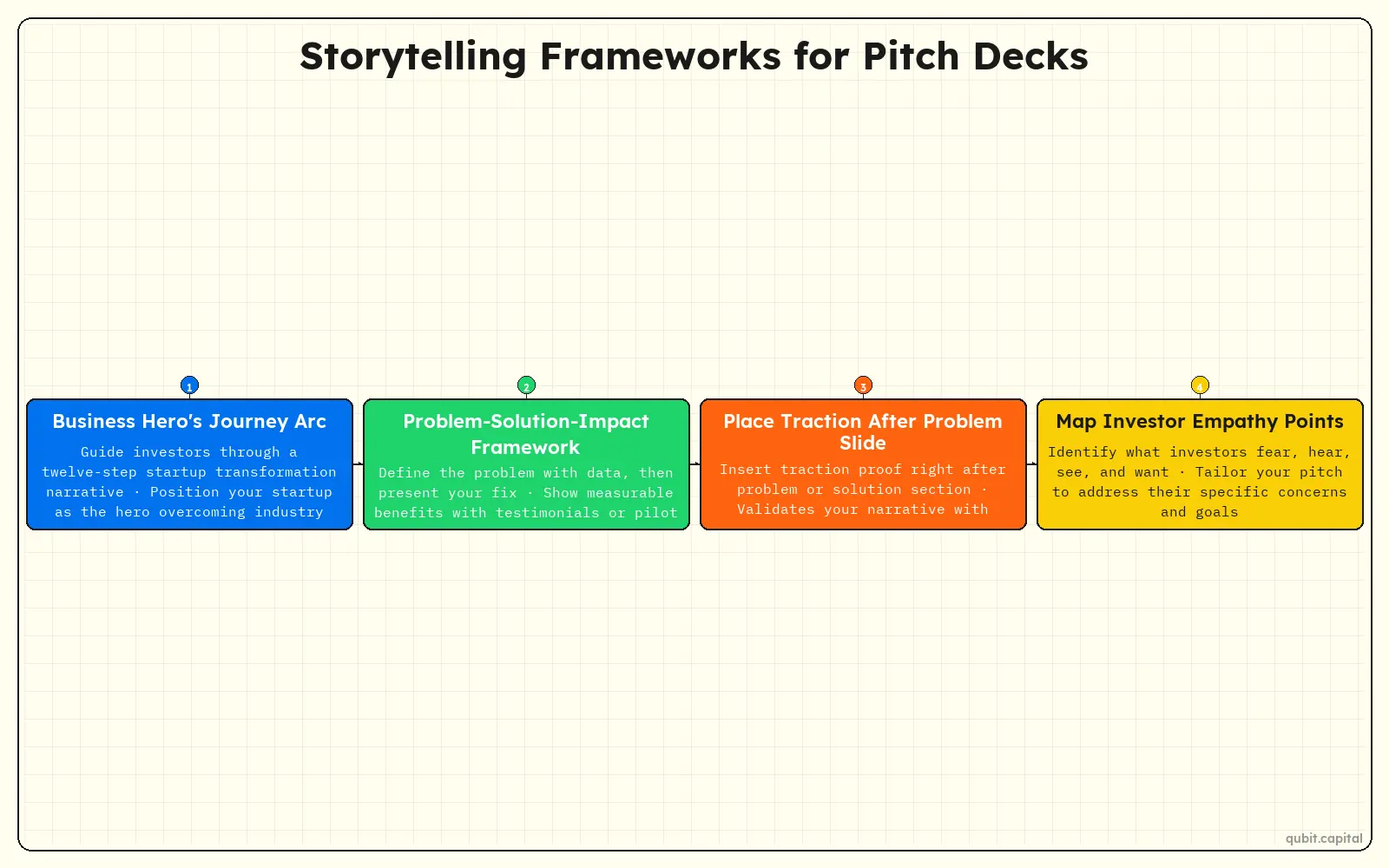
Adapting Joseph Campbell’s Hero’s Journey to business storytelling can be powerful. This framework guides your audience through a transformative adventure, positioning your startup as the hero.
Steps of the Business Hero’s Journey:
- The Ordinary World: Introduce the current state of the industry, highlighting issues or inefficiencies.
- Call to Adventure: Present the problem or opportunity disrupting the status quo.
- Refusal of the Call: Acknowledge initial hesitations or challenges faced.
- Meeting the Mentor: Describe key advisors or experiences that guided you.
- Crossing the Threshold: Illustrate when your startup commits to solving the problem.
- Tests, Allies, Enemies: Share obstacles encountered, alliances formed, and competition faced.
- Approach to the Inmost Cave: Detail critical challenges testing your resolve.
- The Ordeal: Highlight significant struggles or turning points.
- Reward (Seizing the Sword): Reveal breakthroughs or achievements.
- The Road Back: Discuss efforts to scale or reach a wider market.
- Resurrection: Explain how overcoming challenges transformed your startup.
- Return with the Elixir: Conclude with the value and impact you bring.
Example: A fintech startup might tell how they noticed small businesses struggling with access to capital (The Ordinary World). They identified a technological solution to streamline lending (Call to Adventure), faced skepticism from traditional banks (Refusal of the Call), partnered with tech firms (Meeting the Mentor), and so on.
Using this framework makes your story engaging and memorable.
Problem-Solution-Impact Framework
This framework focuses on articulating the problem you’re addressing, your solution, and its impact.
1. Problem
- Define the problem specifically.
- Use data and examples to illustrate its severity.
2. Solution
- Present your unique solution.
- Explain how it effectively addresses the problem.
3. Impact
- Demonstrate the benefits and value provided.
- Include evidence like customer testimonials or pilot results.
Example:
- Problem: Over 60% of rural areas lack high-speed internet.
- Solution: Satellite-based broadband services.
- Impact: Enabling education, healthcare, and economic growth in underserved communities.
This framework ensures your pitch is concise and focused on what matters to investors.
Strategic Placement of the Traction Slide in Your Narrative
Building on these frameworks, the placement of your traction slide plays a critical role in shaping investor perception. Positioning traction evidence immediately after the problem or solution section draws attention to your startup’s momentum at a pivotal moment. This approach leverages narrative flow to validate your story with proof of progress before deeper details. Effective placement signals credibility early and sets a positive tone for the remainder of your pitch.
The Empathy Map Technique
Understanding investors’ perspectives allows you to tailor your pitch. The Empathy Map helps you consider:
- Think and Feel: Concerns about market saturation, risk, ROI.
- Hear: Influences from trends, peers, media.
- See: Current market offerings, competitors.
- Say and Do: Investment behaviors, public statements.
- Pain Points: Previous poor investments, regulatory challenges.
- Goals: High ROI, investing in innovation, making an impact.
By mapping these aspects, you craft a narrative that addresses investor motivations and concerns. For help in conveying complex concepts within these frameworks, see simplifying complex ideas for clear communication.
Personalizing Your Storytelling Pitch Deck for Investors
Tailoring your storytelling deck to resonate with specific investors can significantly boost your pitch’s effectiveness. Demonstrating that you’ve understood their interests and priorities sets you apart.
Researching Investor Backgrounds and Interests
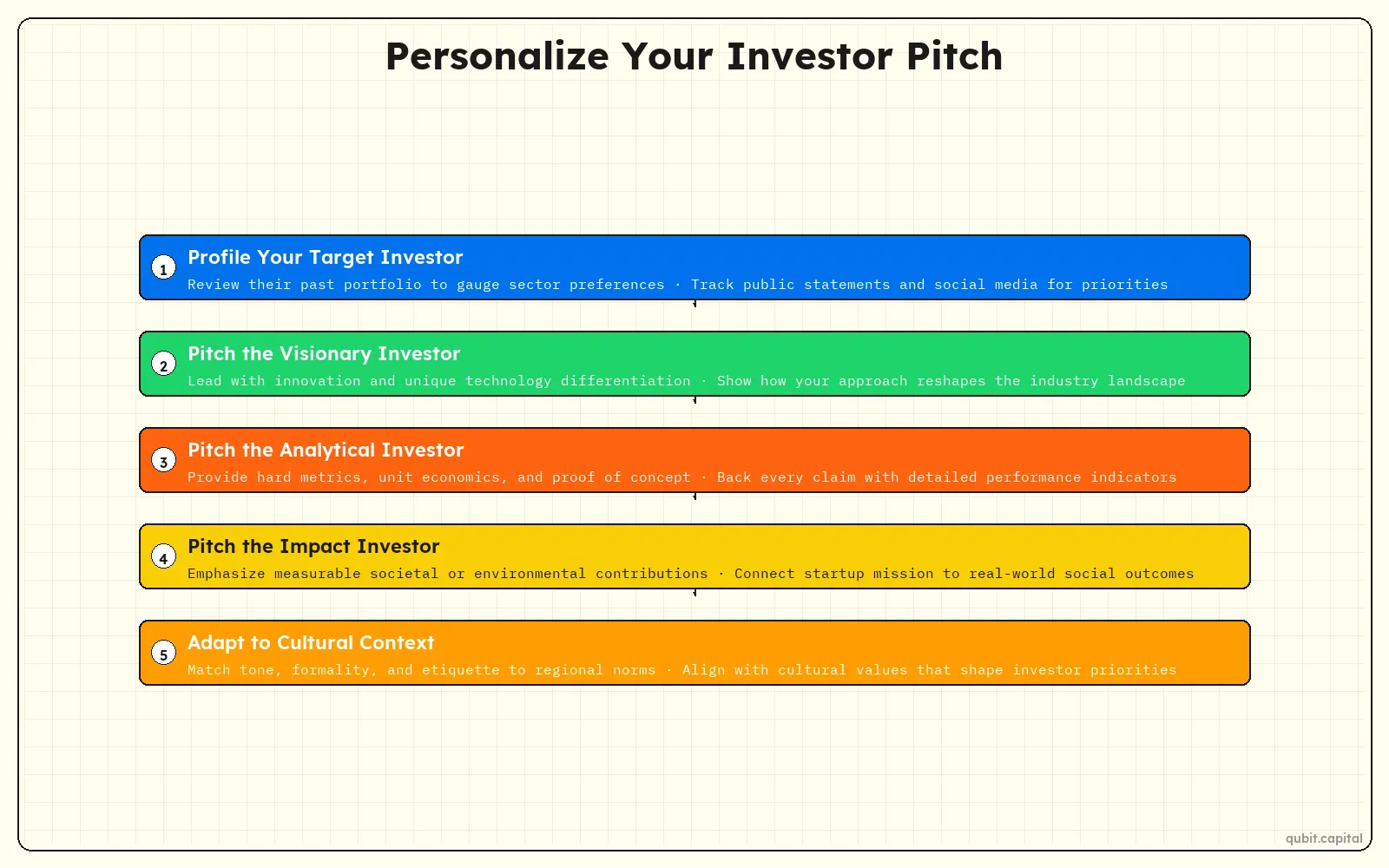
Before crafting your pitch, research potential investors:
- Investment Portfolio: Review their past investments to gauge preferences.
- Public Statements: Analyze their viewpoints on market trends and investment philosophy.
- Social Media and Publications: Follow their posts to understand their interests.
If an investor focuses on sustainable technologies, emphasize how your product contributes to environmental goals.
Customizing Narratives for Different Investor Personas
Investors have diverse motivations. Consider these personas:
- The Visionary Investor
- Values innovative technologies.
- Pitch Strategy: Highlight your unique approach and industry impact.
- The Analytical Investor
- Focuses on data and proof of concept.
- Pitch Strategy: Provide detailed analytics and performance indicators.
- The Impact Investor
- Seeks ventures with social impact.
- Pitch Strategy: Emphasize your startup’s societal contributions.
Aligning your narrative with the investor’s persona increases relevance.
Managing Cultural Nuances in Storytelling
When pitching to international investors, cultural sensitivity is key:
- Communication Styles: Adapt your tone and language to suit cultural preferences.
- Cultural Values: Understand values that may influence priorities.
- Business Etiquette: Be aware of norms regarding formality and presentation styles.
For instance, when approaching investors in Japan, reflecting long-term commitment and harmony may resonate well.
Incorporating using customer success stories to illustrate impact makes your pitch relatable across cultures by showcasing real-world applications.
Exclusive Case Studies of Successful Storytelling Pitch Decks
1. Airbnb (Seed Round- $600 K)
Airbnb’s early pitch deck is perhaps the most famous example in history. It told a simple but powerful story: ordinary people need affordable, unique stays, and Airbnb’s solution makes that possible. The slides used clear, concise messaging, simple visuals, and walked investors through problem → solution → market → business model → traction in a way that felt like narrative progression, not a data dump. That crisp story helped them secure their first seed funding.
Key takeaway: Start with a relatable problem story and show how your product solves it without overwhelming investors with text.
2. Uber (Seed Round -$1.25 M)
Uber’s early deck turned the mundane pain of unreliable taxis into a story of urban convenience and scalability. Instead of massive charts or technical jargon, the Uber deck used before/after contrasts to show how app-based ride ordering changed everything. This narrative helped investors see why the world would care, not just what the product did.
Key takeaway: Frame your deck around a daily life problem that resonates with investors and use simple visuals to illustrate the transformation.
3. Dropbox (Seed Round – $1.2 M)
Dropbox’s pitch deck is famous for one storytelling strategy: simplicity. The entire deck focuses on a single clear idea , syncing files seamlessly, explained through product demo visuals rather than complex bullet points or technical explanations. This simplicity mirrored the product’s core value.
Key takeaway: Sometimes less is more. A straightforward narrative with demo-led slides can make complex concepts instantly understandable.
4. Tinder (Raised – $50 M over round series)
Tinder’s deck (originally “Matchbox”) didn’t just describe the app features, it told a story that placed the investor in the user’s shoes. Instead of abstract stats, it explained the problem through real use scenarios and then showed how users interact with the app, driving home why it works.
Key takeaway: Let product experience tell part of the story, a step-by-step show-don’t-tell approach can be very engaging.
Practical Tools and Templates for Your Storytelling Deck
Most pitch decks fail because the story lacks structure, not ambition. Investors move fast. If your narrative forces them to work, you lose attention. The tools below are designed to fix specific, recurring pitch deck problems founders face during real investor reviews.
93% of reviewed pitch decks had design working against founders. Leveraging professional templates and strategic visuals can address these common pitfalls, boosting clarity and credibility.
Implementing advanced storytelling techniques for presentations is easier with the right resources. Here are practical tools to help you craft a compelling pitch deck. These tools help you showcase startup traction in pitch deck strategies.
1. Core Story Frameworks That Improve Clarity
Use a single narrative structure throughout your deck. Switching frameworks mid-presentation creates confusion and weakens conviction.
2. Business Progress Narrative
Use this framework when investors struggle to understand how your startup moves from insight to scale.
Structure:
Problem → Existing Alternatives → Core Insight → Solution → Why It Wins → Proof → Next Milestone
This approach keeps the deck execution-focused and prevents vision-only storytelling.
3. Problem–Solution–Proof Structure
Use this when investors question urgency or market depth.
For every problem, clearly show:
- Who experiences it
- How frequently it occurs
- What it costs them
- Why current solutions fall short
Only introduce your solution after the problem is fully grounded, then immediately show proof of traction or validation.
4. Investor Perspective Mapping
Before finalising your deck, write one sentence per slide answering:
What investor risk does this slide reduce?
If a slide does not reduce risk, it likely does not belong.
5. Traction Metrics That Signal Real Progress
Traction slides fail when they show too much data or the wrong data.
6. How to Choose the Right Metrics
Select metrics that clearly answer at least one of the following:
- Are users adopting the product
- Are they staying engaged
- Are they paying or converting
- Is growth repeatable
Limit each slide to one primary metric and one supporting metric.
7. Metrics to Avoid
Avoid vanity metrics such as total sign-ups, impressions, or downloads unless they directly correlate with revenue, retention, or usage intensity.
If a metric cannot explain future growth, remove it.
8. How to Present Traction Visually
- Show trends, not snapshots
- Highlight growth rates, not raw totals
- Label time periods clearly
- Use one chart per slide to avoid clutter
Clarity beats density every time.
9. Narrative Quality Control Checklists
Before sharing your deck with investors, run these final checks.
10. Narrative Clarity Check
Can someone understand what you do, who it is for, and why it matters by reviewing only your problem, solution, and traction slides?
If not, the story needs tightening.
10 Investor Alignment Check
Your deck should clearly communicate:
- What type of company this becomes
- How large the opportunity can get
- What milestone this round enables
Missing any of these creates hesitation.
11. Credibility and Proof Check
Every major claim should be backed by data, customer behaviour, or market evidence.
If proof is missing, reframe or remove the claim.
12. Visual Discipline Guidelines
Design should reduce cognitive load, not increase it.
- Use visuals only when they clarify structure or data
- Avoid decorative icons and stock imagery
- Keep chart scales and labels consistent
- Use whitespace intentionally to guide focus
A strong storytelling deck does not impress investors.
It removes reasons to say no.
Overcoming Common Storytelling Challenges in Your Pitch Deck
Crafting a compelling pitch isn’t without challenges. Here are strategies to address common hurdles.
1. Simplifying Complex Ideas Without Losing Essence
- Use Analogies
- Relate complex concepts to familiar situations.
- Visual Aids
- Utilize diagrams or infographics.
- Layered Information
- Start with a high-level overview before details.
2. Balancing Data with Narrative to Maintain Credibility
- Selective Data Presentation
- Include only relevant statistics.
- Contextualize Data
- Explain what data means practically.
- Narrative Integration
- Weave data into your story.
3. The Risk of Vanity Metrics in Your Pitch Deck
This focus on credible data requires founders to avoid vanity metrics that may appear impressive but lack real substance. Including irrelevant or misleading statistics can erode investor trust and weaken your overall narrative. Instead, prioritize metrics that directly reflect genuine progress and business fundamentals. Careful selection of data strengthens your pitch and supports long-term credibility.
4. Ensuring Authenticity and Avoiding Clichés
- Be Genuine
- Share true experiences and motivations.
- Avoid Overused Phrases
- Steer clear of buzzwords that may sound insincere.
- Personal Reflection
- Share personal insights to differentiate your pitch.
Incorporating Multimedia and Visual Elements into Your Pitch Deck
Visual elements can amplify your pitch, making complex information accessible and engaging.
1. The Impact of Visuals in Storytelling
- Enhance Understanding
- Images simplify complex ideas.
- Evoke Emotions
- Visuals trigger emotional responses.
- Aid Memory Retention
- Engaging visuals make your pitch memorable.
2. Best Practices for Slide Design
- Keep It Simple
- Uncluttered slides with white space.
- Consistent Branding
- Uniform fonts and colors.
- Readable Text
- Large fonts, high contrast.
3. Using Multimedia Elements
- Videos
- Demonstrate products or share testimonials.
- Animations
- Illustrate processes or data trends.
- Interactive Content
- Engage investors with interactive elements.
How Should You Tailor Mission and Vision in a Storytelling Pitch Deck?
Your mission and vision are foundational to your company’s identity and can be powerful in your pitch.
1. Aligning Your Pitch with Your Core Values
- Authentic Representation
- Clearly articulate your mission.
- Passion and Purpose
- Convey dedication driving your venture.
2. Connecting Your Mission and Vision to Investor Goals
- Shared Values
- Find common ground with investors.
- Strategic Alignment
- Show how your vision aligns with market trends.
3. Demonstrating Long-Term Value and Impact
- Future-Proofing
- Explain adaptability to market changes.
- Scalability
- Highlight growth potential.
- Social and Economic Impact
- Emphasize benefits beyond financial returns.
Conclusion
Creating an advanced storytelling pitch deck combines creativity and strategy. By understanding investor psychology, using sophisticated frameworks, and personalizing your narrative, you can craft a pitch that informs and inspires.
Use these approaches to showcase startup traction in pitch deck strategies. Investors invest in visions and people, not just businesses. Your story is your chance to showcase your passion and the unique value you offer.
By implementing these advanced techniques, you’re equipped to captivate investors and stand out in a crowded market.
Ready to transform your pitch deck into a powerful storytelling tool?
Contact our team for expert guidance, and let Qubit Capital help you craft a narrative that resonates with investors. For more insights on creating impactful presentations, explore our comprehensive guide on crafting powerful presentations that secure funding.
Key Takeaways
- Use Advanced Storytelling Frameworks: Employ structures like the Business Hero’s Journey to craft compelling narratives.
- Understand Investor Psychology: Tailor your pitch to align with investor motivations, biases, and personas.
- Personalize Your Pitch: Customize your narrative for specific investors and cultural contexts to increase relevance.
- Leverage Visuals Effectively: Enhance your story with impactful visuals and multimedia elements for better engagement.
- Address Common Challenges: Simplify complex ideas, balance data with narrative, and maintain authenticity to overcome hurdles.
Need a pitch deck investors actually read?
A deck built to answer real investor questions. Clear story, strong positioning, investment-ready slides.
- Structure your narrative and core messaging
- Fix clarity gaps and investor objections
- Investor-grade design and structure
Frequently asked Questions
How do you highlight traction on a pitch deck traction slide?
Focus on key metrics like user growth, revenue, and partnerships. Use visual elements and a clear narrative for maximum investor impact.