

 Back
Back









Table of Contents

Securing a venture capital deal often hinges on the final meeting, where every answer, slide, and impression can determine your outcome.
Global startup funding reached $91 billion in Q2 2025, marking an 11% year-on-year increase. This signals intense investor activity and growth across the VC landscape. Founders preparing for final meetings operate in a highly dynamic market, increasing both challenge and upside.
This blog is designed to equip you with actionable strategies for your final VC meeting preparation. Whether it’s perfecting your startup pitch readiness or addressing investor concerns, we’ll cover everything you need to know. Let’s jump right in!
What to Expect in Final VC Meeting Preparation
Getting to a final VC meeting already means you’ve beaten brutal odds. An INSEAD-backed analysis of VC funnels summarized by Founders Network’s term-sheet breakdown shows that a typical firm reviews roughly 100 opportunities for every deal it closes.
Only 1 in 4 opportunities ever leads to a meeting, one-third of those make it to a partners’ meeting, about half of partner-meeting opportunities proceed to due diligence, and roughly a third of diligence cases result in a term sheet.
Put differently, that funnel implies that only, 1–2% of initial opportunities reach a term sheet and that even at the partners’ meeting stage, the odds of winning a term sheet are still only around 1 in 6. This means final VC meeting marks a decisive moment in your fundraising journey, where investor impressions are solidified and critical decisions are made.
Understand the Staged Structure of VC Meetings
The decisive VC meeting is rarely a one-off event. It’s the peak of a staged fundraising process that usually includes pre-screening, initial partner meetings, and detailed diligence sessions. Each step is designed to filter, stress-test, and deepen conviction.
At every stage, investors are building a picture of your startup: they’re assessing risk, upside, and your ability to lead at scale. This isn’t just about presenting numbers. It’s about showing that your business can grow, that you understand your risks, and that you can execute against a clear plan.
As you move into deeper diligence and late-stage negotiations, precision becomes non-negotiable. Investors are placing growing emphasis on comprehensive due diligence, the detailed process they use to evaluate all aspects of your business, and a sharp, data-driven narrative can significantly increase their confidence.
The broader market context makes this even more important. At a time when 42% of VCs cite increased competition as a central challenge, you’re fighting for attention in a crowded pipeline. Late-stage negotiations are where outcomes are often decided.
Your job is to arrive at each meeting prepared, with a pitch that matches where you are in the process and what investors expect at that point. Address their likely concerns upfront, show you understand the bar, and close gaps before they become objections.
If an investor passes, ask for feedback, refine your materials, and use that insight to improve your next meeting. If you face tough or unexpected questions, stay calm, respond clearly, and treat them as a chance to demonstrate how you think under pressure.
How to Prepare Effectively for VC Meetings
Preparation is the foundation of a successful VC meeting. In a world where the average VC reviews around 1,000 startups a year but meets with only about 200, you don’t just need a good story, you need to be sharper and more prepared than most founders they see.
Start by tightening what investors already know about you:
- Revisit previous interactions
Go through past emails, calls, and notes with each investor. Make sure your messaging, metrics, and narrative are consistent with what you’ve already shared. Continuity builds trust. - Update your financials
Keep your financial model, key metrics, and projections current. Accurate, up-to-date numbers signal readiness and reliability. Tools like Fondo Accounting can help automate bookkeeping and reduce last-minute errors by giving you clean financials before critical meetings. - Research the VCs you’re meeting
Understand their thesis, typical cheque size, portfolio, and preferences. Tailor your pitch to match their focus and highlight why your startup fits their strategy. This alone can materially improve your odds of a serious follow-up.
Once your foundation is solid, focus on how you show up in the room (or on Zoom):
- Use teaser decks to prime investor engagement
Sending a concise teaser deck before the meeting can significantly boost engagement. This is usually an 8–12 slide overview that introduces your team, product, traction, and market opportunity. When investors see this in advance, they arrive informed and ready to dive deeper, making the live meeting far more focused and productive. - Rehearse Q&A and run mock interviews
Don’t just practice the pitch, practice the questions. Mock sessions with your team, advisors, or other founders will help you refine your answers, stress-test your assumptions, and respond confidently to tough pushback. - Test tech and logistics
Check slides, links, screen sharing, and meeting access ahead of time. A glitchy setup is a small thing that can quietly undermine confidence. - Prepare your follow-up email
Draft a short, clear follow-up in advance: thank them for their time, recap key points, share any requested materials, and confirm next steps. Sending this quickly after the meeting reinforces that you are organized and serious.
Expert insights, including those from Ramana Nanda, emphasize that early and thorough preparation directly improves deal flow. The more prepared you are before you get into the room, the more those scarce meetings work in your favor instead of feeling like one more pitch lost in a crowded pipeline.
How to Craft a Story That Makes Your Pitch Stand Out
A standout pitch starts with a story that feels real and hits both emotionally and analytically. Investors don’t just want to know what you’re building; they want to know why you, why this, and why now.
And the bar is high. If you’ve been invited to a final partner meeting, you’re already in a tiny minority. Getting to a term sheet can take 6–12 months, and, typically less than 5% of those who connect with a venture capitalist obtain a term sheet. This final meeting is not “just another Zoom” – it’s the last filter in a long, highly selective pipeline. Your story has to carry its weight.
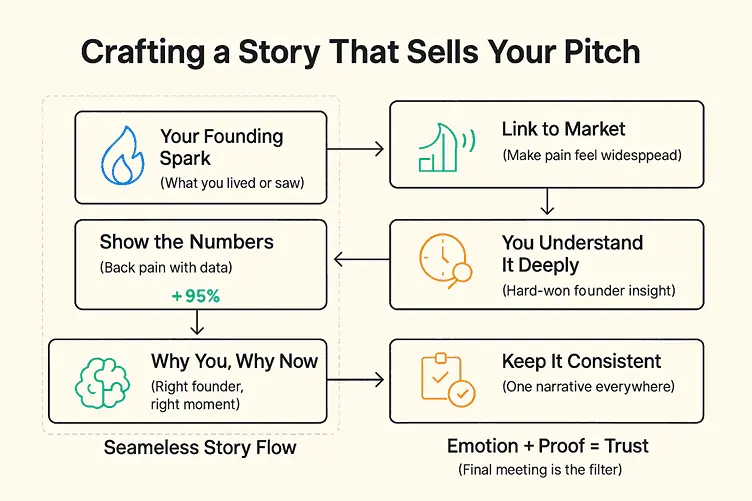
Start by anchoring your narrative in your personal journey, what you saw, struggled with, or learned that led you to start this company. Keep it sharp and relevant. The goal isn’t to tell your entire life story; it’s to show the specific insight or frustration that made the opportunity obvious to you.
Then quickly connect that story to the market:
- Use data to show the scale and urgency of the problem.
- Bring in stats on market size, adoption, or growth so it’s clearly not just your personal pain point.
- Make the link explicit: “I experienced X… which matters because Y million people / a $Z market face the same issue.”
A strong narrative balances this emotional hook with hard numbers. The challenges you’ve overcome and the insights you’ve gained should naturally lead to one conclusion: you understand the problem deeply, and your startup is well-positioned to win the market.
To make this work in the room, your story needs to flow cleanly from:
- Your personal story
- The problem and market opportunity
- Your solution, traction, and proof points
Practice until those transitions feel natural, not bolted on. The same core story should also stay consistent across your emails, warm intros, teaser decks, and calls, so by the time you reach that final partner meeting, investors are hearing one coherent narrative, not disconnected fragments.
This isn’t just theory. Among startups that combined narrative and data effectively, Intercom achieved a 393% annualized growth rate despite decelerating ARR, showing how a compelling story backed by strong performance can still excite investors and drive engagement.
In the end, the pitches that stand out are the ones that make investors feel the problem and trust the numbers. If you’re already in that sub-5% reaching the final stage, getting this balance right is often what separates a polite “we’ll pass” from a signed term sheet.
Additionally, insights into multi-channel investor outreach strategies expand your perspective on utilizing various platforms, which resonates with the steps you take before a final VC meeting.
How to Handle Tough Questions from Investors
Tough questions are not a bad sign, they’re a signal that investors are taking you seriously. How you handle them is a live test of your expertise, judgment, and leadership. With only 20–30 minutes per meeting, your answers need to be clear, evidence-based, and straight to the point. Every response has to earn its place.
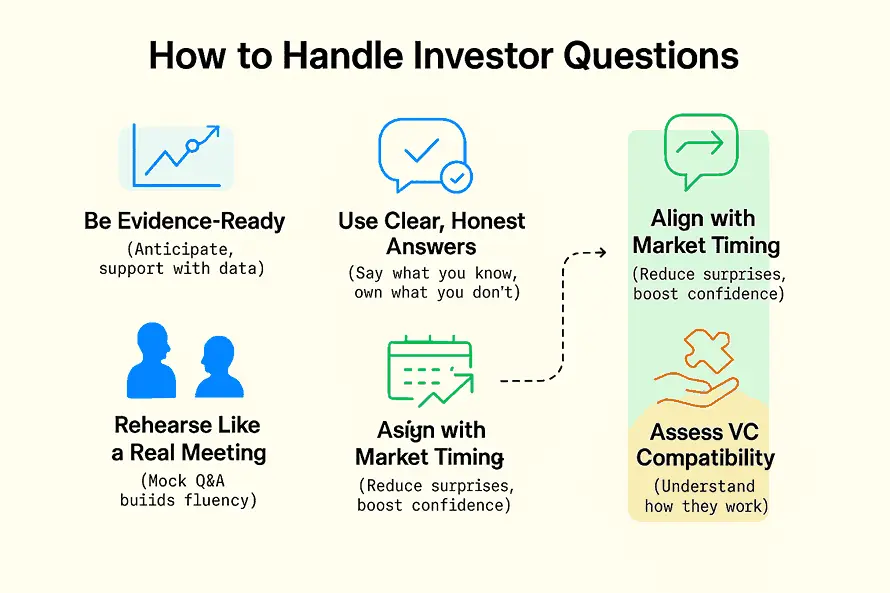
1. Prepare Evidence-Based Responses
Investors often probe strategic, financial, and operational aspects of your business. Anticipate these questions by preparing data-driven answers that highlight your company’s strengths and address potential concerns. Reference guidance on capital raising pitfalls (common mistakes founders make when seeking investment), such as those outlined in Fix Capital, to tackle objections with clarity and confidence.
2. Emphasize Honesty and Follow-Up
Transparency builds trust. If you don’t have an immediate answer, acknowledge it honestly and commit to providing a detailed follow-up. Promptly delivering the promised information demonstrates reliability and strengthens investor relationships.
3. Rehearse Structured Q&A Sessions
Practice makes perfect. Conduct mock Q&A sessions with your team to refine your responses and ensure consistency. Align your preparation timeline with market rhythms by considering the best time to reach out to investors, reducing last-minute surprises during meetings.
4. Ask Strategic Questions to Assess VC Alignment
Beyond answering investor questions, founders should prepare thoughtful questions to ask VCs during the meeting. This approach transforms the conversation into a two-way dialogue, allowing you to evaluate the investor’s motivations, value-add, and long-term support. Strategic questioning demonstrates your commitment to building a strong partnership and helps clarify whether the VC’s approach aligns with your company’s goals.
By asking about governance style, follow-on funding intentions, and risk tolerance, you gain insight into how the VC will support your growth beyond capital. These questions also reveal the investor’s expectations and involvement level, which are critical for a successful collaboration. Engaging VCs in this manner builds mutual respect and lays the groundwork for a productive relationship.
- Inquire about the VC’s value-add beyond financial investment, such as mentorship or network access.
- Ask about their approach to governance and decision-making to gauge compatibility with your leadership style.
- Discuss follow-on funding intentions and support for future rounds to assess long-term partnership potential.
Handling tough questions effectively not only reassures investors but also positions you as a confident leader capable of steering your business toward success.
Deliver Your Presentation with Confidence and Impact
How you deliver your pitch can make or break its success. By the time you reach a final VC meeting, preparation isn’t just about the content of your deck, it’s about how confidently and clearly you communicate it. Consistent practice is what turns a scripted pitch into a natural conversation. Rehearse until you can move through your key points without sounding memorized, so you have enough mental space to read the room, respond to reactions, and stay composed under pressure.
Start with a strong opening that immediately tells investors what you’re building, who it’s for, and why it matters now. This sets the tone and shows that you’re in control of the narrative from the first minute. Close with a sharp, memorable summary that reinforces your core thesis, underlines your traction and vision, and makes it very clear what you are asking for. These opening and closing moments are where investors decide whether you feel like a leader they want to back.
Visuals should support your story, not compete with it. Use clean, consistent charts and diagrams to make complex data simple and easy to absorb. Design choices, layout, fonts, colors, should look intentional and professional, reinforcing that you are detail-oriented. Even small touches, such as polished social sharing buttons or consistent icon styles, contribute to an overall sense of quality. When your delivery, slides, and design all line up, investors are more likely to trust not just your story, but your ability to execute at a high standard.
As you refine your pitch, consider tools like the best CRM for investor management to streamline tracking practice sessions and investor interactions.
Handle Meeting Logistics and Nail Your Follow-Up
A well-organized meeting sets the tone for professionalism and reliability. Begin by confirming the meeting format, whether virtual or in-person, and ensure all participants are aligned on the schedule and agenda. Testing equipment ahead of time is equally crucial, especially for virtual meetings, where technical glitches can disrupt the flow and leave a poor impression.
Post-meeting follow-ups are just as important as the meeting itself. Craft timely and thoughtful follow-up emails to reinforce key points discussed and maintain investor interest.
Proper logistical planning not only showcases your organizational skills but also ensures a seamless experience for investors. Combine this with effective meeting follow-up strategies to leave a lasting impression and build stronger connections.
Set Yourself Up for Long-Term Success After the VC Meeting
Final VC meeting preparation is more than just a presentation, it’s a reflection of your startup’s overall readiness and maturity. Investors often view thorough preparation as a direct indicator of broader business capabilities. When founders demonstrate a clear vision and meticulous planning, it builds confidence in their ability to deliver sustained success.
Looking at the full journey, Stripe has raised roughly $9.4 billion across 19 funding rounds, including a $6.5 billion Series I round in 2023 and a $694 million secondary transaction in 2024, as summarized in Growth Navigate’s overview of Stripe’s funding rounds. The progression from a $2 million seed to multi-billion-dollar late-stage rounds illustrates how VC capital scales once product-market fit and platform effects are proven
How to Turn Your Funding Journey into a Success Story
Strategic preparation transforms the funding process into an opportunity for growth. By embracing dynamic financial modeling, founders can present data-driven insights that enhance pitch credibility. This approach ensures readiness for last-minute opportunities, allowing entrepreneurs to adapt and shine during critical moments. Investment pitch transformation begins with meticulous planning and a focus on impactful storytelling.
1. Showcase Your Product or Service
Capturing the essence of your product or service is vital when pitching to venture capitalists. Clear communication ensures investors grasp your offering’s value and potential impact. Highlighting unique features and addressing market needs effectively can set the stage for a compelling pitch.
Stripe shows how a developer-first product can compound through multiple funding rounds. The company started with a $18,000 Y Combinator investment at roughly a $1 million valuation, then raised a $2 million seed round led by Sequoia, and eventually a $600 million Series H in 2021 that valued Stripe at about $95 billion.
2. Share Your Vision and Strategy
A compelling pitch begins with a clear articulation of your vision and strategy. By sharing your long-term goals and the roadmap to achieve them, you demonstrate focus and foresight. Investors value clarity and alignment, so ensure your strategy reflects both ambition and practicality. This approach builds confidence in your ability to execute effectively.
3. Highlight Your Market Opportunity
Understanding your market potential is essential for success. Clearly defining and communicating this opportunity not only attracts investors but also aligns your team around shared goals. A well-articulated market opportunity demonstrates the demand for your solution and positions your business for sustainable growth.
One of the most cited early-stage VC stories is Airbnb’s original pitch deck, which helped the founders raise around $600,000 after Y Combinator and prove the market for short-term home-sharing. You can see how they framed the problem, market size and business model in the Airbnb pitch deck case study.
Address Legal and Regulatory Considerations
Understanding your legal and regulatory landscape is a non-negotiable part of preparing for a VC meeting. Investors will look beyond your product and metrics to assess how well you understand compliance, risk, and the rules that govern your market.
You should be ready to explain which laws, licenses, data protections, and industry standards apply to your business, how you’re complying today, and what your plan is as you scale into new markets or jurisdictions. This level of clarity signals professionalism, lowers perceived risk, and builds confidence in your startup’s operational discipline.
Ignoring legal and regulatory impact can be expensive. SoftBank Group’s stock dropped 11% in a single day in November 2025, losing over 40% of its market value from its peak, a sharp reminder of how compliance issues and external market factors can quickly reshape outcomes. When you show investors that you understand these dynamics and are proactively managing them, you position your company as a more reliable, fundable partner—not just a promising product.
Demonstrate Your Operational and Infrastructure Capabilities
Investors don’t just want to know that your product works, they want to know it will still work when you’re 10x or 100x bigger. In a VC meeting, you should clearly show that your operations and infrastructure can handle scale without falling apart.
Explain how your team runs day-to-day, how you manage key workflows, and how you keep quality and reliability high as you grow. When you highlight streamlined processes, clear ownership, and resilient systems, you signal that your startup isn’t held together by duct tape, but built on a foundation that can support serious growth.
This isn’t just theory, major operational and infrastructure investments are directly tied to stronger funding outcomes. Scale AI, for example, reached a $13.8 billion valuation in its $1 billion Series F round led by Accel and is now seeking up to $25 billion through a tender offer.
That kind of valuation is built on the back of infrastructure that can support massive demand. When you demonstrate that your operations and infrastructure are designed to scale, you help investors see your company as a reliable, high-upside asset rather than a risky experiment.
Conclusion
Securing success in VC meetings requires a combination of thoughtful preparation, a compelling narrative, and strategic Q&A handling. By focusing on crafting a clear, story-driven pitch deck and ensuring robust follow-up, founders can significantly enhance their chances of making a lasting impression. These strategies not only help communicate your vision effectively but also demonstrate your readiness to execute it.
We encourage founders to integrate these tactics into their approach, refining their presentations and interactions to align with investor expectations. If you’re ready to elevate your pitch, we at Qubit Capital offer expert Pitch Deck Creation services to help craft a winning presentation.
Key Takeaways
- Thorough VC meeting preparation lays the groundwork for successful funding outcomes.
- A narrative that blends emotional storytelling with solid data captures investor interest.
- Skillfully handling tough questions sets your pitch apart from the competition.
- Careful logistical planning and timely follow-up reinforce investor confidence.
- Real-world examples, such as Front’s Series A success, demonstrate the effectiveness of these strategies.
Frequently asked Questions
What should you include in a final VC meeting checklist?
A final VC meeting checklist should cover presentation preparation, financial model updates, team introductions, and a clear follow-up plan.