

 Back
Back








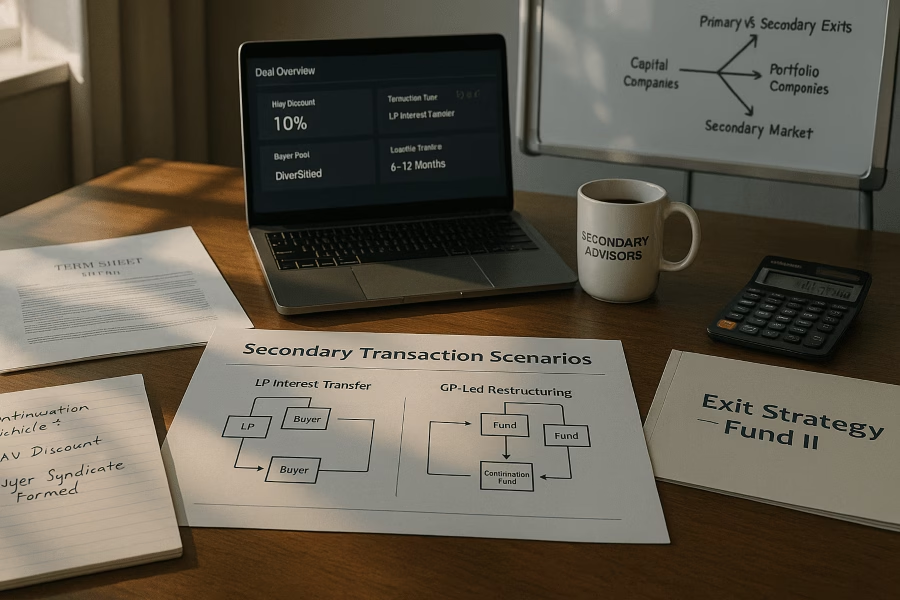
Table of Contents

Private equity secondaries have emerged as a vital mechanism for investors seeking liquidity or exit strategies in an otherwise illiquid market. These transactions involve the resale of existing private equity stakes, offering flexibility to both buyers and sellers. Recent growth underscores this shift. In 2024, private equity secondaries market volumes surpassed $160 billion, setting a new industry record. This scale highlights their pivotal role in modern investment strategies.
Whether you're an institutional investor or a startup founder, understanding secondaries can unlock opportunities to optimize your portfolio or secure capital. The discussion on how to find investors for startups provides a comprehensive framework that sets the stage for exploring liquidity options and exit paths in private equity secondaries.
This blog will delve into the types of private equity secondary transactions, their benefits, and actionable insights for navigating this dynamic market.
Types of Private Equity Secondaries Market Transactions
The private equity secondaries market offers diverse pathways for liquidity and portfolio optimization for both limited partners (LPs) and general partners (GPs). Limited partners (LPs), or investors in the fund, and general partners (GPs), who manage the fund, both benefit from secondary transactions. These transactions fall into three primary categories: LP stake transfers, GP-led deals, and direct secondary sales.
LP Secondary Transactions
Rising liquidity needs have driven notable volume. In 2024, LP Secondary market recorded $87 billion in deals, reflecting the impact of a softened exit environment. This trend underscores the centrality of LP transactions.
LP stake transfers are the most traditional form of secondary transactions. In these deals, limited partners sell their stakes in private equity funds to other investors, often seeking liquidity or portfolio rebalancing. For buyers, this can be an opportunity to acquire mature assets at potentially discounted valuations.
According to Buyers Market, certain periods, such as 2021, have created favorable conditions for secondary buyers, highlighting the cyclical nature of this market. LP transactions are straightforward and typically involve fund stakes across multiple assets, making them a popular choice for institutional investors.
GP-Led Transactions
GP-led deals have gained significant traction in recent years, offering general partners the ability to restructure or extend the life of portfolio assets. These transactions often involve continuation funds, where existing assets are transferred into a new vehicle under revised terms.
A notable example is the Edison Partners Continuation Fund, which illustrates how GPs can retain control while providing liquidity to existing LPs. Interestingly, 48% of continuation fund activity in 2024 is expected to focus on single-asset vehicles, underscoring the growing preference for targeted strategies within GP-led processes.
Direct Secondary Transactions
Direct secondaries involve the sale of individual company shares, often by founders, employees, or early investors. These transactions are particularly common in late-stage startups seeking liquidity before an IPO. For instance, Robinhood’s auction-style secondary demonstrated how creative liquidity solutions can address pre-IPO funding needs. Direct secondaries offer flexibility and can be tailored to meet specific liquidity goals, making them a valuable tool for startup ecosystems.
Comparing Types of Secondary Transactions
| Characteristic | LP Secondaries | GP-Led Secondaries | Direct Secondaries |
|---|---|---|---|
| Seller Type | Limited Partner | General Partner | Shareholder/Employee |
| Asset Focus | Fund interests | Single or multiple assets | Direct company shares |
| Typical Use Case | Portfolio rebalancing | Extended asset hold | Early liquidity for holders |
| Buyer Visibility | Fund-level data | Asset-level data | Company-level data |
Each type serves distinct strategic purposes within the secondary market for private equity.
Startups like yours already closed their rounds with us.
Founders across every stage and industry. Here's what it took.
- Raised $7.6M for Swiipr Technologies
- Raised $0.5M for Ap Tack
- Raised €0.5M for Ivent Pro

How Secondaries Bring Liquidity and Boost Returns
The private equity secondaries market has emerged as a dynamic solution for unlocking liquidity and enhancing returns for sellers and buyers. Market momentum is accelerating. This year, global deal volume in secondaries is expected to hit $175 billion, up over 15% from $152 billion in 2023. This signals growing liquidity and competitive returns.
- Identify your exit goals
- Choose transaction type
- Assess counterparty risk
- Analyze asset performance
- Evaluate legal considerations
Unlocking Liquidity for Sellers
Secondary transactions also reduce blind pool risk, as buyers can evaluate prior performance data before committing. This transparency allows for informed decision-making and minimizes exposure to underperforming assets. A review of how to prioritize investors sheds light on the methods for targeting outreach efforts, thereby complementing the strategic evaluation of exit opportunities in the secondary market.
Key Risks in Private Equity Secondaries
While prior performance data can help mitigate some risks, private equity secondaries still present unique challenges for investors. Illiquidity remains a concern, as these assets often cannot be sold quickly without a discount. Valuation subjectivity and concentration risk may also impact outcomes, alongside withdrawal restrictions and potential conflicts of interest. Understanding these risks is essential for developing a comprehensive secondary investment strategy.
- Faster liquidity
- Accelerated returns
- Risk mitigation via performance data
What Are Secondary Funds and How Do They Work?
Secondary funds offer a unique approach to private equity investing by acquiring existing stakes in companies or funds, not investing directly in new ventures. Top firms drive diversification further. In 2024, commitments to secondaries funds exceeded $2.4 billion, underscoring institutional confidence in this strategy.
One of the key benefits of secondaries funds is diversification. By acquiring stakes across multiple companies or funds, these investments spread risk more effectively than traditional private equity models. Additionally, secondaries funds often come with lower fees compared to primary funds, making them an attractive option for cost-conscious investors.
Another advantage is earlier liquidity; since secondaries funds invest in mature assets, investors may see returns sooner than they would with primary funds, which typically require longer holding periods.
Diversification Strategies for Secondaries Funds
- Allocate investments across multiple fund vintages to reduce exposure to single economic cycles and market timing risks.
- Include a variety of sectors and geographies to minimize the impact of downturns in any one area or industry.
- Partner with different fund managers to avoid concentration risk and benefit from diverse management styles and expertise.
For those interested in the legal considerations surrounding secondaries funds, the Latham practice provides valuable insights into structuring and engaging in these investments. Understanding these aspects can help investors make informed decisions and navigate the complexities of the secondary market.
To further explore how geographic factors influence secondary strategies, an analysis of local vs global investors pros cons introduces a balanced perspective on liquidity strategies and exit paths. This context highlights the importance of aligning investment goals with the fund’s location and investor base.
Trends in Private Equity Secondaries Market
The private equity secondaries market is experiencing transformative growth in 2024, driven by technology and evolving investor dynamics. In 2024, secondary market deal volume hit a record-breaking $152 billion, spotlighting new liquidity demands and narrowed bid-ask spreads.
AI-Driven Due Diligence Adoption
Artificial intelligence is revolutionizing how secondary opportunities are evaluated. By incorporating advanced analytics, investors can now process vast amounts of data with greater speed and precision. This innovation reduces the time required for due diligence while enhancing decision-making accuracy. For more insights into how AI is streamlining private equity processes, explore AI-driven due diligence adoption.
AI-driven analytics are shaping secondary market investment strategies by improving due diligence and decision-making accuracy.
Retailization Through '40 Act Funds
The secondary market is becoming increasingly accessible to retail investors, thanks to the rise of '40 Act funds. These vehicles are democratizing private equity by allowing individual investors to participate in opportunities traditionally reserved for institutions. This shift is expected to broaden the market base significantly. Learn more about this trend by visiting Retailization through '40 Act funds.
Evolving Transaction Structures
As the market matures, transaction structures are adapting to meet diverse investor needs. From bespoke solutions to innovative deal formats, flexibility is becoming a hallmark of secondary transactions. These changes are enabling investors to tailor their strategies more effectively, ensuring alignment with their long-term goals.
For a deeper dive into these trends and their implications, we encourage you to Download now our comprehensive research on private equity secondaries in 2024.
Where to Find Early Liquidity Opportunities in Secondaries
Secondaries are making early liquidity increasingly accessible through secondary market transactions, offering stakeholders new avenues for quick exits.
Early liquidity is becoming increasingly accessible through secondary market transactions, offering stakeholders new avenues for quick exits. Private equity secondaries, particularly those focused on startups, have gained traction as a solution for early investors seeking to cash out before traditional exit events like IPOs or acquisitions.
Auctions and early secondary deals are reshaping the landscape by providing liquidity options tailored to startups and their investors. These mechanisms allow stakeholders to sell their shares to interested buyers, often at competitive rates.
Great returns start long before due diligence, at the top of the funnel. If your pipeline feels thin, diversify channels across intermediated, outbound, and thesis-led origination. This breakdown of private equity deal sourcing strategies shows how to build repeatable, high-quality deal flow without burning cycles.
How Financing Structures Are Changing in Secondary Markets
Secondary markets are transforming venture capital financing through innovative structures addressing liquidity needs and evolving investor strategies.
Key Structural Innovations:
- Dedicated Secondary Funds: Specialized funds like Launchbay (€100M raised) focus exclusively on secondary transactions, meeting growing European demand for liquidity solutions outside traditional IPO/acquisition exits.
- Pre-IPO Liquidity Solutions: Structured financing enables early investors and employees to realize partial gains before public offerings, reducing pressure for premature exits while allowing companies to remain private longer during optimal growth phases.
- Data-Driven Transaction Modeling: Advanced analytics and investor mapping tools enhance secondary deal evaluation, providing quantitative insights into market dynamics, valuation benchmarks, and growth potential that inform better pricing and risk assessment. Incorporating data analytics for investor mapping can further enhance decision-making in these transactions, offering quantitative insights into market dynamics and growth potential.
Market Maturation Impact:
As secondary markets mature, they're becoming integral to venture capital ecosystems rather than niche alternatives. These innovations provide founders with flexible capital sources, offer early investors liquidity without forcing company sales, and create new entry points for institutional investors seeking exposure to proven growth companies. The evolution reshapes traditional venture timelines and exit strategies fundamentally.
Conclusion
Understanding the private equity secondaries market and emerging trends can significantly enhance your investment strategies. This blog has explored key approaches, offering insights into how diverse secondary transactions can unlock new opportunities while mitigating risks. By staying informed about market dynamics, investors can position themselves for sustainable growth and long-term success.
This private equity secondaries overview helps investors stay informed about market dynamics for sustainable growth. Note: Some secondary transactions carry risks such as illiquid markets or unfavorable tax implications, which should be evaluated case-by-case.
If you're seeking expert guidance to connect with investors who align with your secondary market strategy, we at Qubit Capital are here to assist. Visit our Investor Discovery and Mapping service to get started today.
Key Takeaways
- Secondaries play a vital role in private equity, covering all major transaction types
- Key benefits include enhanced liquidity, accelerated returns, and reduced portfolio risk
- Data-driven insights highlight strong market volumes and cutting-edge exit strategies
- Real-world examples, from Edison Partners to Robinhood, demonstrate secondary market investment strategies in practice
- Emerging trends like AI-powered due diligence and new financing structures are reshaping the secondary market for private equity
Find startups worth your time.
Curated startup opportunities matched to your thesis and investment criteria.
- Deal flow filtered by sector, stage, and fit
- Research and context included with every opportunity
- Less noise. More relevant deal flow.

Frequently asked Questions
What are the main benefits of private equity secondaries?
Private equity secondaries provide enhanced liquidity, portfolio diversification, and quicker returns for investors. They also reduce exposure to illiquid assets.