

 Back
Back










Table of Contents

Amid heightened interest in venture-backed startups, global VC investment reached $120 billion in Q3 2025. This marks four consecutive quarters of growth. The trend demonstrates robust market momentum and signals substantial opportunity for well-prepared founders.
This stark reality highlights the importance of planning for a successful exit from the outset. For founders, understanding the dynamics of venture capital (VC) exits is crucial, as it not only shapes the trajectory of their business but also determines the returns for investors.
Venture capitalists typically hold their investments for seven to ten years, a timeline that underscores the need for strategic foresight and patience. The framework outlined in the startup fundraising strategies article sets a broad foundation that provides context for your subsequent discussion on exit strategies.
This guide will explore the essentials of exit planning, including IPO readiness, acquisition strategies, and advanced VC math. Let’s jump right in!
Maximize Your VC Returns with Smart Exit Strategies
A venture capital exit strategy is a plan for founders and investors to sell shares or ownership and convert the company's value into financial returns, often through IPO, acquisition, or buyback.
This section explores four primary exit strategies, acquisitions, secondary market sales, buybacks, and IPOs.
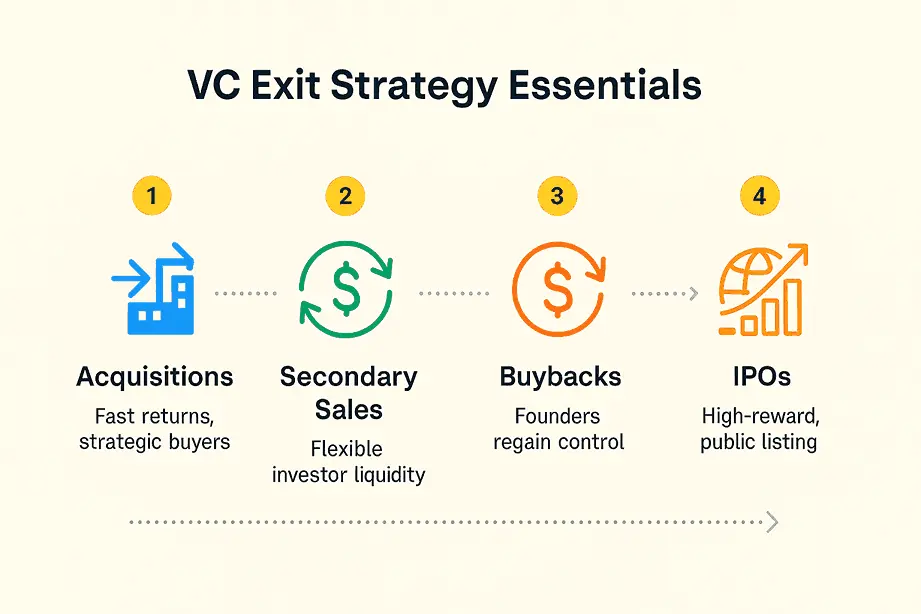
1. Acquisitions: Rapid Liquidity and Strategic Growth
Acquisitions are often the fastest route to liquidity, providing immediate returns for investors and founders. These deals typically involve a larger company purchasing a startup to integrate its technology, talent, or market share.
Exit volumes remain strong. In Q3 2025, exit activity generated $75.6 billion from 362 exits, the most active quarter since 2021. These numbers validate the significance of acquisitions and other exit routes for investors and founders pursuing liquidity.
Google’s acquisition of YouTube for $1.6 billion in November 2006 exemplifies the speed and scale of such transactions. This deal demonstrated how technology-driven companies could rapidly become acquisition targets, reshaping entire industries.
For instance, Google’s acquisition of YouTube for $1.6 billion in November 2006 exemplifies the speed and scale of such transactions. This deal not only delivered rapid liquidity but also allowed YouTube to expand its reach under Google’s umbrella. Similarly, Facebook’s $1 billion acquisition of Instagram in 2012 highlights how rapid user growth can drive lucrative acquisition deals, offering founders both financial security and strategic alignment.
2. Secondary Market Sales: Flexibility for Investors
Secondary market sales allow investors to sell their shares to other private buyers, providing flexibility and liquidity without waiting for a full company exit. This strategy is especially useful for VC capital firms looking to rebalance their portfolios or secure partial returns before the startup reaches maturity. While secondary sales may not offer the same scale of returns as acquisitions or IPOs, they provide an alternative pathway for investors seeking liquidity.
3. Buybacks: A Founder-Friendly Option
Buybacks occur when the startup repurchases shares from investors, often to regain control or simplify its ownership structure. This strategy can be advantageous for founders who wish to retain greater autonomy while providing investors with a profitable exit. Although buybacks may not deliver the exponential returns of acquisitions or IPOs, they can be a practical solution for startups with steady cash flow and a clear growth trajectory.
4. IPOs: The Pinnacle of Exit Strategies
Initial Public Offerings (IPOs) represent the ultimate exit strategy for many startups, offering unparalleled visibility and access to capital. While IPOs can deliver significant returns for VC capital firms, they require meticulous preparation, including robust financial reporting, market positioning, and regulatory compliance. For investors, the potential for 10-20X returns makes IPOs an attractive option, but the process is often lengthy and complex.
Why Secure Virtual Data Rooms Matter in VC Exits
Building on these exit strategies, secure Virtual Data Rooms (VDRs) play a critical role in managing sensitive documents. VDRs enable founders and investors to share confidential information efficiently with buyers, legal teams, and advisors. This approach streamlines due diligence, reduces the risk of data leaks, and fosters trust among all parties. Using VDRs can accelerate deal timelines and support stronger valuations during complex exit negotiations.
The Role of backward VC math (calculating expected exit values based on investment targets)
Understanding backward VC math is crucial for determining exit valuations. This approach involves calculating the required exit value to achieve target returns, typically 10-20X, based on the initial investment and fund size. By working backward from these metrics, VC capital firms can set realistic expectations and align their strategies with the startup’s growth potential.
Recent technology IPOs redefine exit paradigms. CoreWeave’s IPO in 2025 contributed to 40% of overall exit deal value. This case shows how AI-driven companies now anchor major liquidity events for investors.
Exit strategies are not one-size-fits-all; they must be tailored to the startup’s unique circumstances and the VC firm’s objectives. Whether through acquisitions, secondary sales, buybacks, or IPOs, the key lies in strategic planning and timing. By understanding these pathways and leveraging backward VC math, investors and founders can maximize their returns and achieve their long-term goals.
For a deeper dive into how investors assess exit prospects, explore our detailed review of the early-stage VC investment memo, which outlines the criteria that influence successful exits.
Startups like yours already closed their rounds with us.
Founders across every stage and industry. Here's what it took.
- Raised $7.6M for Swiipr Technologies
- Raised $0.5M for Ap Tack
- Raised €0.5M for Ivent Pro

Prepare for Your IPO Success with These Essential Tips
Launching an Initial Public Offering (IPO) is a transformative milestone for any company, but achieving success requires meticulous preparation. From ensuring predictable revenue growth to establishing strong governance, every detail matters. Below are actionable strategies to help you prepare for a successful IPO.
1. Maintain Predictable Revenue Growth
A company’s financial performance is often the first metric investors scrutinize. To attract favorable public valuations, focus on generating steady and predictable revenue growth. For startups, an annual revenue benchmark of $50–100M is considered viable for IPO readiness. This figure not only demonstrates market demand but also signals scalability.
Market performance sets expectations for IPO outcomes. For 2024, the US Venture Capital Index returned 6.2% compared to 8.1% for private equity. This shows why sustained growth is critical for outperforming broader industry benchmarks.
For companies assessing their market potential, the discussion on market dynamics is further supported by the bottom-up market sizing article, which explains a methodical approach to estimating market potential. This resource can help gauge whether revenue forecasts align with IPO benchmarks.
2. Build Robust Governance and Leadership
A well-structured governance framework and a strong leadership team are critical for meeting investor scrutiny. Public markets demand transparency, accountability, and strategic foresight. Establishing a board of directors with diverse expertise and ensuring compliance with regulatory standards will instill confidence among stakeholders.
Additionally, compliance details are clarified by the PCAP statement (a standard disclosure document for private equity reporting) article, which outlines the necessary considerations in formatting and compliance.
3. Prioritize Comprehensive Due Diligence
Thorough due diligence is the backbone of IPO preparation. Investors and regulators will examine every aspect of your business, from financial statements to operational processes. Conducting internal audits and addressing any discrepancies early can prevent costly delays.
Emphasizing vc due diligence ensures that your company is prepared to meet the rigorous demands of public scrutiny. This process not only safeguards your reputation but also strengthens investor trust.
Find the Best Exit Path with Smart Strategies
Exiting a startup is a pivotal moment that demands careful planning and strategic foresight. To ensure maximum returns and negotiation power, founders must evaluate market conditions, internal readiness, and stakeholder alignment while exploring multiple exit pathways.
Assessing Market Conditions and Internal Readiness
Factors such as industry trends, investor sentiment, and economic stability can significantly impact valuation and buyer interest. Internally, startups must assess their operational readiness, financial health, and scalability. Conducting operational due diligence ensures a seamless transition during the exit process, minimizing disruptions and maximizing efficiency.
Exploring Multiple Exit Pathways
A startup’s exit strategy should not be limited to a single option. Considering multiple avenues—such as IPOs, acquisitions, and secondary sales—can enhance negotiating power and open doors to higher returns. For instance, acquisitions often provide immediate liquidity, while IPOs offer long-term growth potential. Tools like Carta can track investor interest, valuations, and cap table (a record of a company’s ownership stakes and securities) changes. This helps founders make informed decisions.
Aligning Stakeholders for a Smooth Transition
Stakeholder alignment is critical to avoid conflicts during the exit process. Founders must ensure that investors, employees, and board members share a unified vision for the exit strategy. This alignment not only streamlines decision-making but also strengthens the startup’s position during negotiations.
Plan for Post-Exit Transition and Continuity
Building on exit pathway selection, founders should plan for post-exit transition to ensure operational continuity. This includes strategies for retaining key personnel, maintaining customer relationships, and preserving core business processes. Effective transition planning minimizes disruption and helps sustain the company’s value and innovation after the exit. Preparing for this phase can also reassure buyers or public investors, supporting a smoother handover.
Understanding venture capital exit strategies is crucial for investors and entrepreneurs aiming to maximize returns. Our extended research paper dives deep into the complexities of VC exits, offering advanced insights and detailed analysis to help you make informed decisions.
From identifying optimal exit routes to evaluating market trends, the paper provides a comprehensive view of the factors influencing successful exits. It explores critical aspects such as timing, valuation, and the impact of regional differences on profit allocation. For instance, an analysis of regional variations in profit allocation emerges from the american vs european waterfall article, offering insights that broaden your perspective on exit outcomes.
Conclusion
Clear exit planning is the cornerstone of successful venture capital exits. Throughout this post, we’ve explored essential strategies, including identifying viable exit routes, conducting thorough preparation, and ensuring robust due diligence. Each step plays a critical role in maximizing outcomes and minimizing risks.
Data-driven decision-making is equally vital, as it empowers founders and investors to align their strategies with market trends and opportunities. By prioritizing these elements, businesses can position themselves for smoother transitions and greater returns.
If you're ready to take the next step in your growth journey, our Fundraising Assistance service is designed to help you achieve your goals efficiently. Let us guide you in adopting proven strategies tailored to your unique needs.
Key Takeaways
- Successful exits are critical for returning investor capital and can occur through IPOs, acquisitions, secondary sales, or buybacks.
- Thorough due diligence and strategic planning improve exit outcomes for both founders and VCs.
- Understanding backward VC math is essential for evaluating required return thresholds.
- Real-world examples like YouTube and Instagram illustrate both the potential rewards and the volatility of exit strategies.
- Data-driven insights combined with targeted Qubit Capital services empower founders to achieve successful exits.
Find startups worth your time.
Curated startup opportunities matched to your thesis and investment criteria.
- Deal flow filtered by sector, stage, and fit
- Research and context included with every opportunity
- Less noise. More relevant deal flow.

Frequently asked Questions
How can founders prepare for a successful IPO exit?
Founders should ensure predictable revenue growth, strong governance, and thorough due diligence before pursuing an IPO exit. These steps boost valuation and readiness.