

 Back
Back










Table of Contents

Venture capitalists (VCs) carefully evaluate startups using a structured due diligence process. To understand the scope of VC activity, global VC funding surged 24% in late 2024, hitting $120 billion across 4,000 deals. This dramatic expansion highlights why rigorous diligence is more critical than ever for both investors and startups.
VC often use CRM tools to make evaluations more efficient. This checklist helps VCs make informed decisions, reducing risks and identifying promising investments. Understanding what VCs evaluate can empower startups to prepare effectively, ensuring they meet the rigorous standards of investors.
Let’s explore the key components of VC due diligence and how startups can position themselves for success.
What Makes Venture Capital Due Diligence Unique?
Venture capital (VC) due diligence is unique because of its detailed, multi-layered approach. Unlike traditional investment evaluations, VC firms thoroughly assess risks, opportunities, and operational dynamics. They often spend at least 20 hours per deal to ensure a comprehensive review. This significant time investment reflects the complexity of evaluating startups, where factors like scalability, market fit, and team resilience are crucial.
There is proven ROI for deeper diligence. Angel investors dedicating over 40 hours to due diligence achieve 7.1x returns versus 1.1x for those spending less than 20 hours. This demonstrates how diligence depth drives investment performance.
One emerging trend reshaping VC due diligence is the growing emphasis on cybersecurity audits. Cybersecurity risks can greatly affect a startup’s valuation and long-term viability, making these audits a critical part of modern due diligence.
Technology is also transforming how VCs approach due diligence. AI-powered automation, for instance, is streamlining the traditionally manual evaluation process. By integrating machine learning for data pattern recognition, VCs can reduce evaluation time by 40-60% while improving accuracy. This innovation not only accelerates decision-making but also enhances the depth of insights, enabling firms to identify potential risks and opportunities more effectively.
Startups like yours already closed their rounds with us.
Founders across every stage and industry. Here's what it took.
- Raised $7.6M for Swiipr Technologies
- Raised $0.5M for Ap Tack
- Raised €0.5M for Ivent Pro

VC Due Diligence Checklist: Screening Criteria Used by Major VC Firms
Venture capital firms do not lack deal flow. They are overwhelmed by it. With roughly 137,000 startups launching every day worldwide, no VC can evaluate everything. Screening is how they survive.
Strong screening criteria allow deal teams to filter thousands of inbound opportunities down to a manageable few that actually fit their fund strategy. This early-stage filtering decides which startups get a meeting and which never reach a partner’s inbox.
Most VC firms start due diligence by assessing a core set of filters before diving deeper. These criteria help eliminate misaligned opportunities quickly.
Primary VC screening criteria
- Company stage
- Geographic presence
- Financial profile
- Industry focus
Once a startup passes these initial filters, VCs look more closely at execution signals.
Secondary evaluation factors
- Founding team quality, including experience, track record, and team cohesion
- Market potential and traction, such as customer growth, revenue momentum, and retention
- Technology, intellectual property, and regulatory alignment, including defensibility and compliance
Recent fundraising trends show how effective screening surfaces category leaders early. Companies like Databricks, OpenAI, and xAI dominated Q4 2024 fundraising rounds, reflecting strong alignment with investor criteria long before capital scaled.
For founders, understanding how VCs screen opportunities is not about gaming the process. It is about positioning your startup so it fits clearly and quickly into the boxes investors already use to decide.
Build a Strong Framework for VC Due Diligence
Successful venture capital due diligence requires a systematic approach. Major VC firms evaluate four core areas: financial health, team strength, market fit, and legal compliance. A comprehensive checklist ensures consistency and prevents critical oversights.
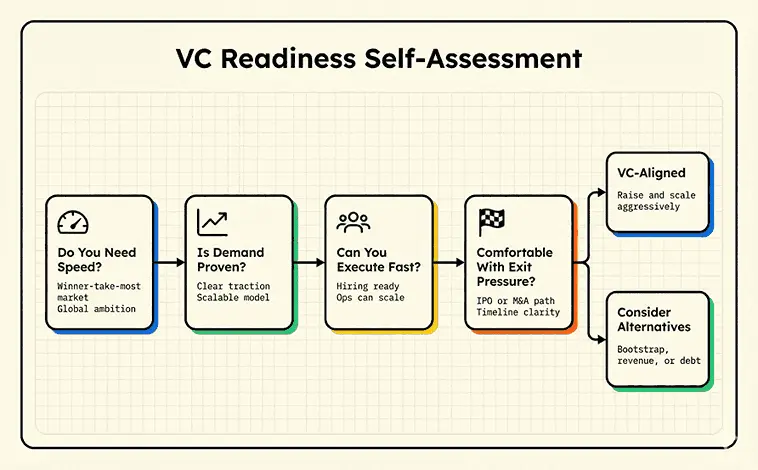
Key due diligence components include:
- Financial assessments verify revenue projections, cash flow statements, and burn rate sustainability. VCs scrutinize whether your numbers are realistic and your runway adequate.
- Team evaluation examines founder experience, key hires, and organizational gaps. Investors want to see the right people executing your vision.
- Market validation confirms product-market fit, competitive positioning, and growth potential. VCs need evidence that your solution addresses a real market need.
- Legal reviews identify compliance issues, intellectual property ownership, and contractual obligations. Unresolved legal problems can derail deals quickly.
By adopting a standardized checklist, VCs can systematically evaluate opportunities while startups can prepare materials proactively. This framework streamlines the process for both parties, ensuring thorough assessment without unnecessary delays.
Additionally, aligning due diligence with broader capital strategies can enhance decision-making. For instance, an examination of ways to secure capital for startup sheds light on how thorough evaluations support funding decisions tailored to different growth stages.
Key Risk Categories in VC Due Diligence
- Timing risk considers whether market conditions and product readiness align for successful growth and adoption.
- Execution risk evaluates the team’s ability to deliver milestones and scale operations as planned.
- Product risk examines the feasibility, differentiation, and defensibility of the startup’s core offering.
- Regulatory risk assesses exposure to compliance requirements, legal changes, or industry-specific restrictions.
Your Complete VC Due Diligence Checklist Template
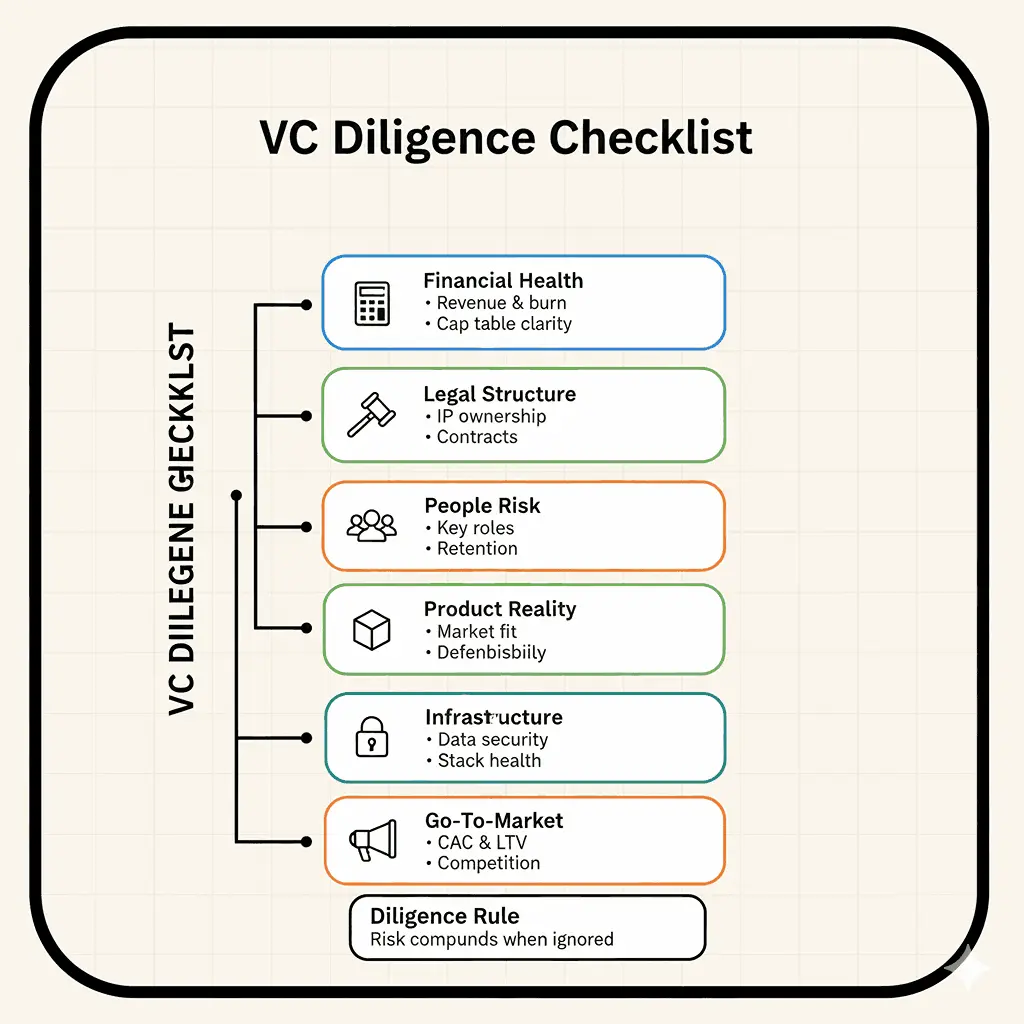
A VC due diligence checklist is essential for evaluating every operational aspect of a startup. This template organizes the process into distinct categories.
- Financials: Review bookkeeping, income statements, cap tables.
- Legal: Check contracts, validate IP, ensure compliance.
- HR: Examine hiring policies, retention plans, and equity distribution.
- IT: Assess data security, tech stack, and software licenses.
- Marketing: Review strategy, key metrics, and spend efficiency.
1. Financials
Use a due diligence investment checklist to assess the startup’s financial health and review accurate bookkeeping practices.
- Review accurate bookkeeping practices. These practices form the foundation of financial due diligence.
- Analyze the startup’s income statements for profitability. Examine the cap table (ownership structure) for transparency.
- A cap table (capitalization table) shows the ownership stakes of all investors and founders.
A cap table shows who owns what, including founders, employees, and investors. It also reveals potential red flags like messy option pools or unclear conversion terms. Use this review to spot unusual revenue spikes, hidden expenses, or risks that could affect future fundraising.
2. Legal
- Verify compliance with local and international regulations.
- Review contracts, shareholder agreements, and customer terms.
- Confirm intellectual property ownership and check for ongoing or potential disputes.
Unresolved legal issues can delay or kill deals, especially at later stages.
3. Human Resources
People risk is execution risk.
- Evaluate team structure, key hires, and role clarity.
- Review employment agreements, equity grants, and compensation plans.
- Assess retention risks and dependency on individual contributors.
A solid HR foundation supports growth and reduces operational fragility.
4. Assets and IT
Technology and assets must scale with the business.
- Assess proprietary technology, infrastructure, and software stack.
- Review data security practices and access controls.
- Confirm software licenses and third-party dependencies.
Startups with unclear IP ownership or legacy systems often face deeper scrutiny.
5. Products/Services
This is where story meets reality.
- Evaluate product-market fit, differentiation, and scalability.
- Review customer usage patterns and adoption signals.
- Assess how defensible the offering is as competition increases.
For example, a SaaS startup with strong retention is often favored over a hardware business with uncertain demand.
6. Marketing and Competition
Growth quality matters more than growth speed.
- Analyze key metrics like customer acquisition cost and lifetime value.
- Review go-to-market strategy and spend efficiency.
- Map competitors to understand positioning and defensibility.
7. Founder Background
Finally, investors assess the people making the decisions.
- Review founder experience, past exits, and domain expertise.
- Evaluate leadership style, vision, and ability to execute under pressure.
Strong founders can navigate setbacks. Weak leadership amplifies risk.
This checklist template not only mitigates typical fundraising challenges and solutions but also ensures a thorough evaluation across all critical categories.
Adapting Due Diligence Checklists by Funding Stage
Building on this checklist, investors should tailor their due diligence approach to the startup’s funding stage. Early rounds may prioritize founder evaluation and market potential, while later stages demand deeper financial and legal scrutiny. This adaptation ensures each review remains relevant, efficient, and aligned with the company’s maturity. Adjusting checklist focus by stage helps both investors and startups prepare for evolving expectations.
How a VC Due Diligence Checklist Can Strengthen Your Investment Deals
- Financial Records
- Legal Documents
- Team Background
- Cybersecurity Measures
Due diligence in investing is more than a tool, it’s a strategic advantage. Using structured diligence improves speed. Typical VC deals once required 83 days to complete, as a study of 700 firms found. Modern checklists and tools now streamline this timeline for both parties.
By using a due diligence investment checklist, investors can ensure no essential details are missed, securing stronger investment outcomes. Modern tools amplify the efficiency of this process. For instance, a robust CRM platform enables venture capitalists to track tasks across multiple deals simultaneously, ensuring seamless management of contacts, pipelines, and relationships.
Centralized Data Rooms for Efficient Due Diligence
This foundation enables more effective collaboration when all due diligence documents are stored in a centralized data room. A single, organized repository allows investors and founders to access, review, and update materials without confusion. Centralized data rooms reduce delays, minimize version control issues, and support faster deal execution. Adopting this approach streamlines the entire diligence process for all parties.
Conclusion
VC due diligence is no longer a formality. It is a high-stakes filter shaped by volume, speed, and risk management. As deal flow explodes and capital becomes more selective, investors rely on structured checklists to move fast without missing landmines. For startups, understanding this process is not about impressing investors with polish. It is about removing friction, answering questions before they are asked, and proving readiness at every level of the business. The startups that pass diligence smoothly are not luckier. They are simply better prepared.
If you want your startup’s story to land the right way during diligence and investor conversations, Qubit Capital’s investor outreach service helps you connect with relevant VCs, angels, and HNIs who are more likely to engage seriously with your business. Start building meaningful investor relationships that turn diligence into decisive offers.
Key Takeaways
- VC due diligence has intensified as global funding volumes grow, making preparation critical for startups competing for limited attention.
- Investors use strict screening criteria early to eliminate misaligned startups before deeper evaluation begins.
- Financial clarity, including clean cap tables and realistic projections, is one of the fastest deal accelerators or killers.
- Founder quality and team execution ability often outweigh product strength in early-stage diligence decisions.
- Legal and IP gaps can delay or derail funding, especially as startups move into later stages.
- Cybersecurity and data governance are now core diligence areas, not optional add-ons.
- Due diligence checklists evolve by funding stage, with early rounds focused on potential and later rounds on proof.
- Centralized data rooms and structured processes significantly reduce deal timelines and investor friction.
- Startups that understand diligence expectations position themselves as lower-risk, higher-confidence investments.
Find startups worth your time.
Curated startup opportunities matched to your thesis and investment criteria.
- Deal flow filtered by sector, stage, and fit
- Research and context included with every opportunity
- Less noise. More relevant deal flow.

Frequently asked Questions
How does a VC due diligence checklist help startups secure funding?
A VC due diligence checklist ensures startups address essential areas, reducing risk and increasing their chances to secure VC funding.