

 Back
Back










Table of Contents

Startup funding is not one-size-fits-all, and stage changes everything. What works for a pre-revenue startup chasing product-market fit looks very different from what a late-stage company needs to scale efficiently. Early-stage founders prioritize speed, flexibility, and survival. Late-stage teams focus on capital efficiency, risk management, and protecting ownership as valuations climb.
Understanding how funding priorities shift across stages helps founders choose the right instruments, avoid premature dilution, and raise capital on terms that actually support growth. This guide breaks down how early-stage and late-stage startups think about funding, and why the strategy that works today may hurt you tomorrow.
How Early Stage vs Late Stage Startups Approach Growth and Risk
In 2024, seed-stage startups raised 12.5% less capital than the year before. That pullback changed how early-stage founders think about risk, runway, and growth. The 12.5% drop reset what your seed pitch must prove. Investors now fund a clear path to the next milestone. Treat every dollar as runway you convert into proof. Raise to the milestone that resets your valuation, then stop.
Early-stage startups raise capital to build and validate. Seed funding typically supports product development, MVP creation, and early market entry. Investors at this stage back potential rather than predictability, which gives founders room to experiment but little margin for wasted capital. For you, this means the seed pitch sells a hypothesis, not a track record. Each dollar should buy down your single biggest unknown. Investors price that unknown into the round. Spend on the experiment that most de-risks the next raise.
Late-stage startups raise capital for a different reason. The goal shifts to scaling proven models, improving operational stability, and moving toward liquidity. Investors expect strong metrics, repeatable growth, and disciplined use of capital. At late stage, your pitch shifts from story to proof. Investors stress-test unit economics and the durability of growth. Frame the raise around the last risk standing between you and exit. Vague upside no longer moves the room.
Because priorities differ by stage, fundraising strategies must evolve. Early-stage founders benefit most when funding goals are tightly defined and milestones are realistic. Tie each raise to the milestone that resets your valuation higher. Investors read tight goals as evidence you understand your own risk. Vague use-of-funds signals you will burn the round learning what to build.
Key focus areas for early-stage fundraising:
- Clarify what this round needs to unlock
- Show credible market proof, even if early
- Build a focused pitch deck tied to outcomes
- Target investors who specialize in your stage
- Plan milestones that justify the next raise
One common pitfall is overvaluing too early. High seed valuations can limit late-stage investor interest and complicate future pricing if growth does not keep pace. A rich seed price sets a bar your Series A growth must clear. Miss it and you face a flat or down round. Down rounds reset employee equity and signal trouble to every future investor. Price the seed for the round after it, not for ego.
In tighter funding environments, early-stage startups must manage risk carefully, while late-stage companies focus on protecting scale and efficiency. Understanding this shift helps founders raise capital that supports long-term growth rather than short-term optics. For a broader overview of raising funds at multiple stages you can learn about different startup fundraising strategies.
The Role of a Complementary Founding Team
A strong product gets you noticed; a strong founding team gets you funded. Once your MVP exists, investors price the people, not the demo, asking whether technical, operational, and commercial skills cover execution. Complementary teams signal you can execute under pressure and adapt as the raise exposes new risks.
Team dynamics matter more than most founders expect. Investors watch how you divide responsibilities, make decisions, and handle conflict in the room. Settling team composition early speeds product development and strengthens every fundraising conversation that follows.
Funding Tools That Support Early Growth
During the development phase, access to the right type of capital is just as important as access to capital itself. Convertible notes, which are short-term debt that converts into equity, and preferred equity, which gives investors priority rights, are common tools used to fund early growth. These instruments help startups secure resources while postponing complex valuation discussions. For you, these instruments delay the valuation fight until you have leverage. A convertible note prices on your next round, when traction is higher. That protects you from anchoring a low number too early in the raise sequence.
Specialized startup-focused lenders and financial institutions often become long-term partners, supporting companies as they move from early traction toward scale.
Accelerators and Mentorship for Early-Stage Startups
Capital alone is rarely enough. Startup accelerators and mentorship programs play a critical role in preparing founders for institutional funding. They provide structured guidance, industry connections, and candid feedback that help teams sharpen their business models and close operational gaps. To investors, accelerator backing is a third-party signal that lowers their risk. It tells them someone credible already vetted your team and model. Use the program to rehearse the pitch and close gaps before institutional money sees it.
Participation in these programs often increases investor confidence and credibility. For many early-stage startups, the combination of mentorship, network access, and fundraising readiness can significantly improve the odds of a successful raise. Teams building in competitive sectors often pair risk management with practical fundraising strategies for tech startups so they raise enough runway without overextending.
Startups like yours already closed their rounds with us.
Founders across every stage and industry. Here's what it took.
- Raised $7.6M for Swiipr Technologies
- Raised $0.5M for Ap Tack
- Raised €0.5M for Ivent Pro

Why Late-Stage Investments Focus on Stability and Fast Exits
Late-stage startups benefit most here because they already hold a market position. Check sizes often exceed $10 million, as the “Late Check” statistic shows. That capital buys aggressive growth, so investors expect disciplined deployment, not experimentation.
Exit Strategy Planning for Late-Stage Startups
At this stage, proactive exit strategy planning becomes crucial for founders and investors. Considering options such as IPOs or acquisitions early helps maximize company valuation and ensures a smoother transition. Clear exit objectives align stakeholder interests and guide strategic decisions. This foresight can also attract investors seeking defined paths to liquidity. For you, naming the likely exit early shapes which investors you pitch. Acquirer-minded founders raise differently than IPO-minded ones. Stating the path signals you know who buys this company and when.
Once a company reaches this point, the playbook shifts toward advanced fundraising strategies for scaling startups that match larger checks with tighter governance and clearer milestones.
Another key focus is the shorter holding period. Investors in this stage often aim for exits within three to five years, as demonstrated by the “Late Exit” statistic. This accelerated timeline aligns with the maturity of these startups, which are already positioned for liquidity events. Higher valuations also play a significant role, reflecting the reduced risk and established market presence of these companies. The three-to-five-year clock, shown by the “Late Exit” statistic, is the investor's, not just yours. Every late-stage term is built to protect that timeline. Pitch the raise as the last step before a near-term liquidity event.
For startups preparing for late-stage funding, advanced financial solutions like bank accounts for business startups become essential. These accounts help manage larger capital flows efficiently, ensuring the company is equipped to handle the complexities of scaling operations and preparing for an exit. If priorities keep shifting, use the startup fundraising roadmap to lock stages, owners, and dates in one place.
Early Stage vs Late Stage Startups: Comparing Investment Stages
Not all startup investments carry the same risk, and not all growth looks the same. Understanding the difference between early-stage and late-stage startups is essential for evaluating risk, return potential, and capital strategy at each phase. What investors expect at seed is fundamentally different from what they demand once a company is scaling. For you, this means each stage rewrites the pitch you must deliver. At seed you sell belief; while scaling you sell proof. Reading the room's stage correctly is half of raising the right money.
The path from early traction to sustained growth unfolds in distinct stages, each shaped by its own financial needs, milestones, and decision pressures. As startups move through these phases, the balance between risk, capital efficiency, and growth shifts for both founders and investors.
Recognizing how these stages differ helps founders raise smarter capital and helps investors align expectations with reality.
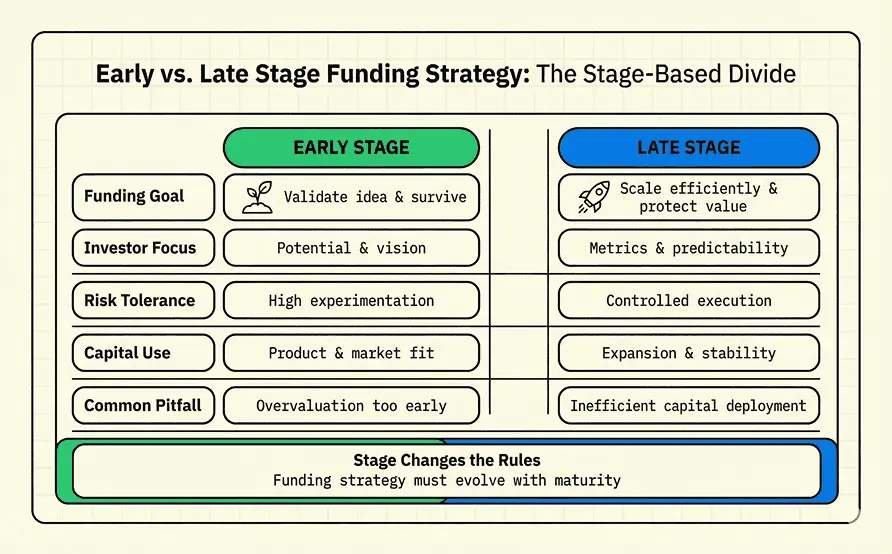
1. Early-Stage Funding: Seed and Series A
Early-stage funding focuses on helping startups establish their foundation. Seed funding, often the first external capital raised, supports product development, market research, and initial operations. In 2024, the median fundraising amount for seed rounds was $3.5 million, reflecting current benchmarks. This number offers founders insight into typical capital they might expect.
Understanding the stages of startup funding helps founders choose the right strategy for each round. Series A funding builds on the seed stage, enabling startups to refine their business model and expand their customer base. Valuation methods here often rely on projections and market potential rather than historical data. Investors seek high-growth opportunities, balancing risk with the promise of significant returns. At the growth stage, startups focus on scaling operations and attracting larger investments. For you, Series A is priced on projection, so the story still carries weight. But investors now expect early proof the seed thesis held. Show the model working in miniature before you ask them to fund scale.
2. Late-Stage Funding: Series B and Beyond
In Q1 2022, the median late-stage company burned $10.6M per quarter. Rapid cash consumption underscores scale requirements, and the risks, of expansion at this phase. For you, that burn rate sets the size and speed of the raise. Late-stage money funds a known engine running faster, not a search. Investors expect every dollar to map to a unit of growth.
As you mature, late-stage funding turns toward scaling operations and reaching profitability. Series B usually funds market expansion. Series C and beyond tighten operations and prepare you for an IPO or acquisition.
Valuation methods evolve in late-stage funding, relying more on tangible metrics like revenue, profitability, and market share. Investors, including private equity firms and institutional funds, prioritize stability and scalability, often adopting portfolio strategies that minimize risk while maximizing returns.
Key Differences in Investor Preferences
Investor priorities shift significantly between early and late stages. Early-stage investors are drawn to innovation and disruptive potential, often accepting higher risks for the chance of exponential growth. Late-stage investors, on the other hand, focus on established companies with proven track records, favoring lower-risk investments with predictable outcomes.
An examination of ways to secure capital for startup presents stage-specific funding methods that integrate seamlessly with the overall discussion of financing evolutions.
Economic Impacts Across the Startup Life Cycle
Funding stages also influence broader economic trends. Early-stage investments drive innovation and job creation, fostering entrepreneurial ecosystems. Late-stage funding contributes to economic stability by supporting mature businesses that generate consistent revenue and employment.
Understanding the progression from early-stage to late-stage funding equips entrepreneurs and investors with the insights needed to navigate the complexities of the startup life cycle. For legal and ops hygiene, venture capital due diligence checklist outlines the unglamorous stuff that kills deals late. Think IP assignments, key contracts, compliance notices, and vendor dependencies.
Tackle Risks and Overcome Challenges in Startup Funding
Risk profiles for early stage vs late stage startups differ significantly, influencing funding decisions and investment strategies. Startup investments often come with high stakes, characterized by volatility, cash flow challenges, and potential illiquidity. Early-stage ventures, while offering exponential growth opportunities, frequently operate on unproven business models, making them inherently risky.
For instance, 38% of startups fail due to cash shortages, highlighting the critical need for prudent financial planning and risk management. For you, that statistic is a runway warning, not a fundraising one. Most of those failures are mistimed raises, not bad businesses. Raise before you need the money, while the metrics still tell a story. The strongest negotiating position is the one you reach with cash in the bank.
Diversification is a key strategy to mitigate these risks. By spreading investments across various sectors, investors can reduce exposure to individual startup failures. Emerging industries, such as climate tech, present both significant risks and massive upside potential, making them attractive yet unpredictable options for diversification.
Effective risk management also involves understanding the nuances of startup funding. A discussion on fundraising challenges and solutions presents an objective look at common obstacles within the fundraising process, aligning with the broader narrative of startup financing.
Balancing risk and reward takes diversification, sector analysis, and financial foresight working together. For investors, those tools turn startup uncertainty into a manageable bet. For you, knowing how they price that risk tells you how to frame yours.
Early Stage Investing: Create a Balanced Portfolio
Early-stage investing is a game of probabilities, not predictions. The risk is high, which is exactly why diversification matters. That probability math sets the bar your pitch must clear. Each investor needs a few bets that return the whole fund. So they fund the credible path to a 10x outcome, not a safe single. Pitch why you are the outlier, not why you are low risk.
Most early-stage portfolios are built around many smaller bets rather than a few large ones. Investors spread capital across multiple startups, knowing that a small number of breakout successes will drive the majority of returns.
Initial check sizes typically range from $500,000 to $5 million, depending on stage, sector, and conviction. This flexibility allows investors to calibrate exposure while managing downside risk. For you, that range explains why round sizes flex so much. Conviction, not a formula, sets your check. Raise the conviction and the number follows.
Early-stage startups play a critical role in portfolios designed for innovation and long-term growth. They offer access to new technologies, emerging markets, and unconventional business models that are unlikely to appear at later stages.
Diversification across industries, geographies, and company types helps reduce dependency on any single outcome. The goal is simple: maximize exposure to upside while protecting the portfolio from inevitable failures.
Ultimately, a balanced portfolio for early-stage investments is about creating a dynamic mix of opportunities. By making many smaller bets, investors can capture the upside of innovation while maintaining a safety net against the inherent volatility of startups.
For those exploring structured investments, an analysis of startup funding options highlights a range of financing methods, from equity to debt, that directly relate to the contextual themes of capital acquisition.
Maximize Returns with Late Stage Venture Capital Portfolios
Late-stage investment portfolios prioritize precision and impact. Unlike early-stage strategies that spread capital across numerous ventures, these portfolios concentrate on fewer, larger investments in companies with proven track records. By focusing on established businesses, investors can minimize risk while targeting ventures with clear paths to liquidity.
This approach targets stronger returns by favoring stability and high-value opportunities. Late-stage companies have shown market viability, scalability, and consistent revenue. For you, that means the raise is judged on durability, so prove the engine repeats.
Concentrated portfolios also allow for deeper engagement with individual companies. During outreach, keep startup accelerator programs best fit handy to tailor your pitch to each program’s selection lens.
Conclusion
Startup funding strategies must evolve as the company evolves. What keeps an early-stage startup alive can quietly constrain a late-stage company, and what fuels late-stage scale would overwhelm a young team. Stage determines risk tolerance, investor expectations, capital instruments, and even how mistakes are priced. Founders who understand these shifts raise capital with intention instead of habit. The real advantage is not raising more money, but raising the right money at the right time, on terms that still make sense when the company grows up.
If you want your funding strategy to evolve as intelligently as your startup does, Qubit Capital’s fundraising consulting services can help you map the right capital approach for every stage. From early validation to late-stage scale, we help founders raise with clarity, not regret.
Key Takeaways
- Early-stage startups raise capital to validate ideas and survive long enough to prove demand, making speed and flexibility more important than efficiency.
- Late-stage startups raise capital to scale proven models, where capital efficiency, risk control, and ownership protection take priority.
- Funding strategies that work at seed can backfire later, especially when early overvaluation creates friction in future rounds.
- Investor expectations shift dramatically by stage, moving from belief in potential to demand for metrics, predictability, and execution discipline.
- Complementary founding teams materially improve fundraising outcomes by signaling execution capability beyond the product itself.
- Early-stage funding tools prioritize flexibility and deferred valuation, while late-stage instruments emphasize structure and downside protection.
- Late-stage investors focus heavily on exit clarity, shorter holding periods, and operational stability to support liquidity outcomes.
- Aligning funding strategy with stage reduces dilution risk, improves negotiating leverage, and supports sustainable long-term growth.
Get your round closed. Not just pitched.
A structured fundraising process matched to your stage and investor fit.
- Fundraising narrative and structure that holds up
- Support from strategy through investor conversations
- Built around your stage, model, and timeline
Frequently asked Questions
How do funding strategies differ for early stage vs late stage startups?
Early-stage startups raise capital to validate ideas, build products, and enter the market. Speed and flexibility matter more than efficiency at this point. Late-stage startups raise capital to scale models that already work and reach profitability. Their funding focuses on stability, larger rounds, and a clear path to exit.