

 Back
Back








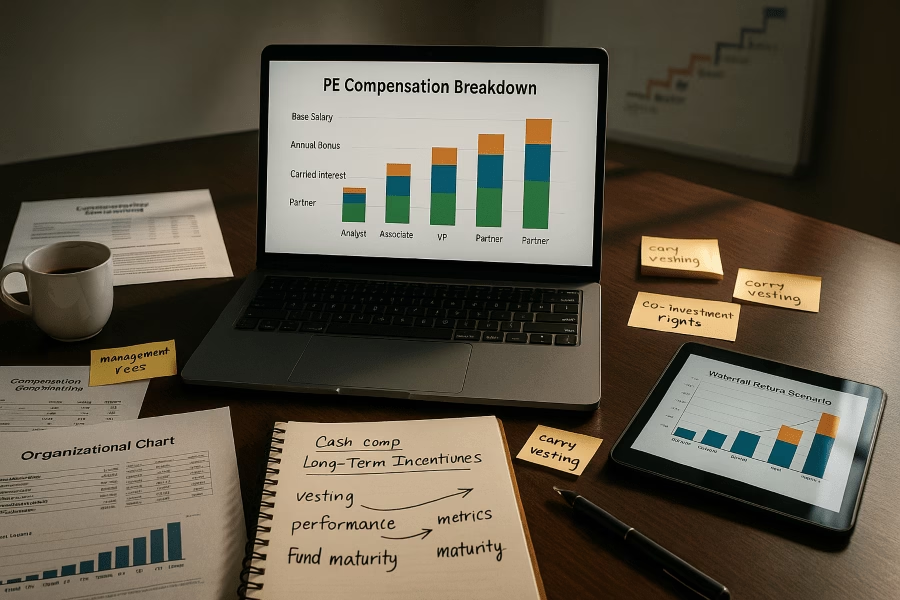
Table of Contents

Private equity compensation, often regarded as one of the most lucrative in finance, is built on three key components: salaries, bonuses, and carried interest. These elements combine to create a comprehensive package that attracts top talent and rewards performance. Knowing how these structures work is essential for anyone aspiring to enter this competitive field or seeking insights into its financial dynamics.
Let’s explore how salaries, bonuses, and carry form the backbone of private equity compensation.
How Do Salaries Work in Private Equity?
Private equity (PE) represents a dynamic sector within finance, offering lucrative opportunities for professionals seeking career advancement. Often regarded as a natural progression different types of investors, private equity roles demand expertise in transaction analysis and collaboration with portfolio companies to drive growth and profitability.
Salaries in private equity represent some of the most lucrative opportunities for professionals seeking career advancement.
- Identify your target role
- Research salary benchmarks
- Evaluate bonus structures
- Review carried interest policies
PE offers high compensation and rapid career growth. Firms combine salaries, bonuses, and profit-sharing for pay.
One of the most compelling aspects of private equity is its compensation structure. PE firms are known for paying top-dollar salaries, complemented by generous performance bonuses. This trend of private equity compensation growth, particularly in management roles, continues to attract top-tier talent from across the financial industry. As highlighted by the PE Trend of “High Compensation Growth,” the appeal of transitioning from investment banking to private equity is undeniable. From a diligence lens, comp design signals firm discipline to LPs. Board reports increasingly track whether pay scales with realized exits or with paper marks. Funds that anchor compensation to cash exits read cleaner during fundraising and audit reviews.
Private equity professionals sit close to portfolio company decisions, joining board meetings and shaping exit timing. Your daily work becomes diligence material that LPs review during fund-of-fund evaluations. Active board engagement also strengthens your file when buyers run reverse diligence at exit.
Private equity remains a cornerstone of career growth in finance, offering unmatched rewards for those ready to embrace its challenges. Also, public funding initiatives often come with conditions that shape compensation frameworks, including entry-level pay scale,in private equity. Those patterns are evident in government-backed investment programs startups, where state-led mandates influence salary structures and bonus schemes.
The market reach of private equity is expansive. Nationwide, more than 13 million workers are employed by over 21,000 private equity-backed businesses. That 21,000-company footprint shows the sector's reach across boards, audits, and exit pipelines.
Startups like yours already closed their rounds with us.
Founders across every stage and industry. Here's what it took.
- Raised $7.6M for Swiipr Technologies
- Raised $0.5M for Ap Tack
- Raised €0.5M for Ivent Pro

How to Navigate Compensation Structures and Salary Benchmarks
Salaries in private equity are structured to blend fixed pay with performance-driven rewards.
Base Salary
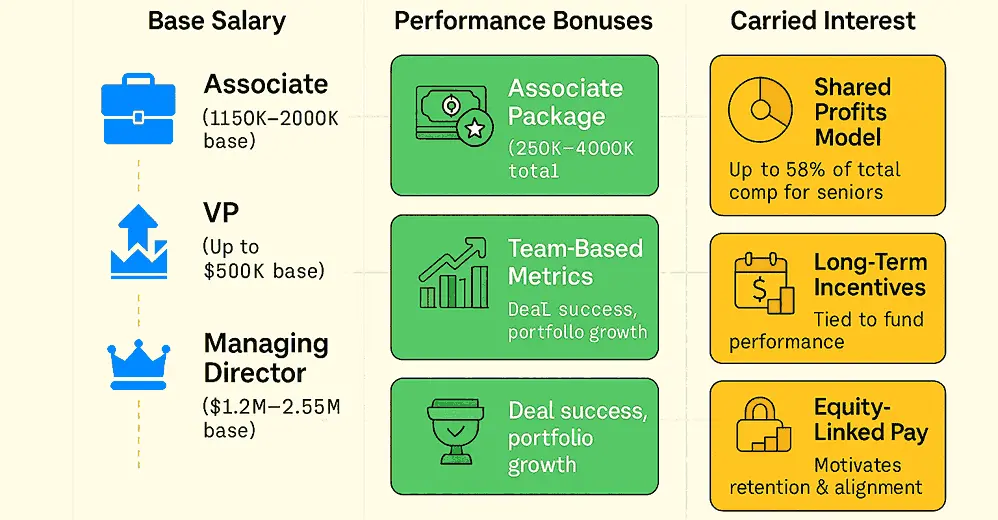
PE salary structures form the foundation of private equity pay. Private equity associate salary typically ranges from $150,000 to $200,000 annually for base pay. As professionals advance, base pay increases significantly, with Vice Presidents earning $500,000 and Managing Directors commanding $1.2M to $2.5M, according to Heidrick & Struggles (2024).Performance Bonuses
Bonuses are tied to individual and team performance metrics, rewarding contributions to deal success and portfolio growth. For analysts, bonuses can range from $100,000 to $150,000, effectively doubling their total compensation. Associates see total packages between $250,000 and $400,000, reflecting their growing responsibilities.Carried Interest
Carried interest is a share of profits from successful investments. This profit-sharing feature is a hallmark of private equity compensation. For senior professionals, carried interest can account for up to 58% of total earnings, underscoring its importance in aligning long-term incentives with firm performance.Compensation varies significantly across roles, reflecting differences in responsibilities and expertise:
Note: Small PE funds and emerging markets sometimes offer non-traditional compensation structures and less upside.
Role-Specific Benchmarks
Compensation varies significantly across roles, reflecting differences in responsibilities and expertise:
Analysts and Associates
Entry-level positions focus on financial modeling and due diligence. Analysts typically earn $100,000 in base salary, while associates see total packages of $250,000 to $400,000.Vice Presidents
Mid-career professionals oversee deal execution and portfolio management. Their compensation ranges from $500,000 to $1,000,000, combining base pay and bonuses.Managing Directors
Senior leaders drive firm strategy and investor relations. Research indicates their total earnings range from $1.2M to $2.5M, with carried interest playing a significant role.
How Geographic Location Impacts Compensation
Geography reshapes the comp curve in measurable ways. New York, London, and Hong Kong pay premiums tied to deal volume and LP proximity. From a diligence view, your location signals how close you sit to fundraising, audit firms, and exit advisors.
Managing Directors, Senior leaders drive firm strategy and investor relations. The average private equity salary increases substantially with seniority, often exceeding $2 million for top executives.
Integrated Compensation Models
PE salary models often balance fixed and performance-based components for stability and incentive.
Private equity firms often adopt integrated models that balance fixed and performance-based components. This approach ensures stability while incentivizing exceptional results. For example, management fees, averaging $20 million annually for mid-sized funds, partially fund salaries, while carried interest aligns professionals with long-term firm success. LPs read this split during diligence. A heavy management-fee load can flag misaligned incentives during fund-of-fund reviews. Boards push for higher carry weighting when exit timelines stretch beyond plan.
1. Balancing Risk and Reward
Compensation structures in private equity reflect the industry’s inherent risk-reward dynamic. A balanced review of the pros and cons of sovereign investments offers a nuanced perspective on how investment risks and rewards can impact private equity compensation systems.
2. Regulatory Risks Affecting Compensation
Carried interest taxation sits at the center of regulatory risk. Tax law shifts can change after-tax outcomes for partners and reshape incentive design overnight. Build your comp memo so it survives a tax-treatment change without rewriting the waterfall.
Optimize Your Carried Interest Allocation
Carried interest allocation drives long-term pay in private equity. Getting the design right matters for incentive alignment, LP trust, and exit-time outcomes. Transparent hurdle rates, clear distribution thresholds, and balanced rewards anchor the strategy.
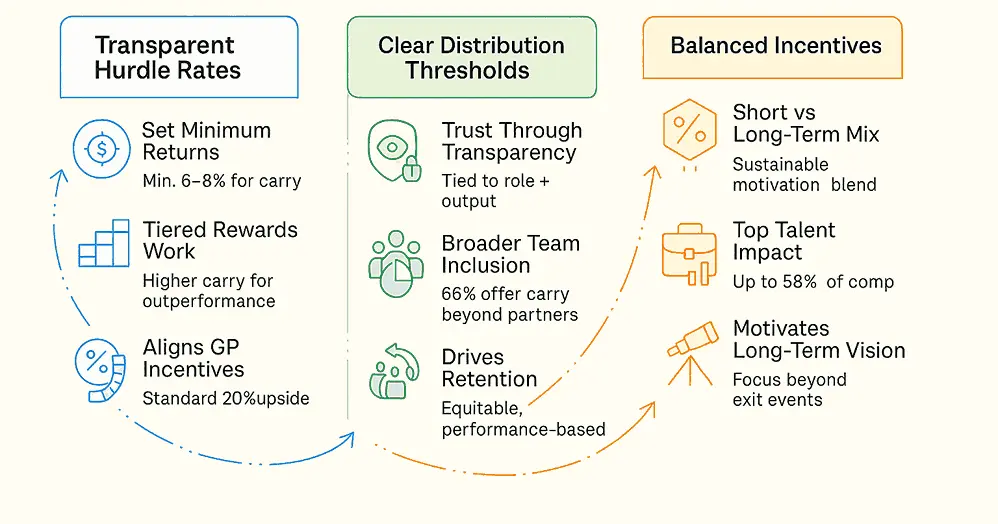
The three pillars of carried interest optimization are: 1) transparent hurdle rates, 2) clear distribution thresholds, and 3) balanced incentives.
1. Transparent Hurdle Rates and Tiered Allocation
Hurdle rates, typically set between 6–8%, establish the minimum return investors must achieve before carried interest is distributed. By clearly defining these performance thresholds, firms can ensure alignment between investor expectations and fund performance. Additionally, tiered carry allocation enables firms to reward exceptional outcomes while maintaining fairness across all levels of the organization. For example, the standard carry percentage of 20% provides general partners with a substantial upside, incentivizing them to exceed benchmarks.
2. Clear Distribution Thresholds Build Trust
Clear distribution thresholds build trust inside private equity teams. Tying rewards to defined responsibilities keeps everyone aligned with fund performance. 65% of private equity firms now extend carry to non-partner employees, broadening retention and strengthening diligence-ready talent files.
3. Balancing Short-Term and Long-Term Incentives
Striking the right balance between immediate rewards and long-term incentives is crucial for sustaining performance. Senior professionals often see carried interest represent up to 58% of their total compensation, underscoring its importance in motivating high-level contributors.
To explore how regulatory frameworks influence carried interest structures, check out our analysis of legal issues with sovereign investments.
What Influences Compensation Decisions in Private Equity?
Salaries in private equity are shaped by a complex interplay of factors, including performance metrics and market conditions.
Market conditions also play a pivotal role. Fluctuations in capital availability can shift the demand for private equity talent, impacting salary benchmarks. For instance, during periods of high investment activity, firms may adjust compensation packages to attract top-tier professionals. Short-term bonus volatility often reflects these shifts, tying pay directly to market trends.
Certifications as a Compensation Lever
Professional credentials like an MBA, CFA, or CAIA lift compensation prospects in private equity. These signals carry weight during partner-track reviews and LP-facing diligence on team quality. Credentials also strengthen your file when firms benchmark teams during fundraising or exit roadshows.
Firm size is another critical driver. Larger funds typically offer higher total compensation packages, but they may also have more hierarchical structures that affect pay distribution. Smaller firms, on the other hand, often provide more flexibility in pay scales, rewarding individual contributions more directly.
Geographical considerations further shape private equity salaries. Compensation levels can vary significantly depending on the region, with major financial hubs like New York or London commanding higher pay due to cost-of-living adjustments and competitive talent pools.
Align Your Firm’S Goals with Employee Incentives
Aligning firm objectives with employee rewards is essential for sustained success. Transparent negotiation processes anchor that alignment, so both sides understand expectations and outcomes. When your team sees how its contributions move firm goals, motivation and trust follow.
Talent development is another cornerstone of alignment. Skill-building programs and growth paths lift performance and improve retention at the same time. Valued employees stay longer, which lowers turnover risk during fundraising cycles and exit windows.
Hybrid compensation models are now central in private equity. Pairing immediate cash with long-term equity creates a balanced approach that fits different employee priorities. The model attracts top talent and locks in alignment with firm-wide success metrics.
As ESG-linked compensation metrics gain traction, firms can further align pay structures with sustainability outcomes, reinforcing their commitment to environmental, social, and governance principles. Similarly, portfolio company exec compensation pooling expands alignment beyond individual deals, promoting unified incentives across the board.
By integrating these strategies, firms can create a cohesive framework where employee incentives drive collective success.
How Can Technology Simplify Compensation Management?
Private equity compensation is no longer something you can manage in a single Excel tab.
As firms add more funds, co-invest vehicles, synthetic carry, and region-specific waterfalls, the math behind salaries, bonuses, and carry gets messy fast. In one 2025 carry & compensation survey, about 40% of private markets firms said growing complexity was their top challenge, and roughly half had already moved off spreadsheets to purpose-built compensation tools. Auditors flag waterfall errors fast. Board comp committees expect a single source of truth before quarterly reviews. Spreadsheet-only firms read as audit risk during LP due diligence.
At the same time, leading firms are changing how they explain carry. Both Heidrick & Struggles and Allvue highlight the shift toward “dollars-at-work” communication: instead of just saying “you have 7 points of carry,” firms show what that could be worth at a 2x or 3x fund outcome.
Modern compensation platforms now let PE firms:
- Model salary, bonus, and carry across multiple funds and vintages
- Run scenario analysis (e.g., different exit outcomes, hurdle levels, or tax changes)
- Produce clear “total rewards” views that combine cash, carry, and co-investment in one place
The payoff is straightforward: fewer errors, cleaner audits, and a comp story that candidates and partners can actually understand.
Real-time analytics further enhance decision-making by offering actionable insights into fund performance. By integrating solutions like Perf Metrics, firms can correlate compensation outcomes with metrics such as TVPI and DPI, ensuring alignment with investor expectations.
Conclusion
Private equity compensation sits on three main pillars: competitive base salaries, performance-linked bonuses, and long-term upside through carried interest. Together, they create a pay model that blends stability with high potential rewards. Throughout this article, we walked through how salaries scale by role and geography, how bonuses reflect deal performance and value creation, and how carry is allocated, vested, and increasingly shared beyond partners to align incentives across the firm.
We also looked at how factors like firm size, market conditions, regulation, and technology shape real-world pay decisions. For professionals, understanding these mechanics is key to reading offers, planning careers, and negotiating from a position of clarity. For firms, thoughtful, transparent structures turn compensation into a strategic asset, not just a cost line.
Turn your story into numbers investors trust with our private equity investment services.
Key Takeaways
- Private equity associate salary packages blend base pay, performance bonuses, and carry, offering significant upside with each successful exit.
- Private equity analyst salary forms the foundation for upward mobility as professionals advance through seniority and performance metrics.
- Seniority plus hard metrics on deal sourcing, value creation, and exit timing push the pay curve sharply upward, meaning you need clear scorecards and role definitions to move up the ladder.
- Transparent incentive models build trust, boost retention, and keep everyone rowing in the same direction by spelling out who gets credit and carry before money hits the distribution waterfall.
- Cloud-based compensation platforms now crunch live portfolio data, vesting schedules, and hurdle rates, sparing you late-night spreadsheet marathons and flagging anomalies before they jeopardize quarterly closes.
- Data-driven insights let you track fee drag, hold periods, and sector multiples in real time, so you can negotiate smarter bonuses and align rewards with firm-wide performance targets.
Find startups worth your time.
Curated startup opportunities matched to your thesis and investment criteria.
- Deal flow filtered by sector, stage, and fit
- Research and context included with every opportunity
- Less noise. More relevant deal flow.

Frequently asked Questions
What is the average salary for a private equity associate?
Private equity associate base salaries typically range from $150,000 to $200,000 per year. Total compensation reaches $250,000 to $400,000 once bonuses are added. Megafunds and top-tier firms pay at the higher end of this range. Smaller funds and regional offices tend toward the lower band. Carry may also be granted but vests over time.