

 Back
Back










Table of Contents

The right VC can change the trajectory of your startup, not just by funding it, but by unlocking hires, partnerships, and hard-to-get credibility. The wrong VC can slow you down with misaligned expectations, pressure, and a timeline that does not match your reality.
Recent data shows that global VC investment reached $368.3 billion across 35,684 deals in 2024. This builds on previous years despite economic challenges. Founders can expect ample opportunities and competition in a rapidly growing market. Micro VCs place early bets, while corporate VCs can offer strategic partnerships and market access, and each comes with different trade-offs.
This guide breaks down the main VC types, what each one looks for, and how to pick the best fit based on your stage, sector, and goals.
Ready to find your ideal partner? Let’s dive in.
How to Match Your Startup Stage with the Right VC Type
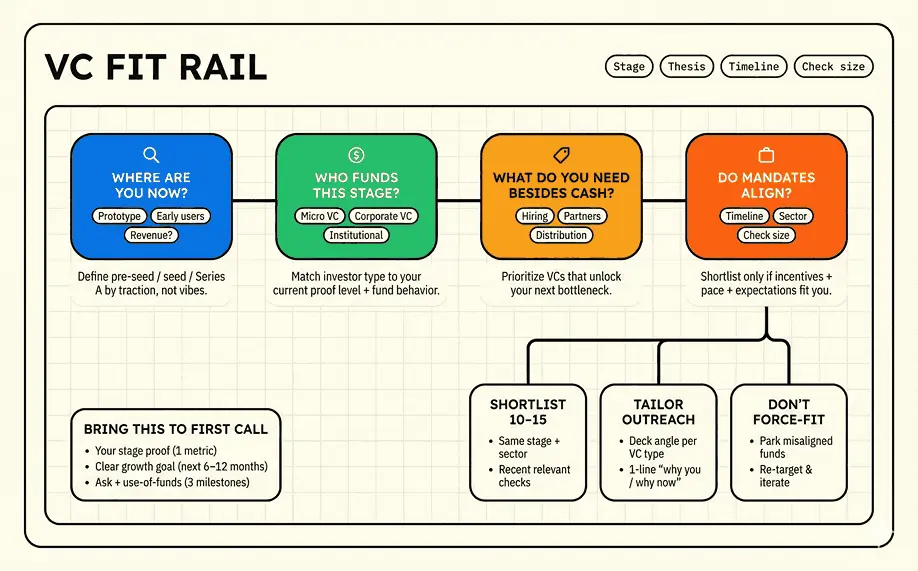
- Define your startup’s current stage, such as pre-seed, seed, Series A, or later, based on product and market traction.
- Research which VC types typically invest at your identified stage, focusing on their fund size and sector preferences.
- Evaluate your growth needs and strategic goals to prioritize VCs offering relevant resources, networks, or patient capital.
- Shortlist investors whose mandates, check sizes, and timelines align with your company’s immediate and long-term objectives.
- Prepare tailored outreach materials that address the expectations and selection criteria of your targeted VC types.
Startups like yours already closed their rounds with us.
Founders across every stage and industry. Here's what it took.
- Raised $7.6M for Swiipr Technologies
- Raised $0.5M for Ap Tack
- Raised €0.5M for Ivent Pro

Micro VC: A Type of Venture Capital Firm Driving Seed Investments
Micro VC firms have carved a unique niche in the world of private capital firms. They prioritize early-stage, seed investments. These firms typically manage smaller funds, ranging from $10 million to $100 million, known as a Micro Fund. This size allows them to remain agile and focus on unproven startups in niche sectors. Unlike larger venture firms, micro VCs embrace high-risk/high-reward opportunities, often providing initial capital through checks between $50,000 and $500,000.
For example, First Rate Ventures has successfully implemented a $20M fund targeting cash flow positive companies with a strategy that focuses on 7-8 survivors out of 10 investments instead of the traditional power law strategy. Their first $500K investment generated $2.5M in partnership revenues, and the fund is now expanding to $30M.
What sets micro VCs apart is their hands-on mentorship approach. They actively guide founders through operational challenges, offering more than just financial backing. This democratization of early-stage funding has gained momentum over the past decade, with micro VC deals increasing significantly. For better follow-ups, tailor outreach to the roles in a venture firm, analyst, associate, partner, platform.
Institutional VC: A Type of Venture Capital Firm for Growth
Institutional venture capital (VC) firms play a pivotal role in scaling businesses beyond early-stage funding. These firms manage substantial funds, often exceeding $100 million and sometimes reaching billions, enabling them to focus on Series A and later rounds. However, only 15.4% of startups successfully raise Series A within two years of seed funding, highlighting the challenges in securing this critical stage of investment.
Institutional VCs command significant capital. In 2024, U.S. VC investment reached $209 billion, representing a 30% rise over the previous year. This surge in available capital expands possibilities for founders needing large-scale growth.
Unlike smaller VC firms, institutional VCs balance strategic and financial motivations, ensuring investments align with both long-term vision and profitability. For example, understanding the typical Inst Fund size helps founders identify the right VCs for large-scale growth.
Verified Capital exemplifies this approach with its $175M fund that invests in only 8-10 companies using a founder-centric methodology. The fund has been significantly oversubscribed, with backing from elite founders, including those from Instacart and Coinbase.
Insights on government-backed investment programs startups reveal an alternative funding mechanism that offers a comparative perspective alongside sovereign wealth fund opportunities.
Best Practices for Pitching to Institutional VCs
- Develop a milestone-driven pitch deck that clearly demonstrates product-market fit and scalable business potential.
- Highlight your team’s expertise and track record to build credibility with institutional investors.
- Prepare detailed financial projections and market analysis to support your growth assumptions and funding needs.
- Anticipate rigorous due diligence by organizing legal, financial, and operational documents in advance.
- Tailor your presentation to address the strategic interests and investment criteria of each institutional VC firm.
You can see how these funding options stack up in our overview of types of investors in startups. This overview lays out each category’s strengths and trade-offs.
How to Use Corporate VC to Build Strategic Partnerships
Corporate venture capital (VC) arms operate with a strategic focus, aligning their investments with the parent company’s broader objectives. Unlike traditional VC firms, these units prioritize partnerships that enhance corporate innovation and growth. By offering specialized resources and fostering strategic collaborations, corporate VC arms create opportunities for startups to scale while maintaining alignment with the parent company’s goals.
Recent examples, such as Intel Capital, demonstrate how spin-out models can balance independence with strategic synergy. Intel Capital has invested over $20 billion across 1,800 companies since 1991, showcasing how spin-outs can maintain strategic partnerships while gaining operational freedom.
For businesses exploring corporate VC, understanding the nuances of compliance is essential. A discussion of legal issues with sovereign investments provides clarity on regulatory frameworks that impact such transactions.
How Government-Backed VC Supports Startups with Public Mandates
Government-backed venture capital (VC) funds play a pivotal role in driving innovation and economic development. These funds aim to achieve long-term growth while addressing public policy objectives, such as fostering technological advancements or supporting underserved sectors. Unlike traditional VC firms, government-backed programs often operate with extended investment timelines, allowing startups to mature and scale sustainably.
Specialized incentives, such as tax benefits or grants, further encourage entrepreneurs to pursue groundbreaking ideas. By aligning financial support with public mandates, these funds create opportunities for startups to thrive while contributing to broader societal goals.
Family Offices: Patient Capital Tailored to Long-Term Growth
Family offices stand out as a unique funding source for startups, offering patient capital tailored to the interests of the families behind them. Unlike traditional venture capital firms, these private entities prioritize flexibility in investment horizons, allowing startups to grow at their own pace. Streamlined processes and personalized approaches enable swift decision-making.
When comparing funding options, understanding the pros and cons of sovereign investments can provide valuable perspective on how family capital differs from government or sovereign backing.
For entrepreneurs seeking alternatives to conventional funding, family offices provide non-traditional solutions that align with long-term goals. Their ability to adapt investment strategies based on family priorities makes them particularly appealing.
How to Tap into Angel Syndicate Funding for Early-Stage Collaboration
Competition is steep for startups seeking angel funding. In 2024, out of 100 companies applying to angel groups, just 2 reached a portfolio. Rigorous filtering makes each syndicate investment highly competitive.
Angel Syndicates offer a dynamic solution for startups seeking early-stage venture capital firms. By pooling resources from individual investors, these groups provide seed and early-stage funding, typically ranging between $100,000 and $1 million.
Precursor Ventures is an example of a firm that focuses on pre-seed and seed-stage investments, with a strong affinity for first-time founders. Their fifth fund, closed in April 2024, raised $66 million to support innovative startups.
These angel groups often fill early funding gaps before institutional capital arrives, creating a supportive environment for innovation. Beyond financial backing, syndicates foster connections that can open doors to valuable networks and insights. For startups aiming to secure both capital and guidance, Angel Syndicates represent a powerful ally in the journey toward growth.
Comparing Major VC Types at a Glance
Your Guide to the VC Funding Lifecycle: From Seed to Scale
The funding journey is a dynamic process that evolves alongside a startup’s growth. From seed rounds that fuel initial development to late-stage investments that drive market expansion, understanding this lifecycle is crucial for aligning capital needs with the right investor type.
Different types of venture capital firms play key roles throughout the funding lifecycle, from seed to scale.
Early-stage funding, such as seed rounds, often focuses on validating ideas and building prototypes. As startups progress, Series A and B funding emphasize scaling operations and expanding market reach. Later-stage funding, including Series C and beyond, prepares businesses for major milestones like IPOs or acquisitions. Board asks make more sense after a pass through venture capital fee structure, what’s management fee vs. carry.
Real-world examples highlight the importance of strategic funding. Take the Airbnb Case, where late-stage capital enabled the company to achieve explosive growth and dominate the market. This funding positioned Airbnb for pivotal events, such as its IPO, showcasing how aligning capital strategies with growth stages can transform a startup into a global leader.
How Venture Capital Has Evolved from Its Roots to Driving Innovation
Venture capital has undergone remarkable transformations since its inception. Initially, informal investments fueled small-scale ventures, often relying on personal networks and individual wealth. Over time, the emergence of structured financial systems brought greater sophistication to funding models, enabling broader access to capital.
Shifting market dynamics have played a pivotal role in reshaping investor priorities. Economic booms and downturns have influenced the appetite for risk, while technological advancements have opened doors to new industries. Today, venture capital is synonymous with driving innovation, backing groundbreaking startups in sectors like artificial intelligence, biotechnology, and clean energy.
This evolution highlights the adaptability of venture capital, transitioning from a niche practice to a cornerstone of global economic growth. Its ability to respond to changing conditions ensures its continued relevance in fostering entrepreneurial success.
Understand Traditional VC Structures and Investment Models
There are several types of venture capital firms, each with distinct investment structures and roles in the financing ecosystem.
Angel investing, often the earliest stage of funding, involves individual investors providing capital to startups in exchange for equity. Venture capital firms, on the other hand, pool resources from multiple investors to fund high-growth companies, typically in exchange for significant equity stakes and active involvement in strategic decisions.
Private equity focuses on mature businesses, acquiring majority stakes to optimize operations and drive profitability. Growth equity bridges the gap between venture capital and private equity, targeting companies with proven business models that require capital for scaling.
Together, these models create a dynamic framework, enabling businesses to access tailored funding solutions at various stages of their lifecycle. Understanding these distinctions is crucial for navigating the investment landscape effectively.
Discover Global Venture Capital Trends with Data-Driven Insights
Global capital flows have shifted upward. For the full year 2024, global funding for VC firms grew 5% from $349 billion to $368 billion, underscoring healthy investor appetite. This growth reflects shifting market dynamics, as regions and sectors adapt to emerging opportunities.
For instance, startups are staying private longer due to larger late-stage funding rounds, fostering specialization in growth-stage investments.
Geographically, emerging markets are gaining traction, while established hubs continue to dominate specific sectors. Use Bain Stats to benchmark global funding trends against regional performance, ensuring a comprehensive understanding of these patterns.
Technology remains a key driver, but industries like healthcare and clean energy are attracting more attention. Valor Equity Partners has leveraged AI-powered investment platforms to identify high-potential startups, leading five seed rounds in local AI companies and investing over $1.2M in April 2025 alone. Their platform sourced 206 AI startups in Q2 2025, showcasing the power of data-driven insights.
How to Fast-Track Early-Stage Funding and Growth for Your Startup
Incubators, accelerators, and micro VCs have become indispensable for startups seeking early-stage funding and growth. These entities provide mentorship, resources, and access to capital, helping founders refine their business models and scale effectively.
According to Carta, 1,287 new funding rounds closed in Q2 2024, a 4% rise over Q1, with $20.9 billion invested. The consistency signals a steady pipeline for founders.
Non-traditional support networks are also reshaping the funding landscape. Platforms like Startup offer insights into incubator programs and emerging VC trends, empowering founders to identify opportunities tailored to their needs. Also, as highlighted in a report from Founders Net, the growing appetite for seed and Series A deals, signaling robust investor interest in innovative startups.
By tapping into these resources, founders can accelerate their journey toward securing capital and achieving sustainable growth. Early-stage support networks are no longer optional, they’re essential for thriving in today’s competitive startup ecosystem.
Explore Alternative Financing Options Beyond Traditional VC
Startups seeking funding often explore paths beyond traditional venture capital. Non-equity financing options like venture debt and mezzanine financing provide alternatives that preserve ownership while addressing capital needs. Venture debt offers loans tailored for startups, enabling founders to access funds without giving up equity. Mezzanine financing, on the other hand, blends debt and equity features, offering flexibility in repayment terms.
Choosing between debt and equity requires careful consideration of trade-offs. Debt financing typically involves lower capital costs but adds repayment obligations, while equity financing dilutes ownership but eliminates repayment risks. Founders must evaluate their growth trajectory and financial stability to determine the best fit.
Emerging models, such as DeFi VC, are also reshaping funding landscapes. Platforms enable startups to bypass conventional fundraising through token sales and decentralized crowdfunding.
How Tech-Driven VC Uses AI, Blockchain, and ML to Transform Investing
Artificial intelligence, blockchain, and machine learning are redefining how venture capital firms operate. These technologies streamline due diligence processes, enhance decision-making, and enable data-driven insights that were previously unattainable.
AI investment is exploding. In 2024, AI spending surged to $13.8 billion, over six times the $2.3 billion invested in 2023. Technology is quickly reshaping the VC toolkit.
For instance, advanced analytics tools like those highlighted by KPMG AI accelerate the evaluation of startups, focusing on innovative applications such as large language models. Blockchain ensures transparency and security in transactions, while machine learning uncovers patterns in vast datasets, helping VCs identify high-potential investments with greater precision.
By integrating these digital tools, venture capital firms are not only improving efficiency but also gaining a competitive edge in identifying and supporting groundbreaking startups. The result is a more dynamic, data-centric approach to investing that aligns with the fast-paced evolution of the tech industry.
What Personalized, Data-Driven Investment Models Mean for VC’s Future
The venture capital landscape is undergoing a transformation, driven by three pivotal trends: prolonged private growth, decentralized finance (DeFi) integration, and personalized funding strategies. These shifts are reshaping how investors and startups interact, creating opportunities for tailored, data-driven investment approaches.
Advanced analytics are enabling VC firms to craft hyper-personalized funding models that align with the unique needs of individual startups. For example, platforms powered by AI algorithms can now match startups with suitable investors, optimizing the funding process and fostering stronger partnerships. This evolution is paving the way for “Personal VCs,” where funding decisions are no longer one-size-fits-all but instead customized to maximize growth potential.
As decentralized finance gains traction, venture capitalists are exploring innovative ways to integrate blockchain technologies, further enhancing transparency and accessibility in funding.
Conclusion
Selecting the right venture capital partner is a pivotal decision for any startup. From understanding the unique strategies of diverse VC firm types to aligning funding sources with your company’s stage and goals, the insights shared here emphasize the importance of thoughtful planning. Matching your startup’s needs with the right investor can accelerate growth and foster long-term success.
Recognizing the types of venture capital firms helps startups make informed funding decisions.
Additionally, using data-driven approaches to evaluate potential VC partners ensures that decisions are grounded in actionable insights rather than assumptions. This methodology not only enhances the likelihood of securing funding but also builds a foundation for strategic collaboration.
If you’re looking to secure the right investors, we at Qubit Capital can help you achieve your fundraising goals. Our Fundraising Assistance Services is here to guide you through every funding stage. Let us help you turn your vision into reality.
Key Takeaways
- You’ll meet a spectrum of VC firm profiles as a startup grows, each shaped to match the capital intensity and risk tolerance of different growth chapters—pre-seed scrappiness through late-stage scale.
- Micro VCs step in early with nimble checks and sleeves-rolled-up advice, giving you quick runway plus direct access to partners who stay close to product and talent decisions.
- Larger institutional and corporate VCs arrive with deeper pockets, formal governance, and industry links that can put you in front of marquee customers or acquisition teams.
- When you want to protect ownership, non-dilutive options like venture debt or revenue-based financing can supply working capital without moving equity off your cap table.
- Data science, AI deal-sourcing tools, and real-time market signals now steer many term-sheet decisions, letting you target investors whose tech stacks already flag your metrics as a match.
- Government-backed VC funds support public mandates and sustainable growth with incentives like tax benefits, grants, and extended investment timelines.
- Family offices offer patient, flexible capital with streamlined decision-making and personalized investment approaches tailored to long-term goals.
- Angel syndicates pool resources from individual investors to bridge seed-stage funding gaps, providing capital, mentorship, and access to valuable industry networks.
Want a targeted investor list you can actually use?
A curated shortlist based on your stage, sector, geography, and check size.
- Thesis-aligned investors matched to your round
- Decision-maker contacts with relevant context
- Ready for outreach, not just research

Frequently asked Questions
How can startups choose the best type of venture capital firm?
Startups should evaluate their stage, industry focus, and capital needs to select the right venture capital firm type. Matching growth goals with VC expertise increases funding success.