

 Back
Back










Table of Contents

A well-crafted VC pitch deck is often the first step toward securing funding for your startup. It sets the stage for showcasing your vision, strategy, and potential to investors. The introduction of a pitch deck is crucial, it’s where you grab attention and establish credibility.
Market dynamics in 2024 make an effective pitch deck more critical than ever. Startup funding in 2024 reached nearly $314 billion, revealing investor appetite and heightened competition. This surge means a compelling value proposition is your key to standing out in a crowded field.
This blog you will learn about the importance of a value proposition slide in a VC pitch deck, and how to highlight highlight your startup’s unique benefits. Prepare to uncover insights that can transform your pitch into a compelling story investors won’t forget.
Why a Value Proposition Slide Is Essential in a Business Portfolio for Startups
A business portfolio is a collection of strategic assets, achievements, and plans that showcase a startup’s value to investors. A value proposition slide is the cornerstone of any business portfolio for startups, serving as the definitive statement of why your product or service stands out. Clarifying this often requires stepping back and carefully defining the value proposition within a pitch deck context, rather than relying on broad marketing language.
This section is particularly relevant for startup founders and teams preparing investor pitches.
The Core Components of a Value Proposition Slide
Rapid growth stories can serve as powerful testimonials. For example, ChatGPT adoption crossed 100M users within 60 days, making their validation undeniable. Such proof points turn abstract claims into compelling evidence for investors.
To resonate with investors, a value proposition slide must be both concise and impactful. Its key elements include:
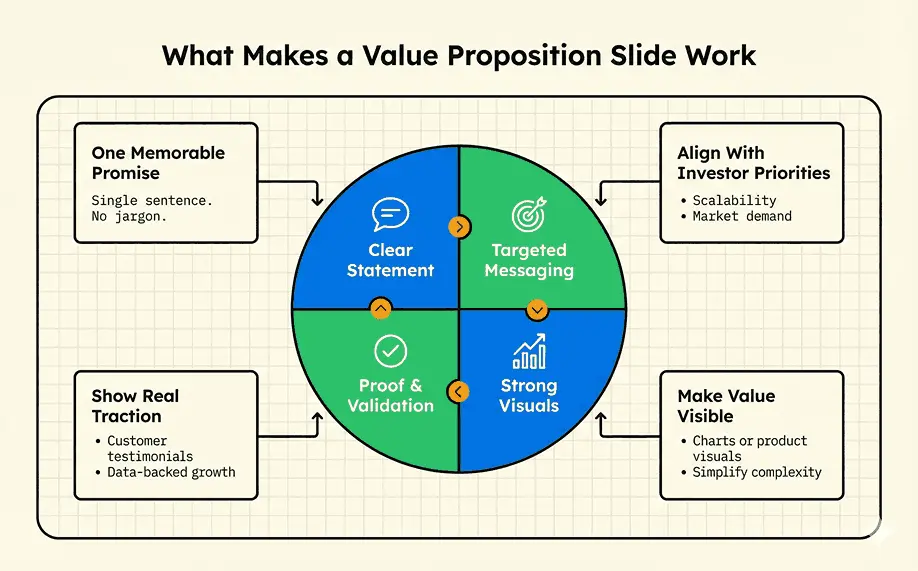
A Clear Statement: This is the heart of the slide, a single, compelling sentence that encapsulates why your product or service is indispensable. Avoid jargon and focus on delivering a message that is both simple and memorable.
Targeted Messaging: Tailor your value proposition to address investor pain points, such as scalability, market demand, or competitive differentiation. Highlight how your solution aligns with their priorities.
Visuals That Speak Volumes: Strong visuals, such as charts, infographics, or product images, can reinforce your message and make complex ideas easier to grasp. A well-designed slide ensures your audience stays engaged.
Testimonials and Evidence: Including customer testimonials or data-driven proof points adds credibility. Investors are more likely to trust your claims when they see real-world validation.
Your exploration of a compelling pitch deck also connects with the broader process of building a pitch deck from scratch, where structure and narrative alignment matter just as much as design.
Startups like yours already closed their rounds with us.
Founders across every stage and industry. Here's what it took.
- Raised $7.6M for Swiipr Technologies
- Raised $0.5M for Ap Tack
- Raised €0.5M for Ivent Pro

Why Value Proposition Slides Critical for Investor Pitches
A value proposition slide is the anchor of your investor pitch. It tells investors, in seconds, why your company matters and why it can win.
- Clarifies the core problem: Defines the specific pain point your target customer faces. Precision builds credibility.
- Articulates your differentiated solution: Explains what you do and how it is meaningfully better than existing alternatives.
- Quantifies the outcome: Highlights measurable impact such as revenue growth, cost savings, efficiency gains, or risk reduction.
- Identifies the target customer: Shows you understand exactly who benefits and why they will pay.
- Establishes strategic context: Aligns the rest of the deck including market size, traction, and financial projections.
Investors scan decks quickly. If your value proposition slide is vague or generic, the opportunity feels weak. If it is sharp and evidence-driven, it sets a strong foundation for the entire pitch.
How to Create a Powerful Value Proposition Slide Step by Step
Bold sector trends can immediately capture attention. AI and green technology investment jumped by 35% this year, signaling investor enthusiasm. Referencing such data can make your opening hook more relevant and impactful.
If you want to learn how to make business portfolio slides that stand out, follow these steps to ensure your slide not only informs but compels VCs to lean in and say “tell me more.” Start by spotlighting the core problem you solve. Next, highlight the distinct benefits your solution offers. A focused explanation of the issue, similar to how strong teams structure their problem slide in a pitch deck, makes the rest of the narrative easier to justify.
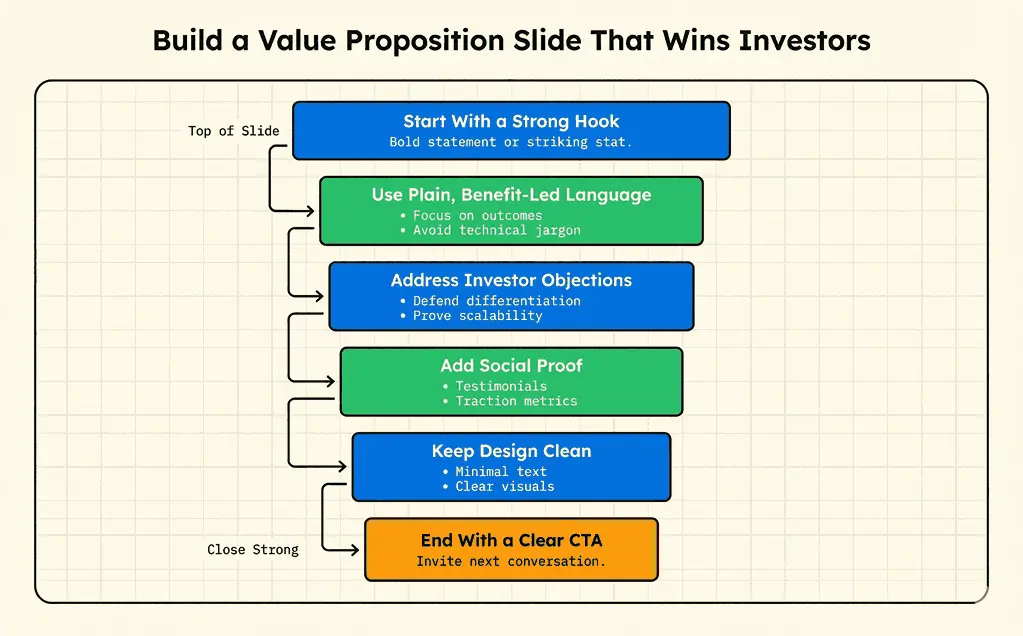
1. Start with a Strong Hook
The first few seconds of your presentation are critical. Begin your slide with a bold statement or statistic that grabs attention. For example, Airbnb’s value proposition slide highlighted “Book unique homes and experiences” in a simple, memorable way. Similarly, Uber’s slide emphasized convenience with “Tap a button, get a ride.” These concise hooks immediately communicate the core benefit of the product.
If your business incorporates cutting-edge technology, consider showcasing relevant data. For instance, the AI Efficiency Stat from Prezent.ai demonstrates how advanced technologies can deliver 15% cost savings and a 20% efficiency improvement. Such statistics can add credibility and intrigue to your pitch.
2. Use Plain Language to Highlight Benefits
Avoid jargon or overly technical language. Investors want to understand the value of your product quickly. Focus on benefits rather than features. For example, instead of saying, “Our app uses AI algorithms,” emphasize the outcome: “Save time and reduce costs with automated solutions.”
Storytelling can also be a powerful tool. Share a brief anecdote or scenario that illustrates how your product solves a real-world problem. This approach makes your value proposition relatable and memorable.
3. Address Objections
Anticipate potential concerns and address them directly within your slide. Investors may wonder how your product stands out in a competitive market or whether it’s scalable. Use concise language to emphasize your unique selling proposition (USP – what makes your product unique and desirable).
At this stage, investors also look for logic in how revenue flows, which is why the structure of a business model slide in a pitch deck often becomes a point of scrutiny.
For example, if your product integrates AI, highlight its differentiation. More startups are showcasing AI integration in pitch decks to quantify gains for investors. If applicable, mention how your technology-driven approach delivers measurable results, such as increased efficiency or reduced costs.
4. Incorporate Testimonials and Real-World Examples
Social proof can significantly strengthen your value proposition. Include testimonials from satisfied customers or partners who validate your claims. If you’re in the early stages and don’t have testimonials yet, reference industry leaders who have successfully implemented similar strategies.
For example, Airbnb’s slide demonstrated how their platform transformed travel experiences, while Uber showcased its ability to simplify transportation. These examples resonate because they focus on the tangible benefits users experience.
5. Keep the Design Clean and Focused
A cluttered slide can dilute your message. Use a clean layout with minimal text and high-quality visuals. Highlight key points using bullet lists or bold fonts to ensure they stand out. Consider integrating a clear market-size breakdown. For example, a TAM-SAM-SOM chart or infographic, this will help to demonstrate your addressable opportunity within broader industry trends.
6. End with a Call to Action
Conclude your slide with a clear call to action that encourages investors to learn more or ask questions. Whether it’s “Explore our technology” or “Join us in transforming the industry,” make sure your CTA aligns with your overall pitch.
Portfolio Diversification Strategies
- Diversifying your portfolio across industries and geographies helps reduce exposure to market and operational risks.
- Including both small businesses and startups in your portfolio balances steady cash flow with high-growth opportunities.
- Strategic diversification supports resilience, enabling your business portfolio to withstand sector-specific downturns and adapt to changing conditions.
Active Portfolio Management Practices
- Implement employee retention incentives during acquisitions to preserve operational continuity and maximize portfolio value.
- Use follow-on investing to concentrate capital on high-performing startups within your portfolio, limiting potential losses.
- Monitor portfolio performance regularly and adapt strategies to respond to market shifts and emerging opportunities.
Forward-looking milestones are often summarized in a structured roadmap slide within a pitch deck, helping investors visualize execution beyond the current stage.
How to Perfect Your Pitch Deck Without Common Mistakes
Investors respond best to concise presentations that respect their time and attention. Following proven guidelines, such as the 10/20/30 Rule for pitch decks, can help ensure your presentation is concise and impactful. This rule advises limiting your deck to 10 slides, keeping your presentation under 20 minutes, and using a font size of 30 points or larger. It also helps to consider the typical number of slides investors expect in a pitch deck, especially when deciding how much detail to include.
Simplicity remains undervalued even by experienced teams. 80% of family offices still rely on Excel as their main tool, according to 57% of surveyed service providers. This highlights why clear, streamlined decks outperform information overload.
Here are Some Common Pitfalls to Avoid
Text Overload
Overcrowding slides with excessive text can overwhelm your audience and dilute your message. Instead, focus on concise, visually appealing content that highlights key points. Use bullet points or visuals to break down complex ideas.Overly Technical Language
While technical details may be important, using jargon can alienate potential investors unfamiliar with your industry. Aim for clear, investor-centered messaging that prioritizes simplicity and accessibility.Lack of Data-Driven Insights
Investors value measurable outcomes and projections. Incorporate relevant data and metrics to support your claims, ensuring your deck is both persuasive and credible.That expectation becomes even stronger when reviewing financial slides in a pitch deck, where projections must align with operational assumptions.
If you want to know how to make a company portfolio that impresses investors, focus on clarity, design, and storytelling.
Best Practices for an Effective Business Portfolio Pitch Deck
- Structure Matters: Adhering to the 10/20/30 Rule for pitch decks ensures your business portfolio is concise and impactful. Clarity also improves when founders map their content against a defined pitch deck outline of essential slides, ensuring nothing critical is overlooked.
Engaging Visuals
- Engage with Visuals: Dynamic visuals and interactive presentations can significantly boost engagement, making your pitch memorable.
Tailored Messaging
- Tailor to Investors: Focus on what venture capital investors care about, scalability, market opportunity, and ROI. For guidance, see our detailed pitch deck vs investor deck comparison. This helps you match your style to each audience’s expectations. Understanding the distinction between formats, including the differences explored in pitch deck vs investor deck comparisons, can also influence how much detail you include.
Timely Data
- Use Timely Data: Incorporate up-to-date statistics or market trends to enhance credibility and relevance.
Boost Your Pitch Using Reliable Templates and Tools
Creating a compelling pitch deck requires both strategic content and professional design. The right templates and tools can transform your presentation from amateur to investor-ready, regardless of your budget or design expertise.
Free Template Platforms for Cost-Conscious Founders
Budget constraints shouldn't compromise presentation quality. Several platforms offer professional-grade templates at no cost:
- Canva provides browser-based editing with drag-and-drop simplicity, featuring hundreds of pitch deck templates optimized for startups. Its collaborative features allow team members to contribute directly, streamlining the revision process.
- Slidesgo specializes in modern, minimalist designs that emphasize content over decoration. Their startup-focused templates include pre-built sections for problem statements, market opportunity, and financial projections.
- SlideCarnival offers unique, creative layouts that help differentiate your pitch from standard corporate presentations. These templates work well for consumer-focused products requiring visual storytelling.
Premium Tools for Professional Impact
When fundraising at Series A and beyond, premium design signals seriousness and attention to detail:
- SlideModel ($20-50) delivers polished, investment-grade templates with sophisticated data visualization options. Their value proposition and competitive analysis slides incorporate best practices from successful funding rounds.
- GraphicRiver ($15-40 per template) provides marketplace access to designer-created decks with unique visual elements. Individual purchase options allow you to invest selectively in standout designs that match your brand identity.
Strategic Template Selection
Choose templates based on audience expectations and funding stage. For example, expectations for a seed round pitch deck differ significantly from later-stage presentations in terms of traction and proof points.
Early-stage pitches benefit from clean, data-focused designs emphasizing traction metrics. Later-stage decks warrant more sophisticated layouts demonstrating operational maturity. The template should enhance your message, not distract from it, avoid overly complex designs that obscure key information or require excessive customization that delays fundraising momentum.
When crafting your pitch deck, it's also essential to understand the distinctions between presentation formats. Diverse presentation formats are outlined in pitch deck vs PitchBook, a discussion that highlights distinctions which may influence the approach you take in your value proposition slide.
By combining the right tools and templates, you can enhance the overall quality of your pitch deck while saving valuable time. Whether you opt for free platforms or premium resources, the key lies in selecting designs that align with your message and audience expectations.
Conclusion
Crafting a compelling value proposition slide is essential for any startup aiming to secure investor interest. You must focus on clear, data-driven narratives and aligning your pitch deck with investor priorities, to effectively communicate your business's unique strengths. Remember, simplicity and precision are key, avoid clutter and ensure every element of your slide serves a purpose.
Crafting a compelling value proposition slide is essential for any startup aiming to secure investor interest. A strong business portfolio for startups can make your pitch stand out.
We understand that refining your pitch deck can be challenging, but it’s a critical step toward achieving your funding goals. If you’re looking to connect with the right investors, our Investor Outreach service is here to help. Let our team guide you in reaching the audience that matters most.
Key Takeaways
- A compelling business portfolio for startups significantly enhances your presentation for investors by showcasing your company’s strengths, vision, and unique value proposition in a concise, visually engaging format.
- It consolidates your company’s offerings, achievements, and strategic vision into a single, cohesive narrative, making it easier for stakeholders to understand your progress and potential.
- Utilizing interactive tools and structured templates can streamline the portfolio-building process, reducing the time required to gather data, design layouts, and maintain consistency across sections.
- Real-world case studies, such as the Startup Wise Guys Portfolio and Shell Startup Engine, offer actionable insights into best practices, design choices, and storytelling techniques that resonate with investors.
- Following structured, step-by-step guidelines increases your chances of attracting quality investors by ensuring every critical element, market analysis, financial projections, team bios, and milestones, is clearly communicated.
Need a pitch deck investors actually read?
A deck built to answer real investor questions. Clear story, strong positioning, investment-ready slides.
- Structure your narrative and core messaging
- Fix clarity gaps and investor objections
- Investor-grade design and structure
Frequently asked Questions
How can a value proposition improve a business portfolio for startups?
A strong value proposition in your business portfolio helps clarify your startup’s unique benefits and appeals directly to investors’ needs.