

 Back
Back










Table of Contents

A messy deck kills good ideas. The fix isn’t “more slides”, it’s the right slides in the right order. This guide gives you a slide-by-slide blueprint that makes your story feel inevitable: problem → solution → proof → path to scale → the ask.
If your business is pre-revenue, pre-product, or highly regulated, highlight traction as team or technology rather than financials.
In this guide, you’ll see exactly what to include on each slide (and what to cut), how to keep momentum from title to close, and where to put the numbers investors actually care about. Build it this way and you won’t just present, you’ll control the room. Let’s dive in.
Let's dive in!
Pitch Deck Structure: What You Need to Know
A winning pitch deck follows a structure: problem, solution, market, business model, team, and financials, each as a focused slide.
Industry studies reveal that 37% of decks omit an email address, and 54% miss out on listing a website. Ensuring this information is present boosts pitch professionalism and investor follow-up odds. Importantly, accelerator insights indicate 40% of companies joined with only a concept, showing the value of strong decks from day one.
A pitch deck serves as a vital business guide for startups, offering a concise presentation that communicates the core idea and value proposition (the distinct benefit you deliver) of the business. It is designed to capture the attention of investors. It provides them with a snapshot of the startup’s potential. Venture capital is a fast-paced, high-pressure space. Clarity and focus are essential for an effective pitch deck.
Recent analysis shows that average view time for a complete pitch deck review in 2025 was just 3.2 minutes. This demonstrates why conciseness and clarity remain essential as investors make decisions rapidly.
Tailoring Pitch Decks for Different Funding Stages
Building on these fundamentals, founders should tailor their pitch deck to the specific funding stage they are targeting. Early rounds often emphasize team strength and market opportunity, while Series A investors focus on traction and business model validation. Later rounds require more detailed metrics and a compelling vision for scale. Adapting content to investor expectations at each stage increases relevance and improves the likelihood of securing meetings.
Investors typically spend only a few minutes reviewing pitch decks, making it crucial to present information in a streamlined and impactful manner.
Iterative Refinement Through Investor Feedback
This approach requires founders to regularly update their pitch deck with the latest milestones and metrics before each investor meeting. Incorporating feedback from previous presentations helps clarify messaging and address concerns. Treating the deck as a living document ensures it stays relevant and compelling, increasing the chances of investor engagement. Iterative refinement demonstrates professionalism and adaptability to potential backers.
A well-structured pitch deck not only highlights the startup’s unique value proposition but also serves as a startup guide for entrepreneurs to articulate their vision, market opportunity, and financial projections. The ability to convey these elements succinctly can significantly influence an investor’s decision-making process.
For those looking to refine their approach, your exploration of how to create a pitch deck connects this detailed slide-by-slide approach with broader strategies for crafting investor presentations.
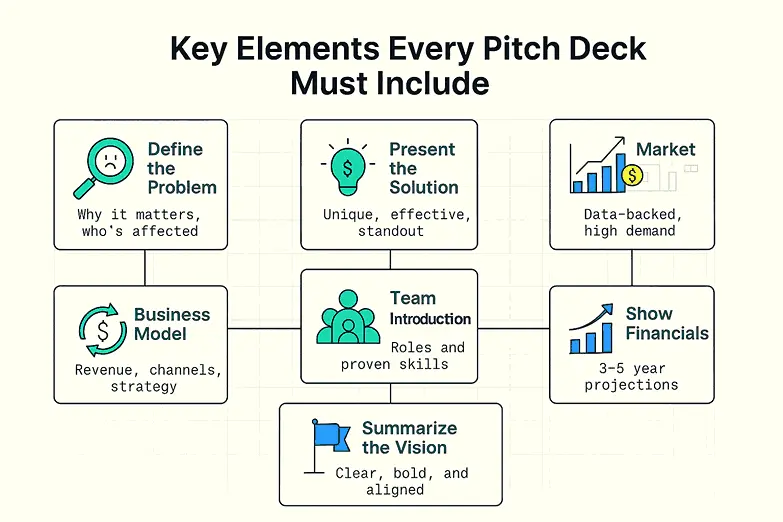
Key Elements Every Pitch Deck Must Include
For optimal results, data-backed design guidelines recommend maintaining a pitch deck between 10 and 20 slides. This concise approach helps founders present a focused, compelling story without overwhelming viewers.
A strong pitch deck structure highlights your business’s strengths and ensures clarity in communicating its viability.
- Problem
- Solution
- Market Opportunity
- Business Model
- Team
- Financials
1. Problem
Begin by addressing the core issue your business aims to solve. This slide should clearly define the problem, emphasizing its relevance and urgency. Investors need to understand why this problem matters and how it impacts your target audience. Avoid overloading this slide with data; instead, focus on presenting a concise narrative supported by key statistics or examples.
2. Solution
Once the problem is established, introduce your solution. This slide should showcase how your product or service resolves the issue effectively and uniquely. Highlight the innovation behind your approach and explain why it stands out from competitors. Visual aids, such as diagrams or mockups, can enhance understanding and engagement.
3. Market Opportunity
The market opportunity slide is where you demonstrate the potential for growth and scalability. Use data to illustrate the size of your target market, trends, and demand for your solution. According to PitchBook Research, over half of successful pitch decks incorporate solid financial forecasts, which often tie into market opportunity analysis. This is your chance to convince investors that your business operates within a lucrative and expanding space.
4. Business Model
Your business model slide should outline how your company generates revenue. Be specific about pricing structures, sales channels, and customer acquisition strategies. This section is crucial for showing investors that your startup has a sustainable and profitable plan in place. Show you know the order of operations. Sequence build → validate → scale and link it to metrics. A sharp product roadmap slide (a visual timeline of your product plan) tells investors exactly what their dollars unlock.
5. Team
Investors often say they invest in people, not just ideas. Use this slide to introduce your team and their expertise. Highlight key members, their roles, and relevant achievements. This is an opportunity to build trust and demonstrate that your team has the skills and experience to execute the business plan successfully. Before you lock the bios, skim team slide pitch deck examples to show roles, proof, and relevance without crowding the slide.
6. Financials
The financials slide is one of the most critical components of a pitch deck. Include projections for revenue, expenses, and profitability over the next 3–5 years. Be realistic yet optimistic, and ensure your numbers align with the market opportunity and business model. According to PitchBook, incorporating solid financial forecasts significantly increases the likelihood of success.
7. Summary
Conclude your pitch deck with a summary slide that ties everything together. This slide should reiterate your value proposition, the market potential, and why your team is uniquely positioned to succeed. Keep it concise and impactful, leaving investors with a clear understanding of your startup’s vision and potential.
This slide-by-slide framework reveals clarifies the essential elements of a pitch deck that shape a compelling presentation using exactly how to create a pitch that flows seamlessly.
How to Structure Your Pitch Deck for Success
A clear pitch deck structure helps organize slides effectively and captivate your audience. This section covers how to organize slides effectively. You'll also learn how to captivate your audience and apply the 10/20/30 rule (10 slides, 20 minutes, 30-point font) for impact.
1. Keep Slides Concise and Visually Clear
A cluttered pitch deck can dilute your message. Focus on creating slides that are clean, concise, and visually engaging. Use minimal text and rely on impactful visuals to convey your ideas. Adopting a Minimalist Design Trend can instantly make your deck more digestible, projecting professionalism and focus.
For modern templates that simplify slide creation, tools like Beautiful.ai Tool offer intuitive designs tailored for pitch decks. Beautiful.ai provides ready-to-use templates that align with contemporary presentation standards, ensuring your slides look polished and cohesive.
Supporting this approach, most design guidelines advocate for minimalist, visual-first templates, helping founders create decks that hold attention and drive engagement within short viewing windows.
2. Use Storytelling to Connect
Investors are drawn to narratives that evoke emotion and demonstrate purpose. Incorporate storytelling elements into your pitch deck to create a compelling journey. Start by identifying your audience’s expectations and craft a story that aligns with their interests. Highlight the problem, introduce your solution, and showcase the impact your business can make.
Storytelling isn’t just about words, it’s about visuals, too. Use graphs, images, and infographics to complement your narrative and make your story memorable. For guidance on structuring slides effectively, you can review Slidebean Pitch Deck Tips, which provide detailed insights into organizing your deck for maximum impact.
3. Apply the 10/20/30 Rule
The 10/20/30 rule, popularized by Guy Kawasaki, is a practical framework for pitch decks:
- 10 slides: Limit your deck to 10 slides to keep it concise.
- 20 minutes: Aim to deliver your presentation within 20 minutes to maintain attention.
- 30-point font: Use a font size of 30 points or larger to ensure readability.
This rule helps streamline your content, making it easier for investors to grasp your key points without feeling overwhelmed.
4. Present Data Effectively
Quantitative data can be a powerful tool in your pitch deck, but it must be presented clearly. Use graphs and charts to visualize market trends, financial projections, and growth potential. Market size slide for pitch deck deepens your grasp on presenting quantitative data effectively, further complementing the strategic slide composition.
Get Inspired with Real Examples and Proven Templates
If you’re not sure how to structure your pitch deck, don’t reinvent the wheel. Some of the world’s best-known startups have already done the homework for you, and investors keep pointing back to the same examples for a reason.
1. Airbnb – the “classic” seed-stage deck
Airbnb’s original 2008 pitch deck is one of the most studied decks in startup land. It helped them raise around $600k at seed and is now used in business schools as a model of a clear, simple fundraising story.
Key things to notice if you study it:
- Starts with a sharp one-line company purpose and a very simple Problem → Solution story.
- Shows a large, obvious market (travel + accommodation) without drowning investors in numbers.
- Uses a short deck with focused slides: problem, solution, business model, market size, competition, and traction.
If you’re early-stage, Airbnb’s structure is a great reference for a lean, narrative-driven deck.
2. Uber (UberCab) – operations-heavy, pre-seed storytelling
Uber’s early 2008 “UberCab” pitch deck raised about $200k in a pre-seed round and is still available slide-by-slide online.
What stands out in that deck:
- It leans heavily into use cases and operating model (how the fleet works, service areas, apps, demand forecasting).
- It still follows a logical sequence: problem (taxis are painful), concept/solution (black-car on demand), differentiation, tech, market, go-to-market.
- It’s a useful example if your startup is very operational or logistics-heavy and investors will care about “how this works in real life” as much as the vision.
3. Mixpanel – a metrics-first SaaS deck
Mixpanel’s pitch deck is a go-to example for B2B SaaS founders. The deck was used in its fundraising journey and is now widely shared as the “metrics and traction done right” reference, including the version tied to its $65M raise in 2014.
Patterns worth copying:
- Clear explanation of the product and value (“analytics that drive action”) without technical fluff.
- Traction slides built around hard KPIs and client logos, not vague promises.
- A logical narrative: problem, solution, product, traction, business model, market, team, and ask.
If you’re a SaaS startup with some numbers, Mixpanel is a strong template for how to make your metrics the hero of the story.
You can also use prompts to draft outlines, slide text, and alt phrasing, then apply your brand system. A practical workflow for ChatGPT pitch deck design gets you to v1 fast without looking generic.
Mistakes to Watch Out for in Your Pitch Deck
When your slides look like Word documents, you’ve already lost the room. Walls of text overwhelm people and bury your main point. Keep slides tight: short headings, clear bullet points, and one core idea per slide so your message lands quickly.
Recent engagement data from Q4 2024 to Q3 2025 shows only 22% of decks are read end-to-end. Cluttered layouts and missing essentials are a big reason investors drop off halfway.
Data visualization is another common trap. Overcrowded charts, tiny labels, and rainbow graphics don’t signal “smart”, they signal “too much work to decode.” Use simple, clean visuals that make your story clearer, not harder. A well-structured pitch deck competition slide, for example, should map competitors and your edge at a glance, not require a magnifying glass.
Remember: investors skim first and question later. Dense jargon, micro-font charts, and fluff slow them down. Lead with proof, keep numbers readable, and save deep detail for the Q&A or appendix. Before you send your deck, run it against a checklist of common pitch deck red flags and make sure your story reads fast, sharp, and obvious.
Conclusion
Crafting a compelling pitch deck is more than just assembling slides; it's about telling a story that resonates with investors. Throughout this blog, we’ve explored essential strategies for creating a narrative-driven pitch deck, emphasizing clarity, structure, and impactful design. By implementing these actionable tips, startups can effectively highlight their unique value proposition and build investor confidence.
A strong pitch deck structure sets the foundation for meaningful conversations with potential investors. If you're ready we invite you to explore our Pitch Deck Services to make perfect pitch for top tier investors. Let us help you turn your vision into reality.
Key Takeaways
- A clear pitch deck structure is essential for securing investor interest.
- Key components include a clear problem, solution, market opportunity, business model, team, and financials.
- Leveraging best practices and design tools can greatly enhance deck effectiveness.
- Real-world examples like Airbnb and Uber offer invaluable insights into successful pitch styles.
- Avoid common pitfalls by focusing on clarity, minimalism, and a coherent narrative.
Frequently asked Questions
What slides are essential for a pitch deck?
The essential pitch deck slides include problem, solution, market opportunity, business model, team, and financials. Each slide should tell part of your startup story.