

 Back
Back








Table of Contents

Running startup challenges and competitions has become one of the smartest ways to generate high quality deal flow. Instead of waiting for warm intros or random cold decks, you bring founders to you, watch them pitch live, and see how they think under pressure. It is deal sourcing and early stage due diligence in the same room.
Globally, momentum around startup competitions keeps building. In 2024, startups on Carta raised 89 billion dollars in new funding, an 18.4 percent increase from the previous year. This kind of growth shows that structured pitch events are now closely linked to real funding outcomes, not just trophies or marketing buzz.
When designed well, startup challenges and competitions help investors spot stronger teams earlier, filter noise faster, and build a visible presence in the founder community. This article explores how to design, run, and scale these competitions so they consistently produce actionable deal flow, not just a nice event.
Why Startup Challenges Drive Deal Flow for Investors
Economic uncertainty and market turbulence don’t just create problems for startups, they create opportunities for savvy investors. When founders face funding gaps, down rounds, or operational pressures, investors with capital and expertise can negotiate favorable terms while backing fundamentally strong companies at discounted valuations.
1. Efficient Filtering of Talent
In traditional inbound deal flow, investors receive a flood of decks that vary wildly in quality and relevance. Challenges reverse this by pre-filtering startups through a structured application process. Founders who participate are already signaling they’re serious, responsive, and aligned with your investment focus. This makes it far more likely that your pipeline is populated with credible, coachable teams.
2. Early Access to Hidden Gems
Not every great startup actively pitches to investors. Some founders stay heads-down, building product, until something pulls them into the spotlight. A well-branded challenge — especially one with sector relevance — can surface these under-the-radar teams earlier than your peers. Being first to spot and engage with them can yield huge returns.
3. Seeing Founders in Action
Pitch decks are one thing; seeing how a founder handles Q&A under pressure, adapts feedback, and interacts with potential partners in real time is another. Competitions let you observe execution skills and cultural fit, which are often better predictors of success than a polished slide deck.
4. Building a Proprietary Sourcing Channel
If your challenge becomes a recurring annual or biannual event, it turns into a sustainable sourcing funnel that competitors can’t easily replicate. Founders start to seek you out proactively, knowing your challenge has a reputation for fairness, exposure, and tangible outcomes.
Detailed analyses of diverse tactics are presented in effective-outreach-channels-investors, providing insight into how different channels contribute to your engagement with quality startups. By combining the right outreach strategies with well-executed competitions, organizations can build a robust pipeline of promising ventures.
Startups like yours already closed their rounds with us.
Founders across every stage and industry. Here's what it took.
- Raised $7.6M for Swiipr Technologies
- Raised $0.5M for Ap Tack
- Raised €0.5M for Ivent Pro

Defining the Investor’s Strategic Objective
Before you send out the first press release, you need clarity on why you’re running the challenge in the first place. A vague “let’s find good startups” won’t cut it.
Ask yourself:
- Are you looking for investment-ready startups in a specific stage (pre-seed, seed, Series A)?
- Is the focus sector-specific (e.g., climate tech, fintech, healthtech) or broad?
- Do you want to identify companies for direct investment, co-investment with partners, or for entry into your accelerator/incubator?
- Is brand positioning, e.g., becoming “the go-to investor for X industry” , a secondary or primary goal?
Your answers here will shape everything , from eligibility criteria and marketing channels to judging panels and follow-up processes. Running a well-structured challenge also signals expertise to the founder community, establishing credibility through thought leadership makes top-tier founders more likely to apply in the first place.
Designing Startup Challenges That Attract Top Startups
The quality of startups you attract depends entirely on the value you offer, and tired founders can spot empty promises from miles away. Successful challenges differentiate themselves by providing concrete benefits that genuinely accelerate a startup’s trajectory, not just another line on a pitch deck.
Crafting the Value Proposition for Founders
Here’s the harsh truth: most founders have ‘pitch fatigue,’ meaning they are tired from repeatedly presenting to investors with little tangible outcome.
Many have pitched at events with only meaningless certificates, small cash checks, or vague ‘exposure.’ To attract high-quality teams, offer real value.
Some high-impact incentives include:
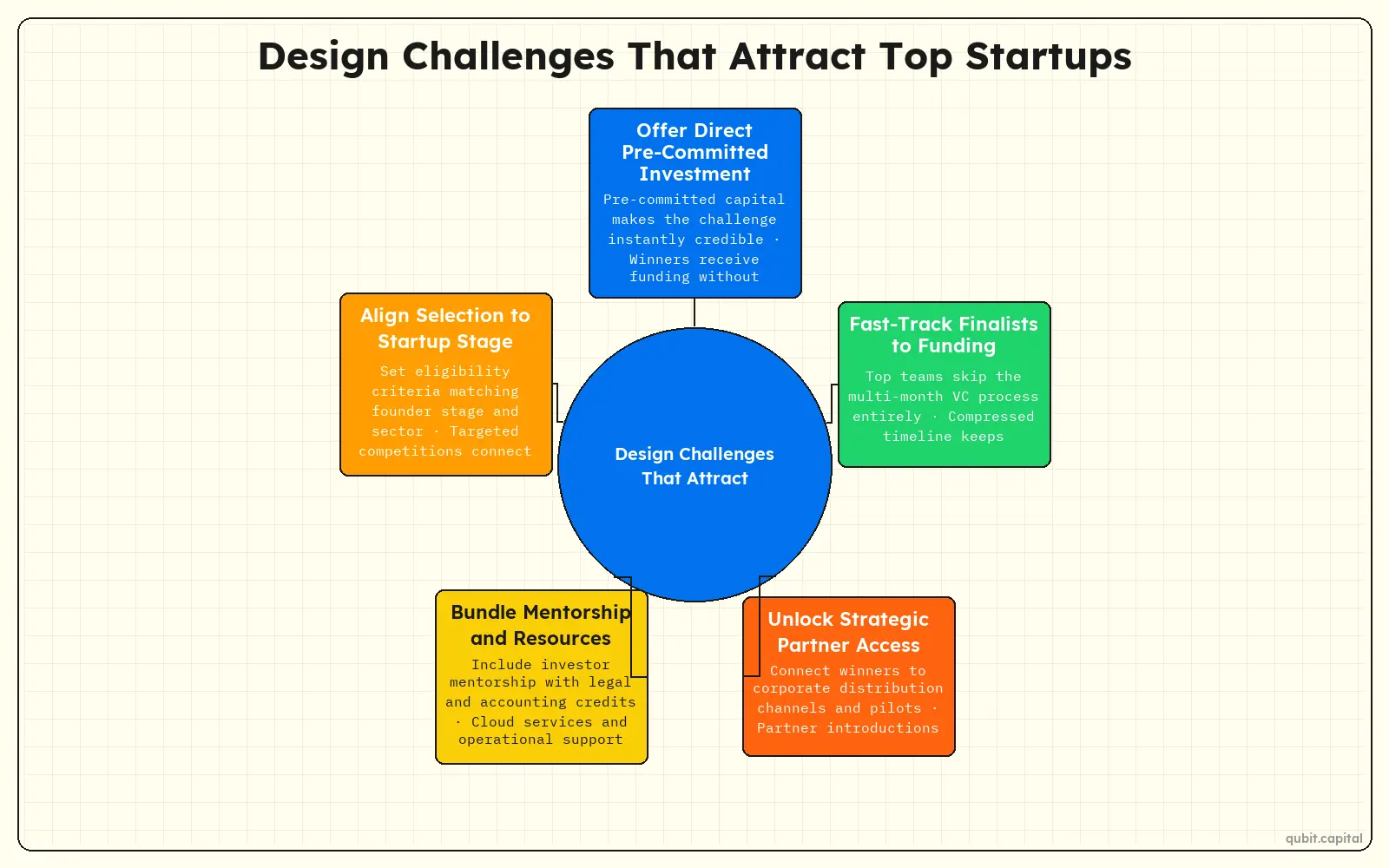
- Direct Investment: Offering a pre-committed investment amount for the winner(s) instantly makes the challenge credible.
- Fast-Track to Funding: Skip the usual multi-month VC process for the top finalists.
- Access to Strategic Partners: Introduce winners to corporate partners, distribution channels, or pilot opportunities.
- Mentorship & Resources: Include a program with investor mentorship, legal/accounting credits, or cloud services.
The clearer and more tangible your value proposition, the more serious the applications you’ll receive.
Real-world competitions highlight the value of practical eligibility rules. For example, some events require startups to have earned less than $10,000 to qualify. This ensures the competition targets genuinely early-stage ventures, aligning incentives with founder needs.
Aligning Competition Selection with Startup Goals
Building on clear eligibility criteria, founders should strategically select competitions that align with their startup’s stage, sector, and fundraising objectives. This targeted approach increases the likelihood of connecting with investors who understand their market and growth needs. By focusing on relevant events, founders maximize exposure to valuable mentorship, funding, and partnership opportunities. This alignment also ensures that both startups and investors benefit from a more efficient and impactful competition experience.
The strongest applications come in when founders believe you're serious about adding real value beyond capital, whether that means mentorship, introductions, or operational support during and after the challenge.
Essential Insights on Startup Competitions and Ecosystem Building
Startup challenges and competitions are more than just a platform for pitching ideas; they catalyze innovation and build inclusive startup ecosystems. They gain exposure and feedback from investment professionals. These are critical for refining their business models.
Comparing Competition Formats for Inclusivity
| Format Type | Accessibility | Participation Benefits |
|---|---|---|
| In-Person | Limited by location and travel | Strong networking, local ecosystem focus |
| Hybrid | Combines local and remote access | Wider reach, flexible engagement options |
| Virtual | Accessible globally, no travel required | Maximum inclusivity, lower networking depth |
Leading competitions demonstrate their credibility through substantial prize pools. Top-tier events typically advance 12-15 semifinalists who compete for over $100,000 in total prizes. These significant awards accomplish two goals: they attract experienced, high-potential founders and signal genuine investor commitment to nurturing the startup ecosystem.
Recent examples illustrate this impact. The Latinas in Tech Startup Competition distributes $30K, $20K, and $10K in non-dilutive funding to its top three winners, directly supporting underrepresented founders with capital that doesn’t sacrifice equity. TechCrunch Disrupt 2024 shows how premier competitions deliver value beyond cash prizes, winners gain media visibility, introductions to tier-one investors, and strategic corporate partnerships that can accelerate growth for years after the event concludes.
Building a reputation before the challenge launches matters just as much as the event itself, consistent content marketing that attracts founders ensures your brand is already trusted when applications open.
Marketing & Promotion Strategies for Maximum Deal Flow
Startup challenges require targeted marketing to attract high-quality applicants and maximize deal flow. Running a competition is only as effective as the quality and volume of applicants you can attract. Many investor-led challenges fall flat here. They announce the event with little outreach and wonder why few startups apply.
Founder Outreach Channels
1. Use Your Existing Network First
Your warm network is the fastest path to credible applicants. Start by:
- Notifying Portfolio Founders: They may know other quality startups who aren’t yet on your radar.
- Tapping Partner Networks: Co-investors, accelerators, and incubators can refer relevant startups.
- Engaging Industry Associations: Sector-specific bodies often have startup directories or mailing lists.
Warm referrals increase the odds of attracting serious teams rather than pitch hobbyists.
2. Use Targeted Founder Communities
Generic press releases won’t cut it. You need to be where founders actually spend their time:
- Slack/Discord Groups: Many sector-specific founder groups welcome challenge announcements.
- Founder Platforms: Sites like AngelList, F6S, and Seedrs often have challenge/event listings.
- University Entrepreneurship Hubs: If your thesis includes younger teams, campus incubators are gold mines.
3. Content-Driven Promotion
Instead of only saying “apply now,” share value-first content to position your challenge as worth the effort. Examples:
- A short LinkedIn post or video about “What We Look For in Startups” from the judging panel.
- A blog post outlining past winners’ success stories.
- A “Behind the Scenes” livestream of your selection process (without giving away confidential details).
By showcasing transparency and credibility, you differentiate your challenge from the sea of opportunistic pitch calls.
4. Incentivize Early Applications
Founders are often last-minute creatures. Offering small bonuses for early applications, like guaranteed feedback from an investor or priority review, creates urgency and improves your review timeline.
Structuring the Selection & Judging Process
Your competition will stand or fall based on how fair, efficient, and insightful your selection process is. Poorly run judging processes can tank your brand with the founder community.
1. Pre-Screening for Fit
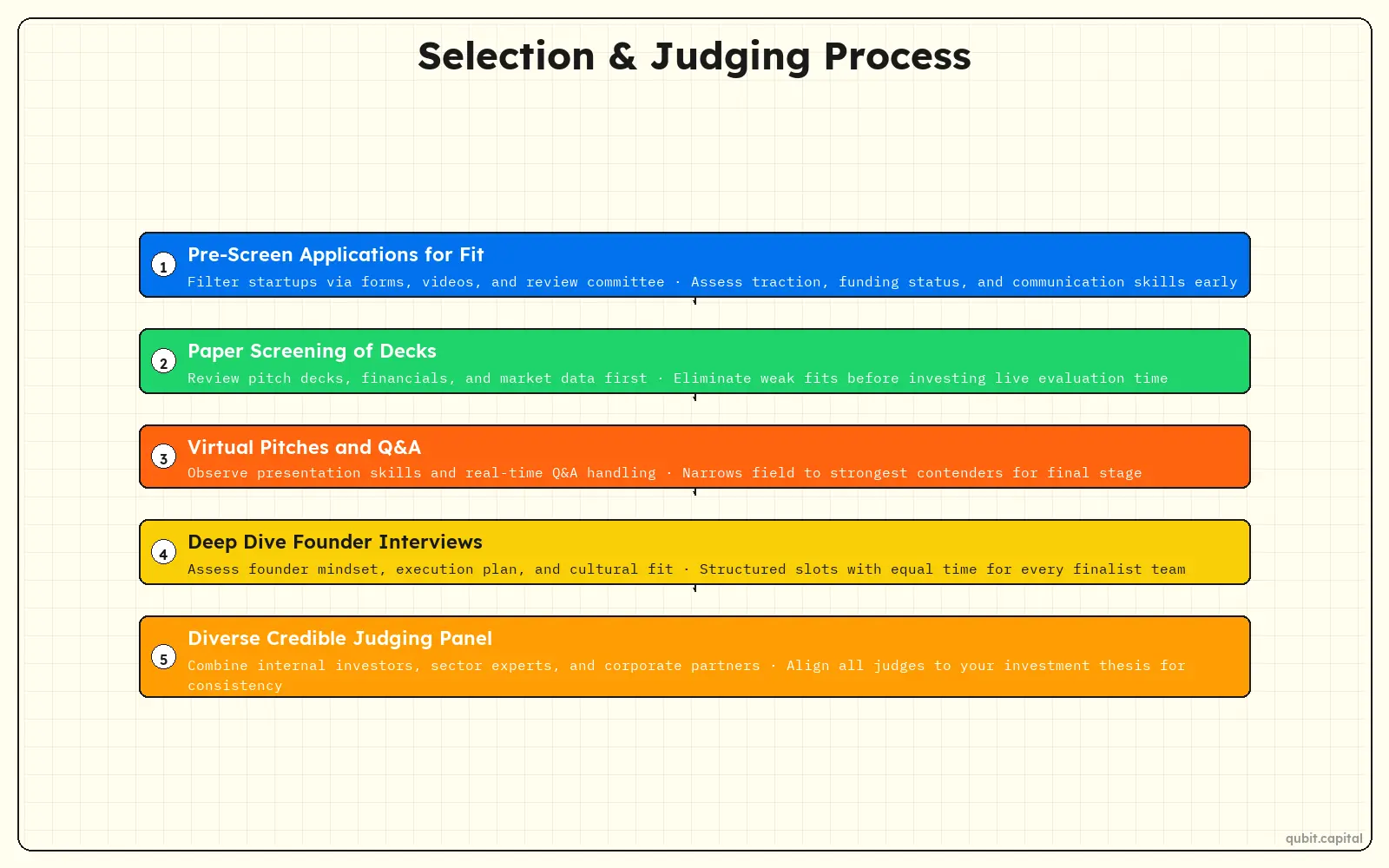
Before you even think about live pitches, filter out startups that don’t meet your basic investment or sector criteria. This can be done via:
- Online Application Forms: Include pointed questions about traction, funding, and market fit.
- Short Video Submissions: Helps assess communication skills and authenticity quickly.
- Initial Review Committee: Use a mix of your investment team and external advisors.
2. Multi-Stage Evaluation
A tiered selection process allows you to evaluate more than just pitch skills:
- Stage 1 – Paper Screening: Review decks, financials, and market data.
- Stage 2 – Virtual Pitches: Observe presentation and Q&A handling.
- Stage 3 – Deep Dive Interviews: Assess founder mindset, execution strategy, and cultural fit.
Each stage weeds out weaker fits and keeps your event day focused on top contenders.
3. Diverse & Credible Judging Panel
Your judging panel isn’t just there to score pitches, it’s part of your brand signal. Include:
- Internal Investors: You need decision-makers in the room.
- Sector Experts: Adds technical credibility.
- Corporate Partners: Can evaluate market potential from a buyer’s perspective.
Make sure every judge understands your investment thesis to maintain consistency in scoring.
A well-structured process can follow event-tested models. For instance, finalists are given a 30-minute slot with 11 minutes to present and 7 minutes for Q&A. Such formats ensure every team receives equal scrutiny and feedback.
Event Day Execution for Maximum Insight
Making the most of competition day requires deliberate preparation and a structured approach to every interaction. These practical steps will help you extract real value from each session.
1. Maintain a Tight Format
Attention spans are short, even in high-stakes events. Keep pitches to 5–7 minutes with 3–5 minutes of Q&A. Use strict timekeeping to respect both founders and judges.
2. Go Beyond the Stage
Some of the best due diligence happens off-mic. Build in networking breaks, one-on-one mentoring slots, or informal roundtables where founders and investors can have candid conversations.
3. Capture the Data
Have a system in place to record pitch videos, collect judges’ notes, and track founder follow-ups. This isn’t just for record-keeping, it feeds into your post-event deal flow pipeline.
Effective PR strategies can amplify the visibility gained through pitch competitions. An examination of communication strategies is provided in investor-pr-strategies, which outlines how coordinated PR and media efforts seamlessly integrate with your broader outreach objectives.
Beware of Spectacle-Driven Competitions
Beyond capturing data, founders and investors should be cautious of competitions that prioritize entertainment or lead generation over real investment opportunities. These events may offer visibility but often lack substantive follow-up or genuine investor engagement. Carefully vetting competitions for transparent judging, credible prizes, and authentic investor presence helps ensure participation leads to meaningful outcomes. This approach protects resources and focuses efforts on events with true growth potential.
Post-Event Conversion: Turning Finalists into Portfolio Companies
Startup challenges offer ongoing opportunities for investors to convert finalists into portfolio companies.
Too many investors treat startup challenges like a one-off showpiece, a nice day of pitches, some photos for LinkedIn, and then… nothing. If your goal is deal flow, the real work begins after the event.
1. Immediate Follow-Up While Momentum Is High
The clock is ticking after the competition. Founders are often in multiple conversations, and enthusiasm fades quickly if investors go silent. Within 48 hours of the event, you should:
- Email finalists with next steps (due diligence, meetings, data requests).
- Provide constructive feedback to non-finalists — it builds goodwill and keeps your brand strong in the community.
- Share photos and videos publicly, tagging startups to boost their visibility.
The faster your follow-up, the stronger the signal that you’re a serious, decisive investor.
2. Streamlining Due Diligence
Since you’ve already seen these startups pitch and interact, part of your diligence is done. Now’s the time to dig deeper:
- Review full financials, legal structure, and cap table.
- Validate traction claims with customer or user references.
- Assess tech/IP through a quick technical audit or expert review.
Aim for a shortened diligence cycle, ideally under 4–6 weeks, to maintain founder engagement.
3. Using Partner Ecosystems
If you can’t invest directly in all finalists, connect them to other investors or corporate partners who might be a fit. This builds your reputation as a connector, making more founders want to apply in future editions.
4. Tracking Long-Term Relationships
Not every promising startup is investable today. Maintain a “watchlist” pipeline for companies you want to track over the next 12–24 months. Invite them to future portfolio events or check in quarterly. Many of your best deals may come from this slow-burn relationship-building.
For the startups that aren't immediate fits, automating your outreach emails with personalized follow-up sequences keeps the relationship warm without draining your team's bandwidth.
Measuring ROI Beyond the Winner’s Check
If you want your competition to become a repeatable deal flow engine, you must measure its ROI — and not just in terms of immediate investments.
1. Quantitative Metrics
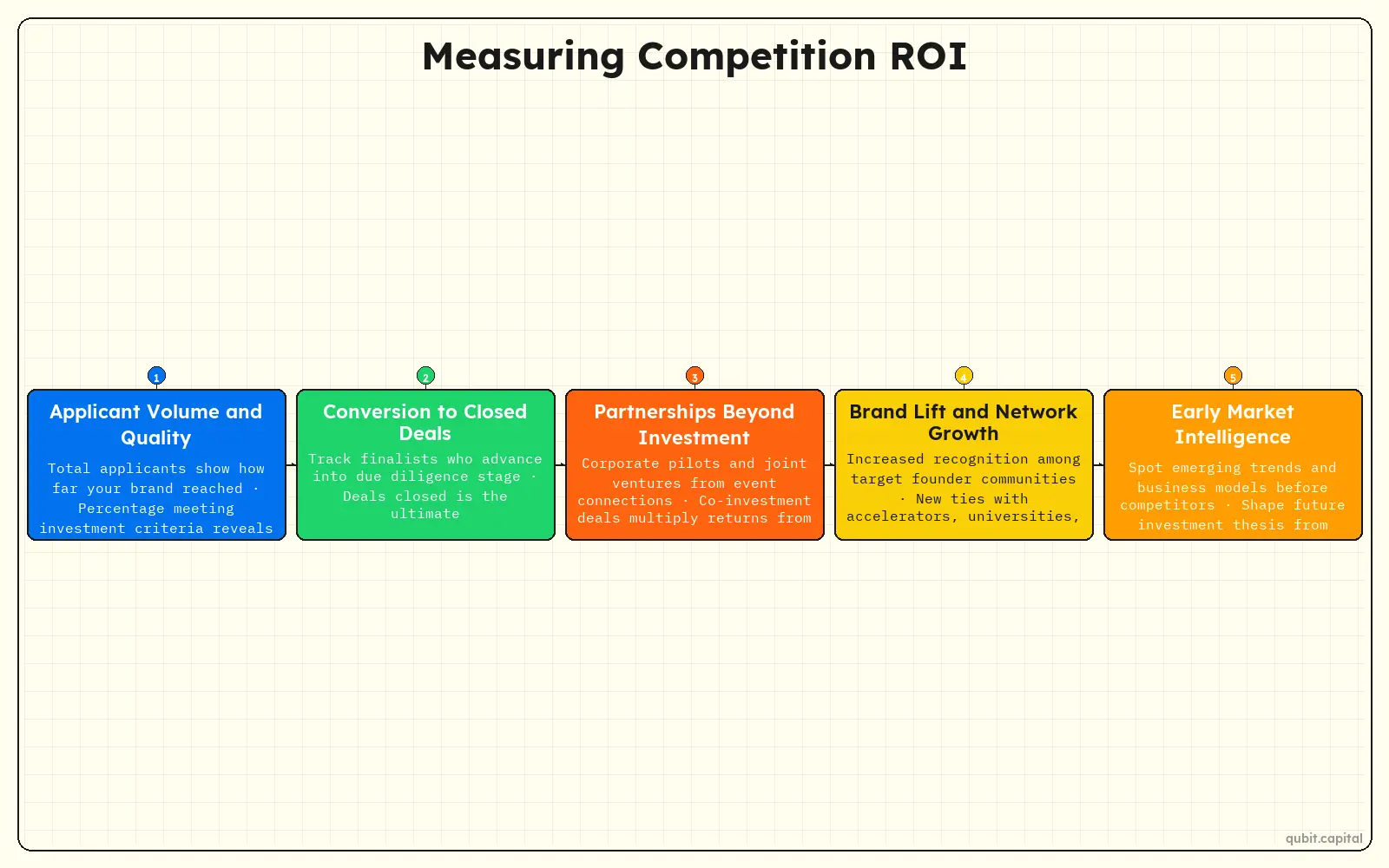
- Number of Applicants: A proxy for brand reach.
- Quality of Applicants: % of applicants meeting your investment criteria.
- Follow-Up Conversion Rate: % of finalists moving to due diligence.
- Deals Closed: The ultimate measure of event-to-investment success.
- Partnerships Formed: Corporate pilots, joint ventures, or co-investment deals.
For example, a global field study tracked 1,871 investment decisions, resulting in $320,000 invested into 16 startups at competition events. Such outcomes underscore the tangible ROI competitions generate for investors and founders.
2. Qualitative Benefits
- Brand Lift: Increased awareness among target founder communities.
- Network Expansion: New partnerships with accelerators, universities, or corporates.
- Market Intelligence: Spotting emerging trends and business models early.
The key is to treat this as a portfolio strategy, you might close only one deal now, but the intelligence and relationships you gain can influence many future investments.
Conclusion
Startup challenges can be a reliable deal flow machine, but only if you treat them like an investment funnel, not an event. The winners are not the point. The point is repeatable access to strong founders, fast signal capture in live Q&A, and a disciplined post-event process that converts finalists into diligence and term sheets. When you design incentives that founders actually want, run a fair selection process, and follow up within days, you stop competing for attention and start attracting it.
If you’re ready to connect with high-potential startups, our Startup Matchmaking service is here to help. Let us support you in building impactful partnerships that drive results.
Key takeaways
- A challenge works best when it has a sharp thesis: stage, sector, geography, and what “investable” means for you.
- Founder value beats hype. Direct investment, fast-track diligence, and real partner access attract serious teams.
- Pre-screening is the real unlock. Strong applications and short videos reduce noise before pitch day.
- Live pitches are due diligence. You learn more from Q&A behavior than from perfect slides.
- Your judges are part of your brand. Credible operators and sector experts raise founder trust instantly.
- Event day is for signal capture, not vibes. Record pitches, standardize scorecards, and log next steps live.
- Post-event follow-up decides ROI. Move within 48 hours, then run a 4–6 week diligence sprint.
- Track results like a portfolio channel: applicant quality, finalist conversion, deals closed, and partner outcomes.
Get your round closed. Not just pitched.
A structured fundraising process matched to your stage and investor fit.
- Fundraising narrative and structure that holds up
- Support from strategy through investor conversations
- Built around your stage, model, and timeline
Frequently asked Questions
How do startup competitions improve deal flow for investors?
Competitions act as a structured filter, surfacing vetted startups that meet specific investment criteria before you ever take a meeting. They give investors early access to founders during funding gaps or down rounds, when terms are more favorable. Run well, a competition becomes a repeatable pipeline rather than a one-off event.