

 Back
Back








Table of Contents

Startup evaluation has always been high impact, but painfully slow. Now AI startup screening is changing that reality. You can use artificial intelligence to review more deals faster, spot patterns across data, and surface promising startups you might miss with manual triage.
AI adoption is also accelerating across business teams. In 2024, 88% of companies reported regular AI use in at least one business function, up from 78% the previous year. That shift signals a clear trend: investors are using AI driven workflows to reduce screening bottlenecks and improve consistency.
In this guide, you will learn how to apply AI to screen startups faster without replacing human judgment. You will see where AI helps most, what data to feed it, and how to set guardrails so speed does not create bad decisions.
Overcoming Traditional Fundraising Challenges by Applying AI to Screen Startups
Evaluating startups has always been high impact, but time intensive. As an investor, you have limited time and unlimited inbound.
AI tools help you screen faster by automating data analysis and first pass triage. They reduce manual effort and surface the most promising opportunities, so your team can spend time where it matters.
The pressure is real on the founder side too. Traditional fundraising is resource intensive and the odds are low. Incubator acceptance rates can sit around 1% to 3%, and accelerators average about 3.8%.
Even more striking, only 1 in 400 startups ultimately secure funding. That is why better screening systems matter. They help investors move faster and help founders get clearer outcomes, instead of getting stuck in “maybe” limbo.
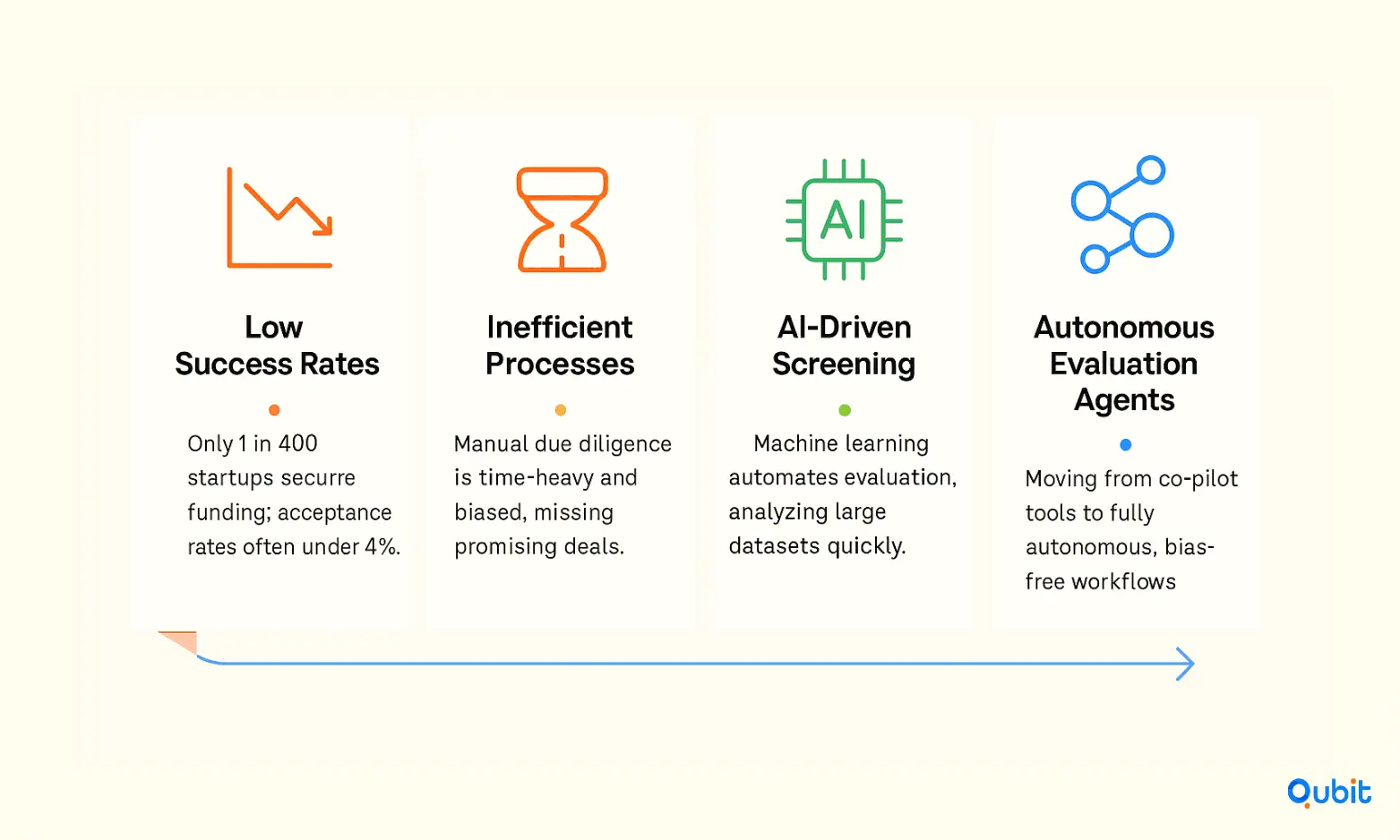
- Traditional fundraising is inefficient and bias prone: Manual due diligence takes time and subjective judgment can skew decisions. That slows evaluation and can cause investors to miss strong startups due to unconscious bias.
- AI screening speeds up evaluation and improves consistency: Machine learning tools can automate parts of investor evaluation and due diligence. This reduces manual work and creates more time for deeper risk analysis.
- Real efficiency gains are already showing up: One VC firm used an AI platform and cut due diligence time by 60%. This is the kind of leverage that changes how many deals a team can review well.
- The workflow is shifting from co-pilots to agents: Co-pilot tools assist humans, while autonomous agents can run entire diligence workflows. This saves time and can reduce bias by standardizing inputs and checks.
Your methodical approach is enhanced by the startup evaluation checklist, a framework that offers a clear set of criteria to complement AI screening techniques. This combination of structured evaluation and advanced technology ensures a more comprehensive and efficient due diligence process.
From Co-Pilots To Autonomous Agents: The New Standard For AI Startup Screening
AI is reshaping investor evaluation by moving past simple co pilot tools into autonomous systems. These systems can run large parts of due diligence with consistent logic and faster processing. The result is a screening workflow that is quicker, more structured, and easier to audit.
This efficiency gain directly drives business outcomes. According to global data, AI-ready industries now see three times higher revenue per employee compared to less AI-integrated sectors. This underscores the compounding returns of embedding AI throughout the investment evaluation cycle.
1. Shifting From Static Metrics To Autonomous Processing
Traditional evaluation leans on subjective judgment and static checklists. AI tools can process real time signals and adjust as new data appears. In one example, an XGBoost model outperformed the median venture capitalist by 25%, showing how algorithmic screening can improve hit rates.
This does not replace your judgment. It upgrades your first pass, reduces noise, and lowers the chance you miss a high potential outlier.
2. Reducing Human Bias with Data-Driven Insights
Human bias is a recurring failure mode in startup screening. AI can reduce that risk by standardizing what you measure and how you compare deals. Data driven platforms and approaches, like those used by Signalfire, show how structured inputs can make decisions more consistent across partners and time.
That said, AI still needs oversight. Regulators are scaling review frameworks in parallel. In 2023, the FDA approved 223 AI-enabled medical devices, up from six in 2015, reflecting both rapid adoption and the need for quality control.
3. Enhancing Screening Efficiency
AI is strongest when it automates repetitive work. It can summarize materials, extract key metrics, flag inconsistencies, and propose follow up questions. This frees your team to focus on judgment calls like market timing, competitive dynamics, and founder capability.
AI also helps you act earlier by spotting patterns across large datasets. That can surface emerging categories before they become obvious.
The Future of Investor Evaluation
AI will keep moving toward agent based workflows that run intake, scoring, and diligence tasks end to end. If you adopt it well, you get faster throughput, cleaner decision trails, and better consistency. If you ignore it, you will still compete, just at a slower clock speed.
Validating Startup Concepts with AI-Driven Pre-Build Evaluations
AI driven pre build evaluations help founders validate a concept before spending months on product and burn. Instead of guessing, you can pressure test demand, positioning, and competition using data driven signals. AI tools can analyze market trends, customer behavior, and competitor activity early. They can also surface insights like sentiment across social platforms, demand indicators, and the gaps competitors leave open.
Some tools can even simulate how users might interact with a hypothetical product, so you can refine the concept before writing code. This also improves fundraising readiness. When your deck shows clear validation, it reduces investor friction because you are not selling a story alone. You are showing evidence, along with what you learned and how you iterated.
AI can also help you align your pitch with how investors evaluate deals. By comparing your deck to proven structures, you can highlight the right proof points, like market pull, differentiation, and traction signals. That makes your narrative tighter and your claims easier to verify.
The result is a faster loop from idea to evidence. You spend less time building the wrong thing and more time building what the market is already asking for.
Boosting Investor Efficiency and Startup Operations with AI Tools
Streamlining investor efficiency and enhancing startup operations has become increasingly achievable with AI-driven tools. By automating manual processes, platforms like Crunchbase and AngelList are revolutionizing how investors and startups connect and collaborate.
1. Horizontal vs. Vertical AI Applications in Startup Operations
Building on these operational improvements, startups should distinguish between horizontal and vertical AI applications. Horizontal AI tools enhance productivity and creativity across multiple business functions, supporting roles from marketing to finance. Vertical AI solutions focus on automating domain-specific workflows, such as sales, recruiting, or customer service, delivering targeted efficiency gains. Recognizing these categories enables founders and investors to choose AI platforms that best match their strategic priorities.
AI tools significantly reduce the time spent on investor matching, enabling startups to focus on growth.
2. No-Code AI Automation Strategies for Startups
- Adopt no-code AI platforms to automate repetitive tasks without requiring programming skills or technical expertise.
- Empower non-technical team members to design and deploy custom workflows, improving productivity across departments.
- Reduce operational bottlenecks by enabling instant process adjustments and scaling automation as the startup grows.
Beyond investor matching, AI tools enhance operational efficiency for startups. Real-time data insights allow founders to make agile decisions, optimizing resources and improving scalability. A case study from The Wyse Group highlights how automating processes with tools like 4Degrees resulted in measurable ROI, showcasing the tangible benefits of AI-driven relationship intelligence.
AI tools are transforming the landscape of startup operations and investor efficiency, making it easier than ever to connect, evaluate, and grow.
Rapid adoption signals widespread operational transformation. In 2025, 81% of development teams use AI in their testing workflows. This ongoing shift reveals the expanding footprint of automation, empowering more startups to scale growth efficiently.
Understanding the Limitations of AI in Investment Decisions
AI can speed up screening and surface patterns, but it still has blind spots. This section shows where AI fails, and where you must keep human judgment in the loop.
- Data Quality And Bias Risk
AI is only as good as its training data. If inputs are incomplete, outdated, or skewed, outputs will be skewed too. Historical bias can also cause models to undervalue unconventional founders or miss new categories. - Qualitative Signals Are Hard To Model
AI struggles with team dynamics, leadership potential, and real conviction. These factors often decide outcomes, but they are not cleanly measurable. Use AI for facts and patterns, then use humans for nuance and context. - Risks Of Over-Reliance In Startup Screening
AI can miss innovation signals if it overweights familiar patterns. It can also reduce oversight and amplify errors when teams treat outputs as final decisions. If automation scales faster than learning, quality drops and bad calls compound. - The Right Operating Model
Use AI for triage, summarization, and quantitative checks. Keep human review for high stakes calls, bias checks, and final judgment. The best process is human plus machine, not machine alone.
How AI Is Changing VC Decision Making
- AI turns investing into pattern detection at scale. It helps you spot trends and signals across huge datasets that manual research misses. This improves forecasting and speeds up early screening.
- Large funds are backing this shift with real capital. Bessemer Venture Partners has deployed over $1 billion to AI native startups since 2023. That level of commitment signals rising conviction in AI driven categories.
- Predictive models help you find under the radar opportunities. They sift market and company data to flag deals with higher probability of breakout. This reduces overhead while improving decision accuracy.
- The end result is better resource allocation. You spend less time on weak fits and more time on the few deals worth deep work. Over time, that improves risk control and return potential.
Conclusion
AI is transforming how startups are evaluated and how investors make decisions. By applying advanced AI tools, venture capitalists can uncover patterns, assess risks, and identify opportunities with greater precision. However, the human element remains irreplaceable, intuition and experience are essential to interpreting AI-driven insights effectively.
A data-driven approach not only streamlines the screening process but also enhances decision-making, ensuring that investments are both strategic and impactful. Combining technology with human expertise creates a balanced framework for success in the competitive world of venture capital.
If you're ready to elevate your startup screening process and secure funding, we at Qubit Capital can help you harness the power of AI. Explore our Fundraising Assistance service today.
Key takeaways
- AI startup screening speeds up first-pass triage, helping investors review more deals without replacing human judgment.
- In 2024, 88% of companies reported regular AI use in at least one business function, up from 78%.
- Fundraising is brutally selective: incubators accept about 1% to 3%, accelerators average 3.8%, and only 1 in 400 secure funding.
- Efficiency gains are real: one VC firm cut due diligence time by 60% using an AI platform.
- Screening is shifting from co-pilots that assist humans to agents that can run end-to-end diligence workflows.
- AI-ready industries now show three times higher revenue per employee, reinforcing the compounding value of embedded AI workflows.
- Models can boost hit rates: one XGBoost approach outperformed the median venture capitalist by 25% in screening performance.
- Investor conviction is rising fast, with Bessemer Venture Partners deploying over $1 billion into AI-native startups since 2023.
Frequently asked Questions
What is AI startup screening and how does it work?
AI startup screening uses artificial intelligence to analyze large datasets and evaluate startups efficiently. It identifies trends and predicts growth potential.