

 Back
Back









Table of Contents

Qualifying leads is a critical step for startups aiming to secure investor interest and drive growth. However, raw data alone often lacks the depth needed to make informed decisions.
Industry adoption of enrichment technologies is accelerating. In 2023, global data enrichment solutions reached $2.37 billion in market value, projected to double by 2030. This signals rising demand for precise, actionable insights. For startups, competitive intelligence increasingly depends on leveraging refined data.
A closer study of artificial intelligence in prospecting is provided in ai investor prospecting, illustrating how AI-driven platforms align with your broader outreach efforts. This article will explore how data enrichment transforms raw data into actionable intelligence for investor lead qualification. From fundamentals to real-world applications, let’s jump right in.
Investor Data Enrichment Fundamentals
Data enrichment helps startups qualify leads by adding verified insights to basic contact data, enabling smarter investor targeting and outreach.
- Audit data health
- Prioritize leads
- Verify for compliance
- Integrate new info
- Analyze and apply
This practice ensures that businesses have access to reliable, actionable insights, which are crucial for informed decision-making. Operational excellence depends on data quality. According to recent research, 85% of businesses say poor-quality customer data directly harms operational efficiency. This illustrates why enriched data is now mission critical.
For B2B operations, enriched data can unlock numerous benefits. It enables businesses to:
- Improve customer segmentation: By adding demographic, firmographic, or behavioral data, companies can better understand their target audience.
- Enhance personalization: Enriched data allows for tailored marketing campaigns and customer experiences.
- Firmographic (company-level) data includes details such as size, industry, and location.
- Boost operational efficiency: Reliable data reduces errors and streamlines processes across departments.
Step-by-step data enrichment stages are illustrated above, covering audit, validation, integration, analysis, and application.
Why Data Enrichment Matters
Building on these benefits, effective data enrichment also requires strict adherence to compliance and ethical sourcing standards. Regulations such as GDPR and CCPA govern how personal and business data can be collected, stored, and enriched. Ensuring that all enrichment activities respect privacy laws helps protect your business from legal risks. Ethical sourcing further builds trust with clients and partners, supporting long-term growth.
Startups like yours already closed their rounds with us.
Founders across every stage and industry. Here's what it took.
- Raised $7.6M for Swiipr Technologies
- Raised $0.5M for Ap Tack
- Raised €0.5M for Ivent Pro

Pre-Enrichment Data Assessment: Setting the Stage for Success
Investor data enrichment starts with a thorough assessment of your current datasets to ensure relevance for investor outreach. Before diving into enrichment, startups must first assess the state of their existing data. Enriching inaccurate or outdated information is like building on a cracked foundation, it compromises the entire outreach strategy.
The stakes are high for startups. Poor data quality costs companies $12.9M per year through wasted outreach and missed opportunities. Pre-enrichment audits help prevent such losses.
1. Data Health Audit
Start by reviewing completeness, accuracy, and consistency. Identify missing fields such as industry, funding stage, or decision-maker titles, and flag outdated entries for removal or verification.
At industry scale, companies spend an average of $100,000 yearly on lead generation. Strategic data audits ensure these resources deliver better ROI.
2. Prioritization Matrix
Not all leads deserve equal enrichment effort. Use a simple scoring system to determine which leads have the highest potential impact, for example, investors who have recently backed similar startups, or prospects active in your target geography.
3. Compliance Checkpoint
Before enrichment begins, confirm that all collected data adheres to data protection laws such as GDPR or CCPA. This ensures your enrichment strategy starts from a legally sound position.
The Step-by-Step Process of Data Enrichment
Data enrichment involves a systematic approach to ensure accuracy and usability: This process benefits from adopting modular and incremental enrichment pipelines that allow for version-controlled updates. By breaking enrichment into manageable stages, teams can monitor progress and address issues without disrupting the entire dataset. Incremental updates ensure data remains fresh and relevant as business needs evolve. This approach supports scalability and continuous improvement in data quality.
1. Data Collection
The process begins with gathering raw information from both internal and external sources.
- Internal sources may include CRM records, transactional logs, website analytics, customer feedback, and email sign-up data.
- External sources may involve public databases, third-party data providers, industry reports, or social media platforms.
The goal at this stage is comprehensiveness, capturing enough relevant data points to provide a strong foundation for enrichment.
2. Verification
Once collected, the data is subjected to a validation process to filter out inaccuracies, inconsistencies, and outdated entries.
- This involves cross-referencing information against trusted databases or verification tools (e.g., postal address checkers, company registries, email verification APIs).
- Inaccuracies at this stage can have downstream effects, so precision and source reliability are essential.
Verification not only ensures correctness but also builds trustworthiness in the dataset.
3. Integration
With verified and corrected data, the next step is to integrate it into existing company databases or systems.
- A key challenge here is data consistency, avoiding conflicting formats, duplicate records, or mismatched fields.
- Many organizations use data integration platforms or ETL (Extract, Transform, Load) processes to ensure a seamless merge.
The outcome is a centralized, unified view of the enriched data, accessible across teams for consistent decision-making.
4. Analysis
Once enriched and integrated, data becomes significantly more valuable when analyzed for patterns, correlations, and actionable insights.
- Businesses often use advanced analytics tools, AI algorithms, or BI dashboards to identify trends such as customer behavior shifts, market opportunities, or operational inefficiencies.
- Statistical modeling, segmentation, and predictive analytics can help turn raw numbers into strategic foresight.
5. Application
The final step is embedding enriched data into real-world business strategies and operations. For operational teams, enriched data can inform supply chain optimizations, product development, and service improvements.
At this stage, enriched data shifts from being a static asset to a dynamic driver of growth and competitive advantage. In marketing, it may mean hyper-personalized email campaigns, targeted ads, and improved lead scoring. In sales, it can enhance prospect qualification, shorten sales cycles, and improve conversion rates.
Common Challenges in Data Enrichment
Despite its advantages, data enrichment comes with challenges that businesses must address:
- Integration Issues: Combining enriched data with legacy systems can be complex and time-consuming.
- Scalability: As data volumes grow, maintaining enrichment processes at scale requires robust infrastructure.
- Regulatory Compliance: Adhering to data privacy laws, such as GDPR, is essential to avoid legal repercussions.
By proactively managing these challenges, businesses can maximize the value of their enriched data while ensuring compliance and scalability.
Data Enrichment Best Practices & Techniques
Optimizing investor data enrichment requires a structured approach and the adoption of innovative techniques. To achieve meaningful results, businesses should leverage data enrichment tools and prioritize clarity in their enrichment goals.
1. Define Clear Objectives
The foundation of any successful data enrichment initiative lies in setting precise and measurable objectives. Without a clear understanding of what you aim to achieve, efforts can become scattered and ineffective. For instance, are you enriching data to improve customer segmentation, enhance lead scoring, or refine investor targeting? Identifying these goals upfront ensures that every step of the process aligns with your desired outcomes.
2. Multi-Source Validation
Relying on a single data source can lead to inaccuracies and inconsistencies. Multi-source validation, where data is cross-referenced across multiple reliable sources, significantly improves data quality. This approach minimizes errors and ensures that the information remains up-to-date and actionable.
Multi-source validation is pivotal for outreach optimization. Growth agencies report email bounce rates dropping from 10-15% to under 5% with advanced enrichment. This methodology directly improves campaign effectiveness and reduces wasted effort.
3. Embrace Automation and Real-Time Scoring
Automation has revolutionized data enrichment by enabling real-time updates and reducing manual intervention. Tools powered by artificial intelligence (AI) can autonomously adapt and refine data processes. For example, AI-Powered Autonomous Data Enrichment systems are designed to self-learn, updating records in real-time for faster and more accurate investor targeting. This innovative approach not only saves time but also ensures that your data remains relevant in dynamic environments.
4. Utilize Advanced Tools
Longer lead forms and real-time lead scoring tools can further enhance data accuracy. By collecting more detailed information upfront and scoring leads as they interact with your platform, businesses can create a more comprehensive and actionable dataset.
Beyond advanced tools, standardizing and normalizing enriched data ensures consistency across all records. This process aligns formats, categories, and naming conventions, making data easier to analyze and integrate. Standardized data reduces manual reconciliation and supports seamless sharing between platforms. Adopting these practices helps maintain data quality as your enrichment efforts scale.
Adopting these best practices ensures that your data enrichment efforts yield high-quality, actionable insights.
Data Enrichment Services, Software & Tools
Finding the right data enrichment services or tools can significantly enhance your B2B lead qualification process. Leading data enrichment providers offer tools designed to capture validated contact information, firmographic details, and technographic trends.
When evaluating data enrichment tools for marketing and lead qualification, automation, integration capabilities, and compliance features are critical factors. Selecting the right data enrichment solution depends on your specific needs, whether you require a comprehensive enterprise platform or a specialized app.
Key Features to Consider
Automation streamlines the process of updating and validating data, saving time and reducing manual errors. Integration capabilities ensure the tool works seamlessly with your existing CRM or marketing platforms, while compliance features help you adhere to data privacy regulations like GDPR or CCPA.
Popular Tools for Data Enrichment
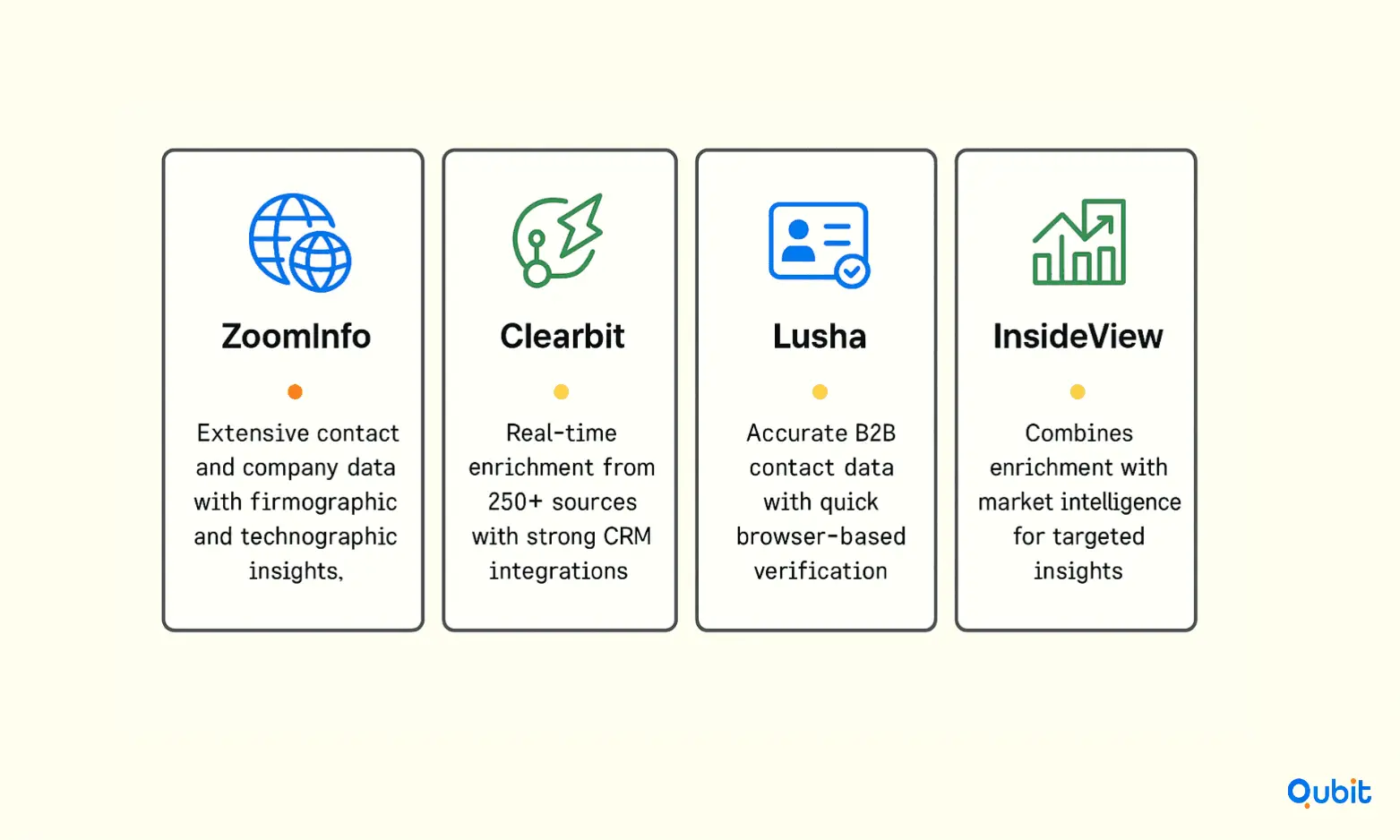
ZoomInfo
ZoomInfo is a robust platform offering extensive contact and company data. It provides firmographic and technographic insights, making it a go-to choice for sales and marketing teams aiming to refine their lead qualification processes.Clearbit
Clearbit specializes in real-time data enrichment, pulling information from over 250 sources. Its integration capabilities with tools like Salesforce and HubSpot make it a favorite for teams looking to enhance their CRM data.Lusha
Lusha focuses on delivering accurate B2B contact data. Its browser extension allows users to quickly gather verified contact details, making it a practical choice for sales professionals.InsideView
InsideView combines data enrichment with market intelligence, offering insights into company hierarchies, financials, and industry trends. This tool is particularly useful for enterprises targeting specific market segments.
Your exploration of startup lead qualification is enriched by the discussion in how to do startup outreach for investors, which lays out a broad perspective on outreach strategies and channels. This resource provides valuable insights into aligning your enriched data with effective outreach methods.
By carefully assessing your requirements and focusing on tools that align with your goals, you can ensure your data enrichment efforts translate into actionable insights for your B2B strategies.
Native CRM Data Enrichment
Native CRM data enrichment integrates directly into platforms like HubSpot, Zoho, or Salesforce to improve how customer data is managed. Instead of relying on external tools, enrichment happens inside the CRM, keeping data accurate and continuously updated.
This native setup ensures real-time synchronization, reducing errors and keeping customer profiles consistent across teams. Contact details, company information, and behavioral insights update automatically, so sales and marketing always work with current data.
Built-in enrichment also creates a unified data environment by removing dependence on disconnected third-party tools. Teams access the same reliable information, improving collaboration, saving time, and enabling more personalized customer interactions with stronger operational efficiency.
Data Enrichment Use Cases & Examples
Investor data enrichment strategies have transformed how businesses approach lead qualification and investor targeting. Real-world examples provide a clear lens into the tangible benefits of enriched data, from improved targeting to reduced bounce rates.
One standout example from data enrichment providers is the Cognism Case Study, which highlights the power of verified data. By incorporating verified phone numbers into their outreach process, Cognism achieved a 25% quarter-over-quarter increase in connect rates.
This improvement significantly reduced bounce rates, demonstrating the value of qualifying leads with enriched business data.
These results underscore the importance of precision in data enrichment. When businesses refine their data, they not only improve the quality of their leads but also enhance the efficiency of their outreach efforts. This approach ensures that every interaction is more targeted, leading to better engagement and higher conversion rates.
Conclusion
Qualifying startup leads effectively begins with mastering the fundamentals of investor data enrichment. By implementing data enrichment best practices, exploring advanced techniques, and utilizing practical tools, businesses can create a robust framework for lead qualification.
A clear, narrative-driven approach ensures that enriched data not only informs decisions but also builds a compelling story that resonates with potential investors.
Adopting these strategies can lead to measurable improvements in identifying and connecting with the right opportunities. The process becomes more than just a numbers game—it transforms into a strategic effort that drives meaningful results.
If you're looking to optimize your data enrichment efforts to qualify startup leads effectively, we at Qubit Capital offer Investor Discovery and Mapping services designed to connect you with the right investors. Let’s get started.
Key takeaways
- Data enrichment services transform raw data into actionable intelligence by adding verified insights.
- It is distinct from data cleansing and involves a systematic process of assessment and validation.
- Best practices include setting clear objectives, utilizing automation, and choosing the right data enrichment solution for your business.
- Data enrichment tools such as ZoomInfo and Apollo provide robust support for B2B data enrichment.
- Data enrichment providers like ZoomInfo and Apollo offer robust support for B2B data enrichment.
- Real-world examples, such as the Cognism Case Study, highlight tangible improvements in investor lead qualification.
Get your round closed. Not just pitched.
A structured fundraising process matched to your stage and investor fit.
- Fundraising narrative and structure that holds up
- Support from strategy through investor conversations
- Built around your stage, model, and timeline
Frequently asked Questions
What is investor data enrichment and how does it work?
Investor data enrichment enhances raw lead data with verified firmographic and technographic insights. These enrichments help startups better qualify and target potential investors. The process adds meaningful context for improved decision-making.