

 Back
Back










Table of Contents

Securing funding often comes down to how well you negotiate startup deals. The best outcomes happen when founders and investors balance vision, valuation, and mutual upside, without breaking trust.
The math is unforgiving. If one quarter of deals lose money and only ten percent return ten times, concentration risk is real. That is why negotiation is not only about “getting a deal done.” It is about structuring a deal you can defend over time.
This guide breaks down startup investment deals from valuation through due diligence and into closing. You will learn how to handle equity splits, lead negotiations cleanly, and structure investor-friendly terms without creating future friction.
Let’s jump in.
Understanding the Investment Climate
Before entering negotiations, founders must understand the current investment climate and what investors are looking for in potential portfolio companies. The startup investment ecosystem has evolved significantly, with investors becoming increasingly sophisticated in their due diligence processes and valuation methodologies.
Today's investors evaluate startups through multiple lenses: market opportunity, team capabilities, product differentiation, traction metrics, and scalability potential. They're not just buying equity in your company; they're investing in a vision, a team, and a path to substantial returns. Understanding this mindset helps founders position their startups effectively during negotiations.
The fundraising process typically follows several stages, from seed rounds to Series A, B, and beyond. Each stage comes with different expectations, valuation ranges, and deal terms. Seed investors might accept higher risk for potentially higher rewards, while later-stage venture capital firms focus heavily on proven business models and clear paths to profitability or exit.
Startups like yours already closed their rounds with us.
Founders across every stage and industry. Here's what it took.
- Raised $7.6M for Swiipr Technologies
- Raised $0.5M for Ap Tack
- Raised €0.5M for Ivent Pro

Preparing for Investment Negotiations
Preparation is what keeps you from signing a deal you regret. When founders walk in unprepared, they either accept weak terms or lose credibility fast.
- Build A Clean Data Room
Include financial projections, cap table details, legal documents, customer data, and core KPIs. This transparency speeds diligence and signals operational maturity. - Defend A 3 Year Financial Model
Your model should run at least three years out, with assumptions you can explain. Investors will not punish uncertainty, but they will punish fuzzy logic. - Know Your Valuation Range
Use established valuation methods to set a realistic range. Pull in comparable company analysis, recent transactions, and scenario based modeling. Do not fixate on the headline number, because terms can matter more than valuation. - Research And Target The Right Investors
Create a target investor profile based on industry, stage, and fit. Review their thesis, portfolio, check sizes, and founder reputation. This helps you tailor your pitch and anticipate objections during negotiation.
Key Terms in Startup Investment Deals
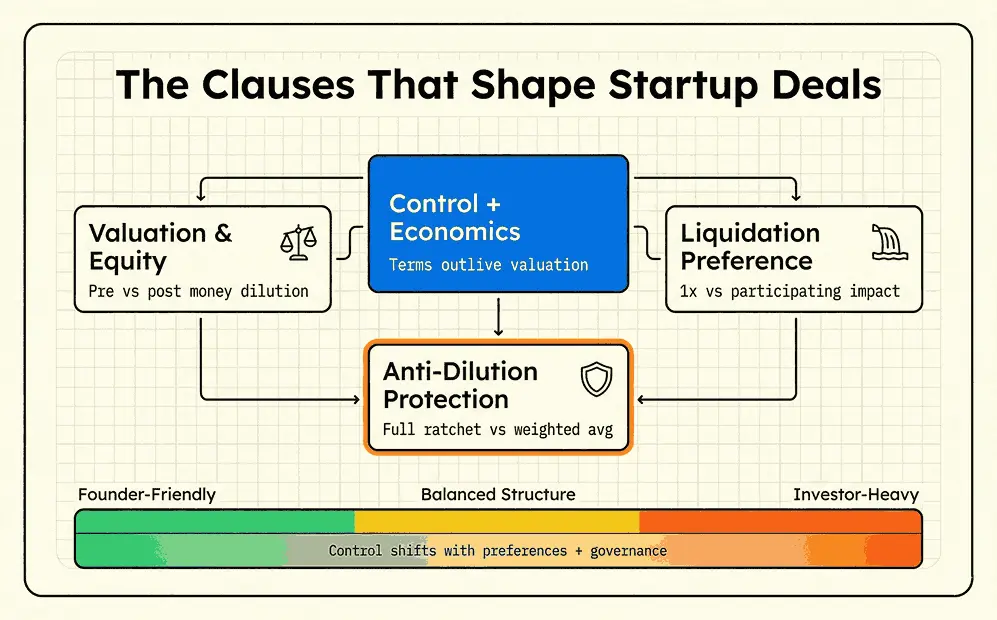
Term sheets look simple until you realize they decide control, payouts, and how flexible the company stays. These are the terms that matter most in negotiation.
- Valuation And Equity Percentage
Pre money valuation is the company’s value before the investment. Post money includes the new capital, which sets investor ownership. Example: a $10 million pre money valuation with a $2 million investment creates $12 million post money, so dilution is 2 ÷ 12 = 16.7%. - Liquidation Preferences
Liquidation preference sets payout priority at an exit. A 1x preference means investors get their money back before common shareholders receive proceeds. Participating preferred is more aggressive, since investors can take the preference and then share pro rata in the remaining proceeds, which can reduce founder outcomes. - Anti Dilution Provisions
Anti dilution protects investors in down rounds. Full ratchet is founder unfriendly because it resets the investor price to the new lower price. Weighted average anti dilution is more balanced, and broad based versions are generally considered more founder acceptable than narrow based. - Board Composition And Voting Rights
Board seats and voting rights shape who controls major decisions. Investors often push for board representation and protective provisions, meaning certain actions need their approval, like raising more capital, selling the company, or changing the business model in a major way. - Founder Vesting Schedules
Vesting keeps founders committed over time. The common structure is four year vesting with a one year cliff. That means no shares vest until year one, then vesting continues monthly. This protects investors if a founder leaves early.
Negotiating Startup Investment Deals: Process & Guidance Strategies
Negotiating startup investment deals requires a well-structured process that balances preparation, leadership, and adaptability. This section explores the critical steps and strategies for navigating startup investment deals. It emphasizes the importance of experienced leadership, meticulous due diligence, and strategic checkpoints.
Key Steps in the Investment Deal Process
Founders in high-growth sectors must leverage market intelligence to remain attractive to investors.
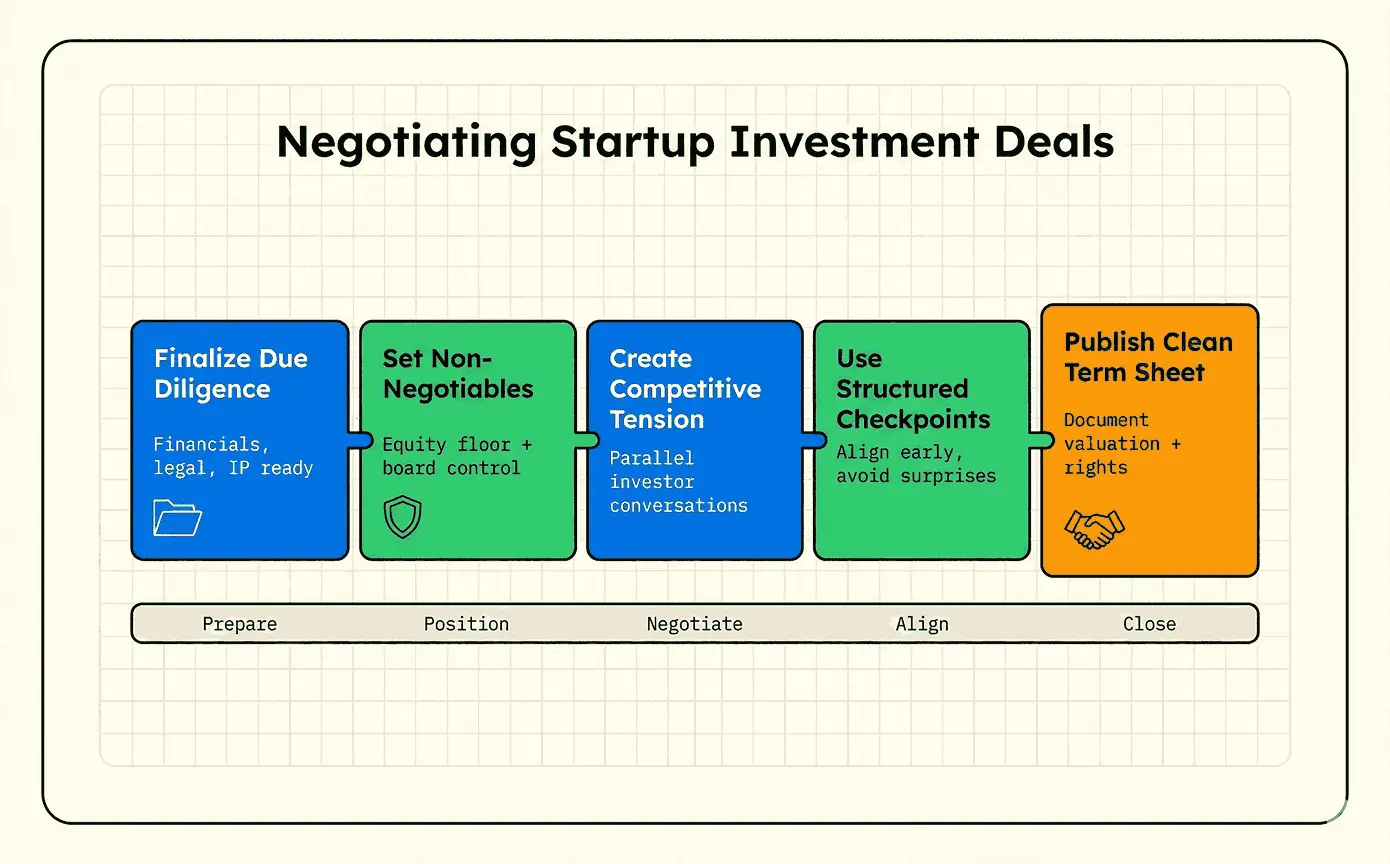
1. Finalize Due Diligence
Thorough due diligence is foundational to any successful investment deal. Founders should prepare comprehensive documentation covering financials, legal structure, intellectual property, team credentials, and market positioning. This transparency builds investor confidence and accelerates the negotiation process.
2. Prepare Market Intelligence
Understanding market conditions, comparable valuations, and investor preferences is crucial. Founders should research recent deals in their sector, identify industry trends, and benchmark their metrics against competitors. This intelligence strengthens negotiating position and helps set realistic expectations.
3. Clearly Communicate Non-Negotiable Terms
Establishing clear non-negotiable terms is a critical step before entering substantive negotiations. By identifying which deal elements are essential, such as minimum equity retention, board composition, or veto rights, founders can set boundaries that protect their core interests. Communicating these terms early prevents misunderstandings and reduces the risk of contentious renegotiations later in the process.
This approach also signals professionalism and transparency, building trust with investors who appreciate clarity. It enables both parties to focus on areas where compromise is possible, streamlining discussions and saving valuable time. Founders who articulate their non-negotiables are less likely to concede on points that could undermine long-term control or company vision.
To implement this strategy, founders should document their red lines and rehearse how to present them confidently. This preparation ensures consistency in messaging, especially when multiple stakeholders are involved. By proactively addressing non-negotiable terms, founders strengthen their negotiation position and lay the groundwork for a more collaborative partnership.
4. Creating Competitive Tension Among Investors
Generating competitive tension among potential investors can significantly enhance a startup's bargaining power. This involves engaging multiple investors simultaneously, creating a sense of urgency and competition. However, this strategy requires careful orchestration to avoid alienating key stakeholders. Structured communication and transparency are essential to maintain trust while fostering competition.
5. Structured Interim Checkpoints
Negotiations can be complex and lengthy, making it essential to establish interim checkpoints. These checkpoints serve as milestones to evaluate progress, address emerging issues, and ensure alignment between all parties. A well-structured process keeps negotiations on track and prevents last-minute surprises.
6. Customizing Critical Deal Terms
Every startup deal involves negotiating key terms that can significantly impact the company's future. These include:
- Valuation: Determining the startup's worth while balancing investor expectations and founder equity
- Option Pool: Allocating equity for future hires without diluting existing stakeholders excessively
- Board Structure: Establishing governance that supports growth while protecting founder interests
- Vesting Schedules: Ensuring long-term commitment from founders and key employees
- Round Sizing: Balancing immediate funding needs with long-term financial strategy
- Liquidation Preferences: Defining how proceeds are distributed in exit scenarios
7. Maintain Professionalism and Emotional Control
Beyond customizing deal terms, founders must maintain professionalism and emotional control throughout negotiations. High-stakes discussions can trigger stress or frustration, but responding calmly preserves negotiation flexibility and demonstrates maturity. Investors are more likely to trust founders who handle pressure with composure and honesty.
Emotional discipline helps avoid impulsive decisions that could compromise key terms or damage relationships. It also encourages open dialogue, allowing both sides to address concerns constructively. Founders who remain professional, even during disagreements, signal reliability and long-term partnership potential.
To cultivate this skill, founders should prepare for challenging questions and practice responses in advance. Seeking feedback from mentors or advisors can also help identify emotional triggers and develop effective coping strategies. Consistent professionalism throughout negotiations ultimately strengthens the foundation for future collaboration.
8. Finalizing the Deal: Publishing Reports and Term Sheets
The final stage of negotiation involves publishing the finalized due diligence reports and term sheets. This step ensures that all parties have a clear understanding of the agreed terms, reducing the likelihood of disputes. Comprehensive documentation should include valuation details, investment amount, equity distribution, governance rights, and exit provisions.
Clear documentation and negotiation frameworks protect founder interests and attract investors. Your approach to finalizing investments establishes the foundation for a strong, mutually beneficial partnership that supports long-term growth and success.
Clear documentation and negotiation frameworks protect founder interests and attract investors. Your approach to finalizing investments gains clarity when you consider how to negotiate startup investment terms, a discussion that maps negotiation strategies within the broader deal-making process.
Negotiating Startup Investment Deals: Equity & Valuation Parameters
Equity and valuation decisions shape control, dilution, and future rounds. During Q3 2024, median Series A valuations reached $45M for primary rounds and $43.6M for bridge rounds. Use these figures as reality checks, not targets.
This section gives you practical guardrails, plus benchmarks to keep negotiations grounded.
1. Structuring Startup Equity Splits
Equity splits should reflect contribution, not default equality. Only about one third of startups give equal equity to all co-founders, which shows how common contribution based splits are.
Use a simple contribution review:
- role ownership and responsibility today
- time commitment and opportunity cost
- unique skills, network access, or IP brought in
- cash invested and personal risk taken
Revisit splits when roles change materially. Do it before pressure hits, not during a crisis.
2. Vesting Schedules: Protecting the Startup’s Future
Vesting prevents a departing founder from keeping disproportionate equity. If co-founder vesting schedules are omitted, a departing founder can destabilize the cap table.
Use founder vesting in the founders’ agreement. A standard vesting period for key employees spans 2 to 3 years, with a one-year cliff. Around 20% of startups experience founder departures, so this is not a rare edge case. Also plan an option pool early. It keeps the company hireable after the round.
3. Pre-Money vs. Post-Money Valuation: Why It Matters
Pre-money valuation is the value before investment. Post-money includes the new capital. This difference determines dilution and control.
Do not optimize only for a higher headline valuation. Terms can hurt more than dilution if they reduce future flexibility. If you want a structured approach, use established valuation methods and comparables. Keep your assumptions defendable and consistent.
To explore valuation strategies further, check out startup valuation methods, which provide insights into pricing early-stage investments.
4. Legal and Tax Documentation: Avoiding Pitfalls
Clean paperwork protects both sides. Poor documentation causes disputes, tax inefficiencies, and delays at close.
Keep it tight:
- keep the cap table current, always
- document vesting, IP assignment, and investor rights clearly
- use equity tools if needed, but still audit regularly
- involve legal help early for founder agreements and term mechanics
Clarity here prevents “small” issues from becoming expensive distractions later.
Consult legal experts to draft agreements that address dispute resolution, vesting terms, and investor rights. For a comprehensive overview, explore legal structures for startup investments.
By prioritizing clarity and fairness in equity and valuation decisions, startups can build a strong foundation for growth while maintaining trust among stakeholders.
Closing the Deal and Moving Forward
The closing process involves executing final documents, transferring funds, issuing shares, and updating the cap table. Coordinate with legal counsel, accountants, and investors to ensure all steps occur correctly and simultaneously.
Announce the funding appropriately, balancing transparency with competitive considerations. A well-crafted announcement generates positive momentum with customers, recruits, and potential future investors while carefully managing information that might benefit competitors.
Immediately after closing, establish strong communication rhythms with your new investors. Schedule regular board meetings, define reporting cadences, and clarify how investors prefer to engage with the company. Setting expectations early prevents misunderstandings later.
Remember that closing an investment round is not an endpoint but the beginning of a partnership. The quality of your relationship with investors significantly impacts future fundraising, strategic decisions, and exit opportunities. Treat this relationship with the importance it deserves.
Common Pitfalls To Avoid
Even experienced founders make mistakes in investment negotiations. These are the ones that create the most damage later.
- Overvaluing Your Company
A high valuation can backfire if you cannot grow into it. It can make the next round harder, create misaligned incentives, and signal poor market awareness. - Ignoring Governance For Economics
Do not trade away board control or accept heavy protective provisions just to “win” valuation. If you cannot run the company, the cap table does not matter. - Taking Money From The Wrong Investors
Capital is not neutral. The wrong investor can slow decisions, damage hiring, and create reputation drag. Prioritize relevant expertise, strong networks, and aligned working style. - Rushing Without Preparation
Momentum matters, but sloppiness costs more. Weak data rooms, unclear legal docs, and vague assumptions lead to mistakes that take years to unwind. - Not Planning For Future Rounds
Today’s terms shape tomorrow’s fundraising. Model how current dilution, preferences, governance, and option pool plans will affect Series A, B, and beyond.
Conclusion
Negotiating startup investment deals is less about winning and more about building a durable partnership. Strong outcomes come from preparation, clear priorities, and terms you can defend long after closing. Start with a clean data room, a credible model, and a valuation range you can explain. Know the clauses that shape control, payouts, and flexibility before you chase a higher headline number.
Use checkpoints, steady communication, and documented decisions to keep diligence moving without surprises. Structure equity splits, vesting, and governance to protect execution speed and reduce future conflict. Close with clean paperwork and clear reporting rhythms, because the round starts the real work.
If you’re ready to secure the right investors and scale effectively, we invite you to explore our Fundraising Assistance service. Let us help you navigate the complexities of fundraising with precision and expertise.
Key Takeaways
- Negotiation is deal design, not deal closure, and it must preserve trust while protecting long-term outcomes.
- Founders should enter talks with a clean data room and a defendable three-year model.
- Don’t fixate on valuation alone, because terms can restrict control and future fundraising flexibility.
- Liquidation preferences and anti-dilution clauses can materially change founder outcomes, even at “good” valuations.
- Board seats and protective provisions decide real control over major actions, not just governance formality.
- Founder vesting protects the cap table if someone leaves, and prevents early exits from breaking incentives.
- Create competitive tension carefully, and use interim checkpoints to avoid late-stage surprises.
- Avoid the big traps: overvaluation, weak governance trade-offs, wrong investors, rushed prep, and no planning for future rounds.
Get your round closed. Not just pitched.
A structured fundraising process matched to your stage and investor fit.
- Fundraising narrative and structure that holds up
- Support from strategy through investor conversations
- Built around your stage, model, and timeline
Frequently asked Questions
What are the most important terms to negotiate in a startup investment deal?
The most important terms include equity split, valuation, vesting schedules, and investor rights. Understanding these elements ensures founders secure favorable investment terms.