

 Back
Back









Table of Contents

The success of a startup acquisition often depends on more than price, product, or market share. Cultural fit can quietly decide whether the deal creates lasting value or slowly falls apart.
Recent research shows that organisations that prioritise cultural alignment are about 50 percent more likely to outperform peers on profitability. That cultural alignment profitability impact makes one thing clear: due diligence cannot stop at financials.
Cultural misalignment is also a leading cause of M&A failure. When values, decision styles, and ways of working clash, integration slows, key people leave, and the original deal thesis starts to erode.
This article is tailored for investors, founders, and acquisition managers who need practical guidance on cultural due diligence in startup acquisitions.
Let's dive into it!
The Hidden Cost of Cultural Misalignment
Cultural clashes manifest in ways that directly impact the bottom line, yet they're difficult to quantify in traditional financial models. Key talent departures within the first year are often the most visible symptom.
Google acquired Nest Labs for 3.2 billion dollars in 2014, but the integration quickly ran into culture clash issues. Reports described an internal ‘employee exodus,’ and in his book and later interviews, founder Tony Fadell talks about the tension between Nest’s hard edged, ship fast hardware culture and Google’s slower, perk heavy big company environment. He eventually left, saying he ‘voted with his feet’ after finding the post acquisition setup unworkable
Product development stalls when teams from different cultural backgrounds can't agree on priorities, decision-making processes, or acceptable quality standards. A startup that moved fast and broke things suddenly finds itself navigating layers of approval processes and risk committees. Innovation suffers accordingly.
Customer relationships deteriorate when the acquired company's culture of responsiveness and personalization gives way to the acquirer's standardized processes and offshore support models. The very attributes that made the startup attractive become casualties of integration.
Employee morale and productivity decline as uncertainty, conflicting directives, and incompatible work styles create friction. Teams spend more time navigating internal politics than serving customers or building products.
What Cultural Fit Actually Means
Cultural fit extends far beyond whether companies have ping pong tables or free lunch. It encompasses the fundamental beliefs, values, and operating principles that shape daily decisions and behaviors.
Decision-making authority represents one of the most critical dimensions. Does the startup empower individual contributors to make significant decisions, while the acquirer requires committee approval for minor expenditures? How are trade-offs between speed and thoroughness resolved? Who has veto power?
Risk tolerance varies dramatically between organizations. A startup culture that celebrates bold bets and accepts frequent failure will struggle inside a parent company where career-limiting mistakes are avoided at all costs and quarterly earnings guidance dominates thinking.
Communication styles can create constant friction. Startups often favor direct, informal communication with flat hierarchies and easy access to leadership. Large organizations may rely on formal processes, scheduled meetings, and carefully managed information flow. Neither approach is wrong, but incompatibility creates daily frustration.
Work-life integration philosophies differ significantly. Some startups maintain sustainable work schedules while others expect intense dedication during critical periods. Some large companies offer structured work-life balance while others demand constant availability. Mismatches lead to resentment and attrition.
Customer orientation varies from companies that obsess over user experience and are willing to sacrifice short-term revenue, to those that optimize for immediate monetization and shareholder returns. These differences drive hundreds of daily decisions about product features, pricing, and support.
Key Aspects of Cultural Due Diligence
Effective cultural due diligence goes beyond a quick “vibes check.” It means looking closely at how the startup actually works day to day. That includes:
- Leadership styles and how decisions are made
- Core organisational values and whether they show up in real behaviour
- Communication practices, both internal and external
- Decision making frameworks and who really has influence
Startups also face unique retention pressure. A 2024 report shows startup employees average 2.8 years of tenure, compared with 4.2 years at larger enterprises. That shorter startup employee tenure highlights why cultural fit is critical for lasting engagement.
If investors identify cultural misalignment early and address it in integration plans, they are far more likely to retain key people and protect momentum after the acquisition.
Effective cultural due diligence involves evaluating leadership styles and core organizational values. It also requires reviewing communication practices and decision-making frameworks. Your exploration of startup acquisition strategies demonstrates how cultural alignment can operate alongside financial and operational analyses in early-stage investments.
Culture Fit vs. Cultural Add in Startup Acquisitions
The Cultural Due Diligence Process
A structured cultural due diligence process in startup acquisitions helps you spot both synergies and friction points before they become expensive. It should run in parallel with financial and legal work, not as an afterthought.
Time efficiency matters here. At early stage startups, hiring often moves from first contact to job offer in one to two weeks. Those fast hiring timelines mirror how quickly things move inside the company. They also underscore the need for rapid integration planning. If your cultural assessment is too slow or too shallow, the organisation will outrun your plans.
Adapting cultural checks to this pace means using focused interviews, pulse surveys, and short workshops instead of long, corporate style diagnostics. The goal is to understand how people really work, make decisions, and handle conflict, fast enough to feed integration design.
Use cultural ambassadors and integration teams
Once proactive integration planning begins, cultural ambassadors and cross functional integration teams become critical.
- Cultural ambassadors
These are respected people inside the startup and the acquirer who model the desired behaviours. They:- Act as bridges between old and new structures
- Surface concerns early, before they turn into resistance
- Reinforce communication around what is changing and why
- Integration teams
Cross functional teams that include product, operations, people, and finance can:- Represent diverse perspectives across both organisations
- Identify emerging cultural issues and process clashes
- Help resolve conflicts quickly and keep day to day work moving
Together, ambassadors and integration teams create a grassroots layer of support under the formal integration plan. That combination improves collaboration, speeds up problem solving, and makes it more likely that the cultural side of the deal succeeds, not just the financial one.
Challenges and Best Practices in Cultural Due Diligence
Cultural due diligence is not a soft, optional exercise. It has direct financial impact. A bad hire can cost up to 30 percent of first year earnings, according to U.S. Department of Labor data. That cost of bad hires shows why structured cultural evaluation is essential at every stage of an acquisition.
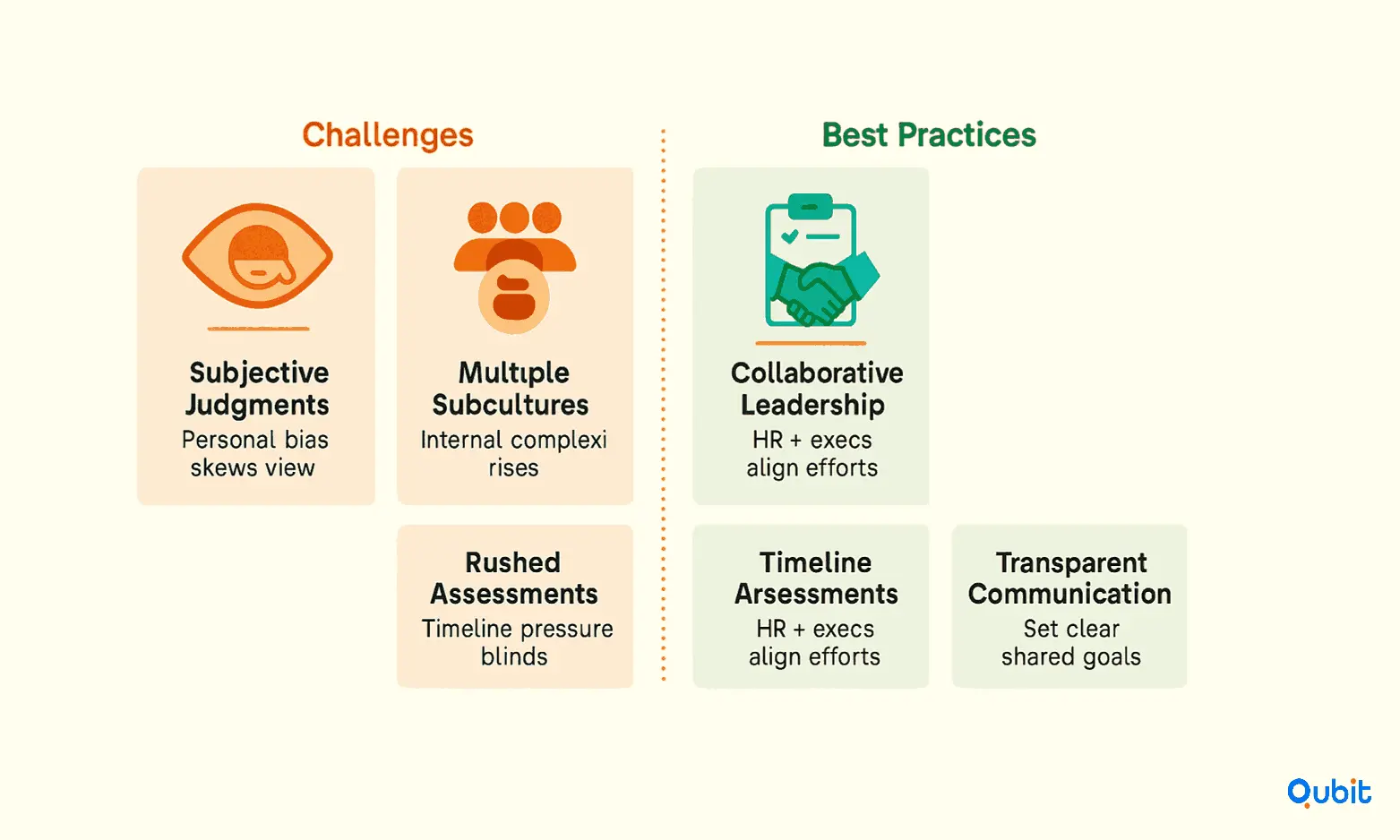
Key Challenges in Cultural Due Diligence
- Subjective evaluations
Cultural assessments can easily be skewed by personal bias. Leaders may confuse “similar to me” with “good fit,” which distorts the real picture of compatibility. - Multiple subcultures
Many startups already have subcultures across teams, functions, or regions. Assessing “the culture” gets harder when engineering, sales, and new international offices all operate differently. - Rushed timelines
Tight deal schedules often push culture work to the end, or compress it into a few superficial conversations. Rushed assessments miss critical gaps that later show up as integration failures.
Best Practices for Effective Cultural Due Diligence
Conduct Early Audits
Initiating cultural audits early in the acquisition process ensures that potential issues are identified before they escalate. This proactive approach allows stakeholders to address discrepancies and align expectations, fostering smoother integration post-acquisition.Collaborative Leadership Initiatives
Joint efforts between HR teams and leadership can bridge cultural divides. By integrating HR strategies with executive decision-making, organizations can create a unified approach to cultural alignment, ensuring that both operational and interpersonal dynamics are considered.Transparent Communication Strategies
Open communication is vital for building trust and reducing resistance during cultural transitions. Sharing clear objectives, timelines, and expectations with all stakeholders minimizes misunderstandings and promotes a collaborative environment.
Utilize Technology and Structured Frameworks
Technology can make cultural due diligence faster and more objective. Data analytics platforms and AI driven insights can:
- Quantify engagement, turnover, and feedback patterns
- Highlight hot spots in specific teams or regions
- Support comparisons between acquirer and target
Structured frameworks then provide standard criteria for assessing cultural fit, so different deals can be evaluated on the same basis. Legal tech and broader M&A tooling already streamline document and legal review. The same stack can support cultural work by centralising surveys, interviews, and qualitative notes.
The growing focus on structured diligence is reflected in the due diligence investigation market, which is projected to reach 16.7 billion dollars by 2034, with a CAGR of 7.40 percent. That growth signals increasing investment in formal processes that reduce risk and improve outcomes.
Embedding Cultural Milestones in Deal Terms
Building on structured frameworks, embedding cultural milestones directly into deal terms can further align incentives with integration goals. Examples include:
- Linking parts of management bonuses or earnouts to cultural indicators such as key talent retention, engagement scores, or successful completion of defined integration steps
- Including explicit commitments around leadership behaviours, communication cadence, and people decisions in integration plans
- Using joint culture scorecards that are reviewed at board or integration committee level on a fixed schedule
When cultural milestones sit next to financial and operational ones in the deal and integration plan, everyone treats culture as a real performance area, not background noise.
By combining early audits, collaborative leadership, transparent communication, technology, and deal level milestones, investors can move cultural due diligence from a soft check box to a disciplined part of how they protect and grow value in startup acquisitions
The Role of Leadership and Future Trends
Leadership has a direct and practical role in whether cultural due diligence works or fails in startup acquisitions. When leaders set a clear tone for integration, they act as a bridge between two cultures. They reduce fear, align behaviours, and turn potential friction into collaboration.
Seasoned leaders with long M&A and change management experience, such as Michael Hofer, show how powerful this can be in practice. International leadership experience helps them understand how different cultures work, how people react to change, and which signals matter most during integration. That strategic vision is often the difference between a smooth culture shift and a slow breakdown.
Emerging Tools Reshaping Cultural Due Diligence
As the business landscape evolves, technology is reshaping how cultural due diligence is done. AI driven cultural analysis tools now help teams scan large volumes of data, including surveys, communication patterns, and feedback. They highlight cultural mismatches that may not appear in a few standard interviews.
Virtual cultural assessment tools are becoming standard in hybrid and remote environments. They allow acquirers to evaluate cultural compatibility without travel or long on site visits. This makes it easier to include remote teams and international offices in cultural assessments from day one.
Technology adoption is accelerating. Over the next three years, 92 percent of companies plan to increase AI investment. This AI investment forecast shows growing trust in technology led analysis. Leaders who use these tools can run cultural due diligence that is more consistent, scalable, and data informed.
Continuous Cultural Monitoring, Not One Time Checks
Another important shift is continuous cultural monitoring. Instead of treating culture as a one time check during the deal, organisations now track cultural health across the full integration journey.
Periodic reviews of engagement, turnover, leadership behaviour, and team feedback help to:
- Catch issues early, before they become entrenched
- See whether promised cultural changes are actually happening
- Adjust integration plans when the data shows drift
This approach prevents slow cultural erosion and supports long term collaboration between teams from the acquirer and the startup.
Leadership With A Holistic View
To integrate technical, talent, and cultural factors, leaders need a holistic approach. Technical due diligence in acquisitions already tests product, security, and architecture. Cultural fit should sit beside that work, not behind it.
Strong leadership brings these threads together by asking:
- Does the talent we are buying want to stay here
- Can our ways of working support how this team delivers
- Are our technical and cultural expectations aligned in reality
For businesses aiming to integrate technical, talent, and cultural considerations, leadership must adopt a holistic approach. Reflecting on technical due diligence in acquisitions offers valuable insights into how cultural fit can complement technical evaluations during investment reviews.
Conclusion
Cultural fit is not a soft extra in startup acquisitions. It is a core driver of whether value compounds or leaks away. Companies that prioritise cultural alignment are roughly 50 percent more likely to outperform on profitability, while misalignment quietly drives attrition, stalled product roadmaps, and customer churn.
Serious acquirers now run cultural due diligence in parallel with financial, legal, and technical checks, then embed culture milestones into integration and incentive plans. AI tools, cultural ambassadors, and continuous monitoring turn this from intuition into a repeatable system.
If you're ready to refine your acquisition strategy with a focus on cultural alignment, contact us at Qubit Capital for our Strategic Acquisition service. Our expertise can guide you through every step, ensuring your next acquisition is both strategic and seamless.
Key Takeaways
- Organisations that prioritise cultural alignment are about 50 percent more likely to outperform peers on profitability.
- Cultural misalignment is a leading cause of M&A failure, showing up as talent loss, stalled product work, and unhappy customers.
- Startup employees average only 2.8 years of tenure, so poor cultural fit accelerates attrition after an acquisition.
- Effective cultural due diligence looks at leadership style, decision making, communication norms, and risk appetite, not office perks.
- Cultural ambassadors and cross functional integration teams act as bridges between old and new ways of working.
- Technology and AI tools make culture checks faster and more objective by tracking engagement, turnover, and feedback patterns.
- The due diligence investigation market is projected to reach 16.7 billion dollars by 2034, reflecting demand for structured risk checks.
- Embedding cultural milestones in earnouts, bonuses, and integration scorecards forces culture to be managed like any other value driver.
Frequently asked Questions
What are the best practices for cultural due diligence in startup acquisitions?
Best practices for cultural due diligence include structured audits, technology-driven assessments, and early evaluation of leadership and values. These reduce integration failures in startup acquisitions and support successful M&A outcomes.