

 Back
Back










Table of Contents

Startup scouting is the cornerstone of identifying innovative opportunities in a rapidly evolving business ecosystem. It involves systematically uncovering promising startups that align with strategic goals, whether for investment, partnership, or acquisition. By focusing on structured criteria and actionable frameworks, startup scouting enables decision-makers to sift through the noise and pinpoint ventures with the highest potential.
Market dynamics are accelerating. 40% of Fortune 500 companies face possible replacement in the next decade if they cannot innovate. This data highlights why startup scouting is not optional but a strategic imperative.
This guide sets the stage for understanding how continuous monitoring, data-driven insights, and clear evaluation criteria can transform your approach to startup scouting. Let’s jump right in.
What Is Startup Scouting Fundamentals?
Startup scouting is a strategic process that enables organizations to identify, evaluate, and engage with early-stage companies that exhibit disruptive potential. In business, scouting meaning refers to the systematic search for opportunities that align with organizational goals.
Scouting startups with disruptive potential is a key objective. Corporate priorities increasingly center on partnership-driven innovation. 88% of survey participants consider collaboration with startups critical to innovative growth. This survey confirms the strategic urgency highlighted earlier, motivating structured scouting efforts.
Your exploration of startup scouting fundamentals naturally connects to the broader perspective offered by the startup scouting strategies discussion, which provides an overarching view of early-stage investment frameworks.
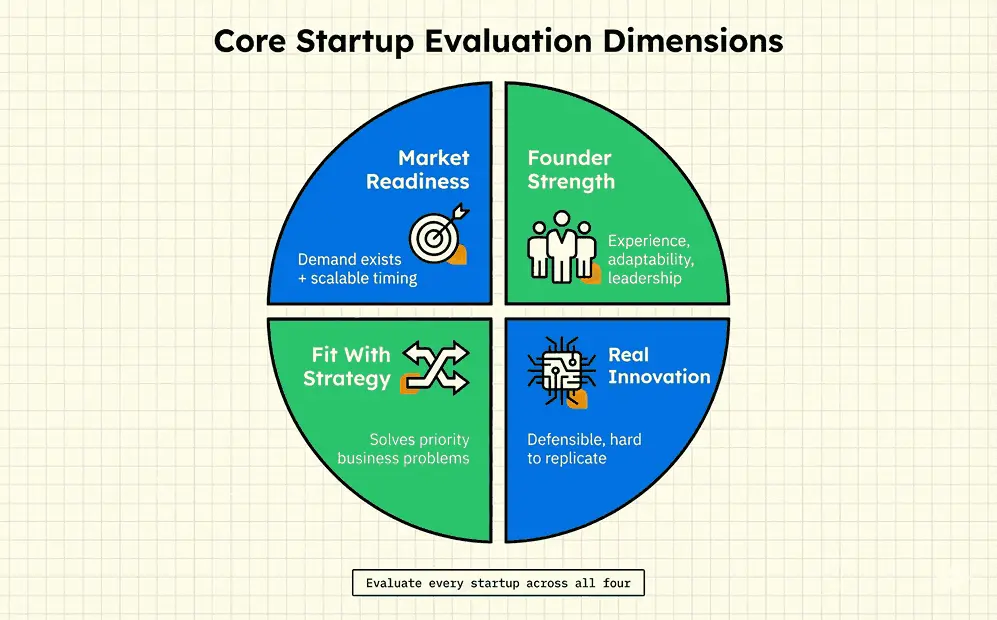
Key Elements of Startup Scouting
To effectively scout startups, organizations must focus on several critical elements:
Market Maturity
Assessing the market readiness of a startup is crucial. This involves evaluating whether the startup’s product or service aligns with current market demands and has the potential for scalability.Team Quality
A startup’s success often hinges on the strength of its team. Factors such as the founders’ expertise, leadership skills, and adaptability play a significant role in determining the startup’s long-term viability.Technological Differentiation
Startups that offer unique, innovative technologies stand out in a crowded market. Evaluating the technological edge of a startup ensures that it brings something truly novel to the table.Strategic Alignment
Finally, the startup’s goals and solutions must align with the strategic objectives of the scouting organization. This alignment ensures that the partnership delivers mutual value and fosters sustainable growth.
By focusing on these elements, organizations can streamline their scouting efforts and maximize the impact of their collaborations with startups.
Startups like yours already closed their rounds with us.
Founders across every stage and industry. Here's what it took.
- Raised $7.6M for Swiipr Technologies
- Raised $0.5M for Ap Tack
- Raised €0.5M for Ivent Pro

How Does Startup Scouting Accelerate Innovation?
Startup scouting fundamentals have emerged as a transformative strategy for organizations aiming to stay ahead in competitive markets. By identifying and collaborating with innovative startups, companies can access fresh ideas, cutting-edge technologies, and agile execution models that drive innovation scouting and corporate innovation.
Startup scouting enables organizations to tap into external innovation ecosystems, fostering scouting partners that bring new perspectives and capabilities. This approach not only accelerates product development but also highlights the value of scouting startups to bypass internal bottlenecks.
Why Startup Scouting Matters
Startup scouting enables organizations to tap into external innovation ecosystems, fostering partnerships that bring new perspectives and solutions. Industry experts advocate sourcing at least half of new ideas from external innovations, emphasizing the importance of integrating startup-driven insights into corporate strategies.
Moreover, scouting startups allows businesses to align with emerging trends and high-growth sectors. A review of high-growth startup sectors presents specific market trends that integrate well with the strategic insights detailed in this foundational guide. This alignment ensures that companies are not only innovating but doing so in areas with significant market potential.
Benefits of External Partnerships
Collaborating with startups offers several advantages:
- Rapid Execution: Startups are known for their agility, enabling faster development cycles and quicker market entry.
- Cost Efficiency: External innovation often reduces the financial burden associated with in-house R&D.
- Access to Expertise: Startups bring specialized knowledge and unique skill sets that complement corporate capabilities.
These partnerships also foster a culture of innovation within organizations, encouraging teams to think creatively and adopt new methodologies.
The Strategic Edge
For businesses aiming to thrive in dynamic markets, startup scouting is not just a tactic, it’s a strategic imperative. It bridges the gap between corporate innovation goals and the practical execution of groundbreaking ideas. As industries evolve, the ability to scout and integrate external innovations will define the leaders of tomorrow.
What Are the Challenges of Startup Scouting?
A startup scout faces distinct challenges that can hinder effectiveness if not addressed properly.
- Data Overload: With thousands of startups emerging globally, scouts face an overwhelming volume of information. Sifting through noise to identify relevant ventures demands effective filtering tools and prioritization criteria.
- Incomplete or Inconsistent Profiles: Early-stage startups may provide limited or unverified information, complicating assessment and increasing the risk of missed opportunities or poor fits.
- Resource Constraints: Building and maintaining a robust scouting function requires skilled personnel and dedicated time, which can be scarce in fast-moving corporate environments.
- Bias and Subjectivity: Without structured evaluation frameworks, unconscious biases can influence startup selection, leading to inconsistent or suboptimal decisions.
Legacy system upkeep intensifies these constraints. 70% of IT budgets go toward maintaining outdated infrastructure. This dramatically limits available resources for effective startup scouting.
Why Is Demand for Technology Scouting Software Growing?
The adoption of startup scouting software and technology scouting platforms is accelerating, driven by the need for efficient discovery and evaluation of emerging innovations. The Technology Scouting Software Market is forecasted to expand at an impressive 17.6% CAGR, growing from USD 150.17 million in 2023 to USD 646.17 million by 2032. This growth trajectory highlights the increasing reliance on these tools to streamline processes and enhance decision-making.
The shift toward intelligent platforms is accelerating. 71% of organizations have already deployed generative AI in at least one business function. This adoption validates the pivotal role of technology in contemporary scouting.
Key Benefits of Technology Scouting Software
Technology scouting software offers a range of advantages that streamline the tech scouting process, including the identification, evaluation, and management of startups.
1. Centralized Data Management
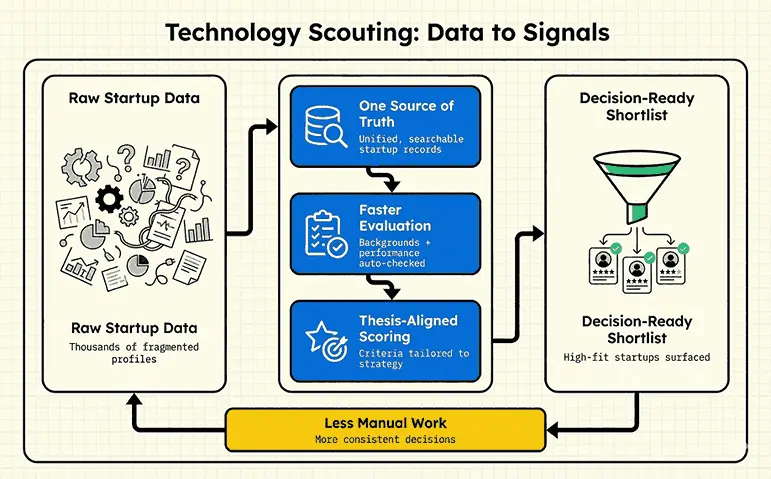
One of the standout features of these platforms is their ability to consolidate information from multiple sources into a single, accessible database. This eliminates the inefficiencies of scattered data and ensures that teams can access relevant insights quickly.
2. Automated Due Diligence
Manual processes often slow down the evaluation of startups and technologies. Scouting software automates due diligence tasks, such as background checks and performance analysis, saving time and reducing human error.
3. Customizable Scoring Systems
Advanced platforms like Q-scout allow users to tailor scoring criteria to match their specific investment thesis. This ensures that evaluations align closely with strategic goals, making it easier to identify high-potential opportunities. For example, investment thesis startup scouting aligns seamlessly with these systematic frameworks, offering practical ways to match criteria with emerging opportunities.
Why Businesses Are Turning to Scouting Software
The projected market growth underscores the increasing adoption of technology scouting tools. As industries become more competitive, organizations are seeking solutions that reduce manual overhead and enhance the accuracy of their evaluations. Platforms like Q-scout exemplify this shift, offering features that streamline discovery and improve decision-making efficiency.
By integrating technology scouting software into their workflows, businesses can stay ahead of trends, identify promising startups, and make data-driven decisions that align with their strategic objectives.
What Are the Best Startup Scouting Strategies?
Mastering startup scouting fundamentals is key to identifying and collaborating with innovative startups for organizations aiming to stay ahead in competitive markets.
1. Build a Scalable Scouting Framework
A scalable framework ensures that your innovation scouting process can adapt to the evolving needs of your organization. For instance, GELITA AG successfully implemented the HYPE Partnering platform, which integrates AI-powered analytics to streamline their scouting efforts. This approach enabled them to evaluate 31 startup applications, with six advancing to the final evaluation stage and two progressing to pilot partnerships. Their success highlights how a structured program can scale globally and yield robust results.
2. Align Scouting with Innovation Strategy and Stakeholder Buy-In
Establishing clear alignment between startup scouting activities and the organization’s innovation strategy is critical for long-term success. This approach requires defining specific innovation objectives that reflect the company’s vision, market ambitions, and risk appetite. Engaging executive leadership and key stakeholders early ensures that scouting efforts receive the necessary support, resources, and visibility across the organization.
When scouting objectives are tightly integrated with strategic priorities, teams can focus on sourcing startups that address real business challenges and opportunities. This alignment also streamlines decision-making, as stakeholders are more likely to champion initiatives that clearly contribute to organizational goals. Regular communication between scouts, innovation leaders, and business units further reinforces this connection and helps adapt scouting criteria as priorities evolve.
- Define innovation objectives that are specific, measurable, and directly linked to corporate strategy and growth targets.
- Secure executive sponsorship to provide resources, remove barriers, and champion scouting outcomes across the organization.
- Establish regular touchpoints with stakeholders to review progress, recalibrate focus areas, and ensure ongoing alignment.
- Communicate the value and rationale of scouting initiatives to foster buy-in and cross-functional collaboration.
3. Avoid Common Pitfalls
Even the most well-intentioned scouting programs can falter without careful planning. An analysis of startup scouting mistakes reveals commonly observed oversights, such as neglecting to define clear objectives or failing to engage with the startup ecosystem consistently. Addressing these pitfalls early on can significantly enhance the effectiveness of your scouting strategy.
4. Engage Continuously with the Ecosystem
Startup ecosystems are dynamic, requiring consistent engagement to stay updated on emerging trends and opportunities. Attend global networking events, collaborate with incubators and accelerators, and maintain active participation in industry forums. These efforts not only expand your network but also position your organization as a credible partner for startups.
5. Validate Fit Through Pilot Collaborations
Pilot collaborations offer a practical approach to assessing a startup’s solution in a real-world context before committing to large-scale partnerships. These short-term, focused projects allow both parties to evaluate technical capabilities, cultural compatibility, and operational feasibility with minimal risk. Successful pilots can accelerate adoption, inform integration planning, and build mutual trust between the startup and the organization.
By structuring pilots with clear objectives, timelines, and success metrics, organizations can objectively assess whether a startup’s offering meets their needs. This process also provides valuable feedback to startups, enabling them to refine their solutions and better align with partner requirements. If a pilot does not meet expectations, both sides can disengage with minimal resource loss, preserving agility and focus.
- Define pilot scope, objectives, and measurable success criteria before initiating collaboration with a startup partner.
- Assign cross-functional teams to oversee pilot execution and ensure comprehensive evaluation of technical and cultural fit.
- Document lessons learned and use pilot outcomes to inform decisions about scaling or discontinuing the partnership.
- Maintain transparent communication with the startup throughout the pilot to foster trust and adaptability.
6. Iterate and Refine Your Approach
Startup scouting is not a one-size-fits-all process. Regularly evaluate the effectiveness of your strategies and refine them based on feedback and outcomes. This iterative approach ensures that your program remains aligned with your organization’s goals and the evolving startup landscape.
These best practices ensure your tech scouting process keeps your organization agile and competitive in the face of rapid technological change.
Which Metrics and KPIs Define Scouting Success?
Measuring success in startup scouting ensures continuous improvement and alignment with strategic goals for each prospect startup.
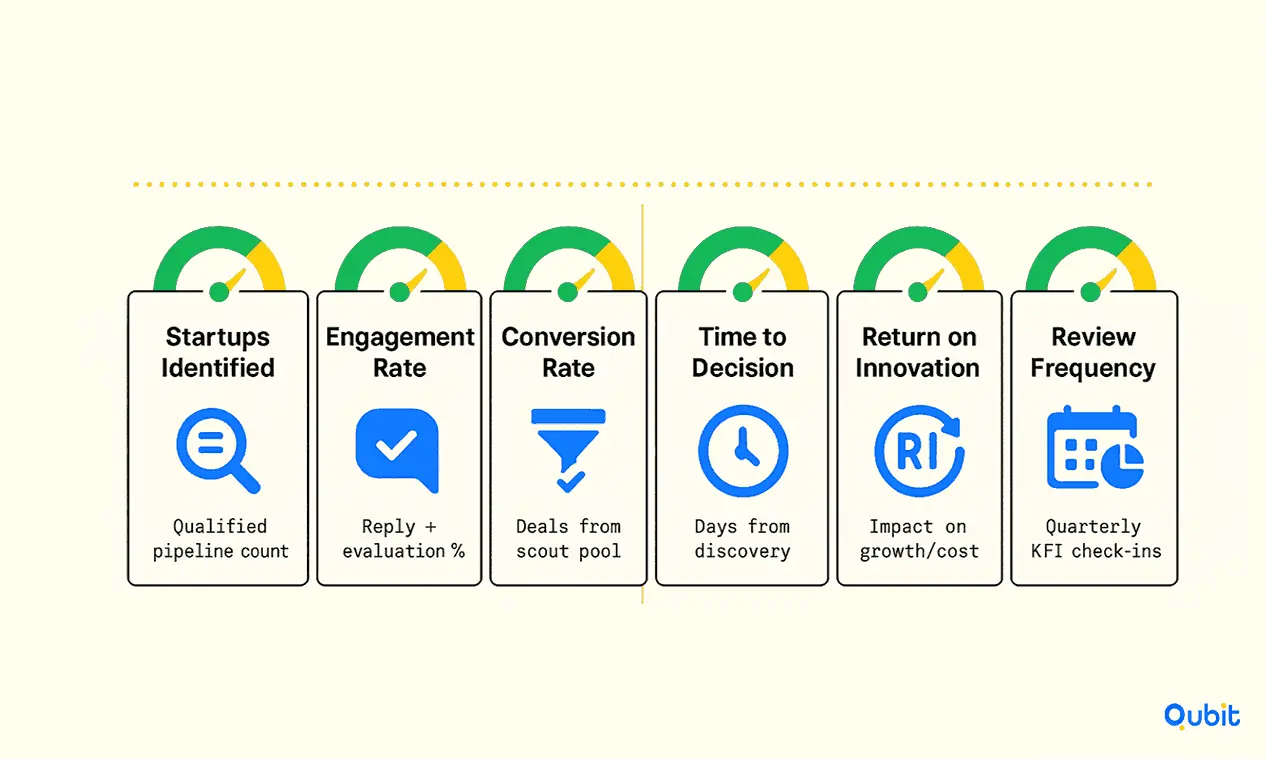
- Number of Startups Identified: Tracking the size and quality of the initial pipeline.
- Engagement Rate: The percentage of startups responding or advancing to deeper evaluation stages.
- Conversion Rate: Proportion of startups moving from scouting to partnership, investment, or acquisition.
- Time to Decision: Average duration from discovery to final decision, reflecting scouting efficiency.
- Return on Innovation: Quantifiable impact of sourced startups on revenue growth, market expansion, or cost reduction.
Regularly reviewing these KPIs helps refine scouting strategies, allocate resources effectively, and demonstrate scouting’s value to leadership.
Tracking financial efficiency reveals hidden drains. 10–20% extra costs go to addressing tech debt during digital innovation projects. Factoring for this overhead is crucial in scouting ROI analysis.
How Should Funding Decisions Integrate With Scouting?
Startup scouting must interface smoothly with funding and investment processes to convert insights into concrete actions. Key integration points include:
- Alignment with Investment Thesis: Scouting efforts should reflect the organization’s focus areas, risk tolerance, and expected returns.
- Structured Handoffs: Clearly defined workflows and communication channels between scouts and investment committees accelerate evaluation and deal execution.
- Collaborative Decision-Making: Involve cross-functional stakeholders early to assess startups’ strategic fit alongside financial viability.
- Post-Investment Tracking: Ensure feedback loops exist to evaluate startup performance and refine scouting priorities accordingly.
This integration ensures that scouting drives meaningful investments and partnerships aligned with long-term objectives.
How Does Competitive Analysis Enhance Startup Scouting?
Incorporating market scouting, research, and competitive intelligence enhances startup scouting effectiveness by:
- Identifying Opportunity Gaps: Understanding market trends and competitor moves reveals niches ripe for innovation.
- Evaluating Startup Fit: Contextualizing startups within current competitive landscapes informs strategic relevance.
- Anticipating Risks: Monitoring emerging threats and disruptors supports risk-aware scouting decisions.
- Informing Strategic Priorities: Aligning scouting with where the market is headed maximizes impact and value creation.
Integrating these analyses into scouting workflows strengthens decision quality and strategic alignment.
Conclusion
Adopting a structured approach to startup scouting fundamentals can transform the way businesses identify and capitalize on emerging opportunities. These strategies not only enhance the ability to discover innovative startups but also strengthen business scouting for long-term growth.
If you’re ready to elevate your startup scouting strategy, we at Qubit Capital are here to help. Explore our Investor Outreach service today and connect with potential investors who can drive your vision forward.
Key Takeaways
- Startup scouting is essential for discovering disruptive early-stage ventures and driving corporate innovation.
- A structured framework, with clear criteria and continuous evaluation, streamlines the scouting process.
- Integrating advanced startup scouting software enhances data centralization and decision-making.
- Collaborative approaches, rather than competitive mindsets, foster stronger innovation ecosystems.
- Real-world case studies, like that of GELITA AG, validate the effectiveness of these systematic strategie
Find startups worth your time.
Curated startup opportunities matched to your thesis and investment criteria.
- Deal flow filtered by sector, stage, and fit
- Research and context included with every opportunity
- Less noise. More relevant deal flow.

Frequently asked Questions
What is startup scouting?
Startup scouting is the systematic process of identifying, evaluating, and engaging early-stage companies with disruptive potential. It combines market research, technology assessment, and strategic fit analysis to find startups that align with an organization’s innovation goals. The process typically involves defining search criteria, sourcing candidates from multiple channels, and running structured evaluations.