

 Back
Back










Table of Contents

Raising capital in the mobility sector, whether your focus is EVs, logistics tech, ridesharing, fleet management, or micro-mobility, means more than just pitching a vision or demoing a prototype. As venture capital flows increasingly toward mature, robust businesses, investor due diligence becomes the defining hurdle between initial interest and closed funding. Especially for mobility startups, where the stakes include not only technological innovation but also regulatory navigation and cross-jurisdictional complexity, thorough preparation is both a defensive shield and a credibility amplifier.
Recent global shifts highlight why diligence matters. In Q4 2024, venture capital funding surged 24%, hitting $120 billion across 4,000 deals. This rapid pace intensifies investor scrutiny, making robust preparation indispensable for mobility founders seeking capital. Startups must embrace detailed diligence to stand out and secure investment.
This article takes you on a founder’s journey through the heart of diligence: understanding exactly what financial records, legal structures, and compliance frameworks sophisticated investors expect. Drawing on real founder stories and industry best practices, we'll detail how to present financials that instill trust, build a legal setup that passes scrutiny, and handle the unique compliance challenges.
The Stakes: Why a Due Diligence Checklist Shapes the Funding Outcome
Investor due diligence means preparing your startup's financials, legal documentation, and compliance records to meet venture capital expectations.
The dramatic rise in mobility innovation is being matched by sharper investor scrutiny, and for good reason. Without documented discipline, mobility startups risk failing investor scrutiny long before the term sheet stage. Consequences for lapses in diligence are staggering. Acquisition failure rates reach 70%–90% when companies neglect proper due diligence. This demonstrates how foundational transparency is to successful fundraising. Proactively addressing every concern prevents deal-killing surprises.
High capital intensity, evolving regulations, and the often slow-to-scale revenue models inherent to this sector mean investors want unshakeable confidence in every number, process, and legal foundation you show.
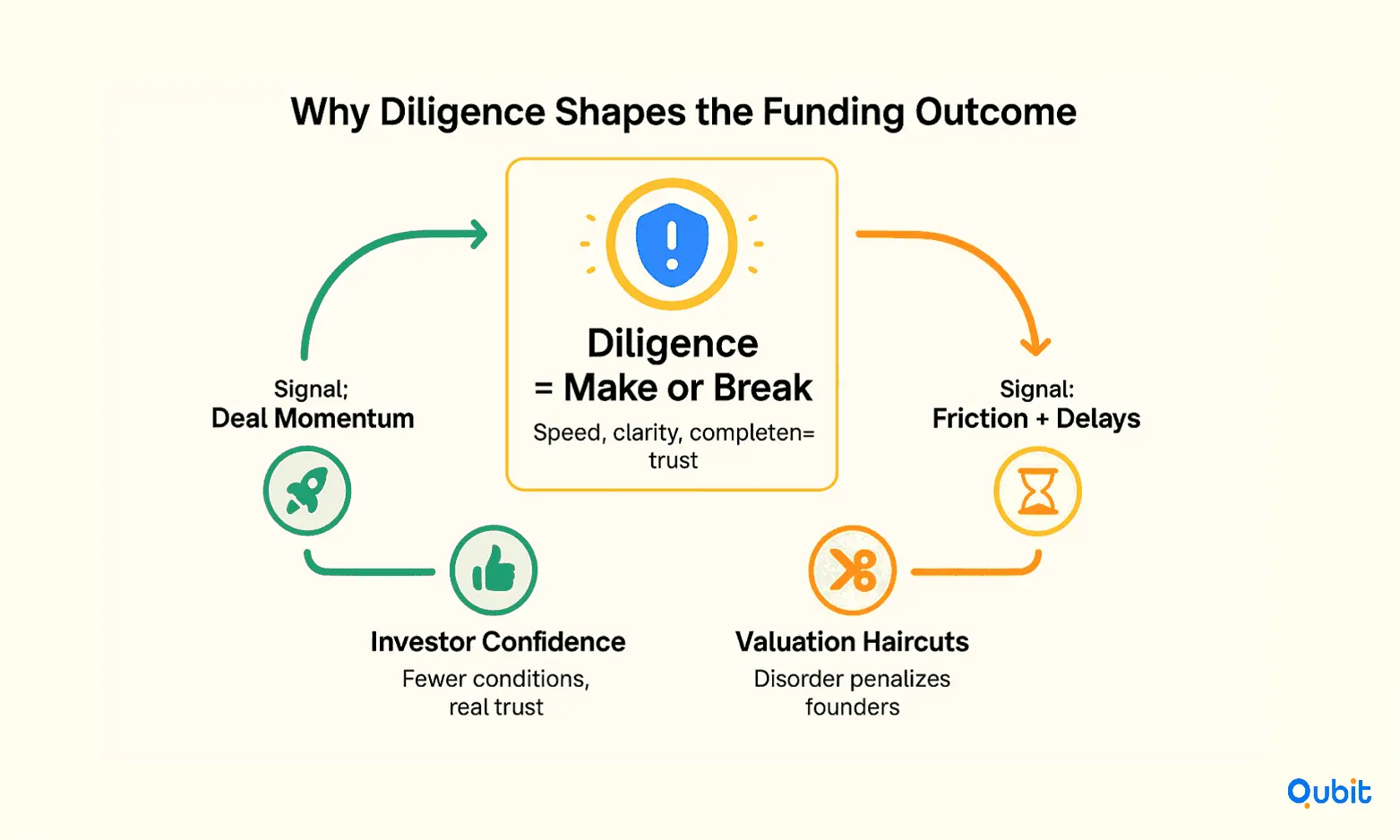
Mobility startups that handle diligence with speed, transparency, and completeness can quickly convert a term sheet into cash. If you stumble, delay, or appear disorganized, you risk losing deals or facing valuation haircuts.
The Value of Early Advisor Engagement
Building on the importance of thorough diligence, founders should engage legal and financial advisors early in the process. Expert counsel ensures all documentation meets investor standards and uncovers potential issues before they become obstacles. This proactive approach streamlines preparation, reduces risk, and signals professionalism to prospective investors. Advisors also tailor diligence efforts to funding stage and sector requirements, increasing the likelihood of a successful raise.
Startups like yours already closed their rounds with us.
Founders across every stage and industry. Here's what it took.
- Raised $7.6M for Swiipr Technologies
- Raised $0.5M for Ap Tack
- Raised €0.5M for Ivent Pro

Financial Diligence Checklist: Beyond the Basics
A due diligence financial checklist for mobility startups goes several layers deeper than basic projections or pitch-deck summary tables.
- Historical Financial Records: Not just summarized numbers, but reconciled P&L statements, audit-ready balance sheets, clear cash flow files, and matching bank statements.
- Revenue Recognition: For hardware, software, or service-based models, clarity on how you account for contracts, subscription payments, or usage-based income.
- Contractual Proof: Signed customer contracts, pilot agreements, letters of intent (LOIs), and any recurring billing documentation. In mobility, recurring fleet deals or strategic partnerships (e.g., with logistics operators or cities) speak louder than projections.
- Unit Economics: Customer acquisition cost (CAC), lifetime value (LTV), margin breakdowns per user/vehicle route or service segment, churn rates, and return on invested capital, especially for asset-heavy models.
- Burn and Runway Calculations: Not just last month’s burn, but detailed forecasts showing how long your funding lasts at various revenue growth or cost scenarios.
- Cap Table Clarity: Up-to-date tables reflecting all convertible notes, SAFEs, options, share classes, and founder/investor equity, messy cap tables are a red flag for future investors’ rights or exit planning.
Delivering a “Clean Book”:
Having a third-party accountant’s review or limited audit, even as an early-stage company, instantly elevates confidence. This is especially critical if your model involves revenue from several verticals (e.g., both EV sales and software services), or cross-border operations with multiple currencies.
Mobility-Specific Nuances:
Expect probing into asset depreciation, leasing arrangements, vehicle financing, contracts with OEMs or city agencies, and debt tranches tied to hardware purchases. VCs increasingly partner with financial/legal specialists familiar with transportation and infrastructure, making it vital for your numbers to withstand sector-specific checks.
Legal Diligence: Structure and Rigorous Documentation
Systematizing documentation and clarifying compliance, the handbook models a roadmap for investor-ready diligence. Mobility founders gain competitive advantage when their legal processes mirror these sector standards.
Corporate Formation and Shareholder Agreements
A due diligence checklist for mobility startups should always include corporate formation and shareholder agreements. Mobility startups often begin with straightforward C-corps or Pvt Ltds. As teams, investors, and geographies multiply, the structure complicates. Investors will ask for:
- Articles of incorporation, updated bylaws, and board resolutions reflecting any changes.
- Shareholder agreements, including all related parties, vesting triggers, anti-dilution clauses, and founder “cliff” details.
- SAFE/convertible note and ESOP documentation, properly executed and up-to-date.
- Side letters, pre-existing option pools, and any multi-jurisdictional holding structures.
Tip: International expansion is common in mobility. If you've set up holding companies (for IP, Asian supply chain arms, or EU operations), ensure you can demystify and document these links—complexity that isn’t explained slows deal progress.
Contracts, IP, and Commercial Agreements
A due diligence technical checklist should include verification of all material contracts and IP assignments.
Material Contracts:
- Major customer, city, supply, OEM, and pilot contracts should be indexed, signed, and easily retrievable.
- For device-based models, provide purchase orders, inventory leases, and warranties.
IP Ownership:
- All IP, data, code, and patents used by the company must be assigned unambiguously to the company, not individuals or third parties.
Lack of clarity in IP or agreements can be fatal. Over 60% of executives cite poor due diligence as the primary reason deals fall apart. Attentive contract documentation prevents these errors, signaling readiness for investor scrutiny.
- Pay special attention to code with open-source components—mobility tools often use mapping, logistics, or communications libraries that come with restrictive licenses.
- File status for patents/trademarks (provisional, granted, jurisdiction) matters for defensibility and competitive moat validation.
Employment & Advisory Agreements:
- Show signed agreements for every current and former team member. Make sure no lingering “consultants” or early contributors have outstanding claims to equity, inventions, or code.
Legal “Health Check” Table Example:
| Area | What to Provide | Red Flags |
|---|---|---|
| Corporate Formation | Certificates, bylaws, board notes | Missing or incomplete documents, conflicting versions |
| Material Contracts | Signed and indexed documents | Undisclosed side deals or handshake agreements |
| IP Assignments | Assignment agreements and patent filings | Founder-held patents, unclear chain of title |
| Employment and Advisor | Signed contracts, NDAs, IP terms | Oral agreements, unclear vesting or share allocations |
| Regulatory Licenses | Local permits and fleet approvals | Pending or missing licenses in active markets |
Compliance Readiness: What Sets Mobility Apart
Unlike pure software startups, mobility ventures often operate simultaneously in physical and digital realms, creating an unusually tangled compliance landscape.
Due diligence for investors includes verifying all city and transport permits are in place and compliant with local regulations.
Key Compliance Areas:
- City and Transport Permits:
From ride-sharing to e-scooter deployments, cities often require permits, pilot program applications, and compliance with service caps, insurance limits, or safety protocols. Diligence-ready companies have all applications, approvals, correspondence, and compliance logs filed and ready to display. - Data Privacy and Security:
Vehicles, telematics, and mobility apps gather vast amounts of user, location, and fleet data. Meeting GDPR, CCPA, and local data-processing regulations is non-negotiable, expect to provide privacy policies, data storage and breach notification procedures, and (in some cases) real incident logs. - Environmental and Safety Regulation:
Compliance with emissions standards, battery recycling, product recalls, or supply chain sustainability certifications can be requested. Mobility startups with “green” or climate claims must be able to evidence both regulatory compliance and impact measurement. - Financial Compliance:
If you offer payment services, subscriptions, or fleet financing, be ready to demonstrate PCI compliance, KYC/AML procedures, and relevant payment licenses. - International Compliance:
Operating across the EU, US, and India? Each may require different insurance minimums, driver background checks, or product labeling practices. Investors will want to see your “localization playbook” and contracts for in-country partners or local legal advisors.
Presenting Your Compliance Framework:
Move beyond mere assertion, provide a summary compliance dashboard, including current status (approved/pending), renewal calendars, compliance officer bios, and recent audits (if any). For emerging areas (like data-driven insurance or autonomous vehicle pilots), show regulator correspondence and proactive risk assessments.
Operationalizing regulatory compliance benefits from collaborative dialogue. The MIT x OPmobility Symposium 2025 brings together mobility stakeholders to share strategies on meeting legal and operational thresholds. Sector-wide knowledge exchange accelerates compliance readiness. Startups can model best practices from these large-scale initiatives to navigate multi-layered regulatory demands.
Building the Diligence Data Room: Best Practices
A due diligence checklist for mobility startups should include a well-organized data room. Clean, indexed, and logically organized data room accelerates trust. Here’s how the most fundable mobility startups format theirs:
Comparing Secure Data Room Platforms
| Feature | DealRoom | IdealsVDR | SmartRoom |
|---|---|---|---|
| Access controls | Granular user permissions | Customizable security settings | Role-based access management |
| Document indexing | Automated folder organization | Advanced search filters | Tagging and categorization tools |
| Collaboration tools | Integrated Q&A workflows | Real-time document sharing | Investor comment tracking |
Demand for robust virtual data rooms is echoing global deal flows. In 2024, startups raised $330 billion in venture capital. This level of investor activity depends on quick access to organized diligence data. Implementing digital-first practices positions mobility startups to compete for modern capital.
An investment due diligence checklist should include summaries for each section, highlighting new items and pending actions. Provide summaries: Precede each section with a 1–2 page summary highlighting what’s new, any pending items, and posture for fix/renewal.
Startup Due Diligence Checklist: Red Flags and How to Fix Them Early
Founders often ask: “What’s the diligence killer?” The answer: avoidable mistakes, not honest imperfection.
Common Issues:
- Financials that don’t reconcile—such as customer revenue unmatched by bank receipts.
- Unresolved IP assignments—particularly early software, code, or models built by contractors.
- Unlicensed city deployments or overlooked insurance gaps in new markets.
- Out-of-date cap tables; unexercised or poorly documented option grants.
- Delayed, unclear answers to repeated investor requests, signaling lack of rigor or internal alignment.
Remediation:
Fixing documentation gaps, patching legal cracks, and clarifying compliance issues, before opening your round, demonstrates both maturity and respect for investor time. This sometimes prompts helpful feedback from would-be investors, even turning “no’s” into future “yes’s”.
Long-Term Payoff: Embedding Diligence Discipline
Venture capital due diligence requires startups to embed financial, legal, and compliance practices as ongoing disciplines.
The most sustainable mobility startups treat financial, legal, and compliance diligence as ongoing disciplines, not fundraising chores.
- Audit trails and regular reviews prevent fire drills at every raise.
- Compliance calendars ensure renewals, licenses, and insurance don’t slip, avoiding “stop work” orders in cor
- e markets.
- Continuous improvement on documentation, digital file management, and team communication means every next raise is easier and more founder-controlled.
As broader funding markets evolve, see trends in Global VC Funding Trends in EV, Battery & Mobility Startups, diligence readiness is emerging as a true competitive edge, separating the scalable from the soon-to-be-stalled.
Conclusion
In the mobility world, where legal, financial, and regulatory expectations are running ahead of many founders’ experience, proactively building and maintaining your diligence foundations does far more than “check a box.” It shortens deal cycles, impresses sophisticated capital, and sets your company on a path to sustainable, resilient growth.
Mobilize your team. Map your numbers, structure your docs, clarify your compliance actions, and treat every investor interaction as a chance to showcase operational maturity.
For founders ready to build the future of transportation, diligence is your passport to capital, and your path to partnership in a sector where trust, resilience, and readiness drive the winners’ circle. We at Qubit Capital are here to support your investor outreach efforts. Start your journey with us today.
Key Takeaways
- A due diligence checklist startup founders can follow is now non-negotiable in mobility fundraising.
- Well-prepared startups outperform in both closing deals and long-term investor relationships.
- Pay attention to sector-specific requirements: city permits, fleet financing, safety compliance, and global operations can all add unique wrinkles.
- Turn diligence from a “chore” to a core business asset: it will pay off at every future round.
Get your round closed. Not just pitched.
A structured fundraising process matched to your stage and investor fit.
- Fundraising narrative and structure that holds up
- Support from strategy through investor conversations
- Built around your stage, model, and timeline
Frequently asked Questions
What documents are required for a startup due diligence checklist?
A startup due diligence checklist should include audited financials, legal formation documents, shareholder agreements, IP assignments, permits, and compliance logs.