

 Back
Back









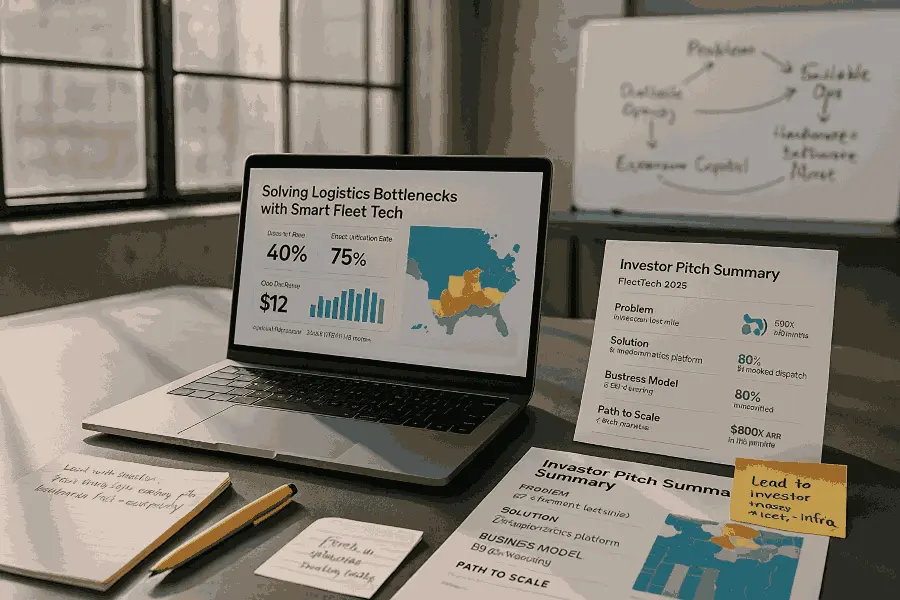
Table of Contents

Logistics and fleet tech is having a moment, but that doesn’t mean every startup gets funded. Investors have seen a parade of delivery platforms, routing tools, EV fleet plays and SaaS dashboards. If your pitch sounds like everyone else’s, you’ll be filtered out in the first five minutes.
This article walks you through how to pitch logistics and fleet tech investors in a way that actually matches how they think: in terms of utilization, uptime, unit economics, route efficiency, and payback periods, not just “AI + trucks = disruption.” You’ll learn how to frame your problem, show why now is the right time, and translate operational wins, better on-time delivery rates, lower cost per trip, higher asset turns, into a sharp investment narrative.
We’ll also break down what logistics-focused VCs and strategic investors really want to see: data from the field, proof that your product works in messy real-world environments, and a path to scale across fleets, cities, or categories. By the end, you’ll have a clear, practical blueprint to turn your operations story into a compelling, investor-ready logistics and fleet tech pitch.
Why Most Logistics Pitch Decks Fall Flat
Most logistics pitch decks don’t fail because the idea is weak, they fail because the story is. Around 95% of startups struggle to build presentations that clearly communicate their value proposition, and logistics founders are no exception. This is exactly why strategic storytelling isn’t a “nice to have” but a core part of investor engagement.
Turning fleet ops, route optimization, and cost-per-km into a compelling narrative is tough, and many decks miss the mark for simple, avoidable reasons: they drown investors in jargon, skip over real-world impact, or fail to connect the product to measurable outcomes.
In this section, we unpack why so many logistics decks fall flat, and what you need to do differently to stand out in the investor’s inbox, not blend into the pile.
1. Missing the Power of Strategic Storytelling
A compelling pitch deck is more than just data points and projections. It tells a story—one that connects with investors on both a rational and emotional level. Unfortunately, many logistics startups fail to weave their data into a narrative that highlights their unique value proposition. Without this, even the most innovative solutions can feel uninspired.
2. Overloading on Technical Details
While technical expertise is critical in logistics, bombarding investors with jargon and intricate processes can be counterproductive. Instead of focusing solely on how the technology works, startups should prioritize explaining the tangible outcomes it delivers. For instance, outdated tracking systems contribute to 34% of delivery delays. A pitch that addresses this pain point with clear, impactful solutions will resonate far more than one bogged down in technicalities.
3. Ignoring the “Why Now” Factor
Timing is everything in a pitch. Investors want to know why this moment is the right one for your solution to succeed. Yet, many logistics decks fail to answer this question convincingly. The sharp decline in funding underscores the need for urgency and differentiation. Startups must demonstrate how their solution aligns with current market demands and challenges, such as operational inefficiencies and the growing need for real-time tracking.
The logistics industry is at a crossroads, and a well-crafted pitch deck can make all the difference. By focusing on strategic storytelling, simplifying technical explanations, and emphasizing the “why now,” startups can stand out in a crowded and competitive market.
Understanding the distinctions between investor profiles is crucial to tailoring your pitch effectively. For instance, the analysis on strategic vs financial investors logistics clarifies how different investor types evaluate opportunities, enabling you to refine your approach.
Startups like yours already closed their rounds with us.
Founders across every stage and industry. Here's what it took.
- Raised $7.6M for Swiipr Technologies
- Raised $0.5M for Ap Tack
- Raised €0.5M for Ivent Pro

How to Pitch Logistics and Fleet Tech Investors Effectively
Investor attention is brutally limited. On average, investors spend 3 minutes and 44 seconds skimming an entire pitch deck before deciding whether to take you seriously or move on. In logistics and fleet tech, where products can be complex and deeply operational, clarity and fast value delivery are non-negotiable.
Use the below pointers as a blueprint to structure your deck and turn your operations story into an investor-ready narrative.
1. Start with a Powerful Problem Statement
Begin by addressing the core issue your logistics startup is solving. Use data to emphasize the scale of the problem. For instance, if inefficiencies in last-mile delivery cost businesses billions annually, highlight this with specific figures. A well-defined problem immediately captures attention and sets the stage for your solution.
2. Present a Transformative Solution
Follow the problem statement with a concise explanation of your solution. Focus on how your technology, process, or service directly addresses the issue. Use visuals or diagrams to simplify complex concepts. The goal is to make your solution both memorable and easy to understand.
For example, ‘Our platform reduced average delivery times by 18% for FleetX by automating dispatch and tracking.’ If an investor only remembers one line about your solution, make sure it’s about measurable impact.
3. Simplify Your Business Model
Investors want to know how you make money, without needing a decoder ring.
Use this part of your deck to show:
- Your revenue streams (SaaS, per-vehicle fee, per-trip fee, GMV take rate, etc.)
- Your pricing logic (why this structure makes sense for fleets, shippers, or 3PLs)
- How you acquire and retain customers
Avoid overloading this slide with edge cases. A clean, simple business model builds far more confidence than a complicated one you can’t explain in one sentence.
4. Quantify Market Opportunity
Demonstrate the potential of your logistics startup by presenting precise market sizing. Use credible sources to back your claims. For example, if the global logistics market is projected to grow to $12 trillion by 2030, include this data to showcase the scale of your opportunity.
5. Highlight Tangible Traction
Showcase your startup’s progress with metrics like revenue growth, customer acquisition, or successful pilot programs. Tangible results validate your business model and demonstrate momentum.
6. Define Your Competitive Advantage
Explain what sets your startup apart. Whether it’s proprietary technology, exclusive partnerships, or operational efficiency, make your unique value proposition clear. Use a competitive analysis chart to visually compare your strengths against competitors.
7. Introduce Your Team
Investors back people, not just ideas. Dedicate a slide to your team, emphasizing their expertise and relevant experience. Highlight key achievements that demonstrate their ability to execute the business plan.
8. Provide Transparent Financial Projections
Include realistic financial forecasts for the next 3–5 years. Break down revenue, expenses, and profitability. Transparency builds trust, so avoid overly optimistic projections that lack justification.
Integrate Scenario and Break-Even Modeling
To really stand out with logistics and fleet tech investors, go one step further:
- Use scenario analysis (base, conservative, aggressive) to show how different fuel prices, demand cycles, or customer ramp speeds affect revenue and margins.
- Include a clear break-even point, when your business covers its costs, and what milestones unlock it (fleet size, number of customers, trips per day, etc.).
This shows you understand risk, volatility, and operational levers, exactly what serious logistics investors are evaluating.
9. End with a Precise Funding Ask
Conclude your pitch deck with a clear funding request. Specify the amount you’re raising, how the funds will be allocated, and the milestones you aim to achieve. A well-defined ask shows investors you’ve thought through your financial needs.
Refresh Decks With Progress Metrics
After assembling your pitch deck, regularly update it with new progress metrics and pilot results to maintain investor engagement. Including recent traction data, such as successful partnerships or operational milestones, signals ongoing momentum and market validation. This approach keeps your presentation relevant and demonstrates your commitment to transparency. Investors are more likely to respond positively to decks that reflect current achievements and evolving business realities.
By following these steps, you can craft a logistics pitch deck that resonates with investors and effectively communicates your startup’s potential.
Know Your Investor (and Segment Your Targets)
Startup competition is fierce, over 150 million startups compete for limited capital in 2025, with nearly 137,000 launching daily. Segmenting and customizing your pitch dramatically improves odds in this crowded field. Before you pitch logistics and fleet tech investors, tailor your story:
- Stage Focus: Early-stage VCs (seed/Series A) may want bold vision with proof-of-concept; growth investors or corporate VCs will expect multi-market traction, robust economics, and defensibility.
- Investor Type: Some funds specialize in fleet electrification, others in SaaS or supply chain automation, and corporate VCs may care most about strategic fit (e.g., logistics operators, OEMs, insurers).
- Geography/Lifecycle: Latin American and Indian investors may prioritize asset-light, quick-scaling tech; North America and EU focus heavily on compliance, decarbonization, and total addressable market (TAM, or the overall sales opportunity for your product).
Do your homework, reference their portfolio, thesis, and recent deals in your approach. Part of effective segmentation means knowing which funding model suits your stage and asset profile, our breakdown of project financing vs. venture capital in mobility can help you match the right capital type to your pitch.
Prove Product-Market Fit With Sector-Specific Traction
Generic “user growth” doesn’t cut it. Use industry benchmarks:
- Fleet Metrics: Vehicles onboarded, weekly/monthly active users (WAU/MAU), total miles tracked, asset utilization lifts, reductions in fuel/maintenance costs, customer retention (% renewals).
- Enterprise Pipeline: Value and stage of current pilots (Letters of Intent, or LOIs, paid pilots, renewals), enterprise/city contracts, partnerships with manufacturers and insurers.
- Efficiency Gains: % reduction in route time, idle asset rates, automated vs. manual workflows.
- Proof of Value: Testimonials or case studies: “Saved $X million in claims for Partner Y.”
Nail the Business Model and Economics
- Revenue Streams: SaaS, transaction fee, hardware+software bundle, value-based pricing (e.g., % of cost savings), or recurring B2B contracts.
- Sustainability/Decarbonization: If you enable EVs, carbon tracking, or compliance, explain how this is monetized or incentivized.
- Margin and Payback: Investors want to see metrics like gross margin, average contract value (ACV), customer acquisition cost (CAC), which refers to the cost to acquire a customer, and lifetime value (LTV), the average revenue a customer brings over time.
For context, one sourcing platform projects €157M in annual recurring revenue and €157M in annual subscription by 2030. This emphasizes investors’ preference for scalable, recurring models when evaluating pitch economics.
Before refining your revenue model, it helps to understand the broader picture of financing logistics and fleet tech startups, including the capital structures that work best at each stage.
Funding Ask, Use-of-Proceeds, and Milestones
When pitching logistics and fleet tech investors, be explicit with your funding ask and connect your milestones to sector benchmarks.
- Be explicit: “We’re raising $5M to expand to 3 new markets, launch v2.0 AI prediction, and reach 5,000 vehicles under management within 18 months.”
- Milestone-Driven: Show what success looks like for this round, revenue, contracts, geography, product launches, or margin improvement.
- Clear next raise planning: How will this funding de-risk the company for Series B or strategic acquisition?
Fleet tech ventures often require significant capital for hardware, pilots, and market expansion, so understanding how structuring large rounds for capital-intensive mobility startups works can help you frame your ask more credibly.
Address Red Flags and Risks Proactively
- Adoption and Change Management: How do you overcome legacy inertia (“We run pilot training programs, partner with existing integrators…”)? Adoption is the #1 failure point for logistics tech.
- Regulatory and Data Challenges: Prove alignment with data/privacy regs and show forward plans for evolving standards. In case of sudden regulation changes, have a rapid update protocol to keep software compliant.
- Scaling Ops: Have a plan for support, customer success, and hardware/service reliability, especially if physical assets are part of your model.
Why Hire Us to Build Your Presentation?
A well-crafted presentation can be the difference between securing investor interest and losing it. Our team specializes in transforming your pitch deck into a powerful narrative that captivates and convinces. With professional storytelling and design expertise, we ensure your startup’s value proposition is communicated with clarity and impact.
1. Professional Design for Clear Storytelling
A visually appealing presentation does more than look good, it enhances the way your story is told. Our designers focus on creating layouts that highlight your key points, ensuring your audience remains engaged. By combining compelling visuals with concise messaging, we help your pitch resonate on both an emotional and intellectual level.
2. Cohesion and Impact for Complex Data
Presenting intricate data doesn’t have to be overwhelming. Our agency excels at turning complex information into digestible, visually cohesive slides. This approach not only simplifies your message but also ensures that every detail aligns with your overall narrative, leaving no room for confusion.
3. Bridging the Gap Between Technical and Investor-Friendly
Startups often struggle to balance technical details with investor-friendly language. We specialize in bridging this gap, crafting presentations that are both technically accurate and engaging for potential investors. The result? A pitch deck that speaks to your audience’s needs while showcasing your expertise.
Conclusion
Logistics and fleet tech investors don’t fund the smartest route algorithm on paper, they fund teams that can prove real-world impact, repeatably. If your deck doesn’t clearly show how you lift utilization, cut cost per km, and improve on-time performance, you’ll blend into the swarm of “AI for logistics” pitches they’ve already passed on. The good news: every metric you already track can be turned into a sharp, investor-grade story with the right structure.
If you’re ready to refine your pitch and connect with the right investors, we can help. Explore our Pitch Deck Creation Services to transform your pitch deck into a powerful tool for securing funding.
Key Takeaways
- A data-backed, clear problem statement is essential to grab investor attention.
- A transformative solution and simplified business model make your pitch relatable.
- Precise market sizing and tangible traction metrics validate your startup’s potential.
- Differentiation through competitive advantages and a strong team builds investor trust.
- Partnering with experts for pitch deck creation can significantly elevate your presentation.
Get your round closed. Not just pitched.
A structured fundraising process matched to your stage and investor fit.
- Fundraising narrative and structure that holds up
- Support from strategy through investor conversations
- Built around your stage, model, and timeline
Frequently asked Questions
How do you prove traction for logistics funding?
Lead with fleet-specific metrics investors actually care about: vehicles onboarded, weekly and monthly active users, total miles tracked, fuel cost reductions, and asset utilization lifts. Generic user growth numbers won’t work — tie every metric to dollars saved or operational hours recovered so investors see real-world impact.