

 Back
Back








Table of Contents

India's transportation and logistics technology sector is experiencing an unprecedented boom, with electric mobility and climate-focused companies driving massive investment inflows. The sector has emerged as one of the hottest investment destination, marking a transformative shift in how the country approaches sustainable transportation and supply chain management.
The transportation and logistics tech sector witnessed explosive growth in the first half of 2025, raising $1.6 billion across multiple funding rounds, a remarkable 104% increase from the second half of 2024. This surge represents one of the strongest comebacks in India's startup ecosystem, demonstrating investor confidence in sustainable mobility solutions and logistics innovation.
With the nation’s rapid urbanization and growing demand for efficient mobility solutions, startups and established platforms alike are attracting significant investor interest. This momentum reflects a broader shift in the global mobility landscape, where innovation and scalability are key drivers of success.
Let’s jump right in to explore the factors driving this growth, the challenges ahead, and the opportunities shaping India’s mobility tech funding ecosystem.
India Mobility Fundraising Sector Dynamics and Trends
1. EV Sector Revolution Fuels Investment Boom
India's electric vehicle market has become a cornerstone of the transportation tech surge. The country reported a 45% year-on-year surge in EV sales, with 1.8 million vehicles sold in FY24, solidifying India's position as a global EV powerhouse.
The EV sector's explosive growth trajectory shows no signs of slowing. According to projections, the Indian EV market is projected to grow from $3.21 billion in 2022 to $113.99 billion by 2029, with a 66.52% CAGR. This represents more than a 35-fold increase in just seven years, underlining the massive opportunity for investors and entrepreneurs alike.
As a result, India’s mobility tech fundraising is being pulled upward by three powerful forces: rapid EV adoption, strong policy support, and growing investor conviction in sustainable mobility. Capital is increasingly flowing into EV OEMs, battery tech, charging infrastructure, fleet electrification, and digital platforms that tie these pieces together.
2. Government Support Powers Growth
The Indian government has positioned itself as a key enabler of the EV revolution through strategic policy interventions. The Government of India has accelerated the adoption of EVs through targeted subsidies, 100% FDI permission, and an increasing focus on building a robust charging infrastructure.
Major policy initiatives include the FAME scheme, the Production Linked Incentive (PLI) program, and the new PM E-DRIVE initiative. The government increased the PLI allocation for automobiles and auto components to Rs. 3,500 crores ($409 million) in FY25, up from Rs. 604 crores ($70 million) in FY24, demonstrating escalating commitment to the sector.
Together, these demand- and supply-side tailwinds are shaping a more mature, capital-attractive mobility ecosystem in India, one where EVs and mobility tech are no longer a niche bet, but a core part of the country’s growth story.
Your analysis benefits from an observation of mobility VC risk appetite, which outlines how investor attitudes are evolving toward established mobility platforms. This shift highlights the growing preference for proven business models and scalable solutions within the sector.
Startups like yours already closed their rounds with us.
Founders across every stage and industry. Here's what it took.
- Raised $7.6M for Swiipr Technologies
- Raised $0.5M for Ap Tack
- Raised €0.5M for Ivent Pro

India’s Position in Global Mobility Tech Funding
India’s ability to maintain its global ranking in mobility fundraising, even amid a slowdown, speaks volumes about its robust ecosystem. Ranking third globally, the country raised $4.8 billion in H1 2025, showcasing its resilience and sustained investor interest. According to a study, this funding represents a 25% year-over-year decline, yet India’s position remains unshaken.
This achievement reflects the country’s strategic focus on technology-driven solutions and its ability to attract global investors. The mobility sector, in particular, has emerged as a key area of growth, with startups leveraging policy incentives and technological advancements to drive innovation.
For a deeper understanding of how mobility ventures secure funding, explore mobility startup fundraising strategies.
The Rise of EV Startups
A new wave of EV-first founders is reshaping India’s mobility landscape, building scalable businesses that sit at the intersection of climate innovation, urban transport, and venture capital.
Accelerated Funding Growth
Electric vehicle startups in India have staged a strong funding comeback, with investments jumping from $1 billion in FY24 to $2.1 billion in FY25. This sharp rise signals a maturing EV ecosystem and growing investor conviction in sustainable mobility as a long-term theme, not just a passing trend.
Policy support has been a major catalyst. Incentives under schemes like FAME II have pushed adoption, especially in the two-wheeler segment. EV two-wheelers account for 89% of all vehicles subsidized, reflecting India’s focus on affordable micro-mobility solutions that can cut emissions while solving daily commute and last-mile delivery problems.
Case Study: Ather Energy – How Capital Turned a Scooter Startup into a Scaled EV Player
Ather Energy is one of the clearest examples of how strong funding can transform an EV startup from “promising” to “category-defining.”
1. Funding as a Scale Accelerator
Ather raised around $128 million in its Series E round, backed by investors like the National Investment and Infrastructure Fund (NIIF) and existing strategic investors. That capital wasn’t just a vanity milestone—it had a very specific purpose:
- Scale production from a small base of 5,000–6,000 scooters per month
- To a much larger capacity of around 30,000 units per month
In simple terms: funding turned Ather’s factory from a “pilot” setup into a serious manufacturing engine. This kind of jump is exactly what investors want to see, money going into scale, not just survival.
2. Proving the EV Business Model
Ather didn’t just build cool scooters; it built a full-stack mobility business:
- Hardware: Premium electric scooters designed for Indian roads and riders
- Charging network: Ather Grid public charging points, which solve range anxiety
- Software & data: Connected dashboards, over-the-air updates, and telematics
This combination helped Ather move from “just another EV brand” to a platform play. For investors, that signals:
- Higher switching costs for users
- Recurring revenue potential (services, upgrades, data)
- Differentiation from low-cost, copycat EV makers
3. Navigating Battery Safety & Regulatory Concerns
The EV space in India has faced multiple fire incidents and safety concerns, especially around batteries and thermal management. That kind of news typically scares investors.
Ather is important here because:
- It still managed to secure large funding rounds despite sector-wide safety noise
- This suggests investors had strong conviction in Ather’s engineering, quality controls, and long-term roadmap
In other words, Ather became a “trust signal” for the EV ecosystem: if a company can maintain investor confidence in a risk-sensitive environment, it shows the ecosystem is maturing.
4. Why This Case Matters for India’s Mobility Funding Story
Ather’s journey highlights three big messages that are useful for your article:
- Scale attracts capital: Investors are rewarding startups that can clearly show how fresh capital converts into higher production, better unit economics, and market expansion.
- Full-stack mobility wins: Startups that combine hardware, software, and infrastructure are seen as more defensible and more valuable.
- EV risk is now “underwritten”: Despite safety, regulatory, and technology risks, serious capital is still flowing into well-run EV companies, showing that EVs in India are now seen as a long-term, institutional-grade bet, not a speculative trend.
Emerging Trends in Mobility Tech
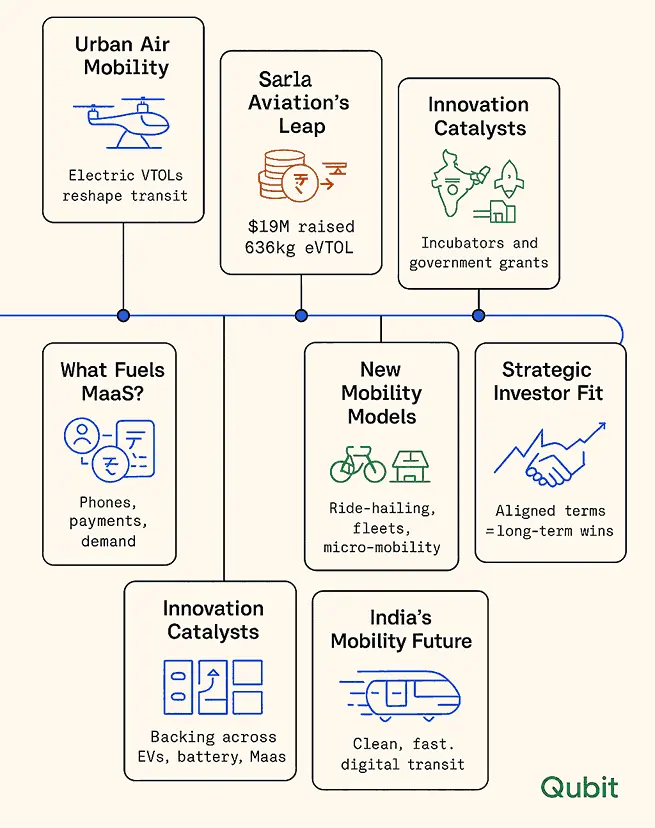
India’s mobility tech ecosystem is evolving beyond roads and ride-hailing, moving into air, integrated platforms, and deep-tech innovation backed by strategic capital.
1. eVTOL and Urban Air Mobility
The development of electric vertical take-off and landing (eVTOL) technology is opening new avenues for urban air mobility.
Sarla Aviation, an Indian startup, raised $10 million in Series A1 funding to develop eVTOL prototypes with a 680kg payload capacity. These innovations have the potential to transform congested urban environments and emergency services, signaling a shift toward advanced air mobility solutions.
2. Growth of MaaS Platforms
Momentum in Mobility as a Service (MaaS) is tightly linked to India’s broader digital funding boom, Indian tech startups raised $11.3 billion in 2024, and a meaningful share of this capital is flowing into digital-first mobility platforms.
India’s MaaS market is projected to grow at a 32.39% CAGR, reaching $4.71 billion by 2030. This growth is powered by:
- Rising smartphone penetration
- Better connectivity and digital payments
- Consumer demand for seamless, app-based mobility
At the same time, shared mobility models, electric ride-hailing, subscription fleets, and micro-mobility platforms, are expanding. They are addressing last-mile deliveries and daily commuting needs more sustainably, strengthening India’s position as a global testbed for mobility platform innovation.
3. University Incubators and Government Grants as Innovation Catalysts
Building on these market trends, university incubators and government prototyping grants play a crucial role in mobility tech advancement. These programs provide startups with mentorship, technical resources, and early-stage funding to develop and validate new solutions. By bridging academic research and commercial application, they accelerate the transition from prototype to market-ready product. This approach helps founders overcome initial barriers and fosters a culture of continuous innovation.
4. Blume Ventures Portfolio in Mobility Innovation
On the venture side, firms like Blume Ventures have been central to shaping India’s mobility story. Their portfolio spans:
- EV manufacturers and platforms
- Advanced battery technology companies
- Next-generation ride-hailing and MaaS players
These startups are tackling everything from charging and storage to fleet optimization and urban commute. They’re not just solving today’s logistics and transport problems, they’re building the rails for long-term, sustainable mobility infrastructure in India.
5. Strategic Investor Alignment
The success of these startups is also a testament to the importance of choosing the right investors. Blume Ventures’ deep domain expertise and long-term vision make them an ideal partner for mobility-focused startups. Your strategic assessment is refined by the insights offered on how to choose right mobility investor, which discusses aligning investment terms with long-term growth.
6. Driving Disruption in the Indian Mobility Market
Blume Ventures’ portfolio demonstrates how innovation in EVs, batteries, and MaaS platforms is reshaping the Indian mobility market. By addressing critical challenges and embracing digital transformation, these startups are driving disruptive transportation models that promise a cleaner, more efficient future.
For startups seeking alternative financing models, exploring options like mobility startup crowdfunding syndicate can provide collaborative pathways to secure growth capital.
Transforming Mobility with EVs and Battery Innovations
Electric vehicles are at the forefront of Blume Ventures’ mobility investments. Startups in their portfolio are developing high-performance EV designs tailored to the unique demands of the Indian market. These companies are not only making EVs more accessible but are also innovating in areas like battery swapping and energy efficiency. For instance, some startups integrate real-time apps and data analytics to optimize battery usage, ensuring a seamless experience for users.
Battery technology is another critical focus area. Innovations in this space are addressing challenges like range anxiety and charging infrastructure. By supporting startups that specialize in advanced battery solutions, Blume Ventures is enabling the creation of EVs that are both cost-effective and environmentally friendly.
1. Asset-Light Models for Scaling Battery Swapping Networks
This foundation enables startups to adopt asset-light business models for battery swapping infrastructure. By partnering with local operators and leveraging existing networks, companies can expand quickly without heavy capital investment. Such models reduce operational risk and allow for flexible scaling as market demand grows. This strategy is particularly effective in urban environments where rapid deployment is essential.
2. Next-Gen Ride-Hailing and MaaS Platforms
Blume Ventures is also championing the rise of Mobility-as-a-Service (MaaS) platforms. These digital ecosystems are transforming how Indians commute by offering integrated solutions that combine ride-hailing, public transport, and even micro-mobility options like e-scooters. Startups in this space are leveraging data analytics and user-centric design to create platforms that are intuitive and efficient.
One standout trend is the growing adoption of digital platforms in transportation. Startups are using real-time apps and innovative battery swapping solutions to enhance customer experience. This synergy between digitalization and mobility is a hallmark of Blume Ventures’ portfolio.
Indian Mobility & EV Startup Segments
| Segment | Notable Startups (India) |
|---|---|
| Ride hailing & bike taxis | Ola, Rapido, BluSmart |
| Shared micro-mobility | Yulu, Bounce, Rapido (bike taxis) |
| EV OEMs (2W/4W) | Ola Electric, Kabira Mobility, Pure EV, Revolt Motors |
| Battery / charging infra | SUN Mobility, Kazam EV, Kazam-enabled charging hosts |
| Subscriptions & sharing | Drivezy, EVeez, various car/bike rental platforms |
| Established EV players | Mahindra Electric, Hero Electric, TVS (EV programs) |
Challenges, Risks, and Red Flags in Indian Mobility Fundraising
Despite sector momentum, both investors and policymakers have become more discerning. Common founder mistakes and sectoral issues include:
1. Capital Intensity & Underestimating Scale
Mobility and EV ventures are highly CAPEX- and burn-intensive—especially hardware, infra, or asset-ops models. Underestimating capital needs or timeline to scale can erode credibility. Investors want “frank talk” about ramp-up costs, working capital, and cash-flow forecasts.
2. Regulatory Fragmentation
Each Indian state, and many cities, runs its own regulatory playbook on transport, permitting, subsidies, and enforcement. Founders who ignore regional “ground realities” or try to scale without local government buy-in often face rollout delays, stalled shops, or headline risk.
3. Customer Acquisition and Retention
India’s price-sensitive customer base makes large-scale adoption tough—high churn and discount-driven growth footed many failed micro-mobility pilots. Having strong retention, repeat usage, and a plan for conversion from “pilot” to “contracted services” is vital.
4. Supply Chain & Safety
Battery safety, recycling mandates, and swings in lithium (or local component) supply chains have shut down or derailed several scale-up stories. Startups need concrete safety/compliance roadmaps, active risk management, and partnerships for component localization.
5. Valuation Bubbles and Cooling Trends
Early-stage euphoria led to unsustainable valuations for pure-play EV or last-mile startups in 2021–2023. Investors today are scrutinizing true margin profiles, unit economics, and customer stickiness, be prepared to justify multiples with repeatable financials, not just vanity metrics.
Targeted Investor Pipeline: Building with Purpose
Mobility fundraising in India requires more than a killer pitch; it demands a deliberate approach to investor targeting.
Start by mapping the landscape:
- Sector Alignment: List investors who have already bet on mobility, EVs, logistics, or infrastructure (e.g., Blume Ventures, Sequoia India, Chiratae, OEM-backed CVCs). Research their average cheque sizes and active portfolio companies.
- Stage and Check Size Fit: Pre-seed funds (e.g., 9Unicorns, India Quotient), growth-stage (Iron Pillar, Bertelsmann), and infra-oriented project funds each have distinct sweet spots. Match your raise ask to their historical ranges.
- Corporate and Strategic Backers: Identify sector-aligned strategics—Mahindra, Tata Motors, Shell India, or even Flipkart for e-mobility supply chain bets.
- Government Programs: List GOI, state subsidies, iCreate, and central innovation funds for non-dilutive capital or pilots.
Build a CRM to track contact dates, intro sources, follow-ups, and responses. Prioritize investors with clear interest in your sub-sector and approach warm leads via advisor or founder networks whenever possible.
How to Access University Incubation and Innovation Grants
- Identify university incubation centers specializing in mobility tech and review their application requirements and deadlines.
- Prepare a concise pitch highlighting your product-market fit and innovation potential for grant committees.
- Apply for government innovation challenges that offer prototyping grants and mentorship opportunities for early-stage startups.
- Engage with academic mentors to refine technical solutions and align them with commercial market needs.
- Leverage incubation program networks to connect with strategic investors and industry partners for pilot deployments.
Regional and Policy Nuances: India’s Geographic Funding Tapestry
Funding, regulatory, and adoption cycles in Indian mobility are hyper-local:
- Metros (Bengaluru, Delhi, Mumbai, Pune): Attract the most VC, corporate capital, and city partnership pilots, but face tougher congestion, capex, and regulatory scrutiny.
- Tier-2/3 Cities: Offer cheaper infra, more receptive government partners, and are home to a fast-emerging logistics and e-2W (electric two-wheeler) market—lower competition, but more education required.
- State Policies: Andhra Pradesh, Telangana, Gujarat, and Tamil Nadu lead in EV & battery manufacturing incentives; Karnataka and Tamil Nadu excel in electronics and IoT hardware clusters; the Northeast is emerging as a microtransit test-bed.
Tip: Founders should map regional grant and subsidy programs and anticipate local compliance regimes for a smarter fundraising cadence.
Social Impact, Inclusion & Diversity in Mobility Fundraising
With the rise of climate- and impact-focused investors—and government mandates, mobility startups with credible ESG, accessibility, and inclusion metrics can unlock new capital and community partners:
- Show impact KPIs: Trips/services delivered to underserved communities, CO₂ saved, jobs created in low-income areas, or accessibility programs (for women, disabled commuters, etc.).
- Highlight representation: Diverse founding teams and gender/inclusion policies can be a tie-breaker for many new climate or city grants.
- Government and NGO Synergies: Many grants are tied to inclusive access, last-mile innovations, or rural mobility pilots, integrate these into the fundraising story, not just as an afterthought.
Post-Fundraising Excellence: Execution, Milestones, and Board Communication
Raising capital is only the beginning. In India’s dynamic, compliance-heavy mobility scene:
- Link each capital raise to precise, measurable milestones (e.g., “Pilot in 3 new states,” “50,000 rides at >95% uptime,” “launch first recycling program”).
- Establish monthly/quarterly board and investor reports, tracking spend vs. use-of-funds, regulatory progress, and new risks (supply chain, policy, competition).
- Be candid—but proactive—with roadblocks: Indian investors value foresight and agility over bravado. Discuss pilot delays, subsidy application snags, or local policy fluctuations early.
- Operationalize compliance: Build teams or advisory relationships for active government, city, and compliance management.
Conclusion
India’s mobility and EV fundraising story is only just getting started. Capital is flowing to founders who deeply understand policy, unit economics, and the realities of building in a complex, multi-city market. If you’re building in EVs, MaaS, battery tech, or logistics, now is the moment to tighten your narrative, sharpen your metrics, and line up the right partners before the next funding cycle.
If you’re ready to sharpen your mobility fundraising strategy and connect with the right investors, we can help. Explore our startup fundraising consulting to turn your traction, metrics, and market narrative into a funding-ready story that attracts long-term, sector-aligned capital.
Key Takeaways
- EV and mobility fundraising in India is rebounding strongly.
- Policy tailwinds like FAME and PLI are de-risking the sector.
- Investors now prefer full-stack, scalable mobility platforms.
- Battery innovation and swapping models are key competitive levers.
- Regulatory fragmentation makes regional strategy non-negotiable.
- Unit economics and retention matter more than headline GMV.
- Aligned, sector-savvy investors unlock faster, smarter growth.
- Post-fundraise discipline and transparent reporting sustain investor trust.
Get your round closed. Not just pitched.
A structured fundraising process matched to your stage and investor fit.
- Fundraising narrative and structure that holds up
- Support from strategy through investor conversations
- Built around your stage, model, and timeline
Frequently asked Questions
What is driving India's mobility tech funding growth?
India’s mobility tech funding growth is fueled by EV innovation, MaaS platforms, and strong investor confidence. Government incentives and urbanization also play key roles.