

 Back
Back









Table of Contents

Equity dilution is a critical consideration for mobility startups seeking funding. As founders bring in external investors, understanding how equity is distributed and diluted becomes essential for maintaining control and ensuring long-term growth. This blog explores the intricacies of dilution norms, funding instruments, and negotiation strategies tailored to the mobility sector.
Your insight into equity distribution benefits from the broader context offered in the mobility startup fundraising strategies article, which frames detailed negotiation tactics within overall funding dynamics.
Whether you’re navigating early-stage funding or scaling operations, this guide provides actionable insights and industry-specific examples to help you make informed decisions. From understanding the impact of dilution to mastering negotiation techniques, we’ll equip you with the tools to secure funding while safeguarding your vision.
Incorporation & Initial Ownership
What is equity dilution? It occurs when a company issues new shares, reducing existing shareholders’ ownership percentages. Founders receive 100% of the company’s shares, which sets the foundation for future equity distribution as the business grows. The dilution of shares meaning refers to the reduction in a founder’s ownership percentage as new shares are issued.
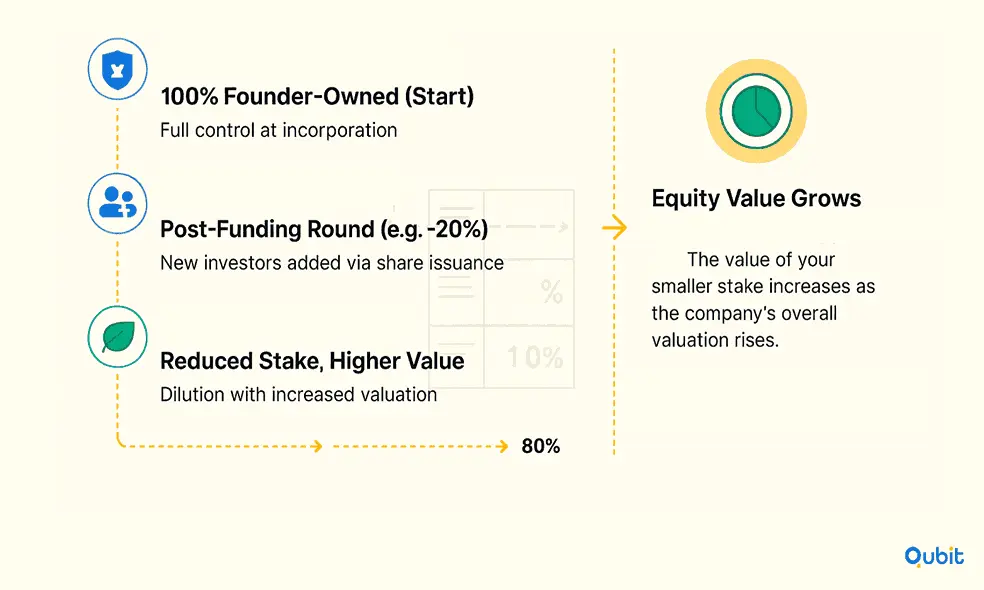
However, as the company progresses and seeks external funding, share dilution becomes a key factor as the dynamics of ownership begin to shift.
For example, if a founder owns 100% of a company at incorporation and later issues 20% of the total shares to investors during a funding round, their ownership stake decreases to 80%. Although the percentage of ownership is reduced, the overall value of their equity often increases as the company’s valuation grows with each successful funding round.
Understanding this progression is crucial for founders. It highlights the importance of balancing ownership retention with the need to secure the resources required to expand the business. By carefully planning equity distribution and aligning with investors who share their vision, founders can ensure that their company thrives while maintaining a meaningful stake in its success.
Startups like yours already closed their rounds with us.
Founders across every stage and industry. Here's what it took.
- Raised $7.6M for Swiipr Technologies
- Raised $0.5M for Ap Tack
- Raised €0.5M for Ivent Pro

Mobility Startup Equity Dilution Ranges: India & Global
Typical mobility startup equity dilution ranges vary by funding round. For example, pre-seed rounds often see 10–20% dilution.
Industry-wide analysis affirms this trend. Global startup dilution rates also typically range 15–30% per funding round. This parallel reinforces that mobility sector norms mirror broader startup experiences, giving founders external validation for expectations.
| Round | Usual Dilution | Comment |
|---|---|---|
| Pre-Seed | 10–20% | Angel or super-angel groups and some micro-VCs. Lower dilution for MVP or IP-heavy teams. |
| Seed | 15–25% | Many founders target under 20% with strong traction, though infra or fleet models can be higher. |
| Series A | 20–30% | Mobility and hardware-heavy rounds can push dilution to 28–30%. |
| Series B | 15–25% | Larger rounds, often with corporate venture or strategic co-leads, leading to moderate dilution. |
| Series C+ | 10–20% | Dilution typically drops as round size increases and business risk declines. |
For a deeper look at how capital is flowing into the sector, review global VC funding trends in mobility startups across EV and battery segments.
Why Mobility Dilution May Be Higher
- High CAPEX (capital expenditures): Building fleets, chargers, or mobility hardware requires more up-front capital before revenue ramps, often increasing equity dilution in startups, especially in earlier rounds.
- Regulatory Delays: Permitting, government contracts, or city pilots can stretch timelines, increasing bridge round needs (and there, extra dilution).
- Infra/OpEx Overhang (infrastructure and operating expenses): Investors want a bigger stake given longer payback cycles and higher risk.
Leveraging Non-Dilutive Funding to Limit Equity Loss
Building on the challenges that drive higher dilution in mobility, founders can pursue non-dilutive funding to reduce equity loss. Grants, subsidies, and strategic partnerships provide capital without requiring founders to give up ownership. These sources can help bridge funding gaps during regulatory delays or capital-intensive phases. By combining non-dilutive funding with equity rounds, startups can extend their runway and retain greater control over their business.
Shifts in VC risk appetite toward mobility platforms also influence how much equity investors demand when timelines and capital needs are uncertain.
Factors That Drive Dilution in Mobility Rounds
- Round Size: Larger rounds (to reach capital-intensive milestones or support city launches) result in greater share dilution per round.
- Investor Profile: Strategic/corporate VC may accept slightly less equity for future synergy, while “growth at all costs” VC funds push for more.
- Milestone Clarity: Raising pre-revenue or with unfinished pilots typically means giving more equity than if you can show usage, contracts, or clear unit economics.
- Competing Term Sheets: More competitive rounds can reduce dilution per rupee raised.
These factors illustrate how dilution in finance can significantly impact founder and investor ownership in mobility startups.
Since investor type directly affects how much equity you give up, choosing the right investor for your mobility startup is one of the most consequential decisions founders make during fundraising.
Mobility Startup Funding Strategies & Early-Stage Instruments
Mobility startup funding strategies often begin with choosing the right early-stage financing instrument. This decision shapes the company’s trajectory.
Founders often weigh options like priced equity rounds, convertible notes, and SAFEs (Simple Agreements for Future Equity), each offering unique advantages and trade-offs. Adoption of this instrument has surged. In Q1 2025, SAFEs represented 90% of pre-seed deals tracked on Carta. This dominant usage illustrates how early-stage founders now opt for faster, simpler capital raises.
Priced Equity Rounds: Establishing Valuation Early
Priced equity rounds are a traditional and widely used funding mechanism where investors purchase shares at a fixed price, typically in exchange for preferred shares. This approach provides clarity by establishing a clear valuation for the startup at the outset. For founders, this can help set investor expectations and create a transparent framework for future funding rounds. However, the downside is that early-stage startups may face challenges in agreeing on a valuation, especially when their business models are still evolving.
Convertible Notes: Delaying Valuation Discussions
Convertible notes offer a more flexible alternative by allowing startups to raise funds as debt, which later converts into equity under predetermined conditions. This instrument is particularly useful for delaying valuation discussions until a later funding round, when the company’s worth is more evident. Convertible notes often include a discount or valuation cap, incentivizing early investors while giving founders time to demonstrate growth. Despite their flexibility, convertible notes can sometimes lead to complex negotiations around conversion terms, which may complicate future funding rounds.
SAFEs: A Growing Trend in the EU
SAFEs, or Simple Agreements for Future Equity, have gained significant traction in the EU startup ecosystem. These agreements allow startups to raise capital quickly without the immediate pressure of determining a valuation. SAFEs are simpler and more founder-friendly than convertible notes, as they eliminate the debt component and streamline the conversion process. This has made them particularly popular among mobility startups and other fast-growing sectors in the EU. The predominance of SAFEs in the region reflects a broader shift toward funding instruments that prioritize speed and flexibility.
For a deeper understanding of how investor motivations align with instruments like SAFEs and convertible notes, explore the ev charging startup investor interest, which highlights trends that influence equity negotiation practices.
Choosing the Right Instrument
The decision between priced equity rounds, convertible notes, and SAFEs depends on factors such as the startup’s stage, growth potential, and the founder’s long-term vision. While priced equity rounds offer clarity, convertible notes and SAFEs provide the flexibility needed to adapt to changing circumstances. Founders should carefully evaluate their options to ensure that their chosen instrument aligns with their strategic goals and investor expectations.
Mobility Startup Equity Dilution Norms Across Funding Rounds
Mobility startup equity dilution is a key consideration at each funding stage. Understanding typical percentages and runway expectations helps founders make informed decisions.
Recent market data shows progress for founders. In 2024, median seed dilution decreased from 23% to 20.1%. This signals improved negotiation power for startups entering seed rounds. Founders can leverage this shift to preserve more ownership as they raise capital.
From pre-seed to Series A and beyond, each stage comes with unique equity dilution startup benchmarks and risks that can impact long-term growth.
Risks of Excessive Dilution
Excessive equity dilution can have long-term consequences, particularly when it surpasses recommended thresholds. It may reduce founder control and deter potential investors in later rounds. For example, Swisspod Equity Crowdfunding successfully raised over €350K across multiple rounds while preserving founder ownership by utilizing platforms like SeedBlink. Similarly, Surf Air Mobility Debt Financing opted for a debt strategy, achieving a 90% reduction in anticipated dilution while securing a $50M term loan. These examples highlight alternative approaches to minimize dilution while maintaining growth momentum.
Understanding Anti-Dilution Provisions in Funding Agreements
Beyond excessive dilution, founders should understand anti-dilution provisions in investor agreements. These clauses adjust investor equity in down rounds, often using broad-based weighted average formulas. While they protect investors from value loss, they can further dilute founders if not carefully negotiated. Balancing these terms is essential for preserving founder incentives and supporting future fundraising.
To further refine your equity strategy, explore our mobility startup investor due diligence checklist, which outlines essential steps for managing equity negotiations alongside financial, legal, and compliance evaluations.
By understanding these norms and risks, founders can strike a balance between attracting investors and retaining control, ensuring their startup’s long-term viability.
Regional dynamics also matter, India’s mobility and logistics tech fundraising surge is producing its own set of dilution benchmarks that differ from global averages.
Founders who know how to identify and pitch EV-focused investors can often secure better terms, reducing unnecessary dilution at each stage.
Sample Cap Table Scenario
| Founders | Employees | Investors (A) | Investors (B) | Pool | |
|---|---|---|---|---|---|
| Post-Seed | 70% | 10% | 20% | N/A | 10% |
| Post-A | 50% | 15% | 25% | 10% | 10% |
| Post-B | 35–45% | 15–20% | 20% | 20–25% | 10% |
This sample cap table scenario illustrates how share dilution affects founder, employee, and investor ownership percentages after each funding round. You can use an equity dilution calculator to model how future funding rounds will affect ownership percentages.
Using Cap Table Modeling for Dilution Planning
These sample scenarios highlight the importance of cap table modeling for founders. By forecasting dilution across multiple rounds, founders can test different funding strategies and option pool sizes. This proactive approach clarifies how each decision impacts long-term ownership and investor alignment. Effective modeling supports better negotiations and helps maintain founder incentives throughout the startup’s growth.
Real-world figures support this model. Founders retain 15–25% ownership after Series A on average. This aligns closely with the post-A cap table scenario, reinforcing the practical relevance of these projections.
Conclusions & Strategic Recommendations
For mobility startup equity dilution, maintaining a balanced profile is essential for long-term success. Applying equity dilution negotiation tactics can help founders retain 50-60% ownership post-Series A and sustain leadership control.
While achieving double-digit ownership at IPO or acquisition is rare, it serves as a benchmark of exceptional equity management. Founders can explore innovative financing methods, such as revenue-based financing or convertible notes, to minimize dilution while securing the capital needed for growth.
Ultimately, strategic equity planning is not just about numbers, it’s about preserving the vision and value founders bring to their ventures. If you’re looking to secure the right investors while optimizing your equity structure, we at Qubit Capital are here to help. Check out our Investor Discovery and Mapping service to learn more.
Key Takeaways
- Mobility startup equity dilution means founders start with 100% ownership but experience dilution as they raise capital.
- Early-stage financing options such as priced rounds, convertible notes, and SAFEs offer distinct advantages.
- Typical dilution rates are 15–20% in early rounds and around 18% in Series A rounds.
- A balanced equity strategy and effective equity dilution negotiation tactics are critical for preserving founder control and ensuring future fundraising success.
- Innovative financing methods, like debt financing, can significantly mitigate excessive dilution risks.
Get your round closed. Not just pitched.
A structured fundraising process matched to your stage and investor fit.
- Fundraising narrative and structure that holds up
- Support from strategy through investor conversations
- Built around your stage, model, and timeline
Frequently asked Questions
What are typical equity dilution ranges for mobility startups across funding rounds?
Mobility startups usually see equity dilution of 10–20% at pre-seed, 15–25% at seed, and 20–30% in Series A rounds. Infrastructure demands can push these numbers higher.