

 Back
Back









Table of Contents

Artificial intelligence is reshaping industries worldwide, and its impact is reflected in the surge of venture capital funding. In 2024, global investments in AI startups skyrocketed by 62%, reaching an unprecedented $110 billion, according to Dealroom. This growth stands in stark contrast to the overall decline in startup funding, which fell by 12% during the same period. Such trends underscore the urgency for AI founders to craft compelling strategies to secure funding in this competitive landscape.
Notably, Founder Institute alumni have secured over $1.85 billion using these pitch deck strategies. Their approach emphasizes clarity, narrative flow, and visual impact over technical jargon. For founders, this demonstrates the material value of refining pitch deck fundamentals in investor communications.
Business Model Clarity Sets Investor Expectations
Building on this landscape, founders must present their business model and customer segmentation clearly in their pitch decks. Investors evaluate AI startups based on how well the deck communicates revenue streams and target markets. This clarity helps investors quickly assess scalability and fit with their own investment thesis. A well-structured business model section builds confidence and sets the stage for deeper engagement.
Your exploration of pitch deck fundamentals is enriched by insights found in the guide on AI startup pitch deck fundraising, which clarifies how foundational strategies align with your overall presentation vision.
Let’s jump right in.
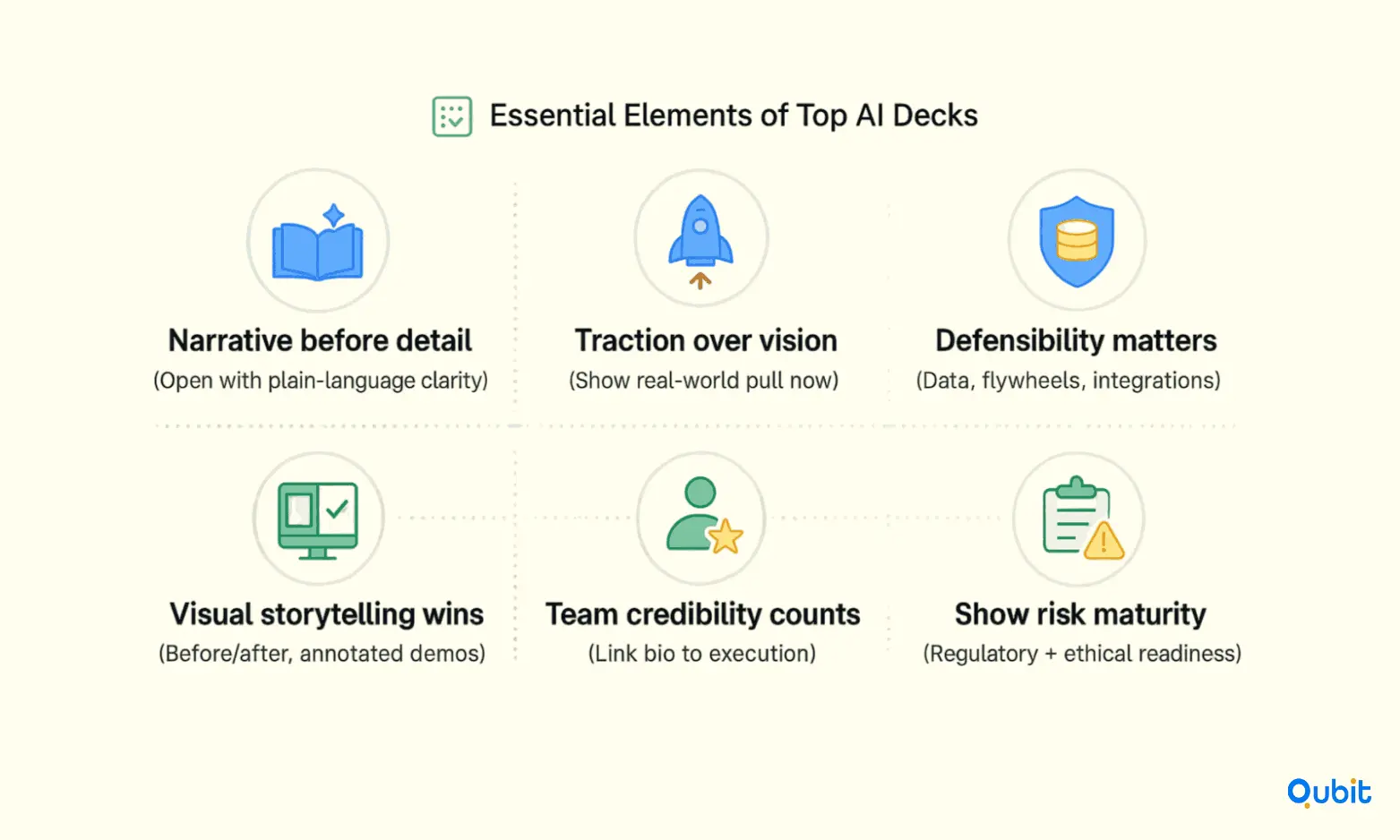
Successful AI pitch decks focus on clarity, evidence, and strong team credibility.
Startups like yours already closed their rounds with us.
Founders across every stage and industry. Here's what it took.
- Raised $7.6M for Swiipr Technologies
- Raised $0.5M for Ap Tack
- Raised €0.5M for Ivent Pro

Narrative is Everything: Clarity Before Complexity
The gold-standard decks, such as those from DeepMind and UiPath don’t just dazzle with technical diagrams or AI jargon; instead, they open with a clear, urgent problem statement, followed by a direct explanation of their solution in plain language. DeepMind’s original deck highlighted the limitations of classical approaches. It then revealed the promise of deep reinforcement learning. The result? Investors from both technical and generalist backgrounds could “get it” in minutes.
Lesson:
Prioritize a one-sentence problem summary and explain your AI’s impact using analogies or real-world applications, not just model specs.
- Start with a problem
- Use plain language
- Show traction
- State the problem in one sentence
- Use analogies for impact
- Present traction evidence
Traction: Matters More Than Abstract Aspirations
Investors see a flood of AI decks forecasting exponential revenue or “market domination.” What earns confidence is specific, early evidence of market pull.
Retention Metrics Signal Sustainable Traction
Building on the need for credible traction, founders should highlight retention metrics and net dollar retention trends in their decks. These metrics show not just initial interest but ongoing customer engagement and revenue stability. Investors increasingly view retention as a stronger indicator of product-market fit than short-term growth. Including these figures demonstrates sustainability and competitive advantage.
Take Anthropic’s pitch: Instead of grand visions, the deck highlights early enterprise partners, safety benchmarks for large language models (LLMs), and letters of intent.
Lesson:
Even if you’re early, showcase pilots, POCs, user testimonials, or credible letters of interest, and quantify any traction (e.g., “10 enterprise pilots in pipeline”).
AI Moats: Prove Your Defensibility
Sophisticated investors are wary of AI’s speed-to-commoditization. The decks that get follow-up meetings explain, concretely, why their solution will maintain an edge. OpenAI’s early materials highlighted proprietary architectures, vast compute access, and exclusive data partnerships. UiPath, now a global automation giant, dedicated slides to its flywheel of data from millions of real-world automation tasks and a growing global community.
Lesson:
Go beyond “proprietary model” claims. Detail unique data sources, product integrations, user networks, or regulatory/compliance barriers that protect your lead.
Visual Storytelling: Runway & Stability AI
Further supporting this, AI-assisted decks see 103% longer reading times and 2.3x higher conversion rates than traditional text-heavy decks. These outcomes reflect the measurable value of clear, visually compelling storytelling.
1. Runway: Democratizing Creativity
Runway’s pitch wasn't just about video editing; it was about "democratizing creativity". Their decks utilize heavy visual "showing" rather than "telling."
- Lesson: For generative AI, the product demo is the pitch. Don't write bullet points about "high-quality video generation." Embed a 5-second loop of the video your tool created.
2. Stability AI: The "Ownership" Pitfall
Stability AI’s leaked deck serves as a cautionary tale. The controversy surrounding their Series A pitch involved the ambiguity of "our models". The deck claimed millions of users were using "their models," which investors later scrutinized for being heavily reliant on open-source communities rather than proprietary, defensible IP.
Rule: Be hyper-specific about what is yours. "We use a fine-tuned Llama 3 for X, but our proprietary orchestration layer Y is what we own."
Team Slides: The Power of Credibility
Investors back people. Successful decks such as DeepMind’s didn’t just list bios—they told a story of a founding team with a track record at top AI labs, published research, or products shipped at scale. Including advisors or early backers with name recognition also raises confidence.
Lesson:
Don’t just state credentials, connect each core member’s background to a key risk or driver of your success (e.g., “former Google AI lead overseeing large-scale deployment”).
Risks and Regulation: Don’t Dodge the Tough Questions
What’s often absent in weaker decks is any mention of regulatory risk, bias, or ethical concerns, especially in sectors like healthcare or fintech. Meanwhile, top decks proactively call out major risks and mitigation strategies. For example, an AI healthtech deck that explains how HIPAA compliance and explainability is “baked in” stands apart from competitors dodging the issue.
Lesson:
Directly address regulatory and ethical risks, and show serious (not superficial) plans for mitigation. This demonstrates maturity and builds trust.
Some Success Stories
UiPath’s Winning Series A Deck: Outlined a clear “why now” (automation market inflection point), then visualized sales velocity with customer growth charts and illustrated their data flywheel. The cachet of their engineering team and early big-brand customers pushed them over the finish line.
OpenAI’s Early Deck (Reconstructed): Centered on the opportunity for transformative AGI, but quickly grounded by technical milestones, access to exclusive data/compute, and detailed risk discussions. Team slide embedded with recognizable names in machine learning.
To further explore how startups can effectively communicate their AI-driven solutions to potential partners, check out this detailed breakdown of AI startup pitch deck fundraising slides. This resource provides clear examples of how to structure a compelling narrative that resonates with investors and corporate collaborators alike.
What Should be Your Pitching Strategy
For Very Early-Stage AI Startups
Many founders underestimate the time commitment. Manual pitch deck creation often takes 40 to 80 hours, according to Peony. This underscores the value of leveraging proven frameworks and AI tools to streamline the process.
If you’re pre-revenue or still building your MVP, you might worry that you don’t have enough traction to impress investors. Instead, focus your pitch deck on the following elements:
1. Vision & “Why Now”
Make a compelling case for the urgency of the problem you’re solving. Use data or recent industry changes showing why this opportunity is timely.
2. Team Credibility
Highlight relevant AI credentials, technical backgrounds, research contributions, previous startup experience, or recognitions. If you have industry experts or notable advisors onboard, spotlight them to instill confidence.
3. Technical Innovation
Demonstrate what makes your AI approach unique, even if you haven’t launched commercially. Use preliminary benchmarks, demo videos, or proof-of-concept prototypes. If your innovation is in algorithm design, proprietary data access, or integration with cutting-edge frameworks, spell that out with clarity.
4. Early Validation Efforts
Show any pilot projects, academic collaborations, grant wins, letters of intent, or even waitlists for product access. If you have technical benchmarks outperforming public baselines, include those.
5. Market Research & Customer Discovery
Explain how you’ve validated the problem with interviews, surveys, or advisory calls, even if you lack paying customers. Map out your ideal customer personas and anticipated use cases.
6. Go-to-Market Hypotheses
Articulate your initial plan for reaching customers, partnerships under consideration, and possible business/revenue models, even if they’re not yet proven.
7. Your Ask
Be clear about what you seek (funding, partnerships) and what the next milestones unlocked with this support will be (MVP complete, first pilots, core hires).
For Advanced-Stage AI Startups
Industry experts agree: a best-practice deck spans 10 to 20 slides and uses images, graphs, and charts to communicate value quickly. This structure ensures your narrative remains clear and memorable. If you have product-market fit, a growing user base, or meaningful revenue, your pitch deck should evolve to emphasize credibility, scale, and defensibility:
1. Traction and Growth Metrics
Lead with proof: Monthly or annual recurring revenue, pilot-to-customer conversion rates, pipeline of signed contracts, or notable renewals. Use graphs that show consistent upward momentum.
2. Customer Success Stories
Quantify real-world impact. Include case studies, testimonials from known brands, and specific ROI delivered to users.
3. Competitive Moat
Go deep on why your AI solution won’t be overtaken, highlight proprietary datasets, unique integrations, network effects, technical IP, or regulatory positioning.
4. Proven Go-to-Market Engine
Detail your sales and marketing machinery, how you consistently acquire customers, scale deployments, and open new distribution channels or markets.
5. Scalability and Financials
Present unit economics, LTV:CAC ratios, gross margins, churn/retention rates, and how those improve as you scale.
6. Roadmap to Category Leadership
Explain how new funding will unlock further growth: expansion into new verticals/geographies, hiring, new product lines, or acquisitions.
7. Governance, Team, and Culture
If you’re raising larger rounds, investors care about management maturity. Show how you’ve built a culture to attract and retain top AI/engineering talent, robust processes, and a scalable company structure.
8. “The Ask”
Connect your funding ask to ambitious, but credible, growth milestones. Explain how the capital drives future value and further de-risks the business for both you and investors.
Your review of best practices is further supported by the analysis of dos donts AI startup pitch deck examples, which illustrates practical considerations that integrate seamlessly with the strategic tips presented here.
1. The "Mistral Strategy": Substance Over Format
One of the most defining moments in recent European tech history was Mistral AI’s seed round. They didn’t use a flashy 20-slide deck to raise their initial €105 million; they used a 7-page strategic memo.
The Lesson: Technical Defensibility is the New Hype
Mistral’s memo stripped away the design fluff to focus entirely on technical nuance. While most Seed decks were promising "ChatGPT for X," Mistral’s document argued for a specific technical wedge:
- Small Models: Training models efficient enough to run on a 16GB laptop.
- Hot-Pluggable Context: Merging language models with retriever systems to handle millions of extra words of context.
Why this worked: It signaled to technical VCs that the team understood the infrastructure bottlenecks of AI, not just the application layer. In a market flooded with "thin wrappers," deep technical insight is your strongest differentiator.
Application for Founders:
Don’t be afraid of density if you are building infrastructure. If your advantage is algorithmic, write a memo or include a technical appendix. Investors today are wary of black boxes; they want to know how you control the data workflow [See our guide on technical due diligence for AI].
The "Jasper" Lesson: The Business Model Slide
Jasper AI’s rise to a $1.5 billion valuation (before the market correction and subsequent stabilization) was fueled by a Series A deck that did one thing exceptionally well: it proved the Business Model.
The Lesson: Show, Don’t Just Tell, Traction
In 2024-2025, the scrutiny on business models has intensified. According to DocSend and PitchGrade data, investors now spend 48% more time analyzing business model slides than they did two years ago.
Jasper’s deck didn’t just say "we have users." It demonstrated:
- PLG (Product-Led Growth) Mechanics: How individual users turned into enterprise seats.
- Revenue Quality: Differentiation between monthly churners and annual contracts.
The "Wrapper" Risk:
Many AI startups fail because their margins are eaten by inference costs (paying OpenAI/Anthropic). A winning deck must show a path to gross margin improvement, either through smaller, fine-tuned models (like Mistral’s approach) or high switching costs.
Application for Founders:
Your "Business Model" slide must include a unit economics breakdown. Show your CAC (Customer Acquisition Cost) vs. LTV (Lifetime Value), but more importantly, show your Inference Cost per User. If you can prove that your costs go down as your model gets smarter, you win. [Check out our template for AI unit economics slides.
Conclusion
Crafting a compelling pitch deck is both an art and a science. From analyzing top AI startup pitch decks, we’ve uncovered essential strategies that drive success: clear storytelling, data-driven narratives, and visually impactful designs. These elements not only capture investor attention but also communicate your startup’s vision effectively.
Refining your investor narrative and aligning it with industry benchmarks are actionable steps that can elevate your pitch. By focusing on clarity and relevance, startups can transform their presentations into powerful tools for securing funding.
If you're ready to take your pitch deck to the next level, we at Qubit Capital are here to help. Our Pitch Deck Creation Service is designed to turn your pitch into an investor magnet. Contact us today to ensure your deck stands out in competitive markets!
Key Takeaways
- Comprehensive analysis of top AI startup pitch decks provides actionable insights.
- Key elements include clear storytelling, data-driven models, and effective visual design.
- Emphasizes the importance of aligning business models with investor expectations.
- Highlights real-world case studies that demonstrate successful funding strategies.
- Offers strategic tips that can be directly applied to enhance investor presentations.
Get your round closed. Not just pitched.
A structured fundraising process matched to your stage and investor fit.
- Fundraising narrative and structure that holds up
- Support from strategy through investor conversations
- Built around your stage, model, and timeline
Frequently asked Questions
How can early-stage AI startups attract VC funding?
Early-stage AI startups should highlight their vision, team credibility, and market timing. Emphasizing data-driven potential and clear investor roadmaps can increase VC interest.