

 Back
Back








Table of Contents

Investors aren’t spreading their bets evenly anymore. AI startups pulled in $89.4 billion in global venture capital, grabbing 34% of all VC funding while making up only 18% of funded companies. That kind of imbalance is a loud signal: capital is chasing AI harder than almost anything else.
This comprehensive guide profiles the most influential venture capital firms, angel investors, and funding sources actively backing AI startups today. From Andreessen Horowitz's aggressive AI thesis to emerging specialized funds, we've compiled detailed insights on investment strategies, portfolio companies, typical check sizes, and proven contact approaches.
What AI Investors Look for in a Startup
In Q1 2025, AI remained the top focus for venture capital worldwide. OpenAI’s $40 billion raise set a new all-time record for a single VC round. Anthropic also raised $4.5 billion over two closings, and Infinite Reality secured $3 billion.
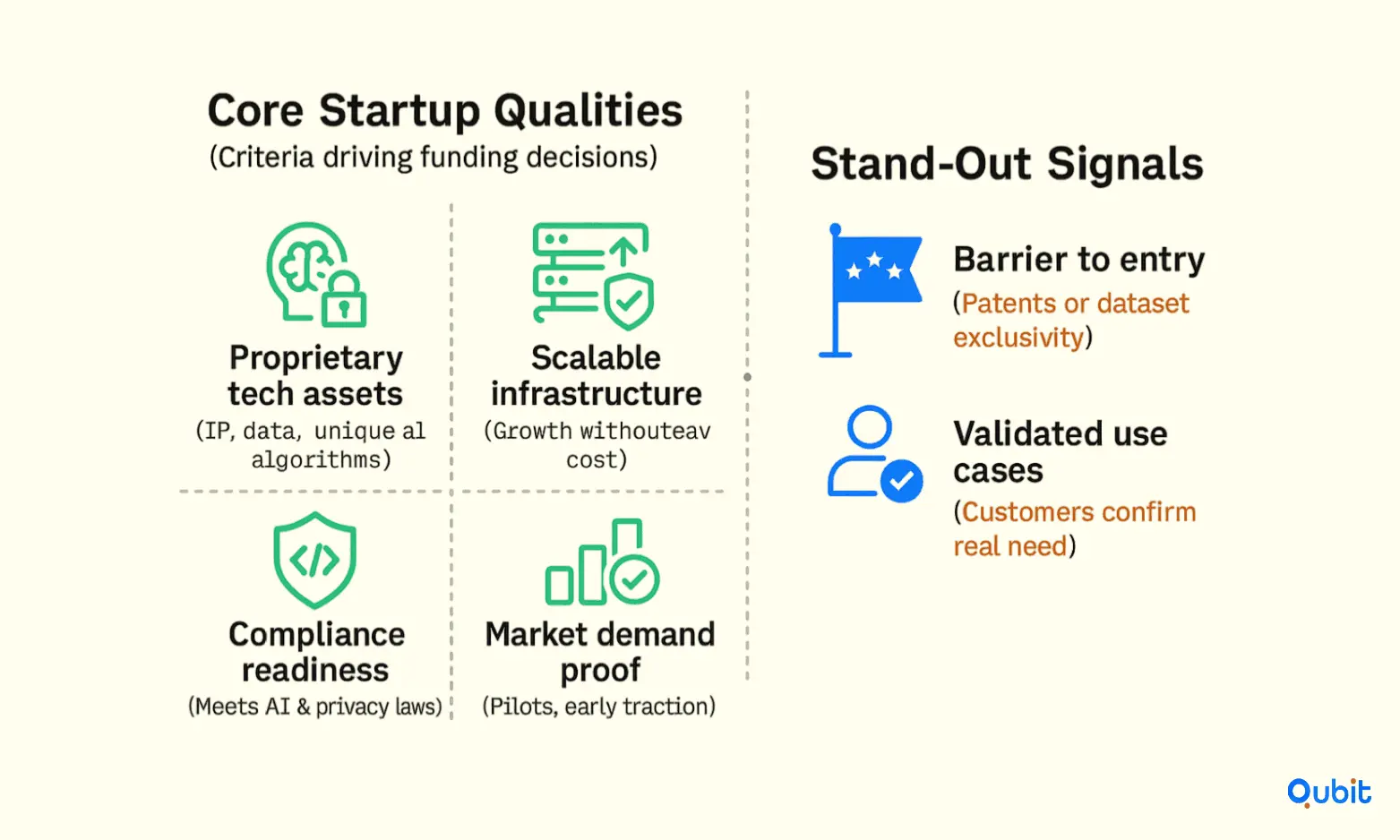
In this environment, securing investment for an AI startup takes more than a clever idea or impressive demo. Investors are looking for clear signals of long-term potential and lower risk, and they tend to focus on a consistent set of criteria when evaluating founders and products. Understanding these priorities can help you position your startup more effectively, and the key factors they look for are outlined below.
1. Proprietary Technology: The Foundation of Differentiation
AI investors are drawn to startups with unique, Proprietary technology, unique intellectual property developed and owned by the company, including innovative algorithms, exclusive datasets, or patented solutions that set the company apart from competitors. Proprietary technology not only demonstrates technical expertise but also creates barriers to entry, making the startup more attractive in a crowded market.
2. Scalability: Building for Growth
Scalability is another critical factor. Investors assess whether the startup’s technology and business model can handle rapid growth without significant increases in cost. For AI startups, this often means ensuring that the infrastructure can support larger datasets, more users, or expanded functionalities without compromising performance. A scalable model signals the potential for high returns on investment.
3. Regulatory Compliance: Mitigating Risks
AI operates in a highly regulated environment, especially in industries like healthcare, finance, and autonomous systems. Startups that proactively address compliance with data privacy laws, ethical AI guidelines, and industry-specific regulations demonstrate foresight and risk management. This reassures investors that the company is prepared to navigate complex legal landscapes.
4. Market Validation: Proof of Demand
Market validation is a key indicator of a startup’s viability. Whether through pilot programs, customer testimonials, or early revenue, demonstrating that there is demand for the product or service is essential. Investors look for evidence that the startup has not only identified a real problem but also created a solution that resonates with its target audience.
5. Multi-Stage Evaluation for AI Startup Readiness
- Conduct a technical audit to verify proprietary algorithms, data sources, and model performance against industry benchmarks.
- Assess business fundamentals including market traction, customer acquisition costs, and gross margin trends to demonstrate financial viability.
- Review regulatory compliance and data governance policies to ensure readiness for investor due diligence.
For founders exploring funding options, it’s worth considering strategies that preserve equity while fueling growth. Detailed insights into maintaining control while accessing capital appear in non-dilutive funding for AI startups, outlining alternatives that preserve equity while fueling growth.
Startups like yours already closed their rounds with us.
Founders across every stage and industry. Here's what it took.
- Raised $7.6M for Swiipr Technologies
- Raised $0.5M for Ap Tack
- Raised €0.5M for Ivent Pro

Top VC Firms Backing AI Startups
AI startups commanded $110 billion in funding in 2024 alone, marking an all-time high for the sector. This surge illustrates the rapid investor prioritization of AI and the urgency for founders to secure strategic partners.
With so much capital chasing a limited number of strong teams, the real advantage comes from partnering with investors who bring judgment, access, and support , not just money.
AI-Focused VC Snapshot
| Firm | Focus | Typical Checks | Best Fit Stages | What They Value |
|---|---|---|---|---|
| a16z | Infra, enterprise, consumer AI | $5M–$50M | Series A–C | Tech moats, massive markets |
| Sequoia | Applied AI & vertical SaaS | $10M–$100M | A–D | Traction + defensibility |
| General Catalyst | Healthcare/fintech AI, infra | $3M–$25M | Seed–B | Category creation |
| Lightspeed | AI infra & vertical apps | $5M–$30M | A–C | Clear differentiation |
| Kleiner Perkins | Healthcare, climate, consumer | $2M–$20M | Seed–B | Impact + technical depth |
The Mega-Fund Leaders Driving AI Innovation
Below are some of the top VC firms most actively backing AI startups:
1. Andreessen Horowitz (a16z)
Stands at the forefront of AI investing, having deployed $2.8 billion across 47 AI startups in 2024 alone. The firm's portfolio reads like a who's who of AI innovation, including OpenAI, Databricks, Descript, and MosaicML. Their typical investment range spans $5M to $50M for Series A through C rounds, with a particular focus on infrastructure, enterprise AI, and consumer applications.
For founders seeking a16z's attention, warm introductions through portfolio CEOs or their extensive network prove most effective. The firm values Technical moat, a significant technological advantage that makes replication difficult—technical differentiation and massive market opportunities, so emphasize these elements in your initial outreach. Their investment committee moves quickly when they see compelling technology coupled with experienced teams.
2. Sequoia Capital
Brings decades of experience to AI investing, with recent blockbuster investments in OpenAI, Stability AI, Character.AI, and Typeface. The firm typically writes checks between $10M and $100M for Series A through D rounds, focusing specifically on applied AI solutions and vertical SaaS with embedded intelligence. Their investment thesis centers on “AI-first companies that solve real business problems” rather than technology seeking applications.
Securing Sequoia's interest requires partner-level introductions and demonstrated market traction. The firm conducts thorough Due diligence, a thorough review of a company’s operations and potential—examining both technical moats and proven customer validation. Founders should prepare for multiple meetings with different partners and be ready to discuss competitive positioning extensively.
3. General Catalyst
Takes a long-term partnership approach to AI investing, with particular strength in healthcare AI, fintech AI, and infrastructure plays. Their investment range typically spans $3M to $25M for Seed through Series B rounds. Notable portfolio companies include Mindstrong Health, DataRobot, and Shield AI. The firm prides itself on extensive operational support, often working closely with founders for years beyond the initial investment.
Their startup success team provides an excellent entry point for initial meetings. General Catalyst looks for category-defining potential rather than incremental improvements, so frame your company's mission in terms of market transformation rather than optimization.
Specialized Growth Investors Scaling AI Companies
In the US, private AI investment grew to $109.1 billion in 2024, nearly 12 times China’s $9.3 billion and far ahead of the U.K. This gap explains why American VC firms can scale AI companies at a pace few other markets can match, and why specialized growth investors matter so much for founders.
1. Lightspeed Venture Partners
Lightspeed Venture Partners has become a major force in AI infrastructure and vertical applications, completing 23 AI investments totaling $890M in 2024. The firm typically invests $5M to $30M in Series A to Series C rounds, with particular strength in:
- Enterprise AI
- Developer tools
- Vertical AI applications
Their broader track record includes established names like Affirm, AppDynamics, and SnapLogic.
When approaching Lightspeed, target sector specific partners who understand your market dynamics. The firm values detailed competitive analysis and clear differentiation strategies. Their decision making process usually involves deep technical review, so expect rigorous sessions on your architecture, data strategy, and scalability plans.
2. Kleiner Perkins
Kleiner Perkins brings a different angle to AI investing with a strong focus on:
- Healthcare AI
- Sustainability focused applications
- Consumer facing products
They typically invest $2M to $20M from Seed through Series B. Portfolio companies like Desktop Metal, Livongo, and Nest reflect their comfort with complex, regulated, and mass market categories.
Evaluation cycles at Kleiner Perkins often run up to six months and include thorough technical due diligence. Warm introductions from academic or technical advisors tend to work best for first contact. The firm especially values founders who can explain the societal impact of their AI products as clearly as the commercial upside.
Together, investors like Lightspeed and Kleiner Perkins show how specialized growth capital plus deep sector expertise can push AI startups far beyond early traction.
Leading Angel Investors in AI
1. Reid Hoffman
LinkedIn's founder, represents one of the most influential voices in AI angel investing. His investment philosophy centers on “AI that amplifies human potential,” leading to early positions in OpenAI, Inflection AI, and DeepMind. Hoffman typically invests $25K to $500K in pre-seed through seed rounds, with over 40 AI startups in his portfolio since 2020.
For founders seeking Hoffman's investment, LinkedIn connections through mutual contacts provide the most effective approach. Focus your pitch on professional networking applications or AI that enhances workplace productivity. Hoffman moves quickly on decisions when he sees clear network effects and scalable user engagement models.
2. Marc Benioff
Salesforce's CEO, brings both capital and strategic insight to his AI investments. With recent investments including OpenAI, Anthropic, and Time AI, Benioff typically writes checks between $50K and $1M for seed through Series A rounds. His investment approach emphasizes strategic alignment with Salesforce's ecosystem and enterprise software focus.
Connecting with Benioff often requires Salesforce Ventures introductions or networking at Trailblazer events. His $15M in personal AI investments during 2024 demonstrates continued commitment to the sector. Emphasize enterprise applications and ethical AI development when crafting your approach.
3. Elad Gilf
Formerly of Google and Twitter, has built a reputation for quick decision making and technical depth in AI investing. His portfolio includes major successes like Airbnb, Square, Stripe, and OpenAI, with typical investments ranging from $25K to $300K in pre-seed through seed rounds.
Technical AI Angels Providing Deep Expertise
- Andrew Ng, the former Stanford AI Lab and Google Brain leader, brings unparalleled technical credibility to his investment activities. His focus areas include educational AI, healthcare AI, and manufacturing applications, with investments typically ranging from $50K to $500K for seed through Series A rounds. Notable investments include Coursera, Landing AI, and Drive.ai.
- Academic introductions or Coursera network connections provide the most effective pathway to Ng's attention. He conducts rigorous technical evaluation and expects founders to demonstrate strong foundations in machine learning fundamentals. Beyond capital, Ng provides extensive technical guidance to portfolio companies, making his involvement particularly valuable for research heavy startups.
- Fei-Fei Li, former Stanford AI Lab Director, focuses her investments on computer vision, healthcare AI, and AI ethics applications. Her typical investment range spans $25K to $300K for pre-seed through seed rounds, with notable positions in Embodied Intelligence and Robust Intelligence. Her investment philosophy emphasizes “human centered AI development.”
Pure-Play AI Venture Funds Leading Innovation
1. IA Ventures
Has established itself as a premier AI infrastructure investor with $150M in their fourth fund. The firm typically invests $500K to $8M in pre-seed through Series A rounds, focusing on data intelligence and applied machine learning applications. Their portfolio success stories include DataDog, TheTradeDesk, and Digital Ocean, demonstrating their ability to identify category defining companies early.
The firm's investment thesis centers on “intelligence as a service across all industries,” making them particularly interested in horizontal AI platforms with broad application potential. When approaching IA Ventures, emphasize data driven insights and clear unit economics. Their geographic focus spans 70% U.S. and 30% international investments.
2. Amplify Partners
Brings a technical founder perspective to AI investing with $315M in their third fund. Their investment range typically spans $1M to $15M for seed through Series B rounds, with a focus on technical infrastructure, developer tools, and AI/ML platforms. Portfolio companies like Docker, LaunchDarkly, and PagerDuty demonstrate their expertise in developer focused technologies.
The firm's investment philosophy emphasizes “technical founders building for technical users,” making technical depth essential in any pitch. They prefer live demonstrations over slide presentations and typically complete their decision making process within four to six weeks. Their technical advisory capabilities make them particularly valuable for infrastructure and platform companies.
3. DCVC (Data Collective)
Represents the intersection of venture capital and scientific expertise, with $300M in their fifth fund dedicated to deep tech AI and computational sciences. Their investment range spans $2M to $20M for seed through Series B rounds, with portfolio companies including Planet Labs, Recursion Pharmaceuticals, and Orbital Insight.
The firm maintains a scientific advisory board including Nobel laureates, enabling sophisticated technical evaluation of breakthrough technologies. Their due diligence process typically extends three to six months, reflecting their commitment to understanding complex technical innovations. Academic or research institution introductions prove most effective for initial contact.
Corporate VCs and Strategic Investors
Google Ventures (GV) operates with $2.4B under management, focusing on AI infrastructure, consumer AI, and enterprise applications. Their investment range spans $1M to $50M from seed through growth stages, with notable portfolio companies including Uber, Slack, Stripe, and DeepMind. Beyond capital, GV provides Google Cloud credits, technical resources, and go-to-market support.
Google employee referrals provide the most effective pathway to GV's attention, often preceded by technical partnerships with Google's various divisions. The firm looks for scalable AI models, strong technical teams, and market defining potential. Their strategic value becomes particularly apparent in companies requiring massive computational resources or global scale.
Microsoft Ventures (M12) has committed $500M to a dedicated AI fund, focusing on enterprise AI, productivity applications, and Azure compatible solutions. Their investment range typically spans $2M to $25M for Series A through C rounds. The $13B OpenAI partnership demonstrates Microsoft's commitment to AI leadership, while other investments include Semantic Machines and Bonsai AI.
The Microsoft for Startups program provides an excellent entry point for initial conversations. M12 offers Azure credits up to $350K plus technical advisory support. When pitching M12, emphasize Azure integration potential and enterprise software applications that complement Microsoft's existing product ecosystem.
AI Investment and Fundraising Trends
AI funding is going through a major shift as macroeconomic pressure, tighter regulation, and changing capital strategies all collide. With higher interest rates and ongoing volatility, investors are far more focused on capital efficiency and clear paths to profitability. Instead of backing every shiny demo, they’re concentrating money on teams that can show discipline, real customer demand, and sensible unit economics.
Against that backdrop, private investment in generative AI still reached $33.9 billion in 2024, up 18.7% year-over-year and 8.5x higher than 2022 levels. In other words, even in a cautious market, AI remains one of the few areas where investors are willing to write large cheques, as long as the fundamentals look solid.
Applied AI Solutions Attracting Capital
Applied AI solutions are emerging as a focal point for funding, with corporate and government entities playing an increasingly prominent role. For instance, Meta invested $14.3 billion for a 49% stake in Scale AI, valuing the company at about $29 billion. This collaboration not only boosted Scale AI’s valuation but also highlighted the synergy between private enterprises and AI innovation.
Similarly, OpenAI’s groundbreaking $40 billion funding round demonstrates the magnitude of investment in AI-focused initiatives. By restructuring to accelerate AGI research, OpenAI achieved a valuation of $300 billion, showcasing how strategic funding can propel advancements in artificial intelligence. These examples illustrate the influx of capital into applied AI, driven by its potential to deliver tangible solutions across industries.
Challenges in Traditional AI Segments
While applied AI thrives, traditional AI segments face mounting challenges. Economic volatility has led to a shift in investor priorities, with funding increasingly concentrated on scalable and practical applications. This trend has left some traditional AI ventures grappling with reduced capital inflows, as investors demand clearer ROI metrics and sustainable growth models.
The rise of corporate and government participation in AI funding also introduces new dynamics. As these entities channel resources into targeted projects, startups in traditional AI segments may encounter heightened competition for funding. This shift underscores the need for adaptability, as businesses must align their strategies with evolving investor expectations.
How to Pitch AI Investors and Win Funding
Securing funding from AI investors requires more than just a groundbreaking idea. It demands a pitch that combines clarity, confidence, and compelling data. To stand out, entrepreneurs must craft a presentation that highlights their vision while addressing investors' critical concerns.
1. Build a Data-Driven Narrative
Investors are drawn to pitches that demonstrate measurable potential. Incorporate market research, customer insights, and growth projections to substantiate your claims. Use visuals like charts and graphs to make complex data digestible. A data backed narrative not only showcases your preparedness but also builds credibility.
2. Prioritize Financial Transparency
A robust financial model is non negotiable. Investors want to see clear revenue streams, cost structures, and scalability potential. Ensure you have a solid financial model slide to communicate growth potential effectively. This slide should outline key metrics like projected revenue, profit margins, and funding allocation.
3. Highlight Your Competitive Edge
AI investors are keenly aware of the crowded marketplace. To differentiate your startup, emphasize your unique value proposition. Whether it's proprietary technology, a niche market, or an innovative approach, make sure your pitch answers the question: “Why you?”
4. Address Risks Head-On
Transparency about potential challenges demonstrates maturity and preparedness. Identify risks such as market saturation, technical hurdles, or regulatory concerns, and present strategies to mitigate them. This proactive approach reassures investors of your ability to navigate obstacles.
- Not addressing regulatory risk
- Weak financial projections
- No proof of market demand
5. End with a Call to Action
Conclude your pitch by clearly outlining what you need from investors and what they can expect in return. Whether it's funding for product development or scaling operations, make your ask specific and compelling.
Streamline Fundraising with Warm Introductions and CRM Tools
After delivering a compelling pitch, founders should leverage warm introductions to build trust with potential investors. Using investor CRM tools helps organize outreach, track engagement, and manage follow ups efficiently. These strategies increase the likelihood of securing meetings and maintaining productive investor relationships. Streamlined pipeline management ensures founders stay focused and responsive throughout the fundraising process.
How to Pick the Right Investor
Startups have unique needs, and identifying investors who align with those needs is crucial. These lists are categorized to help you zero in on the most relevant options:
- Investor Type: Whether you’re seeking angel investors, venture capitalists, or private equity firms, these lists provide detailed profiles to match your preferences.
- Funding Stage: From seed funding to Series A and beyond, you’ll find investors specializing in each stage of growth.
- Industry Focus: Tech, healthcare, fintech, or consumer goods—our resources highlight investors with expertise in your sector.
- Geographic Location: Explore investors based in specific countries or regions, ensuring proximity and local market understanding.
- City-Specific Lists: For startups targeting investors in major hubs like San Francisco, London, or Bangalore, city focused lists offer a granular approach.
Why Segmentation Matters
Segmenting investors by these criteria ensures startups can focus their efforts on those most likely to align with their vision. For example, a healthcare startup in its early stages might prioritize investors specializing in health tech and seed funding. This targeted approach saves time and increases the likelihood of securing the right partnership.
Conclusion
Crafting a compelling pitch deck and delivering clear communication to investors are essential steps for startup success. Throughout this blog, we’ve explored strategies to structure a narrative driven pitch deck, ensuring your story resonates with potential investors. From highlighting key metrics to showcasing your vision, every element plays a role in building trust and sparking interest.
A well organized pitch deck not only captures attention but also sets the foundation for meaningful investor relationships. Remember, clarity and confidence in your communication can make all the difference in securing funding.
We at Qubit Capital can help you identify the right investors to fuel your growth. Explore our Investor Discovery and Mapping service for tailored investor matches. Let’s work together to connect your startup with the resources it needs to thrive.
Key Takeaways
- Diverse investor resources empower AI startups with targeted funding opportunities.
- Curated datasets from OpenVC and Seedtable offer robust data-driven insights.
- Actionable fundraising tips guide founders through tailored stages of investor engagement.
- Effective pitch strategies underscore the importance of a compelling, narrative driven presentation.
- Emerging market trends highlight evolving investor priorities and capital allocation shifts.
Get your round closed. Not just pitched.
A structured fundraising process matched to your stage and investor fit.
- Fundraising narrative and structure that holds up
- Support from strategy through investor conversations
- Built around your stage, model, and timeline
Frequently asked Questions
What do AI investors look for in promising startups?
AI investors seek startups with proprietary technology, scalability, regulatory compliance, and clear market validation. Strong growth potential is essential.