

 Back
Back










Table of Contents

The journey of consumer and marketplace investing ultimately leads to one critical milestone: the exit. Exit strategies represent the culmination of years of investment, growth, and value creation, determining whether investors achieve their target returns and founders realize their entrepreneurial ambitions. In an ecosystem where approximately 90% of startups fail, having a well-defined exit strategy becomes essential for protecting investments and maximizing returns.
Recent research in consumer startup exits reveals how rare major wins are. Only 1.5% of startups achieve exit values over $50M, underscoring the importance of robust planning. This signals that even seasoned founders must weigh likely outcomes against ambitious targets and prepare accordingly.
In this comprehensive guide you will explore various exit strategies available in consumer and marketplace investing, providing frameworks for evaluation, timing, and execution that maximize value for all stakeholders involved.
Understanding Consumer Startup Exit Strategies
Consumer startup exit strategies help investors and founders plan for liquidity and maximize returns in competitive markets. An exit strategy is a contingency plan executed by investors, venture capitalists, or business owners to liquidate their position in a financial asset or business.
The primary exit strategies for consumer and marketplace investors include acquisitions, IPOs, secondary sales, MBOs, and ESOPs.
In the context of consumer and marketplace investing, exit strategies serve multiple purposes: providing liquidity to investors, enabling founders to realize returns on their efforts, and allowing successful businesses to access larger markets or resources through strategic partnerships.
The main goal of any exit strategy is converting illiquid equity into cash or liquid securities. This should maximize returns on investment.
Startups like yours already closed their rounds with us.
Founders across every stage and industry. Here's what it took.
- Raised $7.6M for Swiipr Technologies
- Raised $0.5M for Ap Tack
- Raised €0.5M for Ivent Pro

Unique Characteristics of Consumer & Marketplace Exits
Consumer and marketplace companies present distinct considerations that differentiate their exit strategies from other technology or service-based businesses. These characteristics directly influence exit timing, valuation methods, and potential buyer interest.
Consumer Brand Considerations:
- Brand equity and customer loyalty as intangible assets
- Customer acquisition costs and lifetime value metrics
- Market penetration and geographic expansion potential
- Supply chain relationships and distribution networks
- Seasonal or cyclical business patterns affecting timing
Marketplace Platform Dynamics:
- Network effects (where the platform becomes more valuable as more users join) and platform liquidity are key considerations for exit planning in consumer and marketplace businesses.
- Multi-sided market dynamics and growth potential
- Data assets and customer insights value
- Competitive moats and switching costs
- Scalability across different verticals or geographies
Primary Consumer Startup Exit Strategy Options
Startup exit strategies include acquisitions, IPOs, secondary sales, and management buyouts.
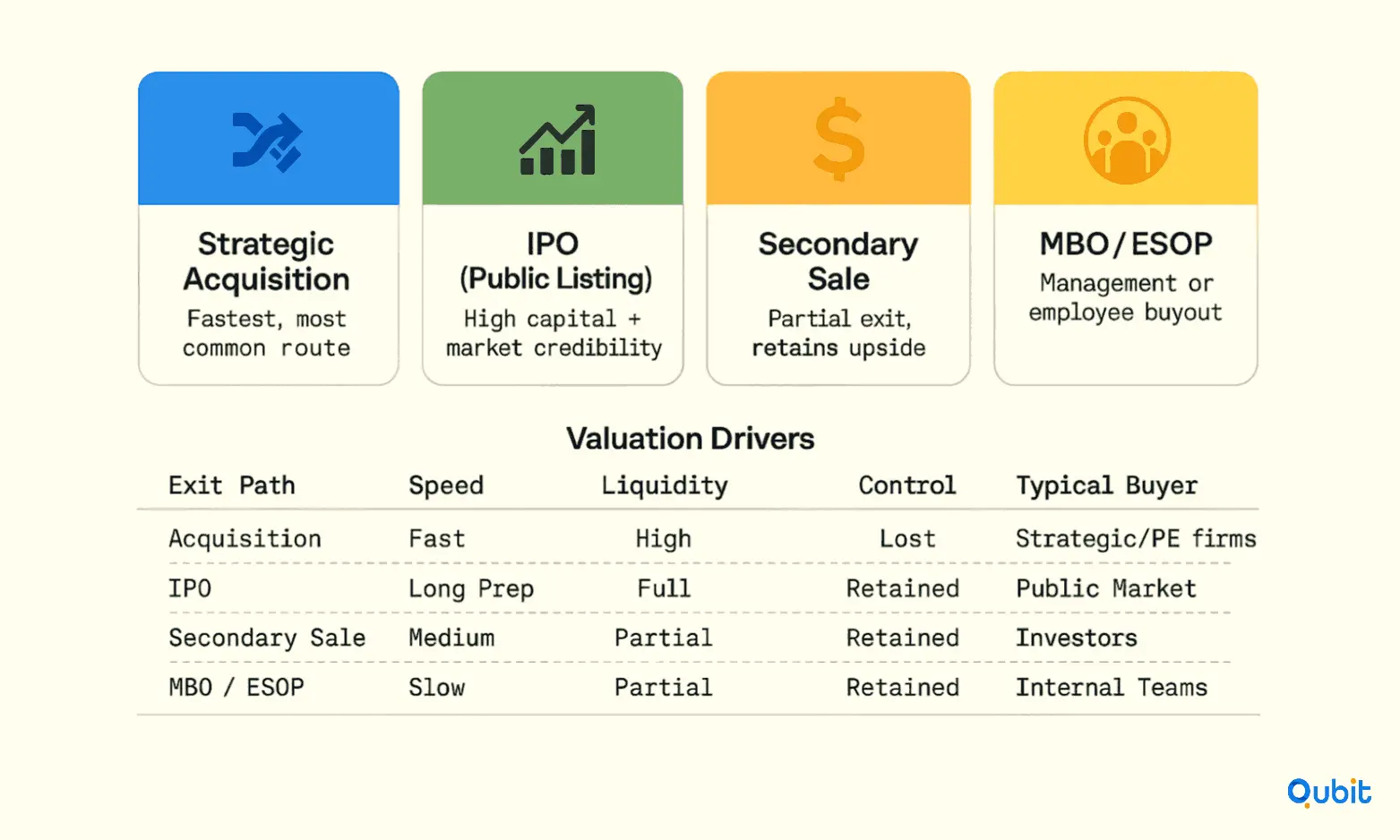
Building on the primary exit options, founders should proactively cultivate relationships with potential acquirers well before seeking an exit. Early engagement allows startups to align their growth strategies with acquirer priorities, increasing the likelihood of a successful transaction. These relationships also provide valuable market feedback and can lead to more favorable deal terms when exit opportunities arise. Establishing trust over time positions the company as a preferred target during acquisition processes.
Flexibility in Exit Strategy Selection
This approach requires founders and investors to maintain flexibility when evaluating exit strategies. Market conditions, company performance, and stakeholder goals can shift unexpectedly, making rigid plans risky. By regularly reassessing available options, teams can pivot to the most advantageous exit path as circumstances evolve. Flexibility ensures that opportunities are not missed and that value is maximized for all stakeholders.
Digital Acquisition Platforms as Exit Channels
Expanding exit options further, digital acquisition platforms now offer streamlined pathways for consumer and marketplace startups to connect with potential buyers. These platforms simplify the transaction process, broaden the pool of interested acquirers, and can accelerate deal timelines. Leveraging such platforms can be especially valuable for companies seeking efficient exits outside traditional M&A or public offerings.
Acquisitions: The Most Common Path
Acquisitions represent the most frequent exit route for consumer and marketplace startups, typically occurring when larger companies purchase startups to access their technology, talent, customer base, or market position.
This exit strategy offers several advantages including faster execution compared to IPOs, more predictable outcomes through negotiated terms, and the potential for strategic synergies between the startup and acquiring company.
Acquisitions are a leading consumer startup exit strategy, offering founders and investors a clear path to liquidity. Industry studies confirm acquisitions are consistently dominant. M&A accounted for 73.7% of venture-backed exits in the U.S. from 2023 to 2025 YTD. This highlights why strategic buyers remain central to most exit outcomes for founders.
Types of Strategic Acquisitions:
| Acquisition Type | Buyer Motivation | Typical Timeline | Valuation Factors |
|---|---|---|---|
| Technology Acquisition | Access to proprietary technology or IP | 3–6 months | Technology differentiation, patent portfolio |
| Talent Acquisition | Acquire skilled teams and expertise | 2–4 months | Team quality, retention agreements |
| Market Expansion | Enter new markets or customer segments | 6–12 months | Market size, customer base quality |
| Competitive Elimination | Remove potential competition | 3–9 months | Market share, competitive threats |
| Vertical Integration | Control supply chain or distribution | 6–18 months | Strategic value, operational synergies |
Acquisition advantages include the ability to provide immediate liquidity to investors and founders, often at premium valuations when strategic value is clear. However, acquisitions may result in loss of company independence, potential restructuring, and founders having limited control over the acquired company's future direction.
Initial Public Offerings (IPOs): The Gold Standard
Going public through an IPO is often considered the gold standard of exits, providing access to significant capital, enhanced company visibility, and the ability for early investors to achieve substantial returns. IPOs enable companies to sell shares to public investors, creating a liquid market for equity positions while maintaining company independence.
IPOs are a prominent startup exit strategy, enabling founders and investors to unlock substantial value. Supporting this gold standard reputation, IPOs remain elusive for most startups. Only 3.8% of U.S. venture-backed exits from 2023 to 2025 YTD were IPOs. This scarcity amplifies the prestige and complexity of the public route.
IPO Advantages:
- Access to large-scale capital markets for continued growth
- Enhanced company credibility and market visibility
- Liquidity for early investors and employees through public trading
- Currency for future acquisitions through publicly traded stock
- Potential for higher valuations compared to private transactions
IPO Challenges:
- Substantial legal, accounting, and regulatory costs (often $3-5 million minimum)
- Extensive regulatory compliance and ongoing reporting requirements
- Market volatility affecting timing and final valuation
- Lock-up periods preventing immediate liquidity for insiders
- Public scrutiny and quarterly earnings pressure
For consumer and marketplace companies, IPOs typically require annual revenues of $100+ million, strong growth trajectories, and proven business models that can withstand public market scrutiny.
Edge case: IPOs may be inappropriate for companies with less than $100m revenue or volatile growth.
Secondary Sales: Partial Liquidity Solutions
Secondary sales allow existing shareholders to sell portions of their equity to new investors without requiring full company exit. This strategy provides interim liquidity while maintaining involvement in the company's continued growth, making it particularly attractive for early investors seeking to reduce risk exposure or diversify their portfolios.
Secondary sales are a flexible startup exit strategy, providing liquidity while maintaining future growth potential.
Secondary Sale Benefits:
- Partial liquidity without complete exit from investment
- Opportunity to reduce risk while maintaining upside potential
- No disruption to company operations or management
- Flexibility to sell additional shares in future transactions
- Validation of company valuation through market transactions
Secondary sales work best for companies that don't require additional capital from the transaction and can attract motivated buyers interested in private market exposure. These transactions often occur during later funding rounds when institutional investors provide liquidity to earlier backers.
Recent market data highlights a geographical spread in exit strategies. Europe accounts for 38% of global startup exits, while the U.S. holds 35%, and Asia 16%. This shift shows secondary sales have gained traction in diverse regions, reflecting global investor demand for liquidity before full exits.
Management Buyouts (MBOs) and Employee Ownership
Management buyouts allow leadership teams to acquire controlling stakes in their companies, ensuring business continuity while providing exit opportunities for existing investors. This approach works particularly well for profitable consumer and marketplace companies where management teams have deep operational knowledge and established customer relationships.
MBO Financing Components:
- Management team personal investment
- Debt financing from banks or lending institutions
- Private equity partnership for additional capital
- Seller financing with flexible payment terms
Employee Stock Ownership Plans (ESOPs) represent an alternative approach that transfers ownership to employees while providing tax advantages and preserving company culture. ESOPs typically cost $50,000-$400,000 to establish with ongoing annual costs of approximately one-third of setup expenses.
Consumer & Marketplace Specific Considerations
Network Effects and Platform Value
Marketplace companies possess unique characteristics that significantly impact exit strategies and valuations. Network effects, where platform value increases with user growth, create powerful competitive advantages but require careful evaluation during exit processes.
Key Marketplace Valuation Factors:
- Liquidity and Transaction Volume: Active buyer-seller matching and transaction frequency
- Market Share and Competitive Positioning: Dominance in specific verticals or geographies
- Unit Economics and Take Rates: Revenue per transaction and margin sustainability
- Customer Acquisition and Retention: Cost efficiency and user stickiness
- Data Assets and Analytics: Customer insights and predictive capabilities
Marketplace exits often attract strategic buyers seeking to expand their platform capabilities or enter new markets. Technology companies, traditional retailers, and financial services firms frequently acquire marketplace platforms to access new customer bases or enhance their digital capabilities.
Consumer Brand Equity and Valuation
Consumer brand companies present distinct valuation challenges during exit processes, as brand equity, customer loyalty, and market positioning represent significant but intangible assets that require sophisticated evaluation methods.
Consumer Brand Value Drivers:
- Brand Recognition and Customer Loyalty: Market research and customer lifetime value analysis
- Distribution Relationships: Retail partnerships and channel access
- Intellectual Property: Trademarks, trade secrets, and proprietary formulations
- Supply Chain Advantages: Manufacturing relationships and cost structures
- Geographic Expansion Potential: International market opportunities
Potential acquirers for consumer brands include large consumer goods companies seeking portfolio expansion, private equity firms focused on consumer investments, and strategic buyers looking to enter new product categories or markets.
Investor Evaluation and Decision-Making
Investors typically expect returns within 5-10 years of initial investment, making exit strategy alignment crucial for successful outcomes. Different investor types have varying expectations and timelines that influence exit planning and execution.
A business exit strategy helps investors plan for returns and align their exit preferences with company goals.
Investor Type Expectations:
| Investor Category | Typical Hold Period | Target Returns | Exit Preferences |
|---|---|---|---|
| Angel Investors | 3-7 years | 10-20x returns | Acquisitions, secondary sales |
| Venture Capital | 5-10 years | 5-15x returns | IPOs, strategic acquisitions |
| Private Equity | 3-7 years | 3-5x returns | Management buyouts, acquisitions |
| Strategic Investors | Variable | Strategic value + returns | Acquisitions, partnerships |
Due Diligence and Exit Preparation
Successful exits require extensive preparation and due diligence to maximize valuation and minimize transaction risks. This process often begins years before the actual exit transaction, involving systematic improvements to financial systems, operational efficiency, and market positioning.
Exit Preparation Checklist:
- Financial Systems: Clean accounting records, audited statements, and predictable revenue streams
- Legal Structure: Proper corporate governance, intellectual property protection, and compliance records
- Operational Efficiency: Documented processes, key person risk mitigation, and scalable systems
- Market Position: Competitive analysis, customer concentration assessment, and growth strategy validation
- Team Stability: Management retention agreements and succession planning
Timing and Market Considerations
Exit timing significantly impacts transaction outcomes, with market conditions, industry trends, and company-specific factors all influencing optimal exit windows. Understanding these dynamics enables better strategic decision-making and value maximization.
Choosing the right exit strategy depends on market trends and company performance.
Optimal Exit Timing Factors:
A well-timed market exit can maximize company valuation and investor returns.
- Market Conditions: Strong M&A activity and favorable valuations in relevant sectors
- Company Performance: Consistent growth, strong financial metrics, and positive momentum
- Industry Trends: Sector consolidation, regulatory changes, or technology disruptions
- Competitive Landscape: Market positioning relative to competitors and potential threats
- Internal Readiness: Management team stability and operational preparedness
Regulatory and Compliance Considerations
Consumer and marketplace companies often face sector-specific regulatory considerations that impact exit processes and valuations. Understanding these requirements early in the investment lifecycle enables better exit planning and risk mitigation.
Common Regulatory Considerations:
- Data Privacy and Security: GDPR, CCPA, and other data protection regulations
- Financial Services: Payment processing, lending, or financial product regulations
- Consumer Protection: Advertising standards, product safety, and disclosure requirements
- Marketplace Regulations: Platform liability, seller verification, and transaction oversight
- Antitrust Considerations: Market concentration and competitive impact assessments
Business Exit Strategy Planning and Implementation
Successful exit strategies require systematic planning that begins during the initial investment phase rather than waiting until exit timing becomes urgent. This approach enables value optimization and reduces execution risks when exit opportunities arise.
Early development of a business exit strategy ensures smoother transitions and maximizes value for all stakeholders.
5-Year Exit Planning Timeline:
Years 1-2: Foundation Building
- Establish robust financial systems and reporting capabilities
- Build strong market position and competitive advantages
- Develop scalable operational infrastructure
- Recruit experienced management team with relevant expertise
Years 3-4: Value Enhancement
- Optimize business model and unit economics
- Expand market reach and customer base
- Strengthen intellectual property portfolio
- Build strategic partnerships and distribution channels
Year 5+: Exit Preparation
- Conduct management presentations and market positioning
- Engage investment banks or exit advisors
- Complete due diligence preparation and documentation
- Execute chosen exit strategy with professional support
Professional Support and Advisory Services
Engaging experienced professionals significantly improves exit outcomes through specialized expertise in valuation, negotiation, and transaction management. The complexity of modern exit transactions makes professional support essential for maximizing value and minimizing risks.
Key Advisory Roles:
- Investment Banks: Transaction execution, buyer identification, and negotiation management
- Legal Counsel: Contract negotiation, regulatory compliance, and risk mitigation
- Tax Advisors: Tax optimization strategies and structure recommendations
- Valuation Experts: Business valuation and financial analysis support
- Industry Specialists: Sector expertise and market intelligence
Common Challenges and Risk Mitigation
Disagreements between buyers and sellers regarding company valuation represent one of the most common challenges in exit transactions. These disputes often arise from differing perspectives on growth potential, market conditions, and competitive positioning.
Valuation disagreements often influence the choice of exit strategy for both buyers and sellers.
Valuation Risk Mitigation Strategies:
- Independent Valuations: Third-party valuation analysis to establish baseline expectations
- Comparable Transaction Analysis: Research similar transactions for benchmark pricing
- Multiple Valuation Methods: DCF analysis, market multiples, and asset-based approaches
- Earnout Structures: Performance-based payments to bridge valuation gaps
- Regular Valuation Updates: Periodic assessments to track value creation progress
Cap Table Complexity and Exit Waterfalls
Cap table (a record of company ownership) and exit waterfall (how proceeds are distributed among investors).
Common Cap Table Issues:
- Stacked Liquidation Preferences: Multiple layers of preferred rights affecting distributions
- Fragmented Ownership: Numerous small investors complicating decision-making
- SAFE (Simple Agreement for Future Equity) Conversion Complications: Uncertain conversion terms creating valuation disputes
- Inadequate Employee Equity: Insufficient stock option pools affecting retention
- Unclear Governance Rights: Ambiguous voting and consent requirements
Exit waterfall analysis reveals how transaction proceeds flow through the cap table, helping identify potential issues before they impact transaction success. Running these scenarios early enables structural improvements that enhance exit prospects.
Case Studies and Market Examples
These consumer brand exits serve as exit strategy examples for founders and investors.
Key Success Factors in Consumer Brand Exits:
For example, Dollar Shave Club's exit to Unilever illustrates the value of brand recognition and customer loyalty in exits.
- Strong brand recognition and customer loyalty metrics
- Diversified product portfolio and revenue streams
- Scalable operational infrastructure and supply chain
- Clear growth opportunities and expansion potential
- Experienced management teams with proven track records
Marketplace Platform Exit Examples
Marketplace platform exits typically focus on network effects, user engagement, and platform scalability as primary value drivers. Successful marketplace exits often involve strategic buyers seeking to expand their digital capabilities or enter new market verticals.
Marketplace exits provide exit strategy examples for platforms leveraging network effects.
Marketplace Exit Value Drivers:
- Active user growth and engagement metrics
- Transaction volume and revenue per user trends
- Market share in target verticals or geographies
- Technology infrastructure and scalability capabilities
- Data assets and customer insights value
Conclusion
Exit strategies are a critical component of successful consumer and marketplace investing, guiding founders and investors toward liquidity events that maximize returns and sustain growth momentum. Acquisitions dominate as the preferred exit mechanism due to their relative speed, predictability, and strategic value alignment, while IPOs offer substantial capital and visibility for market leaders.
Effective consumer startup exit strategies ensure investors and founders achieve their financial and strategic goals. Entrepreneurs and investors who proactively plan and execute thoughtful exit strategies position themselves to reap the full rewards of their investments while laying a foundation for continued success in the evolving consumer and marketplace sectors.
Access our startup fundraising consultation to build a clear, investor-ready strategy that aligns growth, timing, and long-term outcomes.
Key Takeaways
- Consumer brands require evaluation of intangible assets like brand equity and customer loyalty, while marketplaces focus on network effects and platform scalability.
- Exit planning should begin during initial investment phases with systematic value enhancement over 3-5 year periods before transaction execution.
- Professional advisory support from investment banks, legal counsel, and valuation experts significantly improves exit outcomes and transaction success rates.
- Clean cap tables and clear exit waterfalls are essential for successful transactions, requiring early attention to ownership structure and governance rights.
Get your round closed. Not just pitched.
A structured fundraising process matched to your stage and investor fit.
- Fundraising narrative and structure that holds up
- Support from strategy through investor conversations
- Built around your stage, model, and timeline
Frequently asked Questions
What are the best exit strategies for consumer startups?
Acquisitions, IPOs, secondary sales, and management buyouts are top exit strategies for consumer startups. Each offers unique benefits depending on company goals.