

 Back
Back









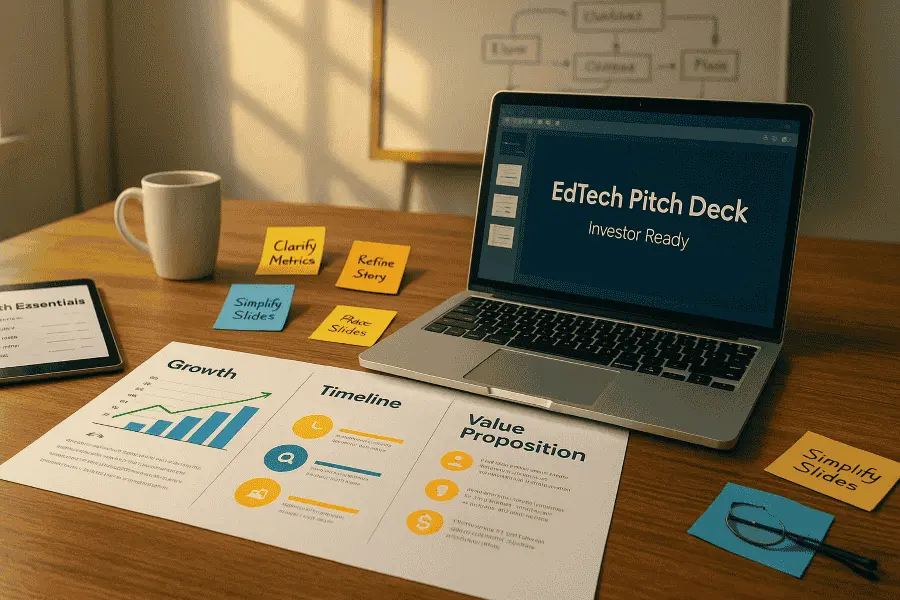
Table of Contents

Building investor trust isn’t just about showing numbers on a slide—it’s about telling a story that makes those numbers feel inevitable.
In EdTech, that story has to do three things fast: prove you understand how learning really works, show why your solution fits into real classrooms or workflows, and convince investors you can survive long sales cycles, regulation, and budget politics. If you skip that context and jump straight to “we’re an AI-powered platform,” you’ll blend in with every other deck in their inbox.
This article explores how to use storytelling to turn your pitch into a clear, credible narrative: who you serve, what painful problem you solve, why you’re uniquely positioned to solve it, and how this becomes a durable, scalable business, not just a nice project. Done right, your story doesn’t just inform investors; it makes them want to be part of the outcome.
What is an EdTech Pitch Deck?
An EdTech pitch deck is a short, structured presentation that explains what you’re building, why it matters in education, and why it’s a strong investment.
It’s not just a slide pack – it’s the main tool you use to build trust with investors. A good deck turns your startup from “another EdTech idea” into a clear, believable story about impact and returns.
Recent data shows why investors care: EdTech companies have achieved average revenue multiples of about 14.4x, compared with roughly 8x for SaaS overall, which signals that education is now seen as a serious growth category, not a side-show. And the global EdTech market itself is projected to grow from about $220.5 billion in 2023 to $810.3 billion by 2033 at a ~13.9% CAGR, underscoring the sector’s scale and momentum. Your pitch deck is where you show how your startup plugs into that upside.
A strong EdTech pitch deck typically:
- Tells a simple narrative: who you serve, what problem you solve, and why now.
- Explains your product and how it actually fits into classrooms, institutions, or learners’ lives.
- Shows your traction: users, pilots, revenue, outcomes, or engagement.
- Quantifies your market (TAM/SAM/SOM) so investors see the size of the opportunity.
- Highlights your business model and unit economics.
- Spells out your defensible edge (data, pedagogy, tech, partnerships).
- Lays out a realistic roadmap and funding ask.
Done well, an EdTech pitch deck ties together market growth, learning impact, and financial upside in one clear story. It becomes the gateway to raising capital, winning partnerships, and earning long-term trust in a crowded, numbers-heavy market.
How to Build an EdTech Pitch Deck
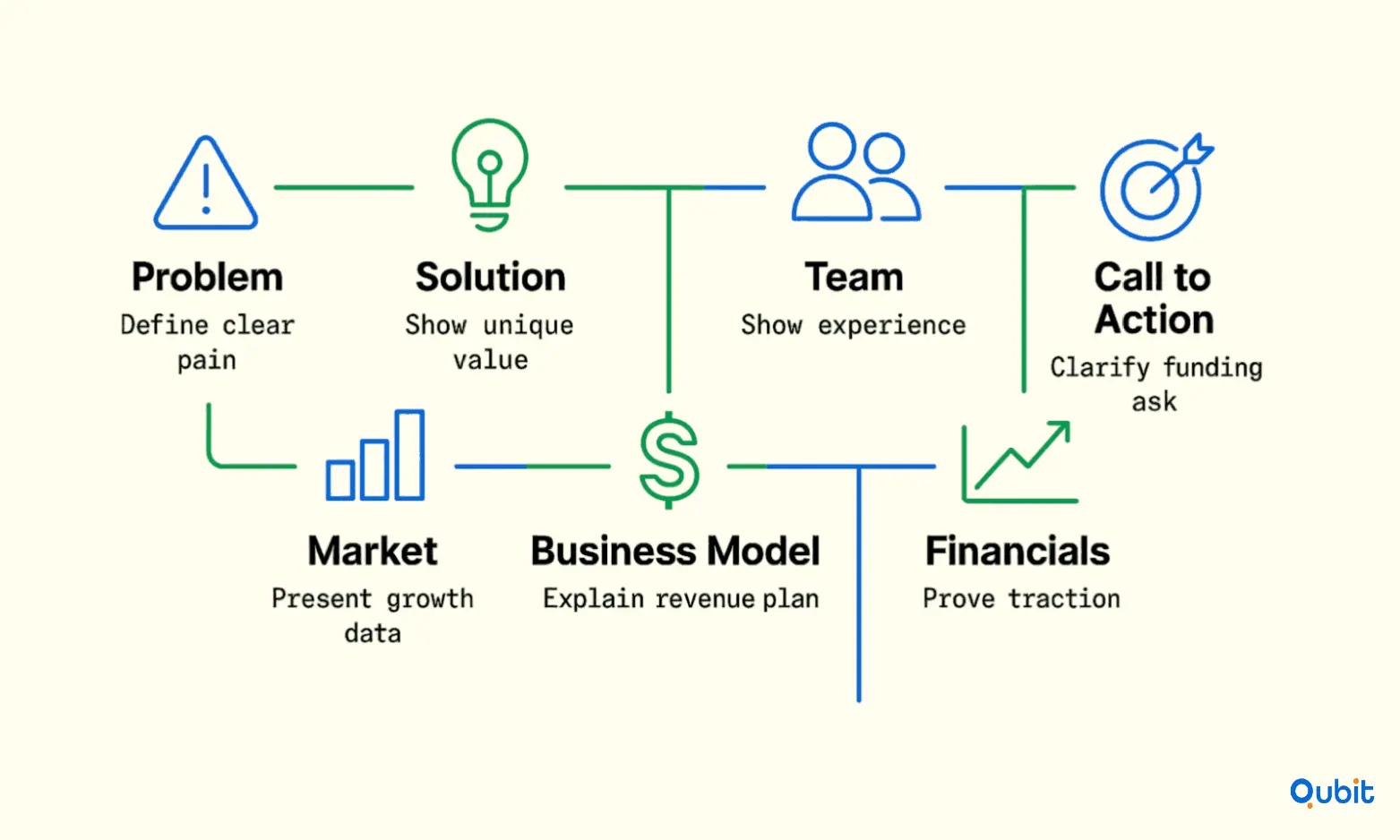
Creating a compelling EdTech pitch deck starts with knowing who you’re talking to and crafting a story that speaks their language.
Begin with storytelling, not slides. Open by clearly defining the problem you’re solving in education—whether it’s access, outcomes, engagement, or skills—and then present your solution in a way that makes the “before vs after” obvious. Your unique value proposition should be explicit and tied directly to the needs of educators, students, institutions, or employers.
Next, anchor your story in market reality. Use data to show:
- The size of the opportunity
- Growth trends in EdTech
- Signals of investor appetite
Then lay out a clear business model:
- Who pays you (schools, districts, universities, employers, parents, learners)
- How you charge (SaaS, per-seat, per-student, usage-based, enterprise deals)
- Why this model can scale efficiently
From there, use visual storytelling, charts, graphs, simple diagrams, to make complex information easy to digest. Show traction, unit economics, and adoption patterns visually rather than burying them in text.
Round out the deck with:
- Financial projections that are ambitious but believable
- Key milestones you plan to hit with this round
- A clear ask (how much you’re raising, what it funds, and what that unlocks)
For a deeper dive into structuring your pitch deck, explore this edtech pitch deck tips resource, which offers insights into visual organization and investor communication strategies.
Edtech Pitch Deck Examples and Ideas
Crafting a compelling EdTech pitch deck requires a balance of creativity, strategy, and clarity. By examining real-world examples and conceptual ideas, you can gain insights into effective design, narrative, and content execution.
Case Studies of Notable EdTech Companies
1. Duolingo – “Make it stupidly simple & human”
What it is: Free, gamified language learning app.
Stage / raise: Early deck that helped them get their first serious funding (pre-unicorn era).
How the deck felt, not just what was on it:
- Design: Literally used a default green PowerPoint gradient, nothing fancy. The magic was in clarity + personality, not design tricks.
- Brand front and center: The green owl mascot appears on multiple slides and even “speaks” in callouts, turning stock photos into part of a story, not random decoration.
- Problem + Solution on one slide: Instead of one “Problem” slide and one “Solution” slide, they forced themselves to explain both in a single, brutally clear slide. If your idea can’t survive that, investors won’t either.
- Simple charts only: No complicated graphs. Just quick, obvious comparisons so an investor can tell at a glance: are you growing or not?
- Short and confident: Around 14 slides total, covering problem, product, market, traction, business model and growth. No filler “mission” fluff.
Story pattern you can copy:
- Brand-y title slide (owl + one-line promise).
- Combined Problem + Product slide that explains the whole story in one breath.
- A few slides on why this way of learning is different (gamification, engagement).
- Simple growth & usage slides.
- Monetization & expansion slides.
Key lesson: They didn’t try to look “serious”; they tried to be impossible to misunderstand.
2. BabySparks – “Emotional problem + ‘de-risk everything’ deck”
What it is: App that helps parents support early childhood development (0–3 years) with daily activities.
Round: $2M seed (2019), B2C app.
How they framed their deck:
- Problem slide = anxiety, not just stats: They lead with the emotional pain of parents who are worried about their baby’s development: no clear guidance, milestone confusion, overwhelming information.
- Solution: A personalized app that adapts to each child – clear “this solves those exact anxieties” connection. The value prop is basically: “your child is unique; the app behaves like it knows that.”
- Business model: Simple subscription with tiered pricing → easy to understand, plus clear upgrade path via premium content / expert consultations.
- Team slide as proof, not biography: They highlight:
- CEO with investment banking background (fundraising + financial discipline).
- COO with three previous exits → direct execution proof.
- Meta-structure: Every slide is treated like part of one argument: “Big emotional problem → tailored product → simple recurring revenue → credible team → low investor risk.”
Story pattern to steal:
- Emotional “parent” or “learner” moment story.
- 3 crisp pain points.
- Product as a direct answer to each pain point.
- Simple subscription & upsell logic.
- Team slide built around: “this is why we specifically can pull this off.”
- “Lessons / proof” slide to pre-empt investor doubts.
Key lesson: The whole deck screams: “Yes, this is emotional and big – but look, we’ve de-risked the hell out of it.”
3. StudySoup – “Data everywhere, story held together by numbers”
What it is: Marketplace where college students buy and sell class notes (C2C).
Round: $300K seed in 2014.
How their pitch deck tells the story:
- Problem slide is very numeric: They quantify the life of a student: “180 hours of lectures and 305 hours of reading” – not “students are busy”, but this much time is being burned.
- Solution: Marketplace for materials from “elite notetakers”, clearly mapping back to time + quality problems.
- Business model: Classic marketplace cut – students pay for notes, notetakers earn, platform takes a slice. Very low cognitive load for investors.
- Traction slide is the star:
- 500,000 registered users
- Revenue doubling every quarter
- Top notetakers making $1,000+ per month, proof that the supply side works and people value the product.
Likely flow / structure (based on Failory breakdown):
- Problem quantified (“students drowning in hours”).
- Solution: “elite notetaker” marketplace.
- Market & opportunity (huge college student base).
- Business model (how money flows).
- Traction (users + revenue growth + top earners).
- Team & roadmap.
Key lesson: They basically weaponised numbers – pain is quantified, traction is quantified, and the business model is painfully obvious.
Audience & Storytelling in EdTech Pitch Decks
Understanding your audience is the cornerstone of creating a compelling EdTech pitch. Investors are not just looking for numbers; they want to see how your solution addresses real-world challenges. By tailoring your narrative to their priorities, you can transform your pitch from a data-heavy presentation into a story that resonates.
Storytelling for EdTech pitches becomes even more impactful when combined with market data. For instance, weaving in statistics about the growing demand for personalized learning tools can underscore the relevance of your product. However, the key lies in presenting this data within a narrative framework—one that highlights the problem, your solution, and the impact it can create. This approach not only builds credibility but also fosters an emotional connection with your audience.
Moreover, aligning your story with the values and goals of your target investors can make your pitch memorable. Are they focused on scalability, innovation, or social impact? Addressing these priorities through storytelling ensures your message sticks.
Ultimately, the best EdTech pitches are those that balance logic and emotion. By integrating storytelling with market insights, you can craft a pitch that not only informs but inspires.
Design and Visual Elements in Edtech Pitch Decks
A well-crafted pitch deck is more than just information, it’s a story told through design. Visual storytelling plays a pivotal role in capturing attention and conveying complex ideas with clarity. Consistent branding is the backbone of a professional pitch deck. By maintaining uniform colors, fonts, and logo placement, your deck exudes credibility and reinforces your brand identity.
Data visualization is another essential element. Transforming raw numbers into charts, graphs, or infographics makes data digestible and impactful. For instance, a bar graph can instantly highlight growth trends, while a pie chart simplifies market share comparisons.
Equally important is the layout. A clean, uncluttered design ensures your message isn’t lost in visual noise. Use white space strategically to guide the viewer’s eye and emphasize key points. Every slide should have a clear focus, with concise text and complementary visuals.
Handling Questions and Objections in EdTech Pitch Decks
Anticipating investor questions is a critical part of crafting a successful Edtech pitch. Investors often probe into areas like market size, scalability, and competitive advantage, so being prepared is essential. Addressing these inquiries with clarity and confidence not only demonstrates expertise but also builds trust.
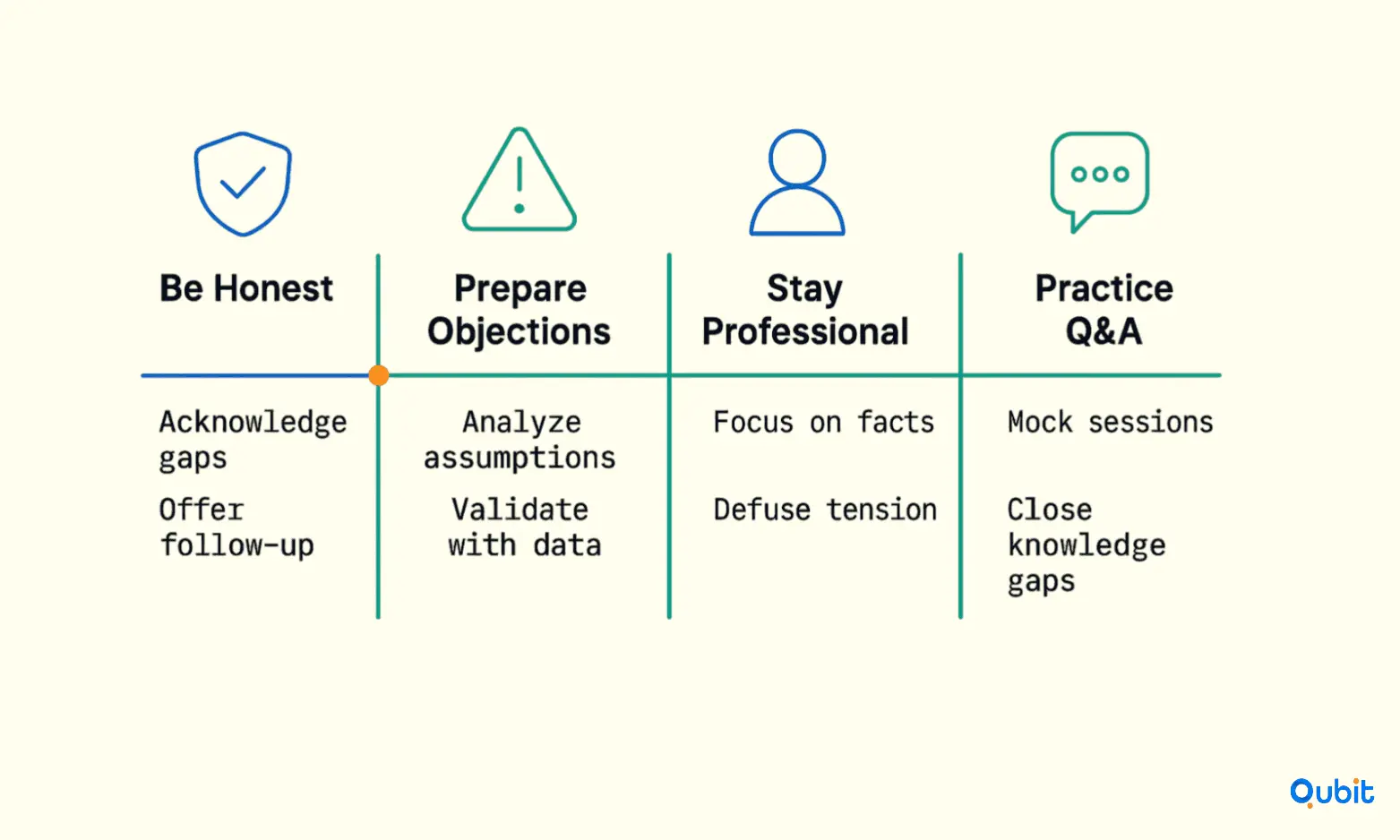
1. Be Honest and Transparent
When faced with tough questions, honesty is your strongest ally. If an answer isn’t readily available, acknowledge it and offer to follow up with detailed information. This approach reflects integrity and fosters credibility.
2. Prepare for Common Objections
Investors may challenge your assumptions or projections. Anticipate these objections by conducting a thorough analysis of your business model, financials, and market research. For example, if scalability is questioned, have data and case studies ready to illustrate your growth potential.
3. Maintain Professionalism Under Pressure
Some questions may feel confrontational, but staying composed is key. Respond calmly, focusing on the facts rather than emotions. This professionalism reassures investors of your ability to handle high-pressure situations.
4. Practice Q&A Sessions
Rehearse potential investor questions with your team or mentors. Mock Q&A sessions can help refine your responses and identify gaps in your preparation.
5. Engage All Investor Firm Roles
Building on the importance of Q&A preparation, founders should actively engage with every member of the investment firm, not just senior partners. Junior associates and analysts often influence internal discussions and can advocate for your startup if they feel respected and included. Authentic, transparent communication with all stakeholders demonstrates humility and professionalism, fostering trust across the firm.
Crucial Considerations in EdTech Pitch Deck Development and Business Strategy
Crafting an impactful pitch deck for EdTech startups demands a blend of strategic insight and innovative storytelling. With venture funding in the sector dropping to $2.97 billion in 2023, an 86% decline from its 2021 peak, founders must deliver compelling, data-driven narratives to secure investor interest.
1. Prioritize Market Research
Understanding your target audience and competitors is foundational. Investors expect startups to demonstrate a clear grasp of market gaps and trends. For example, microlearning platforms, which focus on bite-sized, mobile-friendly modules, are gaining traction due to their high user engagement and retention rates. Highlighting such trends can position your product as a timely solution.
2. Define a Unique Value Proposition
A strong value proposition differentiates your EdTech solution from competitors. BenchSci’s pitch deck, which emphasized its ability to solve pressing industry challenges through data-driven storytelling, helped secure $50 million in Series B funding. Similarly, integrating AI-driven personalization, such as adaptive learning algorithms, can showcase innovation and resonate with investors seeking scalable solutions.
3. Monetization Strategies Matter
Investors are keen on understanding how your business will generate revenue. Whether through subscription models, licensing fees, or partnerships, your pitch deck should outline a clear and sustainable monetization plan. Floqq’s immersive VR/AR learning pitch, which raised $1.1 million in Series A funding, demonstrated how cutting-edge technology can attract funding.
4. Address Regulatory Compliance
EdTech startups must navigate complex regulatory landscapes, including data privacy laws and accessibility standards. Proactively addressing these concerns in your pitch deck builds investor confidence and minimizes perceived risks.
Watch for local data privacy laws or overstated traction which may undermine trust.
5. Time Fundraising to Market Cycles
Strategic timing can significantly influence the success of EdTech fundraising efforts. Investors often concentrate their attention during specific periods, such as Q3-Q4 and Q4-Q1, when market activity peaks and funding decisions accelerate. By aligning your fundraising campaigns with these cycles, you increase the likelihood of capturing investor interest and maintaining momentum throughout the round.
This approach requires careful planning and research into investor behavior and market trends. Founders should schedule concentrated pitch sessions within these windows, signaling progress and urgency to potential backers. Demonstrating awareness of industry timing not only showcases professionalism but also positions your startup as responsive to investor expectations.
- Monitor market cycles to identify periods of heightened investor activity and focus your outreach accordingly.
- Plan pitch sessions and communications within 2-3 week windows to sustain momentum and signal round progress.
- Leverage seasonal trends and industry events to maximize visibility and engagement with targeted investors.
6. Integrate Marketing and PR for Investor Trust
Building investor trust extends beyond the pitch deck itself. Effective EdTech fundraising campaigns leverage multi-channel marketing and strategic PR to enhance credibility and visibility. Content marketing, social media outreach, and investor-focused materials help establish thought leadership and reinforce your startup’s reputation in the education technology sector.
Proactive PR efforts, such as publishing white papers, sharing success stories, and preparing crisis communication plans, demonstrate professionalism and readiness for growth. These initiatives create a positive narrative around your brand, making it easier for investors to recognize your value and potential impact.
- Develop investor-facing content, including case studies and press kits, to build credibility ahead of funding rounds.
- Engage in multi-channel marketing using social media, blogs, and paid campaigns to systematically increase awareness.
- Prepare PR strategies that position your startup as a thought leader and manage communications during challenging periods.
Conclusion
Crafting a compelling pitch deck involves more than just assembling slides; it’s about creating a narrative that resonates with your audience. By defining the purpose of your pitch deck, building it step-by-step, incorporating case studies, and weaving in audience-focused storytelling, you can create a presentation that captures attention and builds trust. Combining effective storytelling with data-driven insights not only enhances your credibility but also strengthens your connection with potential investors.
If your deck needs to connect learning impact, adoption signals, and unit economics into one investor-proof arc, we stitch the story to the numbers. Move ahead with our education technology fundraising services. Book a pitch-readiness sprint this week!
Key Takeaways
- Storytelling bridges emotional appeal with robust market data in EdTech pitches.
- A well-crafted pitch deck can effectively communicate your startup’s value proposition.
- Visual design and clear structure are crucial for engaging investors.
- Preparation for questions and objections strengthens investor confidence.
- Utilizing proven templates and real-world examples can boost funding success.
Frequently asked Questions
How can visual storytelling benefit my EdTech pitch deck?
Visual storytelling enhances your EdTech pitch deck by making data easy to understand. It demonstrates impact visually, keeping investors engaged and focused.