

 Back
Back










Table of Contents

A great pitch deck is not just a slide collection. It is your first serious conversation with investors in a crowded EdTech market. If it does not hook them fast, the meeting is already slipping away.
EdTech is no small playground anymore. By 2030, the global EdTech market is expected to hit $348 billion. That kind of growth attracts capital, competition, and very high expectations. Investors are not just betting on ideas. They are betting on clarity, scale, and execution.
This is where storytelling meets strategy. A strong EdTech pitch deck connects your vision with real market demand, clear data, and a believable path to growth. It shows investors you understand both education and business, which is rarer than it should be.
This guide is built for EdTech founders who want more than polite nods. We will break down how to structure your narrative, present market data with confidence, and design a deck that speaks the investor’s language without losing your mission.
If you are ready to turn innovation into a pitch investors actually remember, you are in the right place. Let’s get into it.
EdTech Pitch Deck Tips: Impact and Purpose
In the EdTech sector, your pitch deck must transcend conventional presentations. It's your platform to articulate a compelling vision that drives both action and investor confidence.
Successful EdTech pitches balance innovation with educational impact. Move beyond mere statistics, investors want to see how your solution transforms learning outcomes and addresses real classroom challenges.
Core Elements for Success:
Focus on three critical components: clear problem identification that resonates with educators and learners, impactful storytelling that demonstrates your solution's real-world value, and concise market data that validates your opportunity.
The framework outlined below will guide you through crafting each component effectively, ensuring your pitch resonates with investors who understand education's unique landscape.
Starting with Limited Resources:
If funding is tight, begin with a streamlined pitch deck. Prioritize market validation through pilot programs, user testimonials, or early adoption metrics. These proof points often carry more weight than elaborate projections, especially when demonstrating traction in educational settings where trust and credibility are paramount.
Your pitch deck’s design finds broader context in how to raise funds for edtech startups, aligning its components with the overarching fundraising strategies discussed there.
Startups like yours already closed their rounds with us.
Founders across every stage and industry. Here's what it took.
- Raised $7.6M for Swiipr Technologies
- Raised $0.5M for Ap Tack
- Raised €0.5M for Ivent Pro

Pitch Deck Development: Structuring Your EdTech Deck
A well-organized pitch deck is essential for clarity and investor engagement. Each slide should serve a specific purpose, contributing to the overall story of your business. Start with proven edtech pitch deck tips to ensure each slide serves a strategic purpose.
1. Start with the Problem
Begin by identifying the core problem your EdTech solution addresses. Investors need to understand the pain points your target audience faces and why existing solutions fall short. Use concise language and impactful visuals to illustrate the problem clearly.
- Tip: Include real-world examples or statistics to make the problem relatable. As context, EdTech products surged from $4 billion in 2018 to $22.4 billion projected by 2025, showing rapid sector adoption. Presenting numbers like these helps investors grasp urgency and demand.
- Visual Design Insight: Opt for clean, uncluttered slides with bold headings to emphasize key points.
2. Present Your Solution
Highlight how your product or service addresses the identified pain points. Emphasize your unique approach clearly.
- Tip: Use a combination of visuals and concise text to demonstrate how your solution works.
- Emotional Resonance: Share a brief story or testimonial that showcases the impact of your solution.
3. Showcase Market Opportunity
Investors want to see the potential for growth. Use this slide to present the size of your target market, key trends, and any gaps your solution fills.
| Market Segment | Definition | Role in Pitch Deck |
|---|---|---|
| TAM (Total Addressable Market) | All potential users or revenue globally | Shows the largest possible opportunity |
| SAM (Serviceable Available Market) | Subset you can realistically serve | Focuses on reachable customers |
| SOM (Serviceable Obtainable Market) | Portion you can capture soon | Sets realistic short-term goals |
- Data-Driven Validation: Incorporate charts or graphs to visualize market data.
- Clarity: Avoid overwhelming the slide with excessive information; focus on the most compelling metrics.
4. Outline Your Business Model
Explain how your EdTech company generates revenue. Whether it’s subscription-based, licensing, or freemium, provide a clear breakdown of your pricing strategy and revenue streams.
Startup financial planning is essential. Recent data shows EdTech platform development and licensing typically require about $310,000 in initial capital expenditure. Sharing cost details like these strengthens your credibility and helps align investor expectations.
- Tip: Include projections to demonstrate scalability.
- Visual Design: Use diagrams or flowcharts to simplify complex models.
5. Highlight Your Team
Investors invest in people as much as they do in ideas. Dedicate a slide to showcasing your team’s expertise, experience, and passion for the mission.
- Tip: Include headshots, brief bios, and key achievements.
- Emotional Resonance: Emphasize the team’s commitment to solving the problem.
6. Financials and Traction
Provide a snapshot of your financial performance and key milestones. Highlight metrics such as revenue growth, user acquisition, or partnerships that validate your progress.
- Data-Driven Validation: Use graphs and charts to make financial data digestible.
- Clarity: Keep the slide focused on the most relevant metrics for your stage of growth.
7. Call to Action
End your pitch deck with a clear and compelling call to action. Specify the funding amount you’re seeking and how it will be used to achieve your next milestones.
- Tip: Be specific about the impact of the investment.
- Visual Design: Use bold text and contrasting colors to make the call to action stand out.
For a deeper analysis of structural elements, explore the edtech series a pitch deck, illustrating how your approach to series funding rounds can be refined for better investor alignment.
Rehearse and Refine Your Pitch Delivery
Building on your completed pitch deck, dedicate time to rehearsing your delivery. Practice aloud to refine timing and clarity, ensuring each slide transitions smoothly. Seek feedback from mentors or pitch coaches to identify areas for improvement and address potential questions. This preparation builds confidence and helps you handle investor interactions with poise.
Investors seek relatable stories, clear data, and compelling visuals.
Common Pitfalls to Avoid in EdTech Pitch Decks
- Failing to specify a clear funding ask with milestones can confuse investors and weaken your credibility.
- Omitting a competitive analysis slide leaves investors uncertain about your market positioning and differentiation.
- Overloading slides with excessive data or text reduces clarity and distracts from your core message.
Balancing Emotional Resonance and Data-Driven Validation
A successful pitch deck strikes a balance between emotional appeal and factual evidence. While data builds credibility, emotional resonance creates a connection with investors.
Quantitative proof resonates strongly with investors. In 2025, 21 successful EdTech pitch decks are analyzed for their data-driven impact. These real examples demonstrate that solid metrics and transparent evidence consistently increase engagement and funding outcomes.
- Emotional Resonance: Use storytelling to humanize your solution and demonstrate its impact.
- Data-Driven Validation: Back your narrative with metrics, charts, and projections to substantiate your claims.
By combining these elements, you can craft a pitch deck that not only informs but inspires.
Visual Design: A Key Differentiator
The design of your pitch deck plays a crucial role in capturing attention and conveying professionalism.
- Consistency: Use a cohesive color palette and font style throughout the deck.
- Clarity: Ensure text is legible and visuals are easy to interpret.
- Impact: Incorporate high-quality images or icons to enhance visual appeal.
Remember, a well-designed pitch deck reflects your attention to detail and commitment to excellence.
Crafting an effective pitch deck is a critical step in securing funding for your EdTech venture. If you're ready to take your pitch to the next level, we at Qubit Capital are here to support you with our Pitch Deck Creation service. Contact us today to get started.
Essential Resources to Enhance Your EdTech Journey
Modern EdTech founders can gain rapid feedback on crucial business metrics. With multi-LLM orchestration, over 50 startup metrics are now evaluated instantly. Leveraging these analytics helps founders strengthen their pitch decks, paving the way for success in accelerators and competitions.
Expanding your EdTech startup requires more than just a great idea, it demands access to tools, networks, and opportunities that can propel your venture forward. Below, we’ve curated a selection of resources that provide structured support, mentorship, and community engagement to help refine your pitch deck and accelerate growth.
1. EdTech Accelerators and Incubators
Joining an accelerator program can be transformative for your startup. These initiatives offer structured mentorship, funding opportunities, and access to industry experts. For instance, ImagineK12 is a standout program designed specifically for EdTech startups. It provides tailored mentorship and guidance to help founders navigate the complexities of scaling their businesses.
2. Pitch Contests for Feedback and Exposure
Pitching your ideas to a panel of experts not only sharpens your presentation skills but also connects you with changemakers in the EdTech space. Consider participating in a specialized pitch contest like the one offered by Michigan Virtual, which provides valuable feedback, exposure, and access to a community of innovators.
3. Building Collaborative Networks
Strong partnerships can amplify your reach and impact. Michigan Virtual, for example, collaborates with over 500 school districts, showcasing the scale of potential collaborations available in the EdTech ecosystem. Highlighting such partnerships can strengthen your pitch deck and demonstrate your ability to scale effectively.
4. Podcasts and Online Communities
Staying informed and connected is vital for any founder. Podcasts focused on EdTech trends and challenges can provide actionable insights, while online communities offer a platform for peer-to-peer learning and feedback. Engaging with these resources ensures you stay ahead of industry shifts and refine your strategies based on real-world experiences.
Accessing accelerators, mentorship opportunities, and community feedback can significantly boost your EdTech venture. By tapping into these resources, you gain accountability and strategic guidance that are essential for growth.
Transforming Concepts into Tangible Impact
Turning ideas into measurable outcomes is a challenge that requires more than just innovation. It demands a structured approach, combining strategic planning, pilot testing, and active collaboration with stakeholders.
EdTech is in a period of extraordinary market expansion. By 2025, global EdTech spending is set to surpass $404 billion, with annual growth rates near 16%. This surge underscores why structured planning and milestone-driven execution create measurable competitive advantage in today's landscape.
For a pitch deck for online learning startups, structured planning and collaboration are essential for measurable outcomes.
1. Strategic Planning: Laying the Foundation
A well-thought-out strategy is the backbone of any impactful initiative. It involves defining clear objectives, identifying potential challenges, and aligning resources to meet goals effectively. Strategic planning ensures that every step taken is purposeful and aligned with the desired outcomes.
For instance, EdTech platforms like Mentorcam have demonstrated the importance of strategic planning. By offering personalized coaching sessions with measurable engagement, Mentorcam secured $1.5M in seed funding after participating in an accelerator program. This success underscores how a robust plan can validate a concept’s viability and attract investor trust.
2. Pilot Programs: Testing and Refining Ideas
Pilot programs serve as a critical testing ground for new ideas. They allow organizations to assess feasibility, gather feedback, and refine their approach before scaling. Importantly, these programs should be supported by clear metrics to evaluate success.
Take the development of AI-Driven Low-Tech Solutions as an example. These tools are designed to operate in low-connectivity areas, making them ideal for underserved regions. By piloting such solutions, organizations can expand their addressable market while ensuring the technology meets the needs of its users.
3. Stakeholder Engagement: Building Trust and Collaboration
Engaging stakeholders early and often is essential for creating lasting impact. This includes investors, end-users, and community leaders who can provide valuable insights and support. Active collaboration fosters trust and ensures that the final product or service aligns with the needs of its audience.
When stakeholders are involved in the planning and pilot phases, they become advocates for the initiative, further amplifying its reach and impact.
Emerging Trends and Future Opportunities
The landscape of innovation continues to evolve, with trends like AI-driven solutions and personalized learning platforms leading the way. These advancements not only address current challenges but also open doors to new opportunities for growth and impact.
By focusing on strategic planning, leveraging pilot programs, and fostering stakeholder collaboration, organizations can transform their concepts into tangible outcomes that drive meaningful change.
Initiating Your EdTech Journey: Actionable Steps
Starting your EdTech venture requires a clear roadmap to ensure success. To get started, focus on building a strong foundation by identifying your unique value proposition and creating a minimal viable product (MVP) early in the process. These steps will help you establish credibility and attract initial interest from stakeholders.
A pitch deck for online learning startups should highlight your roadmap and MVP to attract investors.
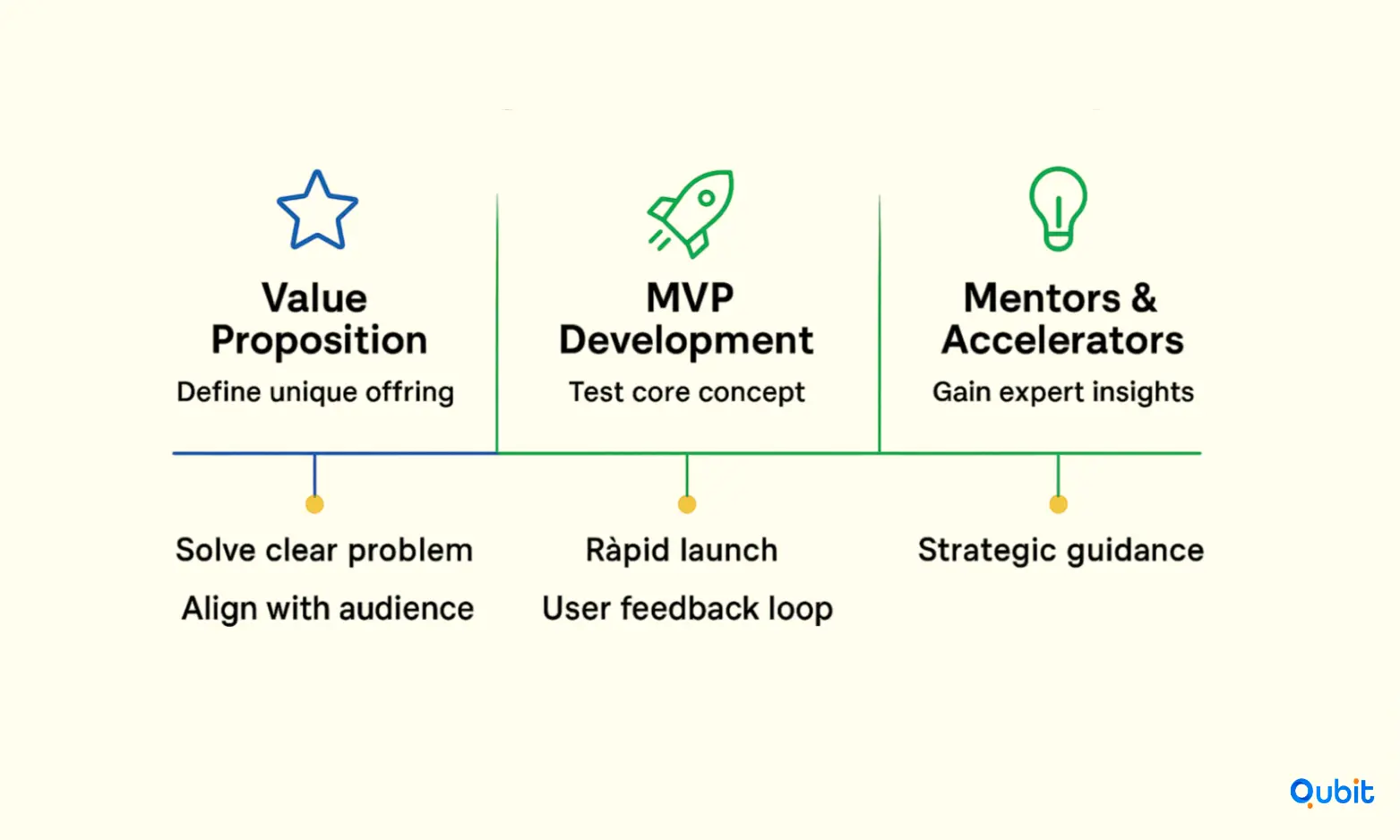
1. Clarify Your Unique Value Proposition
Your value proposition is the cornerstone of your EdTech business. It defines what sets your solution apart from competitors and why users should choose it. Begin by identifying the specific problem your product solves and the audience it serves. For example, are you addressing gaps in personalized learning or simplifying administrative tasks for educators? Once defined, articulate this clearly in your pitch deck and marketing materials to ensure alignment across all communication channels.
A strong value proposition is essential for effective pitch deck development.
2. Develop a Minimal Viable Product (MVP)
An MVP is the simplest version of your product, built to test your core idea with real users. By focusing only on essential features, you can validate assumptions quickly without burning time or capital. Zero in on one critical pain point and solve it exceptionally well. For example, an adaptive learning platform should start with a single subject or grade level, not full-scale coverage. This focus speeds up iteration and sharpens feedback.
Launch with a small, well-matched group of educators or students. Track usage metrics and completion rates, and pair them with interviews or classroom observations. Together, these insights explain both what users do and why. Document everything. Investors look for early proof of product–market fit, and even limited traction can validate demand. Use these metrics in your pitch deck to back your vision with evidence.
3. Seek Feedback from Mentors and Accelerators
Engaging with mentors and accelerators early can significantly shape your strategy. These experts offer critical perspectives on your pitch deck, business model, and go-to-market approach. Their feedback helps you identify blind spots and refine your messaging. Additionally, accelerators often provide access to networks, funding opportunities, and resources that can fast-track your growth.
By taking these actionable steps, you’ll establish a solid foundation for your EdTech journey, ensuring your product resonates with users and stands out in the competitive market.
Conclusion
A strong EdTech pitch deck is not about packing in slides. It is about telling a clear, credible story investors can believe in. When you define the problem precisely, anchor your narrative in real data, and align every insight with investor priorities, your deck shifts from informative to persuasive.
The best pitch decks show more than potential. They prove traction, respect constraints like budgets and privacy, and connect learning outcomes to scalable business impact. That is what turns interest into conviction.
If your raise needs to unify efficacy data, budget cycles, and privacy-by-design into one investable arc, we make it investor-ready. Move forward with our edtech fundraising assistance. Run a due-diligence dry run!
Key Takeaways
- Your EdTech pitch deck is your first real investor conversation, not a slide dump, and attention is lost in seconds.
- Investors back clarity, execution, and scale, not just bold ideas in a $300B-plus market.
- Strong EdTech decks blend storytelling with proof, showing you understand classrooms and balance sheets.
- Clear problem definition beats flashy features every single time.
- Early traction, pilots, and real users matter more than perfect forecasts when resources are tight.
- Every slide must earn its place by pushing the story forward with purpose.
- Emotional impact opens doors, but data is what keeps investors listening.
- A memorable pitch aligns mission, market demand, and a believable path to growth.
Get your round closed. Not just pitched.
A structured fundraising process matched to your stage and investor fit.
- Fundraising narrative and structure that holds up
- Support from strategy through investor conversations
- Built around your stage, model, and timeline
Frequently asked Questions
What are the key edtech pitch deck tips for raising funds?
Focus on a clear problem, strong learning outcomes, and real traction like users, revenue, or pilot results. Show scalability, defensible tech, and how you’ll win in a crowded edtech market without burning cash.