

 Back
Back









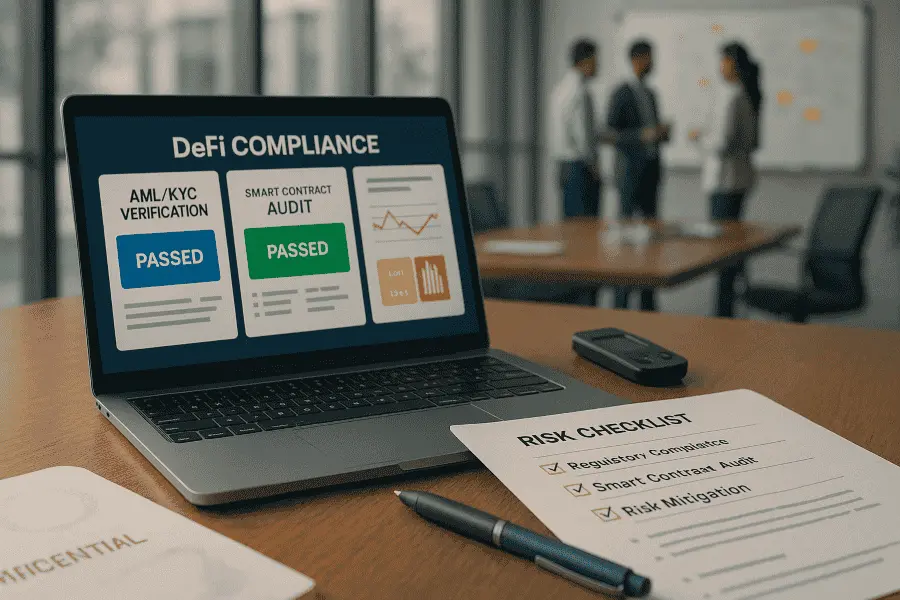
Table of Contents

The DeFi revolution has unlocked new avenues for blockchain startups to raise capital, but it’s also brought a complex landscape of risk and compliance. As a founder, you must balance innovation with operational resilience, regulatory clarity, and investor trust. In 2025, this balance is more critical than ever. Regulatory frameworks like MiCA, DORA, and new IRS and Treasury rules are reshaping how DeFi projects operate and raise funds, especially in the US and Europe.
Recent forecasts point to extraordinary expansion. DeFi market size projection estimates a jump from $20.76 billion in 2024 to $637.73 billion by 2032. This rate of growth underscores why compliance, risk management, and investor confidence are now foundational for fundraising success.
This article is your comprehensive guide to navigating these challenges, with actionable strategies and internal links to help you build a compliant, resilient DeFi fundraising engine.
Why Is Compliance Critical for DeFi Capital Raising?
To raise capital in DeFi, founders must implement robust compliance and risk management strategies from the outset.
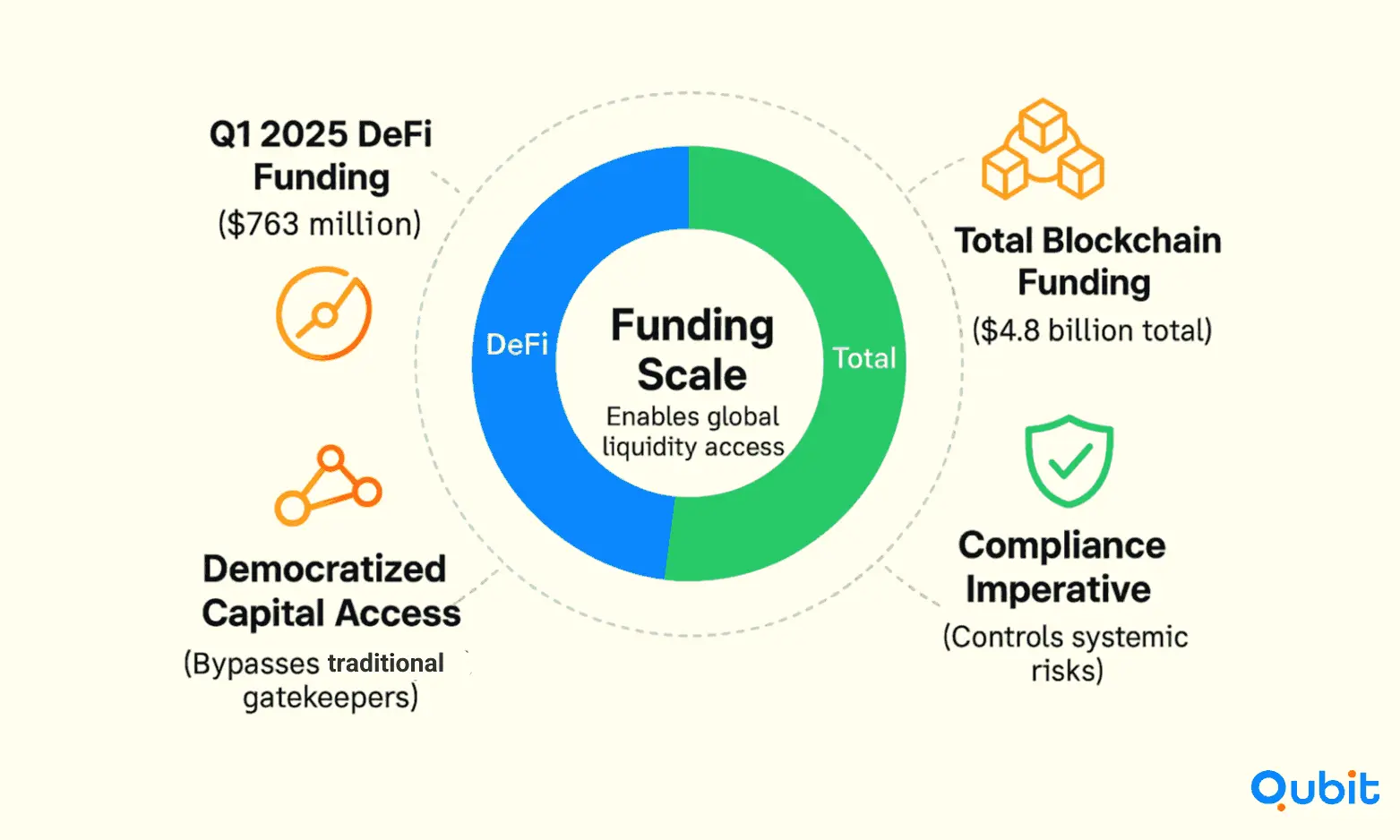
Decentralized finance (DeFi) has democratized access to capital, enabling blockchain startups to bypass traditional gatekeepers and tap into global liquidity pools.
The capital landscape is expanding. As of early September 2024, total crypto market capitalization stood at $2.01 trillion, with stablecoins comprising 8.5% or $171 billion. For founders, this pool amplifies access yet multiplies compliance and reporting obligations.
AML Compliance Challenges Unique to DeFi
This opportunity requires founders to address anti-money laundering risks that arise from DeFi’s pseudonymous and decentralized design. Traditional AML frameworks struggle to track transactions and verify identities in decentralized environments. Founders must adopt tailored solutions such as on-chain analytics, privacy-preserving KYC, and embedded smart contract controls. These approaches help build investor trust and meet evolving regulatory standards.
Startups like yours already closed their rounds with us.
Founders across every stage and industry. Here's what it took.
- Raised $7.6M for Swiipr Technologies
- Raised $0.5M for Ap Tack
- Raised €0.5M for Ivent Pro

What Is the Regulatory Landscape for DeFi Fundraising?
The regulatory environment for DeFi compliance is evolving rapidly. Europe’s Markets in Crypto-Assets Regulation (MiCA – rules for crypto assets), Digital Operational Resilience Act (DORA – operational rules for finance), and Directive on Security of Network and Information Systems (NIS2 – cybersecurity standards) are setting new standards for cybersecurity, operational resilience, and investor protection.
MiCA sets new standards for crypto assets. DORA and NIS2 focus on operational resilience and cybersecurity for DeFi projects. In the US, the IRS and Treasury have introduced new tax reporting rules, including Form 1099-DA, stricter cost basis tracking, and lower reporting thresholds for digital asset transactions.
Key compliance requirements for DeFi fundraising in 2026 include anti money laundering cryptocurrency obligations:
- Secure key management and rapid incident reporting
- Third-party risk monitoring and operational resilience
- Transparent tax reporting and basis tracking for all token transactions
- Anti-abuse measures to prevent obfuscation of gains and losses
What Are the Core Risks in DeFi Capital Raising?
1. Smart Contract Vulnerabilities
Smart contracts are the backbone of DeFi fundraising, but they’re also a top risk for DeFi compliance. In 2024, DeFi hacks and exploits resulted in over $1.5 billion in losses. Vulnerabilities in token sale contracts, liquidity pools, governance modules, or DeFi protocols can destroy trust overnight.
Mitigation strategies:
- Invest in third-party security audits before launching any fundraising contract.
- Establish a bug bounty program to incentivize white-hat disclosures.
- Use modular, well-tested contract libraries.
- Learn from the case studies in DeFi funding models, where security-first projects consistently attract more capital.
Consider edge cases, like non-standard token structures or operating in jurisdictions lacking DeFi regulation.
2. Regulatory Non-Compliance
New reporting and tax rules are now strictly enforced. The IRS requires brokers and some DeFi platforms to report all digital asset sales above $600 using Form 1099-DA, with cost basis tracking set to become mandatory by 2026.
Rapid expansion heightens these challenges. DeFi sector CAGR is projected at 46.8% between 2024 and 2032. Such accelerated growth demands strong compliance and adaptive risk controls for sustainable fundraising.
Mitigation strategies:
- Implement KYC/AML procedures, even if your protocol is permissionless.
- Track all token swaps, staking rewards, and liquidity pool transactions for accurate tax reporting.
- Consult with tax professionals to ensure compliance with US, EU, and other relevant jurisdictions.
- For a deeper dive, see how DeFi investment trends are influencing compliance expectations.
3. Third-Party and Oracle Risks
DeFi fundraising often relies on oracles and third-party infrastructure. These dependencies introduce external risks.
Mitigation strategies:
- Use decentralized, redundant oracle networks.
- Monitor third-party service providers for operational reliability and regulatory standing.
- Have contingency plans for oracle failure or manipulation.
Illicit Finance Risks and Continuous Monitoring
Beyond third-party vulnerabilities, DeFi faces illicit finance risks such as laundering through decentralized exchanges, mixers, and cross-chain bridges. These channels can be exploited by cybercriminals to obscure transaction flows and evade detection. Continuous, real-time monitoring using advanced analytics is essential to identify suspicious activity and maintain compliance.
4. Investor Protection and Governance
Decentralized fundraising can expose projects to governance attacks or rug pulls. Institutional investors are especially wary of projects without clear legal enforceability or robust governance.
Mitigation strategies:
- Design transparent, on-chain governance with clear voting and proposal mechanisms.
- Lock team and advisor tokens with vesting schedules.
- Publish regular, auditable reports on treasury management and protocol upgrades.
What Should DeFi Founders Know About Tax Reporting?
The IRS and Treasury’s final regulations now require detailed reporting for DeFi fundraising activities, including token sales, swaps, staking rewards, and liquidity pool participation. The reporting threshold for NFTs and stablecoins is now just $600, and brokers must issue Form 1099-DA for all qualifying transactions.
1. Token Swaps and Sales
Swapping one token for another is a taxable event. You must track the fair market value at the time of the swap and report gains or losses.
2. Staking and Yield Rewards
Staking rewards are taxed as ordinary income when received, and subsequent sales are subject to capital gains tax. Accurate record-keeping is essential.
Founders should also ensure aml compliance blockchain standards are met when reporting transactions.
3. Liquidity Pools
Depositing or withdrawing from a liquidity pool can trigger taxable events. Rewards from fees are ordinary income, and all transactions must be tracked for compliance. For more, see DeFi liquidity funding for how liquidity pools affect both funding and compliance.
4. Airdrops and Bonuses
Airdropped tokens and referral bonuses are taxed as income when received, with subsequent sales triggering capital gains events.
Tip: Use automated tax tracking tools and consult professionals to avoid costly errors.
The scope of reporting continues to broaden. In 2024, DeFi market valuation reached $78.5 billion, with forecasts to $183.53 billion by 2032 at 11.2% CAGR. Thorough record-keeping protects founders as taxable events multiply with sector expansion.
Why Does Institutional Capital Require DeFi Compliance?
Despite technical progress, institutional capital is still cautious about DeFi. The main barrier is legal enforceability and unresolved regulatory risk. While asset managers and hedge funds are active, pensions and endowments are waiting for clearer standards.
What founders should do:
- Build compliance into your protocol from day one.
- Document all legal opinions, audits, and compliance frameworks.
- Engage with institutional investors to understand their risk thresholds and reporting needs.
What Are the Best Practices for DeFi Fundraising Compliance Strategies?
1. Proactive Legal and Regulatory Monitoring
Monitor global regulatory developments, including anti money laundering cryptocurrency rules, and adapt your fundraising model accordingly. Engage legal counsel familiar with DeFi and digital asset law.
2. Transparent Governance and Community Engagement
- Adopt transparent, on-chain governance with regular community updates. Use DAOs or similar structures to align incentives and build trust.
- Ensure your protocol meets crypto AML compliance standards. Use DAOs or similar structures to align incentives and build trust.
- Adopt transparent, on-chain governance with regular community updates. Ensure your protocol meets crypto AML compliance standards. Use DAOs or similar structures to align incentives and build trust.
3. Embedding AML Controls in DeFi Protocols
Building on transparent governance, founders should embed AML controls within smart contracts and DAO frameworks. This includes automated transaction monitoring, multi-signature approvals for high-risk transfers, and on-chain voting to enforce compliance policies. These measures create auditable records and align community incentives with regulatory requirements.
Conclusion
Raising capital via DeFi is no longer the regulatory “wild west.” In 2025, DeFi compliance is essential as founders must navigate a complex matrix of operational, legal, and tax risks to build trust with both retail and institutional investors.
The DeFi projects that thrive will be those that treat risk management as a core product feature, not an afterthought. Build compliance into your DNA, and you’ll be well positioned to access global capital and scale with confidence.
Stay updated on regulatory changes in your target fundraising markets. Build relationships with legal advisors who specialize in DeFi and digital assets. We at Qubit Capital provide expert Fundraising Assistance to help navigate complex financing landscapes. Let’s connect and explore how we can support your journey toward success.
Key Takeaways
- DeFi fundraising offers massive growth potential, but success now depends on strong compliance, risk management, and investor transparency.
- Regulations such as MiCA, DORA, and new IRS reporting rules are reshaping how DeFi startups raise capital and manage operations.
- Security risks like smart contract vulnerabilities, oracle dependencies, and governance attacks must be addressed through audits, monitoring, and transparent governance.
- Accurate tax reporting for token sales, swaps, staking rewards, and liquidity pools is essential as regulatory oversight increases.
- Institutional investors favor DeFi projects that embed compliance, AML controls, and operational resilience into their protocols from the start.
Get your round closed. Not just pitched.
A structured fundraising process matched to your stage and investor fit.
- Fundraising narrative and structure that holds up
- Support from strategy through investor conversations
- Built around your stage, model, and timeline
Frequently asked Questions
What does DeFi compliance mean for crypto fundraising?
DeFi compliance means meeting the legal, tax, and operational standards that regulators require for decentralized finance fundraising activities. This includes implementing KYC/AML procedures, following securities laws for token sales, and maintaining proper transaction records. Founders who build compliance into their fundraising model from day one are better positioned to attract capital and avoid enforcement actions.