

 Back
Back









Table of Contents

Global expansion is a high-leverage move if you want to outpace competitors and stay attractive to investors. For startups, it can be the fastest path to bigger customers and stronger positioning. For established companies, it can diversify revenue, reduce market risk, and grow brand visibility across regions.
But ambition is not a strategy. Winning internationally needs clear differentiation and tight execution. You have to know why your product wins in a new market, how you will enter, and what you will do better than local incumbents.
The opportunity is real and growing. Global software spending hit USD 675 billion in 2024, nearly 50% higher than in 2020, which signals rising demand and a larger runway for tech companies expanding abroad.
Next, we will break down the essential strategies to help you expand globally with confidence and avoid expensive missteps. Let’s dive into the essential strategies that can propel your business toward global success.
Global Expansion Importance for Tech Startups
Expanding internationally offers tech startups a unique opportunity to amplify their growth potential and establish credibility in competitive markets. Global expansion allows tech startups to boost funding, enter new markets, and build investor confidence. By entering global arenas, startups can access untapped customer bases and diversify revenue streams. Exposure to varied market dynamics also fosters innovation.
Additionally, global expansion provides a solution to market saturation challenges. When domestic markets become crowded, entering international territories can rejuvenate growth trajectories and ensure long-term sustainability. This strategy not only enhances brand visibility but also positions startups as credible players on a global scale, fostering trust among customers and investors alike.
For startups seeking to align their global expansion strategies with effective fundraising tactics, our guide on software startup fundraising strategies offers comprehensive steps to secure diverse capital sources.
Using Investor Support for Global Growth
Building on these advantages, startups can accelerate global expansion by partnering with investors who provide both capital and operational expertise. Flexible financing from experienced backers enables companies to pursue international opportunities confidently and scale efficiently. Operational support, such as access to dedicated growth teams or strategic guidance, helps startups navigate unfamiliar markets and regulatory complexities. This approach reduces risk and increases the likelihood of sustainable global success.
Preparation for Global Expansion
Expanding into international markets requires a thorough understanding of the unique challenges and opportunities each region presents. Success hinges on conducting detailed research. Pay special attention to market conditions, local regulations, and cultural dynamics.
Key Areas of Research
Market Conditions
Assessing demand, competition, and economic trends in the target region is essential. Tools like Google Market Finder can help identify high-potential markets by analyzing search data and consumer behavior.Regulatory Compliance
Each country has its own legal framework governing business operations, taxation, and employment. Staying compliant with these regulations is non-negotiable. For instance, understanding import/export laws or data privacy requirements can prevent legal complications.Cultural Dynamics
Cultural nuances influence consumer preferences, communication styles, and business etiquette. Ignoring these factors can lead to misunderstandings or alienate potential customers. Resources like Statista provide valuable insights into demographic trends and cultural behaviors.
Pre-Expansion Readiness Checklist
- Evaluate product-market fit in the target region by gathering local customer feedback and analyzing competitive offerings.
- Assess operational readiness, including supply chain capabilities, staffing needs, and support infrastructure for new markets.
- Analyze cost implications such as regulatory fees, localization expenses, and ongoing operational overhead for each region.
- Identify potential legal or compliance barriers that could delay or complicate market entry in specific countries.
- Develop a phased entry plan with clear milestones and contingency strategies to address unforeseen challenges.
Global Expansion Strategies
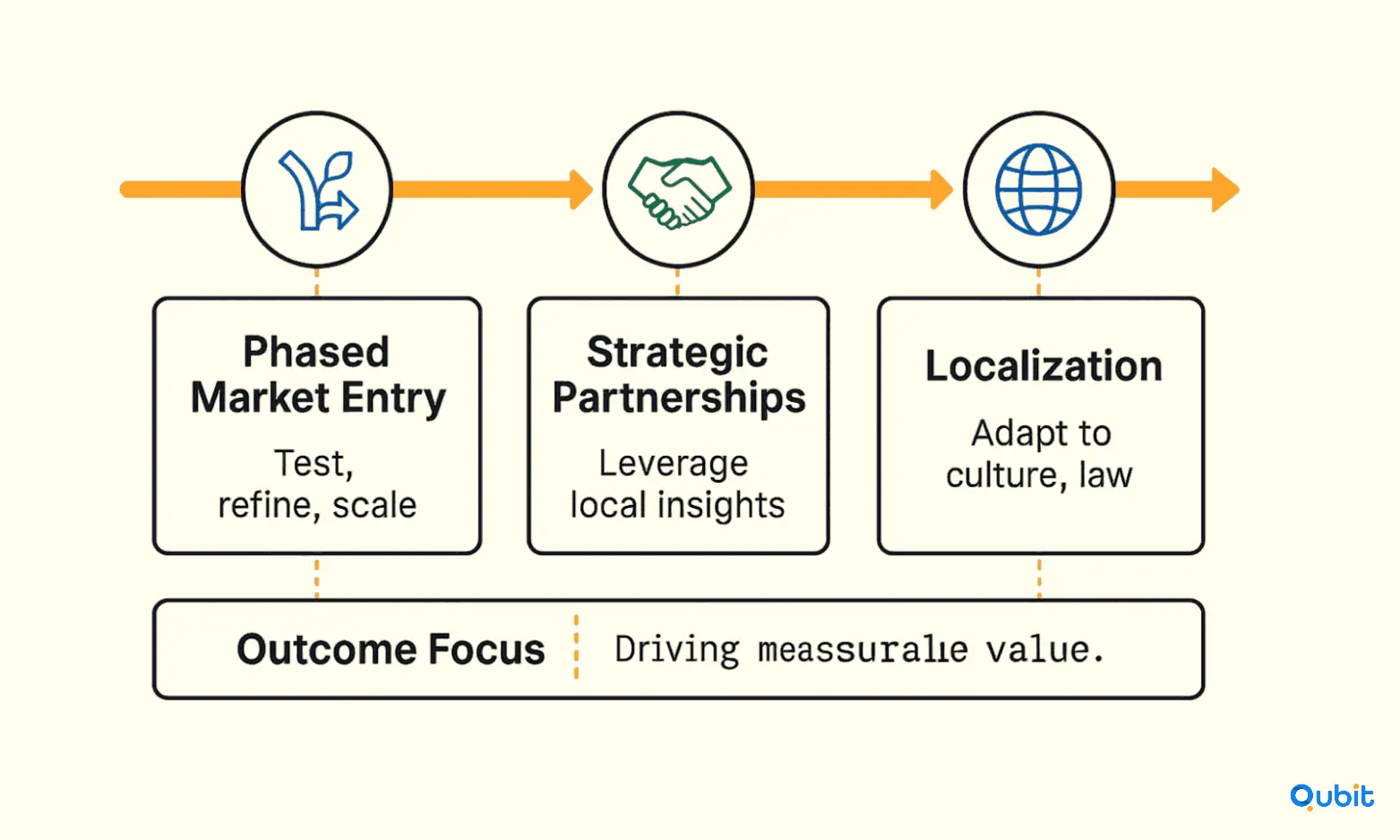
Phased market entry, strategic partnerships, and localization are three essential strategies that can help businesses tailor their efforts to regional demands. Let's learn more about them:
1. Phased Market Entry
Rather than diving into multiple markets simultaneously, businesses often benefit from a phased approach. This strategy allows companies to test the waters in one region, refine their processes, and scale gradually. For example, tech-driven startups frequently align their global expansion strategies with investor trends, such as the dominance of AI startups capturing 37% of all VC funding in Q3 2024. This phased entry ensures resources are allocated efficiently while minimizing risks.
Operational execution matters for phased entry. According to PitchBook, 71% of Series A founders choose an Employer of Record as their first international step. This approach streamlines compliance and mitigates risk during initial expansion.
2. Strategic Partnerships
Collaborating with local entities can provide invaluable insights and resources. Partnerships with established players in the target market can accelerate entry, reduce operational hurdles, and foster trust among local consumers. Larger corporations are increasingly investing in globally oriented startups, as evidenced by corporate venture capital-backed funding reaching 47% of all deal value in Q1 2025, a four-year high.
3. Localization
Tailoring products, services, and marketing strategies to align with local preferences is non-negotiable. Localization goes beyond language translation; it involves adapting to cultural nuances, regulatory requirements, and consumer behaviors. Ignoring these factors can lead to significant strategic errors, as underestimating cultural differences often results in failed market penetration.
4. Employer of Record (EOR) Solutions
Employer of Record (EOR) solutions offer startups a streamlined path to hiring international employees without the need to establish local legal entities. This approach allows companies to quickly onboard talent in new markets while remaining compliant with local labor laws and tax regulations. EOR providers handle payroll, benefits, and employment contracts, reducing administrative burden and legal risk for expanding businesses.
By utilizing EOR services, startups can test new markets with minimal upfront investment and operational complexity. This flexibility is especially valuable for early-stage companies seeking to validate demand or scale rapidly in response to market opportunities. EOR solutions also help mitigate risks associated with misclassification of workers or non-compliance with foreign employment standards.
Overall, integrating EOR into your global expansion strategy enables faster market entry, greater agility, and reduced legal exposure. This method complements phased entry and localization by addressing the practical challenges of building an international workforce.
Global Expansion Case Studies and Applications
Expanding into international markets requires a blend of strategic planning and innovative approaches. Companies like Spotify, Zoom, Uber, and Airbnb have demonstrated varied and effective global expansion models, each tailored to their unique industries and goals. These examples highlight the importance of adaptability and localized strategies in achieving success on a global scale.
Sector context matters. In 2024, global fintech investment totaled USD 95.6 billion across 4,639 deals. These figures highlight both opportunity and the need for agile strategies like EOR. One standout approach is the use of Employer of Record (EOR) solutions for market testing. For instance, fintech companies have embraced Fintech Market Testing via EOR Solution to accelerate market entry without incurring the high costs of setting up local entities. This method allows businesses to test products and services in new markets while minimizing regulatory and financial risks. It’s an ideal strategy for industries operating in highly regulated environments.
Similarly, SaaS companies have adopted a different route by establishing regional offices and hiring local talent. A notable example is a European SaaS startup that implemented a SaaS International Scaling Strategy. By forming strategic partnerships and adapting their products to meet local needs, they expedited their global growth and solidified their presence in multiple regions.
These case studies underscore the importance of aligning expansion strategies with market-specific challenges and opportunities. Whether through EOR-driven market testing or localized scaling efforts, businesses can reduce risks and accelerate their path to global success.
Measuring Global Expansion Impact
Evaluating the success of global expansion requires a precise approach to metrics and tools. Key performance indicators (KPIs) such as market share, revenue growth, and customer acquisition rates serve as foundational benchmarks for assessing progress. These metrics provide a clear picture of how well a business is penetrating new markets and scaling operations internationally.
Contextualizing measurement benchmarks, the SaaS ecosystem captured USD 207.39 billion in VC investment and reached a combined valuation of about USD 273 billion in 2024. SaaS ecosystem valuation signals why robust performance tracking is essential.
Real-time data tracking is equally critical for informed decision-making. Tools like Google Analytics offer insights into user behavior across regions, enabling businesses to identify trends and optimize strategies. Similarly, Net Promoter Score (NPS) surveys can gauge customer satisfaction and loyalty, offering valuable feedback on the effectiveness of localized efforts.
Global Expansion Do's and Don'ts
Despite best practices, fewer than 1% of start-ups ever secure funding and reach the growth stage. Rigorous research remains a critical differentiator. To ensure success, startups must focus on proven strategies while avoiding common mistakes.
Do's for Effective Global Expansion
Conduct Thorough Research
Understanding the target market is essential. Dive deep into local consumer behavior, economic conditions, and competitive landscapes. This knowledge will help you tailor your approach to meet specific market demands.Prioritize Localization
Adapt your products, services, and marketing strategies to align with local preferences. From language translations to cultural sensitivities, localization builds trust and enhances customer engagement.Adopt Agile Methodologies
Flexibility is key when entering new markets. Implement iterative processes to test, learn, and refine your strategies based on real-time feedback.
Don'ts That Could Derail Your Expansion
Neglect Cultural Nuances
Ignoring cultural differences can alienate potential customers. Missteps in communication or branding may lead to misunderstandings and harm your reputation.Overlook Regulatory Compliance
Each country has unique legal and regulatory requirements. Failing to comply can result in fines, operational delays, or even bans. Always consult local experts to ensure adherence.
Global expansion is a rewarding yet complex journey. By following these do's and don'ts, startups can navigate challenges effectively and position themselves for sustainable international growth.
Conclusion
Global expansion can unlock faster growth, stronger defensibility, and better investor perception, but only when the entry plan is disciplined. The winners treat each new market like a product launch, with clear positioning, localized execution, and measurable milestones. A phased rollout, strong local partners, and compliant hiring options like an Employer of Record reduce risk and keep burn predictable. Track outcomes early, iterate quickly, and avoid culture or compliance blind spots that can stall momentum.
If you are planning to expand and raise capital around that story, book a fundraising consultation with Qubit. We will pressure-test your market entry plan, build an investor-ready narrative, and map the right investors for your stage.
Key Takeaways
- Global expansion is a growth lever, not a vanity milestone, so start with a clear why for the target market.
- Validate product-market fit locally before scaling, using customer feedback, competitor analysis, and demand signals.
- Use phased market entry to learn cheaply, improve execution, and protect runway.
- Partner with local operators to move faster, reduce mistakes, and build trust with customers and regulators.
- Localize beyond language, including pricing, onboarding, support, and brand cues that fit cultural expectations.
- Consider Employer of Record hiring to test markets quickly without setting up a full legal entity.
- Set KPIs upfront, track them weekly, and use data to decide whether to double down or exit a market.
- Do not ignore regulatory requirements, because one compliance miss can erase months of progress.
Frequently asked Questions
What are the key global expansion strategies for tech startups?
Tech startups should use phased market entry, build strategic partnerships, and prioritize localization. These strategies maximize growth and minimize risks.