

 Back
Back








Table of Contents

Launching a successful ecommerce venture requires more than just a compelling idea, it demands a clear strategy for growth and market entry. A well-crafted go-to-market plan paired with an accurate ecommerce growth forecast can transform your pitch into a persuasive narrative that resonates with investors.
The pace of innovation and investment is accelerating. In 2025, the ecommerce technology sector raised approximately $7.3 billion, driving several companies to unicorn status. This influx of capital highlights that investors continue to believe in scalable technology-driven models.
For founders, this signals a competitive, opportunity-rich landscape demanding a robust go-to-market approach. This blog explores how founders can align their capital planning with actionable growth strategies to secure funding and scale effectively.
Why Defining Your Ideal Customer Profile Matters
This strategic approach requires founders to clearly define their ideal customer profile before launching. Identifying demographic and behavioral traits enables precise targeting and tailored messaging. Investors value startups that demonstrate deep understanding of their audience, as this increases conversion potential. Establishing ICP early shapes every subsequent go-to-market and growth decision.
Your analysis of growth potential is enriched by a broader discussion in ecommerce startup fundraising strategies, where funding approaches are examined in a complementary context.
Iterative Go-To-Market Refinement for Ecommerce Success
Building on growth analysis, founders should regularly review key performance indicators and market feedback to refine their go-to-market strategy. This iterative process enables startups to adapt quickly to changing conditions and customer needs. Continuous improvement of GTM tactics sustains competitive advantage and investor appeal. Agile refinement supports scalable, long-term ecommerce growth.
From capital planning to alternative funding options, this guide will equip you with the tools to present a pitch that stands out. Let’s dive into the essentials of crafting a plan that drives investor confidence and business success.
Comparing Ecommerce GTM Frameworks
| Framework | Core Focus | Best Use Case |
|---|---|---|
| Funnel | Stepwise customer acquisition process | Driving conversions from awareness to purchase |
| Flywheel | Continuous customer engagement and retention | Building loyalty and repeat business |
| Account-Based Marketing | Personalized targeting of high-value segments | Maximizing impact with select customer groups |
Capital Planning for Ecommerce Go-to-Market Plan and Growth Forecast
A successful ecommerce pitch requires a go-to-market plan that defines target customers, funding sources, and growth projections to convince investors. Strategic capital planning is essential for an effective ecommerce go-to-market plan and growth forecast. Businesses must align funding strategies with this expanding opportunity.
Market expansion requires strong investor engagement. In the first half of 2025, $7.1 billion in capital was deployed to ecommerce startups, marking a 33% year-over-year rise. This influx supports both new entrants and growth-stage firms as they target operational scale.
Estimating Startup and Operational Costs
Financial requirements of an ecommerce business begins with a detailed breakdown of startup and operational costs. These include website development, inventory procurement, marketing expenses, and logistics. For example, Clearco has funded over 10,000 businesses since 2015, showcasing the scale of investment required to support ecommerce growth.
To forecast and manage cash flow effectively, a detailed perspective on cost structures is offered in the ecommerce unit economics financial model, where numerical breakdowns deepen your understanding of revenue dynamics.
Aligning Funding with Expansion Goals
Capital planning must also consider the scalability of the business. As ecommerce markets grow at a projected year-over-year rate of 8.4%, businesses need to ensure their funding strategies support expansion into new markets. This involves securing adequate capital to meet increased demand while maintaining operational efficiency.
Effective capital planning involves estimating startup and operational expenses while ensuring these align with market expansion goals and investor expectations.
Highlighting success stories, such as DTOCS Founder Pallavi Pande, who won the 2025 AAPI Award, demonstrates how effective capital planning can lead to recognition and sustained growth.
- Define value proposition.
- Analyze market and competitors.
- Estimate startup costs.
- Choose funding sources.
- Project growth.
- Prepare investor pitch.
Startups like yours already closed their rounds with us.
Founders across every stage and industry. Here's what it took.
- Raised $7.6M for Swiipr Technologies
- Raised $0.5M for Ap Tack
- Raised €0.5M for Ivent Pro

Traditional Funding Sources for Ecommerce Startups
Competitive pressures are reshaping fundraising realities. In the D2C sector, funding declined 97% from its 2021 peak, showing a sharp move away from 'growth at all costs.' Founders must adapt by blending traditional and alternative pathways.
- Friends and Family
- Bank Loans
- Angel Investors
- Venture Capital
- Grants
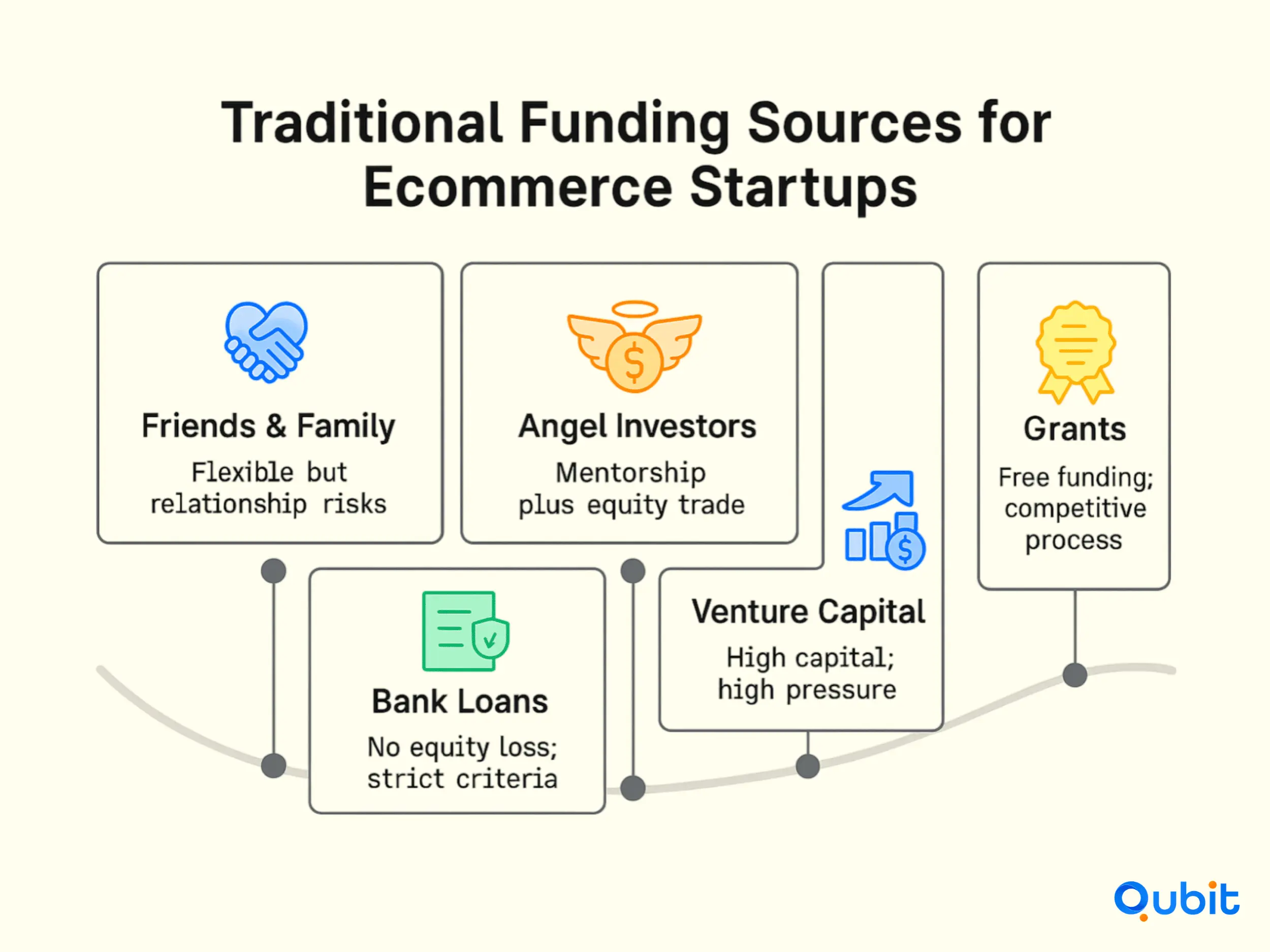
Traditional funding sources include friends/family, loans, angel investors, VCs, and grants.
1. Friends and Family
Many entrepreneurs begin by seeking financial support from friends and family. This approach offers flexibility, as agreements can be informal and tailored to individual circumstances. However, mixing personal relationships with business can lead to complications. Misaligned expectations or financial strain may jeopardize relationships if the business faces challenges.
2. Bank Loans
Bank loans remain a popular choice for startups seeking predictable repayment terms. Entrepreneurs can access funds without giving up equity, making this option appealing for those who want to retain full control of their business. However, stringent eligibility criteria and collateral requirements can be barriers for early-stage startups.
3. Angel Investors
Angel investors provide funding in exchange for equity, often bringing valuable mentorship and industry connections. Their involvement can accelerate growth, especially for ecommerce businesses with innovative models. Yet, equity considerations must be carefully weighed, as giving up ownership can impact long-term decision-making.
4. Venture Capital
Venture capital (VC) firms are ideal for startups with high growth potential. In Q1 2024, VC funding for ecommerce reached $66 billion, marking a 6% quarterly increase despite market fluctuations. This demonstrates strong investor appetite for innovative ecommerce models. While VC funding offers substantial resources, it often comes with significant equity dilution and pressure to scale rapidly.
5. Grants
Grants provide non-dilutive funding, making them an attractive option for startups. Governments and organizations often offer grants to support innovation, but the application process can be competitive and time-consuming. Additionally, grants may come with restrictions on how funds can be used.
Each funding source has its advantages and challenges, and selecting the right one depends on your business model, growth stage, and long-term goals. Balancing financial needs with equity considerations is key to building a sustainable ecommerce startup.
Alternative Funding Options for Ecommerce Startups
This section highlights innovative options like crowdfunding, incubators and accelerators, self-funding (bootstrapping), and invoice-based financing. Each approach offers distinct advantages and challenges, empowering entrepreneurs to choose the best fit for their business goals.
1. Crowdfunding: Harnessing Community Support
Crowdfunding has gained significant traction as a funding method for ecommerce startups. Platforms like Kickstarter and Indiegogo allow entrepreneurs to creatively pitch their early-stage products or concepts to a global audience.
By showcasing their product or service, startups can rally public support and secure funding while simultaneously validating market interest. However, crafting an engaging campaign requires time and effort, and success often hinges on the ability to connect emotionally with potential backers.
For example, successful go to market strategies examples include startups using crowdfunding to validate demand before scaling.
2. Incubators and Accelerators: Structured Growth Opportunities
For startups seeking mentorship and structured support, incubators and accelerators provide an excellent pathway. These programs offer guidance, resources, and sometimes seed funding in exchange for equity.
Entrepreneurs benefit from expert advice and networking opportunities, which can be invaluable during the early stages of business development. While the equity trade-off may seem steep, the long-term benefits of mentorship and industry connections often outweigh the initial cost.
3. Self-Funding: The Power of Bootstrapping
Bootstrapping, or self-funding, is a popular choice for entrepreneurs who prefer to maintain full control over their business. This approach involves using personal savings or reinvesting profits to fuel growth.
While bootstrapping eliminates the need for external investors, it can limit scalability and place financial strain on founders. Careful budgeting and strategic planning are essential to make this method work effectively.
4. Invoice-Based Financing: Aligning Capital with Revenue
Invoice-based financing offers a unique solution for ecommerce startups looking to scale. Services like Clearco provide growth capital by advancing funds based on future invoice amounts. This method aligns funding availability with revenue flow, ensuring businesses can invest in inventory or marketing without waiting for customer payments. However, startups must carefully evaluate the costs associated with this type of financing to avoid overextending their resources.
The market for flexible funding is rapidly expanding. By 2027, revenue-based financing is projected to reach $42.35 billion. This surge positions it as a key instrument for founders matching capital with sales performance.
Future Funding Strategies and Go to Market Strategy for Ecommerce Startups
Securing funding for ecommerce startups requires a blend of innovation, strategic planning, and industry expertise. As the market evolves, adopting a forward-thinking go to market strategy can ensure sustainable ecommerce growth and attract long-term investor confidence.
1. Harnessing Technological Innovation
Investors are increasingly drawn to startups that integrate cutting-edge technologies to solve industry challenges. For example, an unnamed startup raised $50M in Series B funding after implementing an AI-powered inventory management platform. This demonstrates how technological advancements can drive future ecommerce funding trends by showcasing operational efficiency and scalability.
AI’s transformative role is reshaping infrastructure plans. Over two-thirds (67%) of consumer markets leaders say leveraging generative AI is expected to increase cloud budgets next cycle. Startups that integrate AI can attract investor interest by signaling adaptability.
This demonstrates how technological advancements can drive future ecommerce funding trends by showcasing operational efficiency and scalability.
2. Optimizing User Experience for Investment Appeal
Glossier’s advanced product detail page (PDP) architecture and Apple Pay integration led to impressive results. There was a 65% ROAS lift and a 25% CPA reduction.
3. Embracing Emerging Channels
Social commerce platforms, such as TikTok Shop, are reshaping ecommerce strategies by merging content, community, and commerce. This shift toward creator monetization offers startups a compelling narrative for future funding pitches, as it aligns with evolving consumer behaviors and market trends.
At the forefront of channel innovation, Whatnot exemplifies success. In 2024, this livestream marketplace raised $225 million in Series F funding, reaching an $11.5 billion valuation and over $6 billion in GMV. Their approach validates live commerce as a major growth strategy beyond Asian markets.
4. Building Investor Confidence Through Financial Planning
Robust financial planning is essential for attracting and retaining investors. Clearco’s $2.5 billion investment in ecommerce businesses since 2015 underscores the importance of demonstrating financial stability and growth potential. Highlighting partnerships with major funding entities can further validate a startup’s credibility.
Conclusion
A successful ecommerce go-to-market plan and growth forecast require strategic planning and adaptability. From capital planning to exploring both traditional and alternative funding sources, the strategies outlined in this article provide actionable insights for startups aiming to raise capital effectively. Incorporating forward-looking funding strategies alongside a robust go-to-market plan ensures long-term sustainability and growth.
If you're ready to accelerate your funding journey, we at Qubit Capital can guide you with our Fundraising Assistance services. Schedule a funding strategy call with Qubit Capital to get a tailored roadmap for your ecommerce startup.
Key Takeaways
- Strategic capital planning is essential for aligning funding with business growth objectives.
- A balanced mix of traditional and alternative funding sources optimizes investor appeal.
- Actionable fundraising tips and data-driven insights strengthen pitch credibility.
- Future funding success relies on leveraging technology and emerging market trends.
- Integrating a solid go-to-market plan with accurate financial forecasts builds investor confidence.
Get your round closed. Not just pitched.
A structured fundraising process matched to your stage and investor fit.
- Fundraising narrative and structure that holds up
- Support from strategy through investor conversations
- Built around your stage, model, and timeline
Frequently asked Questions
How does a growth forecast benefit an ecommerce go-to-market plan?
A growth forecast helps ecommerce businesses set realistic targets, attract investors, and align funding strategies by projecting future sales and market expansion.