

 Back
Back








Table of Contents

The travel industry moves fast, feels every macro shock, and rebounds just as sharply, so winning investors here needs more than a generic startup pitch. With travel and tourism projected to grow about 5.8% annually over the next decade, capital is paying attention, and so are a lot of competing founders.
In a market like this, you need a funding story that’s tailored to travel: clear on demand drivers, resilient against disruption, and believable on margins and scale.
This guide breaks down practical strategies to help you secure capital, from crafting a compelling, travel-ready business plan to understanding what investors actually look for in this sector. Whether you’re refining your pitch or exploring funding options, you’ll get the context and tactics you need to stand out in a crowded, opportunity-rich market.
Let’s dive into the essentials that can transform your funding journey.
How to Navigate the Travel Industry Funding
Raising capital for a travel startup isn’t just about selling a dreamy vision of beaches and boarding passes, you have to show investors you understand the real dynamics of the market.
Travel is no longer a short-lived “post-Covid bounce”; it’s a long-term growth story. The global tourism market is worth about US$12.16 trillion in 2025 and is forecast to reach US$17.97 trillion by 2033 (around 5% CAGR). That kind of steady expansion tells investors there’s durable, structural demand, not just a temporary rebound.
Your job as a founder is to plug into that growth with a model that actually works. That means:
- Aligning your product with clear demand drivers (e.g., experience-led travel, digital bookings, sustainability, AI-enabled personalization)
- Addressing classic travel pain points for investors, like seasonality, margin pressure, and high customer acquisition costs
- Clearly explaining your revenue plan and unit economics, how you make money, how that scales, and how you protect margins over time
When you frame your startup against a multi-trillion-dollar market that’s compounding, and pair that with a grounded, defensible model, you stop looking like a “travel idea” and start looking like a serious growth candidate in a very big, very real category.
Startups like yours already closed their rounds with us.
Founders across every stage and industry. Here's what it took.
- Raised $7.6M for Swiipr Technologies
- Raised $0.5M for Ap Tack
- Raised €0.5M for Ivent Pro

Challenges in Travel Startup Funding
1. Seasonality and Revenue Fluctuations
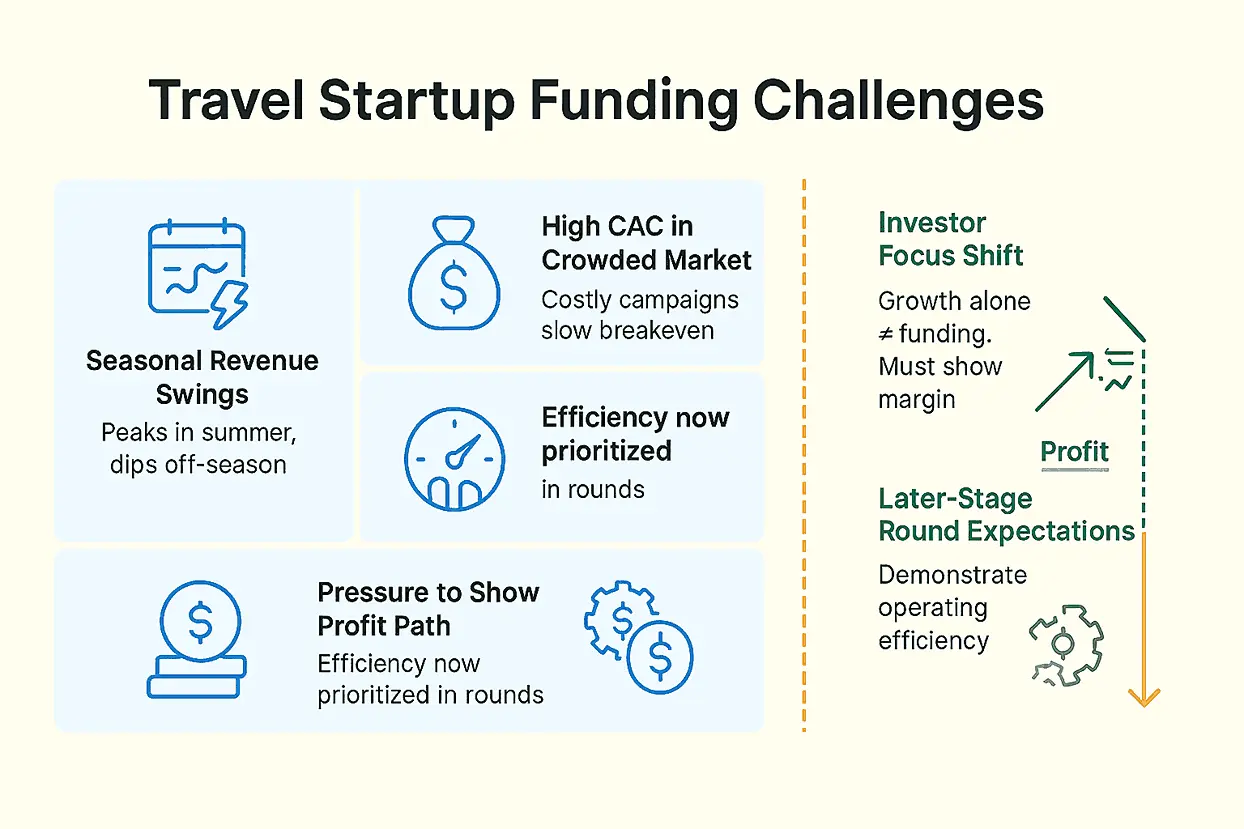
Travel businesses often experience uneven revenue streams due to seasonal demand. For example, summer vacations and holiday travel drive spikes in bookings, while off-peak seasons can lead to significant revenue dips. This cyclical nature makes it difficult for startups to maintain consistent cash flow, which is a key concern for investors evaluating long-term viability.
That pressure isn't just anecdotal. A PhocusWire industry survey found that travel CAC rose roughly 35% between 2022 and 2025, while customer lifetime value grew only 4.5% in the same period. For a travel startup, that widening gap means payback periods are stretching right when investors are getting pickier about efficient growth, so showing a defensible CAC-to-LTV ratio in your pitch matters more than it did two years ago.
2. High Customer Acquisition Costs
Acquiring customers in the travel industry can be expensive, especially for startups competing with established players. Marketing campaigns, partnerships, and loyalty programs require substantial investment upfront, often before profitability is achieved. This challenge underscores the importance of operational efficiency and strategic planning to attract investors.
3. Investor Focus on Profitability Timelines
The funding landscape has shifted, with investors increasingly prioritizing profitability over pure growth. Startups are now expected to demonstrate clear paths to sustainable revenue, rather than relying solely on market expansion. This trend impacts negotiations, particularly for later-stage funding rounds, where operational efficiency becomes a critical factor.
Opportunities in the Travel Market
1. Massive Market Potential
The global travel and tourism sector contributes around $11 trillion a year to the world economy, underlining just how vast this market’s opportunities really are. From niche markets like eco-tourism to emerging technologies such as AI-driven travel planning, startups have ample room to innovate and capture market share.
2. Recent Funding Trends
Recent data highlights that travel startups secured $4.2 billion in funding during Q3 2024, reflecting both the promise and scrutiny this market attracts. This funding activity suggests that startups with strong business models and clear profitability strategies can still attract significant capital.
3. Importance of Industry Expertise
Finding investors with travel-specific expertise can be a game-changer. These investors not only bring capital but also provide valuable insights into market dynamics, helping startups align their strategies with industry trends.
Actionable Insights for Travel Startups
To thrive in this competitive landscape, travel startups must focus on aligning their business models with investor expectations. Demonstrating operational efficiency, addressing seasonality challenges, and showcasing innovative solutions can significantly improve funding prospects.
Many early founders start with minimal traction. Notably, 40% of companies join with just an idea rather than a tested product. This reality makes precise concept definition and differentiation critical for travel industry fundraising.
1. Define Your Business Concept
Start by presenting a clear and compelling business concept. Investors need to understand what your business does, who it serves, and why it matters. Highlight your unique value proposition, what sets your travel startup apart from competitors and makes it indispensable in the market.
Key Elements to Include:
- Mission Statement: A concise summary of your business’s purpose and goals.
- Product or Service Description: Detail what you offer, emphasizing innovation or differentiation.
- Target Audience: Specify the demographic or industry your business serves, supported by data.
A strong business concept lays the foundation for the rest of your plan, ensuring investors grasp your vision from the outset.
2. Conduct a Thorough Market Analysis
Investors want assurance that your business operates in a viable market. A detailed market analysis demonstrates your understanding of industry trends, customer needs, and competitive dynamics.
Steps to Build an Effective Market Analysis:
- Assess Market Size: Quantify the total addressable market (TAM) and segment it into reachable portions.
- Analyze Competitors: Identify key players, their strengths, and gaps you can exploit.
- Understand Customer Behavior: Use surveys, focus groups, or industry reports to pinpoint customer preferences.
For a deeper dive into evaluating market opportunities, explore travel market size unit economics, where methods of quantifying opportunity are presented for a clearer analysis.
3. Outline Your Operational Strategy
A robust operational strategy reassures investors that you have a practical plan to execute your vision. This section should detail how your business will function day-to-day and scale over time.
Key Components of an Operational Strategy:
- Management Structure: Define roles and responsibilities within your team.
- Processes and Systems: Explain workflows, technologies, and tools that ensure efficiency.
- Scalability Plan: Describe how your operations will adapt as your business grows.
Highlighting a well-thought-out operational strategy builds confidence in your ability to deliver results.
4. Present Financial Projections
Financial projections are the cornerstone of any funding pitch. Investors need to see realistic forecasts that demonstrate profitability and growth potential.
What to Include in Financial Projections:
- Revenue Model: Explain how your business generates income, supported by data.
- Expense Breakdown: Provide a detailed overview of costs, including fixed and variable expenses.
- Profitability Timeline: Indicate when your business expects to break even and achieve sustained profits.
Use visuals like charts and graphs to make your financial data more digestible.
5. Build Investor Confidence
Securing funding hinges on your ability to instill confidence in potential investors. Demonstrate your expertise, commitment, and understanding of the market through every aspect of your business plan.
Strategies to Strengthen Investor Trust:
- Highlight Success Stories: Share milestones or achievements that validate your business model.
- Showcase Partnerships: Mention collaborations with reputable entities to boost credibility.
- Provide Transparent Data: Ensure all figures and projections are accurate and well-supported.
Industry standards in presentation are highlighted through travel startup pitch deck tips, offering you context on what components resonate well with investors.
Key Insights Into the Investor Ecosystem
The travel investment ecosystem is driven by a few non-negotiables: sustainable unit economics, clear tech differentiation, and the ability to scale globally. If your model leaks cash, looks copy-paste, or only works in one narrow market, most serious investors will quietly pass.
One area showing how investor priorities are evolving is bleisure travel (business + leisure). One estimate puts the bleisure market at around US$933 billion in 2022, projected to reach about US$2.33 trillion by 2030 at roughly 12.1% CAGR. That kind of growth tells investors there’s real money in formats that blend work, lifestyle, and travel, especially when supported by strong data and smart tech.
For travel startups, the takeaway is simple:
- Show you understand where the growth is (like segments such as bleisure, wellness, or sustainable travel).
- Prove your unit economics and tech moat are strong enough to capture a slice of that expansion.
Aligning with these investor priorities doesn’t just make your deck look sharper, it materially improves your odds of tapping into the growing pools of capital flowing into the next generation of travel brands and platforms.
What Investors Value Most
Investors in the travel sector prioritize measurable and sustainable growth. This often begins with sustainable unit economics, which demonstrate a startup’s ability to generate profit while scaling. Metrics such as customer acquisition cost (CAC) and lifetime value (LTV) are critical in proving the viability of a business model. Additionally, travel-specific KPIs like churn rate, seasonality data, and net promoter score (NPS) often weigh heavily in investment decisions. These metrics provide deeper insight than generic startup KPIs, helping investors assess long-term potential.
Another key factor is technology differentiation. Travel startups that integrate cutting-edge solutions, such as AI-driven personalization or blockchain for secure transaction, stand out in a crowded market. For instance, accelerators like Travelport Labs focus exclusively on travel innovations, offering startups the resources to refine their technology and gain industry-specific expertise.
Finally, global scalability is non-negotiable for most travel-focused investors. Startups must demonstrate their ability to expand across diverse markets, adapting to regional preferences while maintaining operational efficiency.
You can also have a look at the guide travel startup investment opportunities the lay up the foundation of as to how you can secure funding by highlighting your financial metrics in pitch deck or a meeting.
The Role of Defensible Market Positioning
A strong market position can make or break a startup’s appeal to investors. Defensible positioning involves carving out a niche that competitors cannot easily replicate. This often requires specialization, such as focusing on eco-friendly travel solutions or catering to underserved demographics.
Sector-specialized investors, like VOYAGERS, are particularly drawn to startups with clear differentiation. VOYAGERS, a UK-based venture capital firm, exemplifies the importance of aligning with investors who have deep expertise in the travel sector. Their focus on travel-specific ventures ensures that startups benefit from tailored guidance and strategic support.
Strategic Alignment Across Expertise and Geography
Matching investor criteria goes beyond financial metrics and technology. Strategic alignment across industry expertise, geography, and portfolio complementarity is equally important. For example, startups seeking early-stage funding can benefit from programs like Plug and Play Travel, which offer not only capital but also industry connections and mentorship.
Why Specialization Matters
Specialization is a proven strategy for increasing success rates in the travel startup ecosystem. Investors are more likely to back ventures that align with their portfolio and demonstrate expertise in a specific niche. This approach reduces risk and enhances the likelihood of achieving scalable growth.
By focusing on sustainable unit economics, innovative technology, and defensible market positioning, travel startups can effectively meet investor expectations. Programs like Travelport Labs and Plug and Play Travel provide invaluable support in achieving these goals, ensuring startups are well-prepared to thrive in a competitive landscape.
For a deeper look at how founders are tackling these obstacles head-on, explore our guide on overcoming fundraising challenges in travel with practical, field-tested approaches.
Plan Your Fundraising Journey Step by Step
Each stage of funding presents distinct challenges and milestones, making it essential to understand what investors expect at every step. From demonstrating early customer traction to showcasing a path to profitability, aligning your strategy with these expectations can significantly improve your chances of securing capital.
1. Seed Stage: Building Early Momentum
The seed stage is where your startup lays its foundation. Investors at this stage prioritize early customer traction, often requiring 3–6 months of consistent usage data from test markets or early adopters. This data serves as proof of concept, showing that your product or service resonates with its target audience. Highlighting this traction in your pitch can help establish credibility and demonstrate market demand.
Additionally, risk mitigation strategies play a crucial role in gaining investor trust during this phase. For travel startups, addressing challenges like refund and chargeback risks can accelerate trust-building with potential backers.
2. Series A: Demonstrating Profitability
Securing Series A funding requires a more refined approach. At this stage, investors expect startups to present a clear path to profitability within 18–24 months. This means showcasing realistic financial projections, operational efficiencies, and strategies to scale revenue while controlling costs.
For travel startups, aligning with region-specific venture capital preferences can also be advantageous. For instance, funds like the Iceland Technology Development Fund may have stage-based preferences tailored to travel ventures. Understanding these nuances can help you craft a pitch that resonates with the right investors.
Key Milestones to Track
To navigate your fundraising journey effectively, focus on these critical milestones:
- Customer Traction: Ensure you have 3–6 months of usage data to validate your concept during the seed stage.
- Profitability Timeline: Develop a roadmap that demonstrates profitability within 18–24 months for Series A funding.
- Risk Mitigation: Address operational risks, such as refund and chargeback challenges, to build investor confidence.
By aligning your strategy with these milestones, you can position your travel startup for success at every stage of funding.
Perfect Your Pitch as a Travel Startup
Crafting a compelling pitch is an art, especially for travel startups aiming to stand out in a competitive industry. Investors in this space often have unique concerns, making it essential to address these directly while presenting a clear growth strategy.
1. Address Travel-Specific Investor Concerns
Travel startups face challenges that differ from other industries, such as fluctuating demand, regulatory hurdles, and high customer acquisition costs. Investors are keenly aware of these risks, so your pitch must demonstrate a deep understanding of these dynamics. For example, showcasing how your startup mitigates seasonality or complies with complex travel regulations can instill confidence.
Highlighting success stories like TravelPerk, which secured $200M in Series E funding by addressing corporate travel pain points, can be a powerful way to illustrate your startup’s potential. TravelPerk’s focus on solving inefficiencies in corporate travel expense management led to a $2.7B valuation and over $2.5B in annualized booking volume.
2. Avoid Unrealistic Assumptions
Overestimating customer acquisition rates or underestimating costs can quickly undermine your credibility. Investors are wary of pitches that rely on overly optimistic projections without solid data to back them up. Instead, focus on realistic metrics and a clear path to profitability.
For example, if your startup targets frequent travelers, provide data on their spending habits and loyalty tendencies. This approach not only demonstrates market knowledge but also shows that your projections are grounded in reality.
3. Tell a Compelling Story
A memorable pitch often hinges on storytelling. Investors want to understand the problem your startup solves and why your solution is unique. Craft a narrative that highlights the pain points travelers face and how your product or service alleviates them.
Consider integrating resources like Amadeus for Startups, which offers specialized support and funding tailored to travel startups. Mentioning such partnerships can enhance your pitch by showing that your business is backed by industry-specific expertise.
4. Tailor Your Pitch to Specific Investors
Generic pitches rarely succeed. Research your potential investors thoroughly and customize your presentation to align with their interests. For instance, if pitching to Worth Capital, emphasize your startup’s strong value proposition and how it aligns with their focus on innovative ventures.
Tailoring your pitch demonstrates that you’ve done your homework and are serious about collaboration. It also increases the likelihood of resonating with investors who share your vision.
Find the Right Funding Option for Your Startup
With a variety of funding sources available, understanding their unique requirements and benefits can help optimize your capital structure and align with your business goals.
UK-based trip-planning platform Timbuktu is a useful example of how this can work. The startup raised £323,686 from 119 backers on Crowdcube, more than doubling its £150,000 target. Campaigns like this tend to work for travel companies with an engaged user base, because backers are often customers first and investors second, which doubles the round as both capital and proof of demand.
1. Traditional Funding Sources
If you’re building something big and defensible, traditional sources like angel investors and venture capital are still the main route.
Travel marketplace GetYourGuide started as a student project and used a grant from ETH Zurich plus early angel funding to build its first version and hire a small team. Over time, it layered on multiple venture rounds as it proved demand for curated experiences and international expansion. A more recent example is Airial, an AI travel-planning startup that turns TikToks and other social content into bookable itineraries. It raised a $3 million seed round from institutional investors to speed up product development and user growth
These cases show a common pattern for travel startups:
- angels or early funds help you prove the concept;
- seed/Series A VCs come in when you can show traction (users, bookings, repeat behavior);
- later rounds fund global expansion, more inventory, and new products.
Crowdfunding can also sit alongside this. Travel and vacation-rental platforms have run public campaigns where customers and fans become small equity holders, turning their user community into a source of capital as well as demand.
2. Alternative Funding Pathways
Some travel businesses are seasonal, niche, or slower to monetize. For them, flexible or non-traditional capital can be a better fit.
Revenue-linked financing lets you borrow for growth and repay as a fixed percentage of future revenue instead of giving away equity. This can work well for travel brands with predictable booking cycles (for example, a tour operator or OTA with recurring seasonal spikes), because repayments naturally fall when revenue dips and rise when revenue grows.
Travel startups also increasingly use crowdfunding as a serious funding tool, not just a marketing stunt. For example, a European vacation-rental platform raised more than €2 million via an equity crowdfunding campaign on Seedrs, combining existing investors with its own user base.
At the larger end, vacation-home startup Pacaso used a Regulation A equity crowdfunding campaign to bring in around $72 million from 17,500 investors, after first raising money from traditional VCs. That campaign doubled as both fundraising and brand awareness in key leisure destinations
This sits on top of a fast-growing wider market: global crowdfunding volume is projected to reach about $5.4 billion by 2033, growing at roughly 15–16% a year, which means more platforms, more investor appetite, and more formats travel founders can tap into.
3. Strategic Partnerships
Strategic partnerships can blur the line between “funding” and “commercial deal”.
Travel platform Hopper is a good example. It secured a major investment from Capital One and, at the same time, powers Capital One Travel behind the scenes. That partnership gives Hopper both capital and a massive distribution channel via bank customers.
Hopper has also signed global distribution partnerships with hotel wholesalers and connectivity platforms, gaining access to hundreds of thousands of hotels worldwide while those partners tap into Hopper’s mobile user base.
On the mobility side, Trafi, a mobility-as-a-service startup, built deep partnerships with cities and transit authorities. These long-term contracts didn’t just generate revenue; they also made Trafi more attractive to investors and ultimately helped it reach profitability and an acquisition.
For a travel founder, the takeaway is:
Choosing the right mix of capital is only half the equation, knowing how to deploy it matters just as much. Our breakdown of scaling travel startups with the right funding strategy covers how to match funding types to each growth stage.
- the “partner” might bring both cash and customers;
- partnership capital often comes with product integration and exclusivity obligations;
- done right, it can reduce your marketing burn because distribution is built into the deal.
4. Optimizing Your Capital Structure
Each funding route reshapes your cap table and your freedom to move:
- Equity (angels + VCs) – Startups like GetYourGuide and Airial gave up equity to reach global scale faster. In return, they gained capital, credibility, and networks, but each round made the founder’s slice
- Revenue-linked financing and debt – These options keep ownership with founders but require confidence in future cash flows. For travel, this works best once you’ve got stable unit economics and a clear seasonal pattern.
- Grants and public programs – Non-dilutive, but competitive and often tied to specific outcomes (innovation, sustainability, local jobs).
- Crowdfunding and community capital – As seen with Your.rentals and Pacaso, these campaigns can raise meaningful sums while turning fans into investors, but they add a large number of small shareholders, which can increase legal and reporting complexity.
By looking at how real travel startups combined these tools, grants plus angels, VCs plus strategic partners, or crowdfunding plus traditional rounds, you can design a funding mix that:
Engage Investors to Build Strong Partnerships
A strong investor network not only opens doors to financial opportunities but also provides mentorship and valuable industry insights that can propel your business forward. Here are actionable strategies to engage investors effectively and cultivate lasting partnerships.
1. Prioritize Consistent Communication
Maintaining regular and timely communication is crucial for keeping investors engaged throughout the funding process. Share updates on your business progress, milestones, and any challenges you’re addressing. For example, when re-engaging investors during follow-up discussions, highlight proven traction, such as demonstrating revenue growth for at least 12+ consecutive months, a key requirement for Series A funding. This transparency builds trust and reassures investors of your commitment to success.
2. Offer Unique Incentives
Attracting and retaining investor interest often requires offering compelling incentives. Consider providing early-bird discounts, exclusive experiences, or equity stakes to make your proposition more appealing. These incentives not only demonstrate your appreciation for their support but also create a sense of exclusivity that strengthens their commitment to your venture.
3. Use Industry Events and Digital Platforms
Building on consistent communication, travel startups should actively participate in industry events and digital platforms to expand investor networks. Engaging at conferences and sector-specific gatherings fosters authentic relationships and opens doors to funding opportunities. Online platforms like LinkedIn and Visible VC enable targeted outreach, helping founders connect with investors aligned to their business model. This approach increases visibility and credibility, positioning your startup for meaningful partnerships.
4. Investor Incentive Structures for Travel Startups
- Offer early-bird equity stakes to investors who commit during initial fundraising rounds to encourage timely participation.
- Provide milestone-based bonus shares for investors supporting the startup through critical growth phases and operational challenges.
- Structure convertible notes with flexible terms tailored to travel sector seasonality and cash flow cycles.
- Include exclusive access to product launches or industry events as non-financial incentives for strategic investors.
5. Share Valuable Industry Insights
Investors value entrepreneurs who can provide meaningful insights into their industry. Share market trends, competitor analysis, or innovative strategies that showcase your expertise and vision. Referencing examples like Mercuri, a venture capital firm known for hands-on mentorship and active network building, can illustrate how investors appreciate founders who prioritize collaboration and knowledge-sharing.
6. Build Trust Through Personal Stories
Personal stories and real-world examples can make your pitch more relatable and memorable. Highlight challenges you’ve overcome, lessons learned, and how these experiences have shaped your business strategy. This human element fosters a deeper connection with investors, encouraging them to see your venture as more than just numbers on a spreadsheet.
Conclusion
Travel is back as a long-term growth story, but the funding bar is higher than ever. Investors aren’t dazzled by “cool trips” anymore, they want clean unit economics, real differentiation, and proof you can survive shocks, not just surf the boom years.
If you can show exactly where you play in this multi-trillion-dollar market, why your model scales globally, and how your metrics hold up under pressure, you stop looking like “another travel app” and start looking like a serious asset in a structurally growing category.
Treat fundraising like a deliberate, staged journey, validate the concept, prove traction, then scale with the right capital and partners. Do that well, and you’re not just chasing the travel rebound; you’re building one of the next reference brands in the industry.
Ready to secure funding for your travel startup? Convert strategy into capital with our travel fundraising assistance and plan your next-stage raise.
Key Takeaways
- Travel is a multi-trillion-dollar, long-term growth market, but investors now obsess over margins, not vibes.
- Your edge is in the unit economics: CAC, LTV, seasonality, and payback need to be defensible, not aspirational.
- Tech differentiation (AI, automation, personalization) is mandatory now, not a “nice to have.”
- Niche + expertise beats generic: own a clear segment (bleisure, wellness, sustainable, corporate, etc.).
- Fundraising is staged: seed = proof of demand, Series A = path to profitability in 18–24 months.
- Mix funding sources smartly, VC, revenue-based finance, government tourism funds, and strategic partners.
- Investor relationships are built over months: consistent updates, clear milestones, and honest numbers win.
Get your round closed. Not just pitched.
A structured fundraising process matched to your stage and investor fit.
- Fundraising narrative and structure that holds up
- Support from strategy through investor conversations
- Built around your stage, model, and timeline
Frequently asked Questions
Which investors are most likely to fund travel startups?
Venture capital firms with travel-tech portfolios, angel investors from hospitality or booking backgrounds, and strategic corporate arms of airlines and hotel chains are the most active funders. Early-stage rounds often come from sector-focused angels, while Series A and beyond attract VCs looking for global scalability and strong unit economics.